Blog
EchoStar Sells $40B in Spectrum to AT&T and SpaceX: What It Means for Boost Customers

Updated on November 3, 2026
10 min read
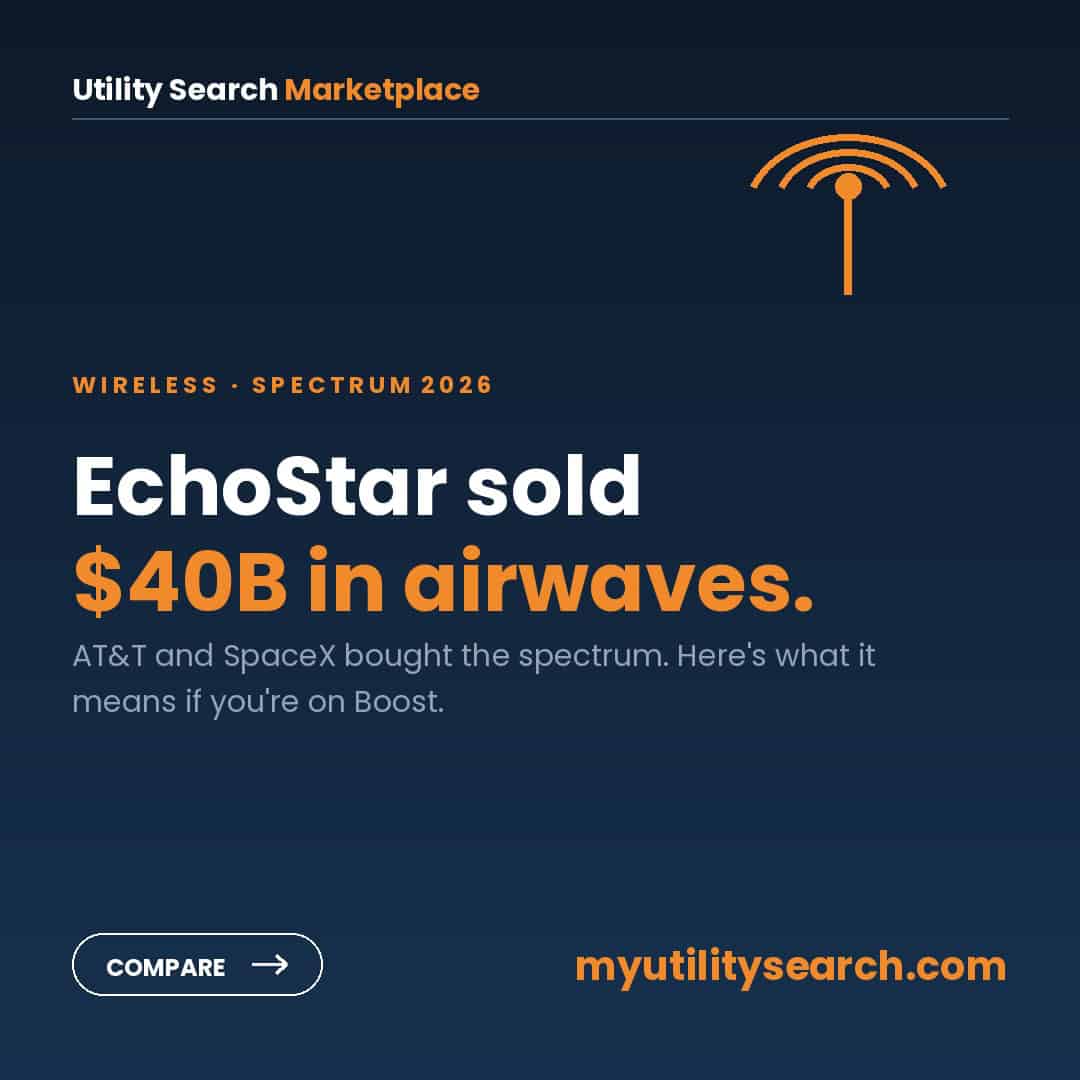
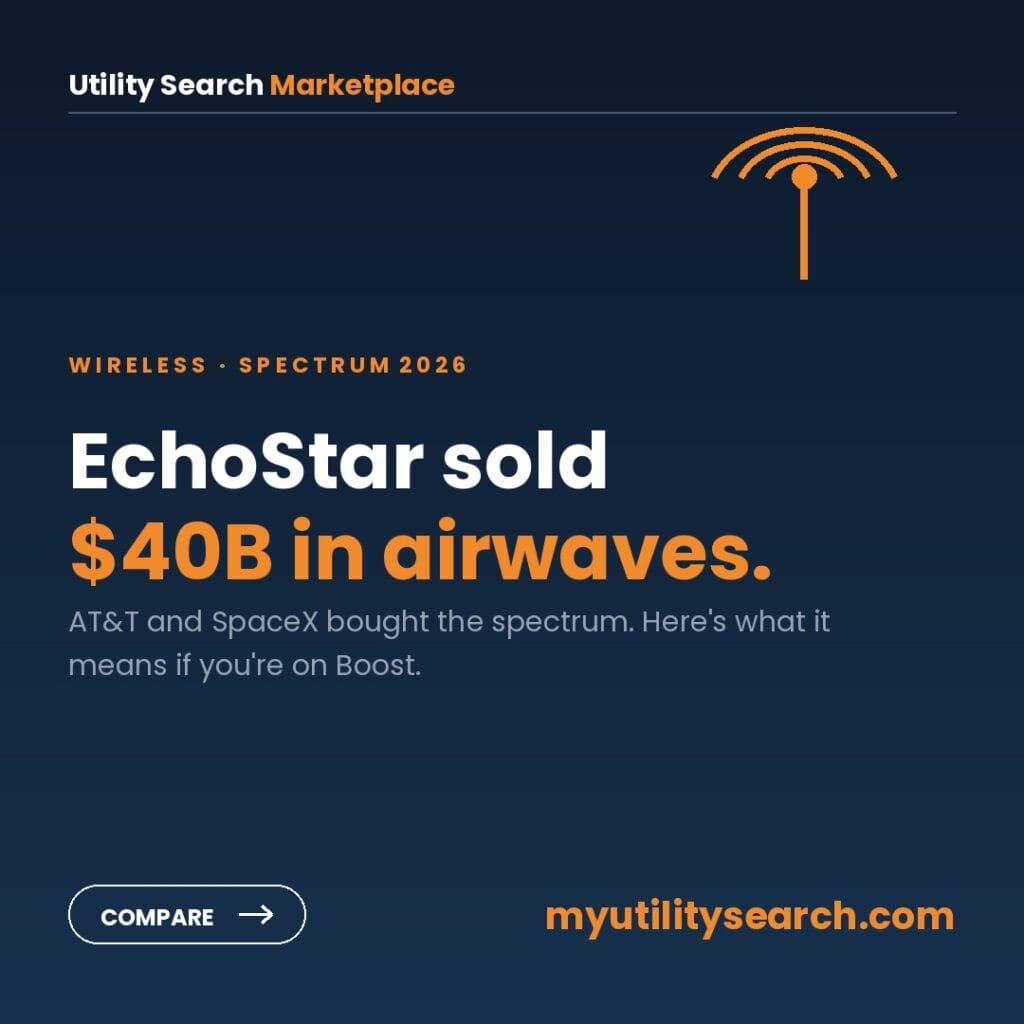
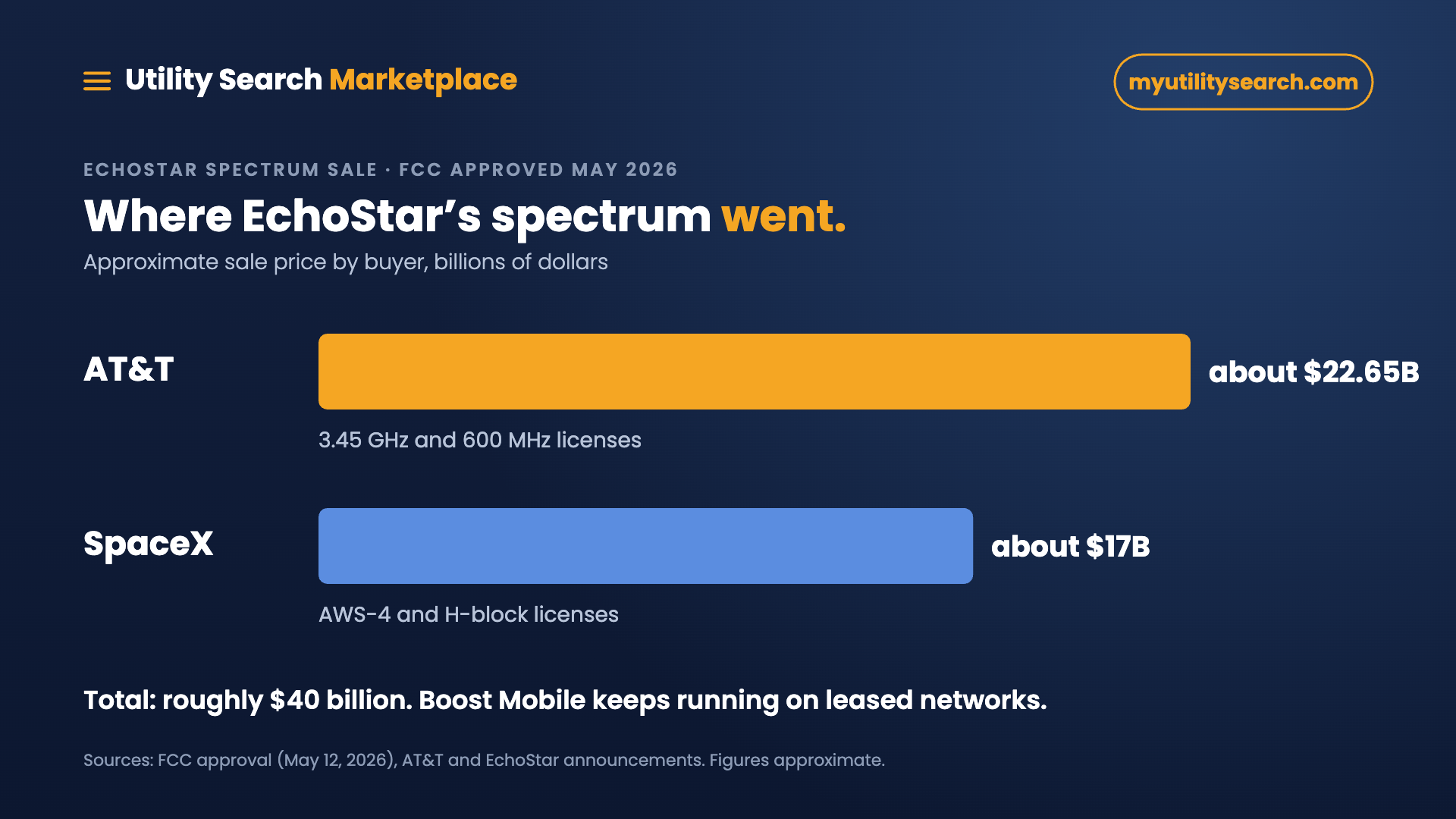
EchoStar sold about $40 billion of spectrum — and Boost Mobile keeps running. The FCC approved the sales in May 2026: AT&T is paying roughly $22.65 billion for EchoStar’s 3.45 GHz and 600 MHz licenses, and SpaceX is paying about $17 billion for AWS-4 and H-block licenses. The echostar spectrum sale is the largest airwave transaction in years, and if you are a Boost customer it changes what your phone connects to more than what you pay.
TL;DR — the echostar spectrum sale
- FCC approved May 2026. Two separate buyers, roughly $40B combined.
- AT&T: ~$22.65B for 3.45 GHz and 600 MHz licenses, plus a 99-year extension on certain Hawaii leases.
- SpaceX: ~$17B for 65 MHz of AWS-4 and H-block, feeding Starlink direct-to-cell.
- Boost Mobile continues — EchoStar keeps serving customers through an MVNO agreement with AT&T.
- FCC condition: EchoStar must fund a $2.4 billion escrow account.
- AT&T must accelerate its 600 MHz network deployment as a condition of approval.
Update, November 3, 2026: SpaceX is now talking about Boost itself
The Washington Post reported on November 2 that SpaceX is in talks with EchoStar to buy Boost Mobile or gain access to its network, two weeks after Bloomberg reported SpaceX was negotiating to put radios on about 80,000 U.S. cell towers. Neither deal is signed. Nothing changes for Boost customers today; we will update this page if an agreement is announced.
What is the echostar spectrum sale, exactly?
At the heart of the echostar spectrum sale is spectrum itself: the set of radio frequencies a carrier is licensed to transmit on. It is the scarcest input in wireless — you cannot manufacture more of it, and without enough of it a network gets congested no matter how many towers you build.
Before the echostar spectrum sale, EchoStar had accumulated a large spectrum portfolio while trying to build a fourth national network. That buildout proved enormously expensive, and rather than continue funding it, EchoStar sold the airwaves to two buyers who each wanted different frequencies for different reasons. AT&T took the licenses that strengthen conventional terrestrial coverage. SpaceX took the licenses that make satellite-to-phone service viable.
What happens to Boost Mobile customers?
Boost Mobile continues to operate after the echostar spectrum sale. This is the question most people actually have, and the answer is reassuring: selling spectrum is not the same as selling the customer business. EchoStar retained Boost and now serves those customers through a mobile virtual network operator agreement with AT&T — meaning Boost traffic rides on AT&T’s network rather than on airwaves EchoStar owns outright.
In practice, that is a mixed picture worth stating plainly. The upside is real: AT&T’s network is larger and denser than the one EchoStar was still building, so coverage in many areas should be as good or better. The trade-off is that MVNO customers are typically deprioritized during congestion — when a tower is busy, the host carrier’s own subscribers get served first. Whether you notice depends heavily on where and when you use your phone.
Your plan, your number, and your billing relationship stay with Boost. As with every deal in the current wave of telecom consolidation, you do not need to re-sign anything or verify your account because of the transaction.
What does AT&T get out of it?
Two things from the echostar spectrum sale: capacity and reach. The 3.45 GHz licenses are mid-band spectrum — the frequency range that carries a lot of data at useful distances, which is why it is the most contested territory in 5G. The 600 MHz licenses are low-band, which travels much farther and penetrates buildings better, making it the workhorse for rural coverage and indoor signal.
Notably, the FCC attached a condition requiring AT&T to accelerate its 600 MHz deployment. That is a consumer-relevant detail: it means the low-band spectrum has to be put into service rather than warehoused. AT&T also already had a licensing arrangement using some of this spectrum for its mobile and fixed wireless customers, so parts of it were in use before the sale closed.
This sits alongside AT&T’s other 2026 expansion — see our breakdown of the AT&T purchase of Quantum Fiber for the wireline half of the same strategy.
Why did SpaceX want spectrum?
Because Starlink’s direct-to-cell ambition needs licensed terrestrial frequencies to work properly. Satellite-to-phone service today is limited — good for emergency texting, not for everyday use — largely because it borrows narrow slices of partner-carrier spectrum. Owning 65 MHz of AWS-4 and H-block outright gives SpaceX room to build a service that could plausibly handle real data, not just SOS messages.
The long-term implication is the interesting one. If satellite direct-to-cell matures, the coverage map stops being defined by tower placement — which matters most to exactly the rural households that have the fewest wired options today. That is speculative, and the timeline is years rather than months, but it is the reason this piece of the echostar spectrum sale drew the most attention.
Is SpaceX buying Boost Mobile?
Not yet: as of November 3, 2026, SpaceX and EchoStar are in talks, and no deal has been announced. The Washington Post reported on November 2 that SpaceX is discussing either buying Boost Mobile outright or gaining access to its network to launch a Starlink-branded phone service. Elon Musk reportedly met with EchoStar chairman Charlie Ergen in October.
The talks follow an October 22 Bloomberg report that SpaceX was negotiating to place radios on roughly 80,000 U.S. cell towers, so Starlink Mobile would have ground coverage in cities and satellite coverage everywhere else. No tower leases have been signed or tower companies named. BNP Paribas analyst Sam McHugh has suggested the tower talk may be leverage to win a wholesale (MVNO) deal from an existing carrier, while New Street Research says both routes could happen.
The complication is the network Boost runs on today. After the echostar spectrum sale, Boost relies on capacity leased from AT&T and T-Mobile. Analysts note those agreements typically cannot be handed to a new owner without the carriers agreeing, and the T-Mobile arrangement is already winding down. That makes the network agreements, not the price, the real test of any SpaceX deal.
What it means for you as a Boost customer: nothing changes until a deal is signed and approved, which would take months. Your plan, number and coverage stay as they are. If SpaceX does buy Boost, expect the biggest change to be satellite texting and coverage outside cell range, not your monthly bill on day one.
Should you switch carriers because of this?
Not on the news of the echostar spectrum sale alone. Spectrum deals change networks slowly — licenses have to be cleared, equipment retuned, and towers reconfigured, which takes quarters and years rather than weeks. Nothing about your phone changed the day the FCC voted.
- If Boost works well where you live, stay. The MVNO arrangement means your coverage is now AT&T’s, which is a large network.
- If you already had dead zones, watch for improvement rather than assuming it. Give the 600 MHz deployment time to reach your area.
- If congestion is your issue, understand that MVNO deprioritization is structural — a different plan on the host carrier may behave differently than the same coverage map suggests.
- If you are rural, the direct-to-cell development is worth tracking, but do not make a decision today based on a capability that is not shipping yet.
Which frequencies changed hands, and why it matters
Not all spectrum is equally useful, and the split in the echostar spectrum sale tells you what each buyer was actually after.
| Band | Buyer | Type | What it is good for |
|---|---|---|---|
| 600 MHz | AT&T | Low-band | Long reach, strong building penetration — rural coverage and indoor signal |
| 3.45 GHz | AT&T | Mid-band | High capacity at useful range — the core of modern 5G |
| AWS-4 & H-block (65 MHz) | SpaceX | Mid-band | Satellite direct-to-cell service |
The rule of thumb: low-band travels far but carries less; mid-band carries more but travels less; high-band is very fast over very short distances. AT&T bought a balanced pair — reach plus capacity. SpaceX bought the specific bands that satellites can use to talk to an ordinary phone. If you want to see how spectrum holdings map to actual coverage where you live, the FCC’s National Broadband Map reports provider-claimed service by address.
What does an MVNO actually mean for your service?
Because the echostar spectrum sale moved Boost onto an AT&T mobile virtual network operator agreement, it is worth understanding what that arrangement is — it is the single biggest practical consequence for customers.
An MVNO does not own the towers. It buys wholesale access to a host carrier’s network and sells retail service under its own brand, keeping its own plans, pricing, billing, and customer support. Roughly a third of the prepaid market has worked this way for years, so this is a well-established model rather than a downgrade in itself.
The one structural caveat is prioritization. When a cell site is congested, host-carrier subscribers are generally served ahead of MVNO subscribers. In practice that means an MVNO customer may see slower speeds at a crowded stadium, a rush-hour highway, or a downtown core at lunchtime, while performance in ordinary conditions is indistinguishable. Whether that matters depends entirely on where you spend your day, which is why blanket verdicts about MVNOs are usually wrong in both directions.
How does this connect to the Dish bankruptcy?
They are two halves of the same story. EchoStar spent years and enormous capital attempting to build a fourth national wireless network, an effort that ran alongside a declining satellite television business. The Dish DBS restructuring addressed the debt side of that pressure; the echostar spectrum sale addressed the asset side.
Read together, they describe a company converting an expensive long-term ambition into cash and a lighter operating model. That is not a failure of the assets — the spectrum was valuable enough to attract roughly $40 billion — so much as an acknowledgment that building a competing national network from scratch is extraordinarily hard. It is the same economic gravity pulling every deal in our telecom consolidation tracker: infrastructure is cheaper to buy than to build.
The bankruptcy half has now played out. Dish DBS and Dish Wireless filed a prepackaged Chapter 11 on June 30, 2026 to restructure roughly $10 billion of debt and wind down the wireless network; the plan was confirmed September 29 and took effect October 1, 2026. Boost, Dish TV and Sling kept running throughout. Our Dish Network bankruptcy explainer has the full timeline.
FAQ
Is Boost Mobile shutting down?
No. EchoStar sold spectrum licenses, not the Boost Mobile business. Boost continues operating, with service delivered through a mobile virtual network operator agreement with AT&T.
How much did EchoStar sell its spectrum for?
Roughly $40 billion combined — about $22.65 billion from AT&T for 3.45 GHz and 600 MHz licenses, and about $17 billion from SpaceX for 65 MHz of AWS-4 and H-block licenses.
When was the echostar spectrum sale approved?
The FCC’s Wireless Telecommunications Bureau and Space Bureau approved the transactions in May 2026, with a condition that EchoStar establish a $2.4 billion escrow account.
Will my Boost Mobile plan or price change?
Your plan, number, and billing stay with Boost. The main practical difference is that Boost traffic runs on AT&T’s network, where MVNO customers can be deprioritized during network congestion.
Why did SpaceX buy spectrum?
To support Starlink direct-to-cell service. Owning licensed terrestrial spectrum outright allows a more capable satellite-to-phone service than borrowing narrow slices from partner carriers.
Does this improve rural coverage?
Potentially. The FCC required AT&T to accelerate its 600 MHz deployment, which is low-band spectrum well suited to rural reach and indoor penetration. Improvements roll out over quarters and years, not immediately.
Is SpaceX buying Boost Mobile?
Not yet. As of November 3, 2026, SpaceX is in reported talks with EchoStar to buy Boost Mobile or gain access to its network, but no agreement has been announced. Any deal would also need consent from the carriers whose networks Boost leases and regulatory approval.
Also compare energy, home security and home warranty at your address
Electricity plans in 14 deregulated states. Security and warranty nationwide.
Are you a commercial customer?
Business internet, phones and IT for an office, store or multi-site location are quoted by address, not from a posted rate. Call our business internet desk at (866) 328-7973, or use BOX by TechGuidance to see every serviceable business connection at your location.
Sources
- TechCrunch: SpaceX reportedly wants to buy Boost Mobile (Nov 2, 2026)
- RCR Wireless: SpaceX to buy Boost Mobile? (Nov 3, 2026)
- Broadband Breakfast: Analysts mull SpaceX 80,000 tower leases (Oct 26, 2026)