Blog
Xfinity vs Verizon: Data Caps, Speeds and Who Actually Wins in 2026

Xfinity vs Verizon, in short: Verizon Fios wins if you upload a lot or want a price lock, because fiber is symmetrical and Verizon advertises no contract and no data caps. Xfinity wins on availability and often on introductory price. The old tiebreaker, data caps, has closed — Xfinity’s current plans now include unlimited data.
Xfinity vs Verizon is the head-to-head most American households actually face. Our ZIP-level coverage data shows Xfinity and Verizon share 5,242 ZIP codes — 83% of Xfinity’s entire footprint. If you have Xfinity, Verizon is almost certainly the other name on your street. And the single most-asked question in that matchup — who caps your data — now has a different answer than most comparison articles still give.
TL;DR — key takeaways
- The data-cap gap has closed. Xfinity’s current plans include unlimited data. The old 1.2 TB cap now applies only to older, legacy plans.
- Verizon Fios has never had a data cap and advertises no annual contract, an included router, and a multi-year price-lock guarantee.
- Upload speed is the real divide. Fios is fiber and symmetrical; Xfinity is cable, so uploads trail downloads on most tiers.
- They overlap in 5,242 ZIP codes, so this comparison is live for the large majority of Xfinity households.
- Verizon now includes Frontier after the January 2026 merger, making it the largest wired footprint in the country at 21,553 ZIP codes.
Xfinity vs Verizon: the short answer
Symmetrical speed, defined
A symmetrical connection uploads as fast as it downloads. Fiber lines like Verizon Fios are symmetrical by design. Cable lines like Xfinity are asymmetrical: the return path to the network is narrower, so upload speed is typically a fraction of download speed on the same plan.
For most households the Xfinity vs Verizon decision comes down to two things: whether you upload much, and whether you are on a legacy Xfinity plan. Verizon Fios wins on upload speed and contract terms. Xfinity wins on availability in cable-first markets and often on introductory pricing. The old tiebreaker — data caps — has largely stopped being one.
Data caps: the Xfinity vs Verizon question everyone asks
This is the most-searched part of the Xfinity vs Verizon comparison, and the answer changed recently enough that plenty of published guides are still wrong about it.
Xfinity. Comcast’s own support page states that its latest plans include unlimited data, and that a 1.2 TB cap may still apply if you are on an older plan. So the cap is now a legacy-customer issue rather than a blanket policy. If you signed up years ago and never changed plans, check your account — you may be carrying a cap that current customers are not.
Verizon. Verizon advertises “no hidden fees, equipment charges or data caps” on its home internet plans. Fios has never metered residential data.
What this means practically: if you are shopping new service today, data caps should not decide your Xfinity vs Verizon choice. If you are an existing Xfinity customer on an old plan, moving to a current plan may remove the cap without you switching companies at all.
Upload speed is where Xfinity vs Verizon actually splits
Fios runs on fiber to the home, which is symmetrical by design — upload speed matches download speed. Xfinity runs primarily on hybrid fiber-coax, where the return path is narrower, so upload speeds trail download speeds substantially on most tiers.
For browsing, streaming and ordinary video calls, this rarely matters. It starts to matter if you routinely back up to the cloud, upload large video files, livestream, run a home server, or have several people on camera at once. That is the clearest technical dividing line in the Xfinity vs Verizon comparison, and it does not change with promotions.
Contracts, equipment and price locks
Verizon states that its internet plans come with no annual contracts, include the router, and carry a multi-year price-lock guarantee. That last point is worth weighing carefully: the most common complaint about cable internet is not the introductory price but the step-up when the promotional period ends.
Xfinity pricing and terms vary considerably by market and by plan generation, which is why the honest answer to the Xfinity vs Verizon pricing question is that it depends on your address. Advertised rates for both companies are heavily conditioned on autopay, paperless billing, bundling and whether you are a new customer.
Compare internet, energy & home security at your address
Where Xfinity vs Verizon is actually a real choice
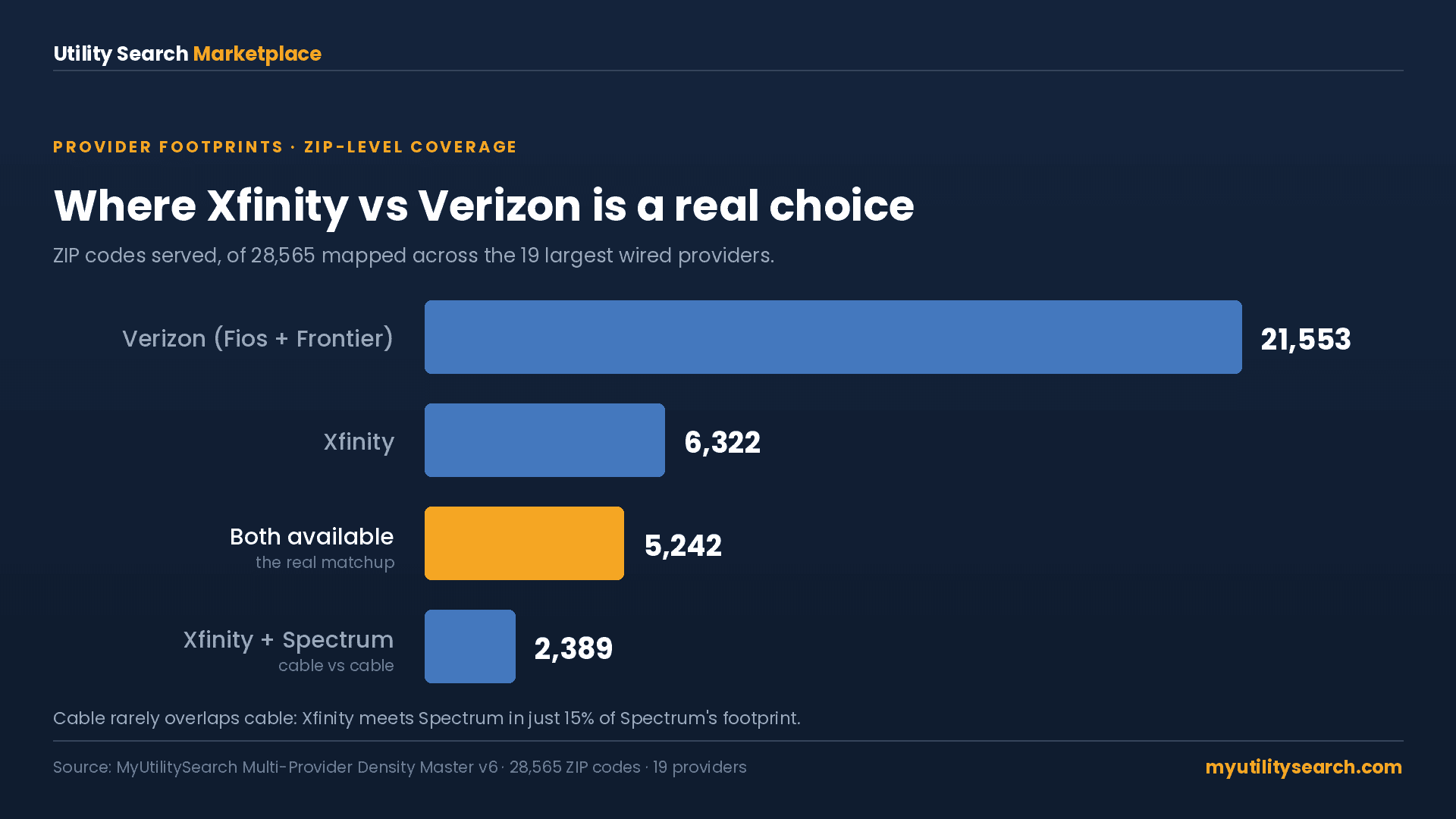
We maintain a ZIP-code-level map of wired provider footprints covering 28,565 ZIP codes and the 19 largest wired internet companies. It shows how often this matchup is genuinely available. You can cross-check availability at your own address on the FCC National Broadband Map:
| Footprint | ZIP codes | Notes |
|---|---|---|
| Verizon (Fios + Frontier) | 21,553 | Largest wired footprint in the country after the January 2026 merger |
| Xfinity | 6,322 | Cable-first markets |
| Both available | 5,242 | 83% of Xfinity’s footprint overlaps Verizon |
| Xfinity and Spectrum both available | 2,389 | Only 15% of Spectrum’s footprint — cable rarely overlaps cable |
That bottom row explains something people find counterintuitive. Cable companies almost never compete with each other — franchise areas were carved up decades ago. Cable competes with the phone company. Which is why the Xfinity vs Verizon matchup, and not Xfinity versus another cable brand, is the one most households are actually deciding.
What the Frontier merger changed
Verizon completed its acquisition of Frontier Communications on 20 January 2026. Frontier is now a Verizon company, and the two footprints together make Verizon the largest wired provider in the United States. For the Xfinity vs Verizon question this matters in two ways.
First, in a number of markets the “Verizon” option is now a Frontier line being folded into Verizon rather than classic Fios, and the plan names and terms may differ during the transition. Second, in 375 ZIP codes nationally, Fios and Frontier were previously the only two wired providers — so those households went from two companies to one. We cover that in detail in our Frontier Verizon merger guide.
Verizon is three products, not one
One thing that trips people up in the Xfinity vs Verizon comparison: “Verizon” at your address might mean any of three different services, and they are not equivalent.
- Fios — fiber to the home. Symmetrical speeds, the strongest of the three, and the one most Xfinity vs Verizon comparisons are actually about.
- 5G Home Internet — fixed wireless over Verizon’s cellular network. Widely available, easy to self-install, but performance depends on signal and network load in a way fiber does not.
- Frontier Fiber — now sold under the Verizon umbrella following the merger. Genuine fiber, but plan names, pricing and support may still differ from classic Fios during the transition.
When you compare an offer, check which of the three you are actually being sold. A 5G Home plan and a Fios plan can look similar on a comparison page and behave very differently in a house with four people on video calls.
Who should pick which
Choose Verizon Fios if you upload a lot, work from home on video, want symmetrical speed, or value a no-contract plan with a price lock more than a low first-year rate.
Choose Xfinity if Fios is not built to your address, if the introductory pricing in your market is materially better, or if you want a bundle Xfinity offers and Verizon does not. Just confirm whether the plan you are offered is a current unlimited-data plan.
Check your own address either way. Both companies price and provision by street, and the Xfinity vs Verizon answer in one ZIP code is often not the answer two ZIP codes over.
What to check before you switch
If you have narrowed the Xfinity vs Verizon decision and are ready to move, these are the things worth confirming first — each one is a common source of regret.
- The post-promotional price, not the headline price. Ask what the rate becomes in month 13 or 25. This is the single biggest gap between what people expect to pay and what they end up paying.
- Whether the plan is current or legacy. On the Xfinity side this determines whether a data cap applies at all.
- Upload speed as an actual number. Not “fast uploads” — the megabits figure for the specific tier.
- Equipment terms. Verizon states the router is included and remains Verizon’s property. Rental fees on the cable side vary by plan and market.
- Early termination and buyout. If you are leaving a contract, ask whether the incoming provider will cover it.
- Installation type. Self-install is faster and usually cheaper; a technician visit may be required for a first fiber connection.
None of these change which company is better in the abstract. They change which Xfinity vs Verizon offer is better for your household this year, which is the only comparison that pays you anything.
Sources
Data-cap policies confirmed against Comcast’s own data usage page and Verizon’s home internet page, both checked 29 August 2026. Footprint figures are from our internal ZIP-level coverage database. Pricing is deliberately not quoted as a fixed figure because both providers set rates by address and promotional status — confirm at your own address before deciding.
Compare internet, energy & home security at your address
Frequently asked questions about Xfinity vs Verizon
Does Xfinity still have a 1.2 TB data cap?
Not on current plans. Comcast states that its latest plans include unlimited data and that the 1.2 TB cap may still apply on older plans. If you have been on the same Xfinity plan for several years, check whether a cap is still attached to your account.
Does Verizon Fios have a data cap?
No. Verizon advertises no data caps on its home internet plans, and Fios has never metered residential data usage.
Is Fios faster than Xfinity?
On download speed the two are broadly comparable at the top tiers. On upload speed Fios is substantially faster because fiber is symmetrical while cable is not. If uploads matter to you, that is the deciding difference in Xfinity vs Verizon.
Can I get both Xfinity and Verizon at my address?
In many places, yes. Our coverage data shows the two overlap in 5,242 ZIP codes, which is 83% of Xfinity’s footprint. Availability is determined street by street, so check your specific address.
Is Frontier the same as Verizon now?
Yes. Verizon completed its acquisition of Frontier on 20 January 2026, and Frontier operates as a Verizon company. In some markets the Verizon option available to you is a Frontier fiber line rather than classic Fios.
Which is cheaper, Xfinity vs Verizon?
It depends entirely on your address and whether you are a new customer. Both companies condition advertised rates on autopay, paperless billing and promotional periods. Verizon advertises a multi-year price-lock guarantee, which reduces the risk of a large step-up when a promotion ends.
The bottom line on Xfinity vs Verizon
The Xfinity vs Verizon comparison used to turn on data caps. It no longer does for new customers. What remains is a straightforward technical trade: fiber gives you upload speed and predictable pricing terms, cable gives you availability and often a better opening rate. Since the two overlap in 83% of Xfinity’s footprint, most households genuinely get to choose — and the right Xfinity vs Verizon answer is whichever one is actually built to your street on terms you can live with after year one.