Blog
6G Sensing: How the Network Will Perceive You, Not Just Connect You

Updated on August 16, 2026
10 min read
6G sensing is the technology that lets a mobile network detect people and objects the way radar does — reading location, movement, gait, gestures, breathing, and heartbeat from the reflections of its own radio signals, with no camera and no wearable, often straight through walls. It is the defining new capability of 6G, and in a February 2026 report the standards body writing 6G flagged that it captures personal and biometric data about people who never opted in. This is the privacy story the “faster download” marketing is quietly skipping.
TL;DR — key takeaways – 6G sensing turns the network itself into a sensor; the same waves that carry data also map the physical world. – It can detect presence, motion, gait, gestures, breathing, and heart rate — through walls, without a camera. – ETSI’s own 2026 report says this sensing data “often include PII” and biometric data of people in the sensed area. – 15 of ETSI’s 18 sensing use cases involve humans. The upside is real (fall detection, rescue); so is the surveillance risk. – Privacy law (GDPR, BIPA, CCPA) wasn’t built for bystanders who are sensed without consent. – Commercial 6G is expected around 2030 — but the rules are being written now.
What is 6G sensing (ISAC)?
Definition — Integrated Sensing and Communications (ISAC): a 6G capability in which one radio system both communicates (carries your data) and senses (measures the environment) using the same spectrum and hardware. The network listens to the echoes of its own signals to reconstruct what’s around it.
For every prior generation, the headline was speed. 6G sensing breaks that pattern. Radio waves don’t just travel from tower to phone — they bounce off walls, cars, and bodies, and those reflections carry information about position and motion. ISAC teaches the network to interpret its own echoes, effectively turning every base station and access point into a passive radar.
You’ve already seen a toy version: Wi-Fi routers that detect movement in a room. 6G sensing is that idea promoted to infrastructure scale and engineered into the radio from day one, at millimetre precision. The network stops being a pipe and becomes a perception layer over the physical world — which is exactly why 6G sensing is a different kind of upgrade than 4G or 5G.
What can 6G sensing actually detect?
The range is wider than most people expect. According to ETSI’s use-case work and its security report, 6G sensing can capture:
- Presence and count — how many people are in a space.
- Location and movement patterns — where they are and where they’re going.
- Gait — the way a person walks, which is biometric and identifying.
- Gestures — hand and body motions.
- Vital signs — breathing rate and heartbeat, from the micro-movements of the chest.
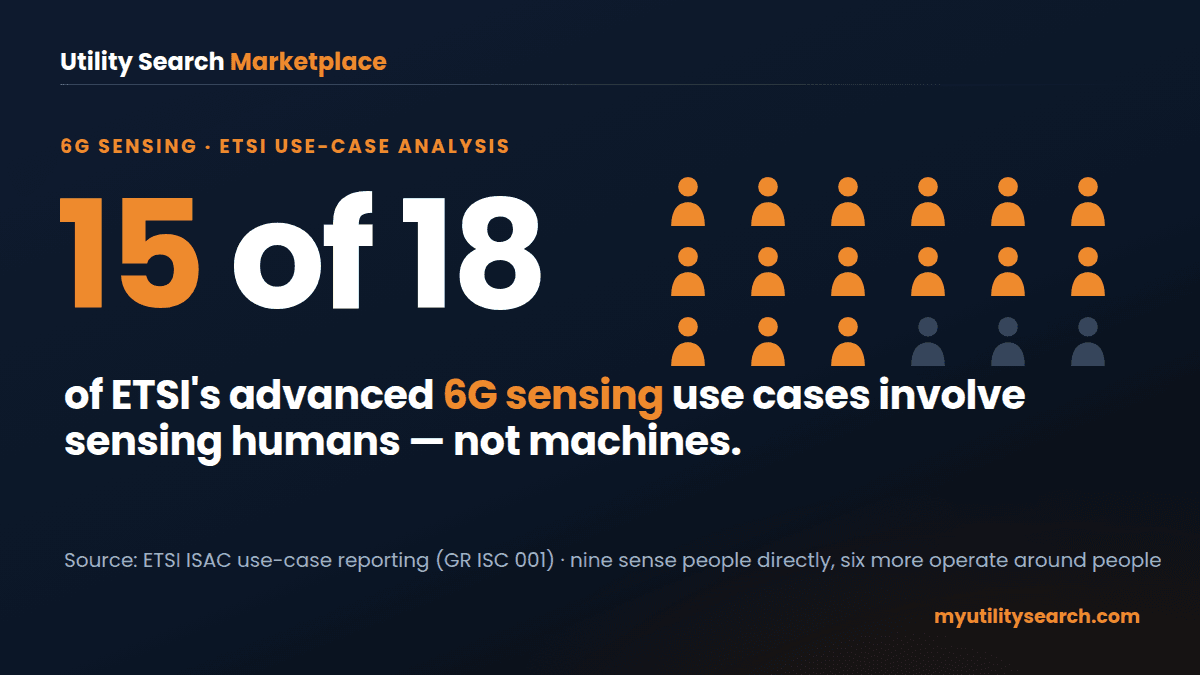
Here is the number that reframes the whole conversation: ETSI maps 18 advanced sensing use cases for 6G, and 15 of the 18 involve humans — nine sense people directly, six more operate in the presence of people. 6G sensing is not mostly about mapping factories. It’s mostly about mapping us.
The dual-use problem: the same feature saves lives and enables surveillance
This is what makes 6G sensing genuinely hard rather than simply scary. The exact same capability powers outcomes almost nobody would object to:
| Beneficial use | What 6G sensing does | The flip side |
|---|---|---|
| Elderly fall detection | Detects a collapse with no camera in the bedroom | Continuous monitoring of anyone in range |
| Search & rescue | Finds heartbeats and breathing under rubble | Locating people who don’t want to be found |
| Smart traffic & safety | Reads pedestrian and vehicle density | Tracking individuals across a city |
| Contactless health | Monitors breathing without a wearable | Capturing vital signs of passers-by |
| Drone / UAV safety | Verifies flights beyond line of sight | Persistent aerial-area monitoring |
A privacy win (fall detection without a lens) and a privacy risk (ambient biometric capture of the public) are the same switch in two positions. That’s the tension the whole story turns on.
Why 6G sensing is a real concern — unlike the 5G scare
The last generation triggered fear for the wrong reasons: health myths with no scientific basis. 6G sensing gives us something legitimate to weigh instead, and the difference is consent.
Every privacy framework assumes a data subject who signs up, taps “accept,” and carries a device they can switch off. 6G sensing dissolves that assumption. The people being sensed are everyone inside the Target Sensing Service Area (TSSA) — bystanders who never opened an app, never agreed to terms, and may not know sensing is active. Their gait and heart rate are biometric-grade personal data, captured passively.
You don’t have to take an activist’s word for it. Here is ETSI — the European Telecommunications Standards Institute, the body standardizing this — in its own words:
“The ISAC-enabled 6GS collects sensing data that often include PII [Personally Identifiable Information] of individuals in the TSSA. The processing of this sensing data may capture a wide range of sensitive information, such as a person’s location, movement patterns, gestures, or even biometric data like gait, facial features, and heart rate, depending on the application and configuration.” — ETSI GR ISC 004 V1.1.1 (2026-02), §5.7.1, Key Issue #7
When the network’s own architects put “captures your heart rate and gait” in a formal standard, the risk isn’t speculation. It’s the roadmap.
The regulatory vacuum: who’s the controller of a sensing area?
Here is the question nobody has answered. GDPR in Europe, biometric laws like Illinois’ BIPA, and California’s CCPA all rest on two pillars: an identifiable data subject and an accountable controller with a lawful basis to process. Point those pillars at 6G sensing and they wobble:
- Who is the controller of a slice of public space a network is illuminating with radar — the carrier, the venue, or the app vendor? Plausibly all three.
- What is the lawful basis for reading a stranger’s heartbeat as they pass a base station? Consent is meaningless if the subject doesn’t know they’re a subject.
- How do you honor a deletion request for data about a person the system never named but absolutely fingerprinted by gait?
None of these have clean answers today — and 6G sensing is being specified now, years before a regulator forces the issue.
Sentiment check: how the debate actually feels right now
Because you asked for the read on sentiment, here’s the honest landscape as of mid-2026. The conversation around 6G sensing is not uniform — it splits sharply by who’s talking:
| Stakeholder | Prevailing sentiment | What they’re signaling |
|---|---|---|
| Tech press & privacy media | Alarmed | “Detect people through walls, monitor heartbeats” headlines dominate |
| Standards bodies (ETSI) | Cautiously constructive | Naming the risk and proposing mitigations in the same document |
| Regulators | Wary, unprepared | No consent framework exists for sensing bystanders |
| Operators & vendors | Bullish | Sensing-as-a-service is a new revenue layer |
| The public | Largely unaware | Almost no consumer awareness that 6G ≠ “faster 5G” |
The net sentiment is concern outpacing readiness — coverage skews alarmed, the technology skews inevitable, and the guardrails skew unfinished. That gap, more than any single feature, is the story. The tone that ages well here is neither hype nor panic: cautious, specific, and early.
Why ETSI flagging it is the actual headline
It’s tempting to dismiss this as academics catching feelings. It isn’t. ETSI GR ISC 004 is a work product of the same organization building the technology, and it doesn’t just gesture at privacy — it names 19 key issues (15 on security and privacy) and proposes concrete mitigations to bake in: gathering consent and sensing policies from affected individuals, transparency about when sensing is active, privacy-preserving sensing techniques, authorization controls on who can sense, anonymization and pseudonymization, and formal data-governance frameworks.
That’s encouraging and cautionary at once. Encouraging, because the guardrails for 6G sensing are being drafted alongside the capability instead of after a scandal. Cautionary, because “the standard recommends consent” is a long way from “every deployment implements it and a regulator can enforce it.” The gap between a mitigation in a spec and a right you can exercise is where privacy usually dies.
Compare internet, energy & home security at your address
Shop InternetShop Energy RatesShop Home SecurityWhy this matters now, if 6G is years away
Because the decisions that count are being made today. Commercial 6G is broadly expected around 2030, aligned to the ITU’s IMT-2030 vision, with 3GPP‘s first 6G release (Release 21) being scoped across the second half of this decade. 6G sensing is being written into the architecture at the ground floor — the radio, the core, and the data-handling rules. Whether it ships as a privacy-preserving public good or the most capable surveillance substrate ever built into public infrastructure is being settled in the specifications right now, not in 2030.
The reframe worth carrying into every one of those conversations: 6G doesn’t just connect your devices. It can perceive you. The only open question is who’s allowed to look, when, and whether you’ll ever know.
What the White House “Winning the 6G Race” memo (NSPM-8) means for you
On December 19, 2025, the White House issued National Security Presidential Memorandum NSPM-8, “Winning the 6G Race,” making U.S. leadership in 6G official national policy. It does not regulate the sensing-and-privacy questions ETSI raised — instead it accelerates the rollout by freeing up radio spectrum for commercial 6G, which is exactly what makes those privacy questions urgent sooner rather than later.
The memo frames 6G as “foundational to the national security, foreign policy, and economic prosperity of the United States” and pivotal to AI, robotics and implantable technologies. Here is what it actually orders:
- Reallocates the 7.125–7.4 GHz band for full-power commercial 6G. The Commerce Department’s NTIA must study how to move federal incumbents to other frequencies (including 7.4–8.4 GHz) and report to the President within 12 months with transition costs and timelines.
- Protects defense and the power grid: the relocation cannot materially impair national-security missions or electric-grid operations that use the 7.125–7.4 GHz band. Fixed satellite-telemetry-uplink and radio-astronomy sites are exempt.
- Opens two more bands for study: NTIA must examine whether parts of the 2.69–2.9 GHz and 4.4–4.94 GHz bands can also be reallocated for commercial 6G.
- Goes global: the State Department must build a coalition of industry and allies behind U.S. positions on Agenda Item 1.7 at the ITU’s World Radiocommunication Conference-27 (WRC-27).
Why it matters for the privacy story: spectrum is the raw material of 6G. By fast-tracking the 7 GHz band, the memo shortens the runway to real-world 6G networks — and the joint communication-and-sensing (ISAC) capability ETSI flagged rides on those same networks. The policy speeds up deployment; it does not yet answer who controls the sensing data or how you consent to being sensed. That gap is the thing to watch. You can read the full NSPM-8 memorandum on the White House site.
Frequently asked questions
Is 6G sensing real or hype? Real, but early. 6G sensing is an active standardization effort (ETSI’s ISAC group and 3GPP Release 21), not a shipping product. Commercial 6G is expected around 2030.
Can 6G sensing really detect a heartbeat through a wall? Yes, in principle. Radio sensing can detect the micro-movements of breathing and heartbeat and can penetrate walls. ETSI’s use cases explicitly include contactless vital-sign monitoring and finding survivors under debris.
Does 6G sensing use cameras? No. That’s the point. 6G sensing works from radio reflections, so it can capture biometric-grade information without any camera — which is part of why it raises new privacy questions.
Do I have to consent to being sensed? Under the current architecture, bystanders inside a Target Sensing Service Area can be sensed without any interaction or notice. Building meaningful consent and transparency into deployments is an open problem ETSI explicitly flags.
Is 6G sensing the same as the 5G health scare? No. The 5G fears were scientifically unfounded. This is a documented, standards-body-acknowledged privacy-design question — a different category entirely.
What is a Target Sensing Service Area (TSSA)? ETSI defines it as the location area a 6G network is set to sense — deriving characteristics of the environment and any objects or people within it.
Which uses of 6G sensing are actually good? Fall detection for seniors, search-and-rescue, contactless health monitoring, safer traffic, and drone verification are all genuine benefits — the same capability that also enables surveillance.
When will 6G sensing affect consumers? Not immediately. Standards run through the late 2020s and commercial launch lands near 2030 — which is exactly why the privacy rules should be decided now, before deployment.
Does the White House 6G memo (NSPM-8) regulate 6G sensing or privacy? No. NSPM-8, “Winning the 6G Race” (December 19, 2025), is a spectrum-and-competitiveness order: it reallocates the 7.125–7.4 GHz band for commercial 6G and directs studies of the 2.69–2.9 GHz and 4.4–4.94 GHz bands. It does not set rules for the sensing capabilities or privacy questions ETSI raised, which remain an open regulatory gap.
Keep going
- Flock, Axon, and the home-security privacy debate
- What is a Flock camera, and how does it work?
- The best home security systems compared for 2026
- Satellite direct-to-device: the next connectivity shift
- The AI fiber boom reshaping business internet
- Telecom consolidation: every major merger tracked
(Publisher note: verify each URL returns 200 before publish — the site had an outage; drop any that don’t resolve. Also add 1–2 links back IN to this post from /telecom-consolidation/ and a home-security page so it isn’t orphaned.)
Compare internet, energy & home security at your address
Shop InternetShop Energy RatesShop Home SecurityBy Christopher Burg · Utility Search Marketplace · Last updated [date]. Primary source: ETSI GR ISC 004 V1.1.1 (2026-02).