





Blog
Frontier Utilities Review 2026: Plans, Rates & Is It Good?


Updated on October 1, 2026
9 min read
The cheapest big-name electricity plan on most Texas grids
Frontier Utilities is a Houston-based Texas retail electricity provider whose Power Saver 9 plan priced at 9.8¢–11.7¢/kWh at 1,000 kWh across the five Texas utility territories as of August 30, 2026 — within a tenth of a cent of the cheapest credible plan on every grid. It also carries the cleanest PUCT complaint record of any mid-market provider we track. And no, it is not the internet company: that is Frontier Communications, a different business entirely.
Key takeaways
- Frontier Utilities’ cheapest plan runs 9.8¢ in Houston to 11.7¢ in TNMP territory at 1,000 kWh — 2–3¢ under mid-market rivals like Discount Power on every grid.
- Its legal entity logged just 14 billing complaints with the PUCT in six months — against 83 for Discount Power’s parent and 150 for Reliant’s.
- It holds a three-star PUCT rating, and the Power Saver 9 carries a $150 early termination fee.
- Frontier Utilities ≠ Frontier internet. The electricity company has no connection to Frontier Communications, the fiber provider now owned by Verizon.
Frontier Utilities vs. Frontier Communications — two different companies. Frontier Utilities is a Texas retail electricity provider, certificated with the Public Utility Commission of Texas under Retail Energy Solutions LLC. Frontier Communications is a national internet and phone company that was acquired by Verizon. They share nothing but the first word of their names. If you searched “frontier utilities” looking for your internet or phone bill, you want our guide to the Frontier–Verizon merger; if you are shopping Texas electricity, keep reading.
What does Frontier Utilities charge?
Texas rates depend on your delivery utility (TDU), not your city. Here is the company’s cheapest listed plan in each of the five territories at the state’s 1,000 kWh benchmark:
| Your utility (TDU) | Main metros | Cheapest plan | Rate at 1,000 kWh |
|---|---|---|---|
| CenterPoint Energy | Houston | Power Saver 9 | 9.8¢ |
| Oncor | Dallas–Fort Worth, Waco | Power Saver 9 | 10.6¢ |
| AEP Texas Central | Corpus Christi, Rio Grande Valley | Power Saver 9 | 10.6¢ |
| AEP Texas North | Abilene, San Angelo | Power Saver 9 | 10.7¢ |
| Texas-New Mexico Power | Texas City, League City | Power Saver 9 | 11.7¢ |
The usage tier moves the price
Every Texas plan is priced at three usage levels on its Electricity Facts Label, and the Power Saver 9 on Oncor prices out like this:
| Monthly usage | Rate | Roughly |
|---|---|---|
| 500 kWh | 11.1¢ | a small apartment |
| 1,000 kWh | 10.6¢ | the state benchmark |
| 2,000 kWh | 10.4¢ | a large home in summer |
The spread between tiers is small — half a cent — because the plan leans on the energy charge rather than usage-threshold bill credits. That makes Frontier Utilities’ pricing more predictable than credit-gated plans that only hit their advertised number at exactly 1,000 or 2,000 kWh. Still, read the Electricity Facts Label at the tier closest to your own bill before you sign.
How Frontier Utilities compares to the rest of the board
On the Oncor grid, 149 residential plans were listed on August 30, 2026. Frontier Utilities sits at the value end of the credible names:
| Provider | Cheapest plan at 1,000 kWh (Oncor) | Term |
|---|---|---|
| Rhythm | 10.5¢ | 9 months |
| Frontier Utilities | 10.6¢ | 9 months |
| Gexa Energy | 10.6¢ | 9 months |
| Payless Power | 10.9¢ | 3 months |
| Champion Energy | 12.3¢ | 9 months |
| Discount Power | 13.2¢ | 10 months |
| Reliant | 15.3¢ | 18 months |
A household using 1,000 kWh a month pays about $26 a month less on the Power Saver 9 than on Discount Power’s cheapest Oncor plan, and roughly $47 less than Reliant’s. Over a nine-month term, that gap is real money — but price is only half the question. The other half is how a provider treats its customers, and Texas publishes a scorecard for that.
The cleanest complaint record in the mid-market
The PUCT keeps a rolling six-month complaint history for every certificated retail entity. Frontier Utilities’ entity — Retail Energy Solutions LLC, which also does business as Companion Energy — has the lowest complaint counts of any mid-market provider in our August 2026 pull:
| Complaint type | Retail Energy Solutions LLC (Frontier Utilities) | US Retailers LLC (Discount Power, Cirro) | Reliant Energy Retail Services LLC |
|---|---|---|---|
| Billing | 14 | 83 | 150 |
| Provision of service | 7 | 20 | 74 |
| Discontinuance | 6 | 14 | 54 |
| Slamming | 2 | 10 | 21 |
| PUCT star rating | ★★★ | ★★ | ★★★★ |
Read these as raw counts, not rates. The PUCT does not publish customer numbers alongside complaint totals, so a bigger provider will show more complaints without necessarily being worse per customer — that is part of why Reliant’s larger numbers coexist with a four-star rating. What the table does establish: for a provider aggressive enough on price to sit at the top of the value board, Frontier Utilities’ fourteen billing complaints in six months is an unusually quiet record. Cheap and quiet rarely travel together in this market.
Compare internet, energy & home security at your address
Who owns Frontier Utilities?
PUCT filings list the certificated entity as Retail Energy Solutions LLC, which markets under the Frontier Utilities and Companion Energy names. Both brands share one complaint record and one certificate. That is worth knowing for the same reason it matters everywhere in the Texas market: several “competing” brands are one company’s shelves — Cirro and Discount Power are both US Retailers LLC, Rhythm and Energy Texas are both Rhythm Ops — so a complaint record follows the entity, not the logo.
What to check before you sign
- Your TDU. The same Power Saver 9 spans 9.8¢ to 11.7¢ depending on who delivers your power.
- The $150 early termination fee. Higher than some rivals’ $95 — the discount buys commitment.
- Your real usage tier. The plan is steady across tiers, but confirm at 500 kWh if you’re in a small apartment.
- The end date. Nine-month terms end mid-cycle; calendar it, because expired plans roll to variable rates.
So is Frontier Utilities worth it?
On the numbers, yes — with one caveat. It offered the cheapest or second-cheapest credible plan on every Texas grid we checked, and its complaint record is the quietest in its weight class. The caveat is the $150 exit fee: if you may move or re-shop within the term, price the risk. For a household that will sit the full nine months, Frontier Utilities is one of the few Texas providers where the advertised bargain and the service record point the same direction.
Is Frontier Utilities legit?
Yes. Frontier Utilities is a licensed Texas retail electricity provider under Retail Energy Solutions LLC, listed on the PUCT’s Power to Choose site with a three-star rating and one of the lowest complaint counts among mid-market providers — 14 billing complaints in the February–July 2026 window.
Is Frontier Utilities the same as Frontier Communications?
No. Frontier Utilities sells electricity in Texas; Frontier Communications is the internet and phone company now owned by Verizon. They are unrelated businesses that happen to share a first name.
How much does Frontier Utilities cost per kWh?
Between 9.8¢ and 11.7¢ per kWh at 1,000 kWh as of August 30, 2026, depending on your utility territory. Houston (CenterPoint) is cheapest at 9.8¢; Texas-New Mexico Power territory is highest at 11.7¢.
What is Frontier Utilities’ cancellation fee?
$150 on the Power Saver 9, per the plan listing on Power to Choose in August 2026 — waivers for a verified move are standard in Texas, but confirm on the plan’s Terms of Service before you rely on one.
Who owns Frontier Utilities?
Retail Energy Solutions LLC, the PUCT-certificated entity, which also does business as Companion Energy. Both brands share one complaint record.
How many complaints does Frontier Utilities have?
Fourteen billing complaints, seven provision-of-service, six discontinuance and two slamming complaints logged with the PUCT between February and July 2026 — raw counts, not per-customer rates, and the lowest of the mid-market providers we track.
Compare internet, energy & home security at your address
Frontier Utilities for business: commercial electricity and gas in Texas, New York and Pennsylvania
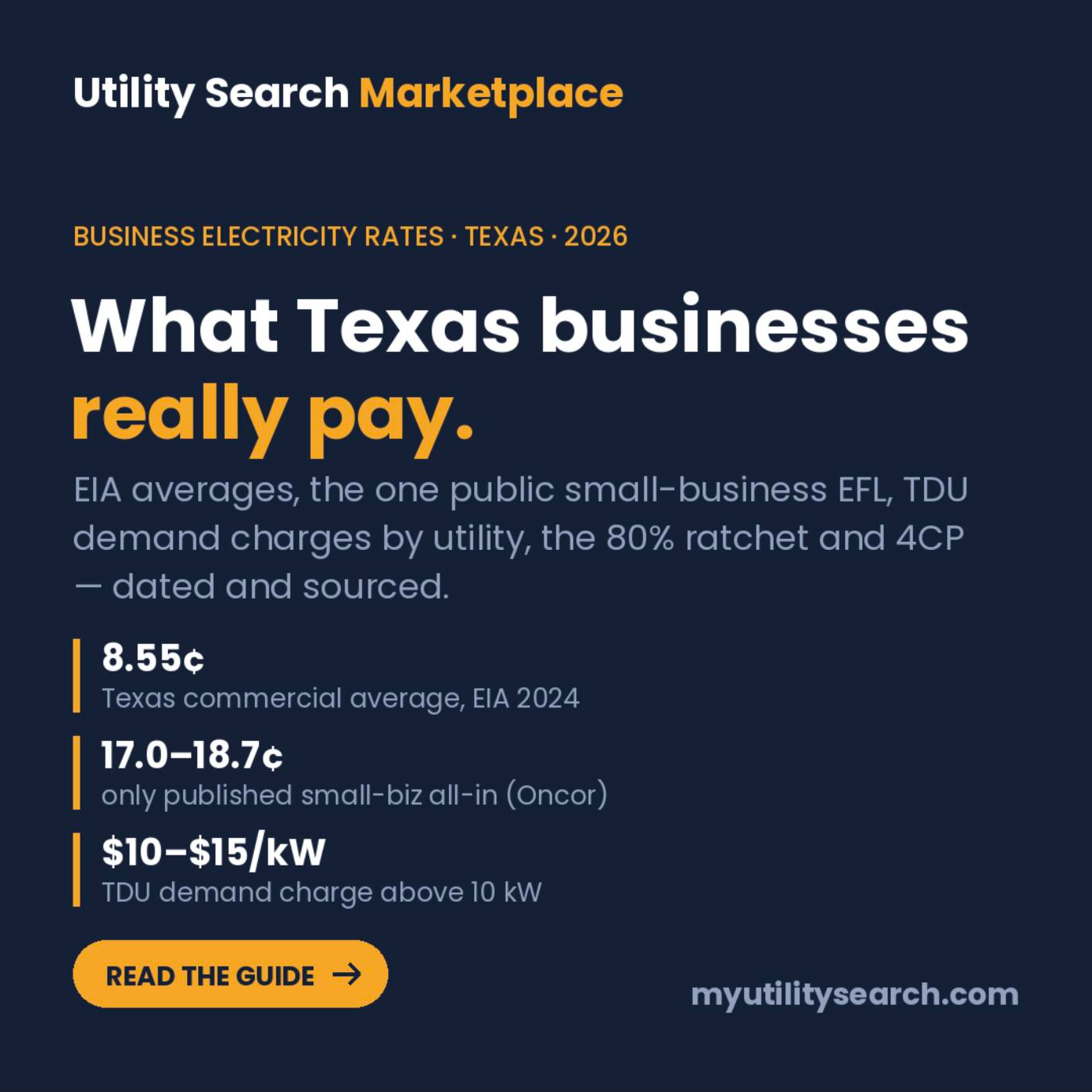
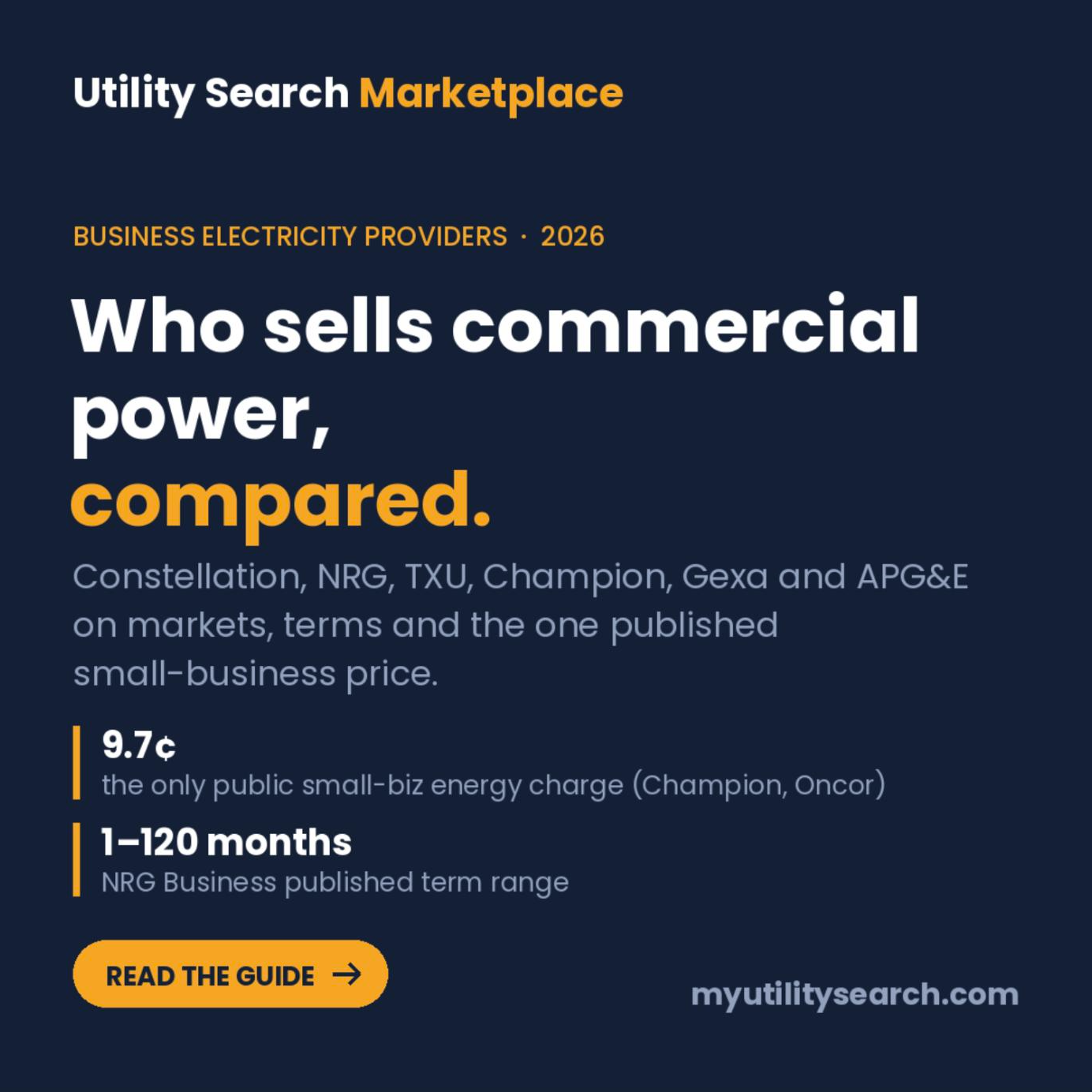
Frontier Utilities, an NRG retail brand, sells electricity and natural gas to commercial customers in Texas, New York and Pennsylvania, with Ohio and Illinois listed as expansion markets, and states its commercial pitch as “competitive prices to save business owners money” with “a variety of energy solutions.” As of September 28, 2026 it publishes no commercial plan names, terms or prices; business accounts are quoted through the commercial contact form, by phone at 877-293-7235 or 844-210-5595, or through its broker channel (the B2B partner portal). As with the other NRG brands, NRG Business’s published Texas small-commercial terms are the closest public reference for structure; hold any Texas quote against Champion’s public 9.7¢ energy charge on Oncor, and any New York or Pennsylvania quote against the utility’s default supply rate for the same period.
| Business product | Price | Terms |
|---|---|---|
| Frontier Utilities commercial electricity | Custom quote; 877-293-7235 | Texas, New York, Pennsylvania; Ohio and Illinois planned |
| Commercial natural gas | Custom quote | Northeast markets |
| Broker channel | B2B partner portal | Dedicated sales support; commission visibility for partners |
Source: the supplier’s own business pages (and NRG Business’s Texas small-commercial terms of service, REP #10011, for the NRG brands), read September 28, 2026. Commercial electricity is priced per meter; treat these as the published starting points.
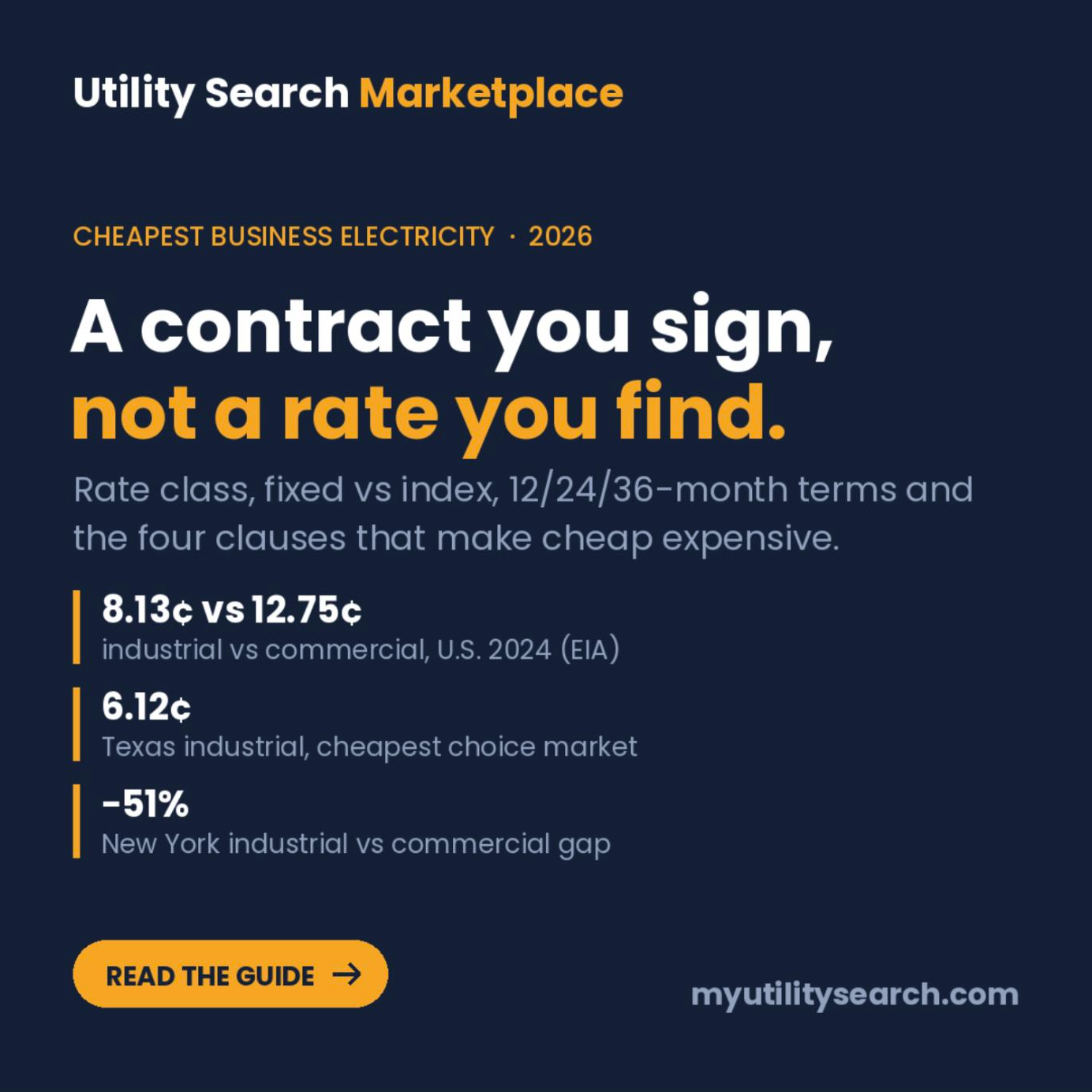
What a commercial contract adds over the residential plan on this page: a price built from your meter’s 12-month usage and load factor rather than a published rate card, term choices from 12 to 36 months or longer, a base charge and pass-through structure that differ from the residential EFL, and exit terms that scale with the months remaining. Compare every business quote as an all-in price at your real usage — the method is in our cheapest business electricity guide and the supplier field is compared in business electricity providers.
Does Frontier Utilities offer business electricity?
Yes. Frontier Utilities sells commercial electricity and natural gas in Texas, New York and Pennsylvania (Ohio and Illinois planned) by custom quote at 877-293-7235 or through its broker channel as of September 28, 2026. It publishes no commercial plans, terms or prices.
Business shopper? Compare business electricity providers, read how the cheapest business contracts are built, or talk to a commercial specialist.
Keep going
- Discount Power review — the mid-market rival, 2–3¢ higher on every grid
- Cheapest electricity in Texas — how to find the real lowest rate for your usage
- Texas electricity rates by city — the five utility territories compared
- How to read an Electricity Facts Label
- How to switch electricity providers in Texas
- The Frontier–Verizon merger — if you were looking for the internet company
How we checked this
Every rate on this page was read directly from Power to Choose, the comparison site run by the Public Utility Commission of Texas, on August 30, 2026. We pulled the full residential plan list at a benchmark ZIP in each of the five utility territories — 75078 for Oncor, 77002 for CenterPoint, 78401 for AEP Texas Central, 79601 for AEP Texas North, and 77590 filtered to Texas-New Mexico Power — and took Frontier Utilities’ lowest-priced plan in each. Complaint figures come from the same site’s company history pages, which publish a rolling six-month record by category for every certificated retail entity. We re-run this check monthly; if the date below is more than a month old, open the current EFL before relying on these figures.
Rates verified against Power to Choose, the Public Utility Commission of Texas, on August 30, 2026, at 1,000 kWh. Rates change frequently — check the current EFL before you sign.


One thought on “Frontier Utilities Review 2026: Plans, Rates & Is It Good?”