Blog
Hawaiian Telcom Internet Review 2026: Fioptics Fiber Plans, Prices & Speeds

Updated on September 5, 2026
6 min read
Hawaiian Telcom internet is Hawaii’s largest fiber provider, delivering symmetrical Fioptics fiber from 100 Mbps up to 3 Gig with no data caps and no annual contract. If Fioptics fiber is wired to your address, it’s the strongest choice on the islands for remote work, streaming, and gaming because upload speed matches download.

TL;DR
• Hawaiian Telcom internet runs on the Fioptics all-fiber network across Oahu, Maui, Kauai, and Hawaii Island.
• Symmetrical speeds from 100 Mbps to 3 Gig; roughly $30–$100/mo.
• No data caps, no annual contract, equipment included on most plans.
• Owned by altafiber (formerly Cincinnati Bell).
Is Hawaiian Telcom internet good?
Hawaiian Telcom internet is a good choice where Fioptics fiber reaches your home. Because fiber is symmetrical, your upload speed equals your download speed — the trait that keeps video calls, cloud backups, and large uploads steady. On plans still served by older DSL lines, performance is far weaker, so availability at your exact address is what decides the experience.
Hawaiian Telcom plans and prices
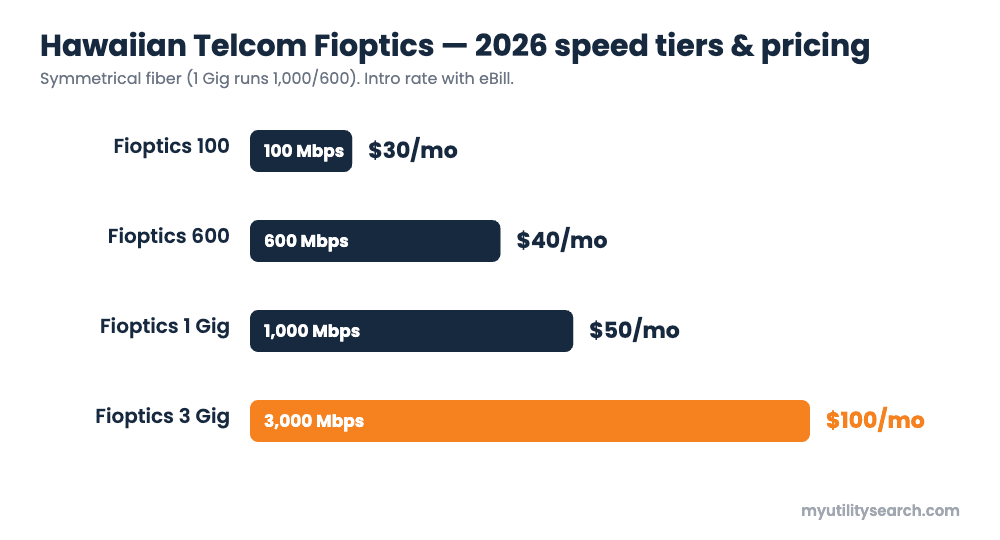
| Plan | Speed (down/up) | Intro price* | Promo perks | Equipment |
|---|---|---|---|---|
| Fioptics 100 | 100 / 100 Mbps | $30/mo | 1-yr price lock | Bring your own router |
| Fioptics 600 | 600 / 600 Mbps | $40/mo | 1-yr price + 1 month free | Bring your own router |
| Fioptics 1 Gig | 1,000 / 600 Mbps | $50/mo | 3-yr price + 2 months free | Free eero Pro 6E |
| Fioptics 3 Gig | 3,000 / 3,000 Mbps | $100/mo | 3-yr price + 3 months free + 1 yr Netflix | Free eero Pro 7 |
*Introductory rate with eBill (includes the $5 eBill discount), guaranteed for at least 12 months; after the promo the price rises about $15/mo to the rate-card rate. No contract, no early-termination fee, unlimited data with no overage charges; $34.99 activation (often waived by promo). Fioptics 100, 600 and 3 Gig are symmetrical (equal upload and download); the 1 Gig tier runs about 1,000 Mbps down / 600 Mbps up.
Going bigger pays off. The Fioptics 3 Gig plan stacks the most value: 3 months free, a free eero Pro 7 whole-home gateway, and a full year of Netflix on us — on top of 3,000 Mbps symmetrical speeds locked in for three years.
Prices are typical published rates and vary by promotion and address. Confirm the live rate before ordering.
Hawaiian Telcom 2026 market landscape: Fioptics builds & competitors
Hawaiian Telcom is Hawaii’s incumbent local carrier and runs the state’s largest fiber network, Fioptics. It is owned by altafiber (formerly Cincinnati Bell), which has continued investing in fiber-to-the-home across the islands.
- New builds: Hawaiian Telcom keeps extending Fioptics fiber deeper across Oahu and the neighbor islands, adding multi-gig speeds where it upgrades from older DSL.
- New competitor entrants: its main rival is Spectrum (Charter), the dominant cable provider in Hawaii; beyond that, fixed wireless and satellite fill the gaps where fiber has not reached.
How Starlink affects Hawaiian Telcom’s tiers
Hawaii’s geography makes satellite unusually relevant: on rural parts of the neighbor islands where neither Fioptics fiber nor cable reaches, Starlink (about $120/mo) is a genuine alternative. But in Honolulu and built-out Fioptics neighborhoods, Hawaiian Telcom’s symmetrical fiber wins on price, latency and upload — so Starlink pressures the rural edge, not its core urban tiers.
Where is Hawaiian Telcom available?
Hawaiian Telcom serves the state of Hawaii, with Fioptics fiber concentrated on Oahu and expanding across Maui, Kauai, and Hawaii Island. Coverage is address-specific — some homes still fall on legacy copper. Check availability at your exact address on the FCC National Broadband Map or directly with the provider.
Pros and cons
Pros: symmetrical fiber, no data caps, no annual contract, local Hawaii-based support, multi-gig options up to 3 Gig.
Cons: Fioptics fiber isn’t at every address yet; legacy DSL plans are much slower; island pricing runs higher than mainland fiber.
Is your plan keeping up?
If your results are lower than you’re paying for, you may have faster options at your address. Compare internet plans available where you live — fiber, cable, and 5G, side by side.
How reliable is Hawaiian Telcom? Outages and island service
Short answer: Hawaiian Telcom’s Fioptics is a fiber network, which is more reliable than cable or copper — especially in Hawaii’s humidity and storm season, where fiber is unaffected by the moisture and corrosion that degrade coax and DSL. The company is investing about $1.7 billion to make Hawaii the first fully fiber-enabled state by the end of 2026, hardening the network island by island.
How do I check a Hawaiian Telcom outage?
Check your account portal or the Hawaiian Telcom app, or call support. Island-wide outages are usually tied to weather or a power event; a single-home outage is most often the ONT or router, so power-cycle both before calling.
Is Hawaiian Telcom better than Spectrum in Hawaii?
For uploads and working from home, Hawaiian Telcom fiber usually wins where it is available: symmetrical speeds, no data caps, and price locks. Spectrum runs a cable network with fast downloads but slower uploads. Historically Spectrum had broader island coverage, but Hawaiian Telcom’s full-fiber build is closing that gap fast.
Does Starlink make sense in Hawaii?
Starlink is a reasonable fallback for remote or neighbor-island addresses with no wired option, but where Hawaiian Telcom fiber reaches, fiber is cheaper, faster, and lower-latency. As the state approaches full fiber coverage in 2026, Starlink’s niche in Hawaii keeps shrinking.
Source: Hawaiian Telcom Fioptics plans and fiber-network announcements.
Compare internet, energy & home security at your address
Frequently asked questions
What is Hawaiian Telcom?
Hawaiian Telcom is Hawaii’s incumbent telecom and largest fiber internet provider, delivering its Fioptics fiber service statewide along with TV and phone.
Who owns Hawaiian Telcom?
Hawaiian Telcom is owned by altafiber, the company formerly known as Cincinnati Bell, which acquired it in 2018.
Is Hawaiian Telcom internet worth it?
On Fioptics fiber, yes — symmetrical speeds, no data caps, and no contract make it the top wired option in most of Hawaii. It’s less compelling on older DSL lines.
How much does Hawaiian Telcom internet cost?
Fioptics fiber plans run roughly $30/mo for 100 Mbps up to about $100/mo for 3 Gig, with equipment typically included.
Is Hawaiian Telcom better than Spectrum in Hawaii?
Where Fioptics fiber is available, Hawaiian Telcom’s symmetrical upload beats Spectrum’s cable upload for video calls and uploads. Spectrum may reach addresses fiber hasn’t yet.
How do I cancel Hawaiian Telcom?
Because most plans have no annual contract, you can cancel by contacting Hawaiian Telcom customer service; return any leased equipment to avoid fees.
Does Hawaiian Telcom require a contract or deposit?
Most Fioptics fiber plans have no annual contract. A deposit may apply depending on credit, but standard plans typically don’t require one.
How do I contact Hawaiian Telcom?
Reach Hawaiian Telcom through its official website or local Hawaii customer-service line for sales, support, and billing.
Compare internet, energy & home security at your address
Keep going
Compare more options in our guide to the best fiber internet for working from home, see the most reliable internet for remote work, or check whether Starlink is worth it for off-grid Hawaii addresses.