Blog
ClearWave Fiber Review 2026: Plans, Prices, Speeds & Availability

Updated on September 28, 2026
14 min read
Clearwave Fiber is a 100% fiber internet provider serving parts of Georgia, Florida, Illinois and Kansas, with symmetrical plans from 100 Mbps to 7 Gig, no data caps and no annual contract. Advertised residential pricing runs $24.99 to $70 a month with AutoPay, and the rate depends on the market — a Savannah, Georgia address quotes 1 Gig at $49.99 while the national plans page lists $70. In September 2026 its parent agreed to combine with Visionary Broadband, creating a 17-state, roughly 700,000-location fiber platform.
Last updated September 23, 2026
The short version
- Upload speed matches download on every tier, which is the main reason to pick fiber over cable.
- Prices vary by market. A Savannah, GA address quotes $24.99 / $34.99 / $44.99 / $49.99 for 100 / 250 / 500 / 1,000 Mbps; the national plans page lists $34.99 / $50 / $60 / $70 for the same tiers. Both assume AutoPay.
- A mandatory $8.78 Carrier Cost Recovery Fee is on the Broadband Facts label but not in the advertised price, so a $49.99 gig line is $58.77 before taxes.
- Optional: router $10/mo, C-Fi whole-home Wi-Fi $10/mo, Service Assurance $7/mo. One-time Fiber Connect fee $50. Early termination fee $0.
- Sister brand Point Broadband prices differently: $29 to $49 for the first 12 months, then $69 to $89. Clearwave Fiber’s rate is not introductory.
- No contracts, no data caps, and the company advertises no automatic price jump after 12 months.
- Ownership moved fast in 2026: the Point Broadband merger closed May 4, and a Visionary Broadband agreement was signed September 8. Nothing changes for existing customers until that deal closes.
Is Clearwave Fiber worth it in 2026?
Where the network reaches your street, yes. Fiber to the home means the upload speed matches the download speed on every plan, so a 500 Mbps plan uploads at 500 Mbps. Cable plans in the same towns typically upload at a fraction of their download speed, which is what people feel on video calls, cloud backups and game updates. Latency on fiber is also steadier under load.
The catch is geography, not quality. Clearwave Fiber is a regional builder, so the honest answer for most households is that the company either passes your address or it does not, and there is no middle ground. If it does, the plan lineup is unusually simple: four mainstream speeds, one equipment charge, no term contract and no usage cap.
Clearwave Fiber plans and prices
Clearwave Fiber prices are set by market, and the gap is large enough to matter. The table below shows both what the national plans page advertises and what a real Savannah, Georgia address quoted at checkout on September 23, 2026. Every tier is symmetrical, and every price assumes AutoPay.
| Plan | Speed (down/up) | National plans page | Quoted in Savannah, GA | Best for |
|---|---|---|---|---|
| Fiber 100 (Economy) | 100 / 100 Mbps | $34.99/mo | $24.99/mo | One or two people, streaming and email |
| Fiber 250 (Basic) | 250 / 250 Mbps | $50/mo | $34.99/mo | Working from home, a few 4K streams |
| Fiber 500 (Enhanced) | 500 / 500 Mbps | $60/mo | $44.99/mo | Busy households, large uploads |
| Fiber 1 Gig (Ultimate) | 1,000 / 1,000 Mbps | $70/mo | $49.99/mo | Heavy use, many devices |
Two things follow from that table. First, never take the national number as your price — the Savannah Clearwave Fiber quote is $20 a month cheaper on the gig tier, and the spread from 250 Mbps to 1 Gig there is only $15, so the top tier is usually the better buy once you are already paying for the line. Second, the Broadband Facts label for the Savannah gig plan states plainly that the monthly price is not an introductory rate and the contract length is “No Contract,” which matches the “no automatic price increases” badge on every plan card. In a category built on 12-month teaser rates, that is the real differentiator.
What the advertised price leaves out
The Clearwave Fiber rate you see advertised is not the bill. These are the charges on the Broadband Facts label and in the checkout flow for the Savannah 1 Gig plan, September 23, 2026:
- Carrier Cost Recovery Fee, $8.78 a month — mandatory. This one is not optional and not in the advertised price. It is the single biggest gap between the sticker and the bill.
- AutoPay, $10 a month if you decline it. Every advertised price assumes AutoPay, and the checkout makes you tick a box acknowledging the $10 difference.
- Router rental, $10 a month (optional). You can bring your own equipment. Unreturned equipment costs $300.
- C-Fi whole-home Wi-Fi, $10 a month (optional). Adds up to one mesh extender, parental controls and security features. It is pre-selected at checkout.
- Service Assurance Plan, $7 a month (optional). Covers repair and service-visit charges.
- One-time Fiber Connect fee, $50. Plus $2 a month for a paper bill and $5 for an agent-assisted payment, both optional.
- Early termination fee, $0. Government taxes vary by location.
Budget realistically. In Savannah the Clearwave Fiber gig plan advertises $49.99, but the honest all-in is $58.77 a month before taxes once the mandatory carrier fee is counted, $68.77 with the router, and $78.77 if you also take C-Fi. Worth noting: the checkout’s own “Estimated Monthly Total” showed $59.99 for internet plus C-Fi and carried the line “Taxes and fees not included” — the $8.78 carrier fee was not in that total.
What happens when you check a real Clearwave Fiber address?
We ran a real Savannah, Georgia address through the Clearwave Fiber checkout on September 23, 2026. Two things stood out. The prices were $20 a month lower than the national page on the gig tier, and the plan cards carried the whole lineup at once: Fiber 1 Gig $49.99, Fiber 500 $44.99, Fiber 250 $34.99 and Fiber 100 $24.99, each labeled “No Automatic Price Increases,” “Unlimited data included” and “No contracts.”
The Clearwave Fiber Broadband Facts label on the gig plan confirmed 940 Mbps typical download, 940 Mbps typical upload and 25 ms typical latency — unusually honest numbers, since typical upload matches typical download. It also listed the $8.78 carrier fee, the $50 Fiber Connect fee and a $0 early termination fee. The Clearwave Fiber checkout then offered three add-ons, two of them pre-selected: the $10 router, $10 C-Fi whole-home Wi-Fi and a $7 Service Assurance Plan. Self-installation is available at some addresses, which avoids a technician visit.
The availability tool itself only autocompletes addresses already on the network. We tested a second downtown Savannah address the company does not appear to pass, and instead of a “not available” page the form returned “Having trouble locating your address? Please submit your address here,” alongside a 866-404-3751 agent line.
In practice a blank autocomplete is itself the answer: if your address does not appear as you type, the network has not reached it yet, and submitting the form puts you on the expansion list rather than into a checkout. Because pricing is set by market, the address check is also the only way to learn your actual rate — do not assume the national page applies to your street.
Compare internet, energy & home security at your address
Where is Clearwave Fiber available?
Under its own brand, Clearwave Fiber lists service in four states. The footprint is concentrated in coastal Georgia, north Florida, the southwest suburbs of Chicago and eastern Kansas.
| State | Markets listed | Examples |
|---|---|---|
| Georgia | 27 | Savannah, Macon, Marietta, Valdosta, Pooler, Hinesville, Richmond Hill |
| Illinois | 15 | Joliet, Orland Park, Tinley Park, Lemont, New Lenox, Rolling Meadows |
| Kansas | 10 | Lawrence, Olathe, Salina, Gardner, De Soto, Lansing |
| Florida | 8 | Jacksonville, Panama City, Lake City, Vero Beach, Titusville |
Sister brand Point Broadband covers a different map of small-town and rural markets, including Alabama, Georgia, Texas, Virginia, Tennessee, Maryland, Michigan, Ohio and Florida. Verify any address against the FCC National Broadband Map as well, since provider maps and federal filings sometimes disagree at the street level.
The Visionary Broadband deal: what actually changed
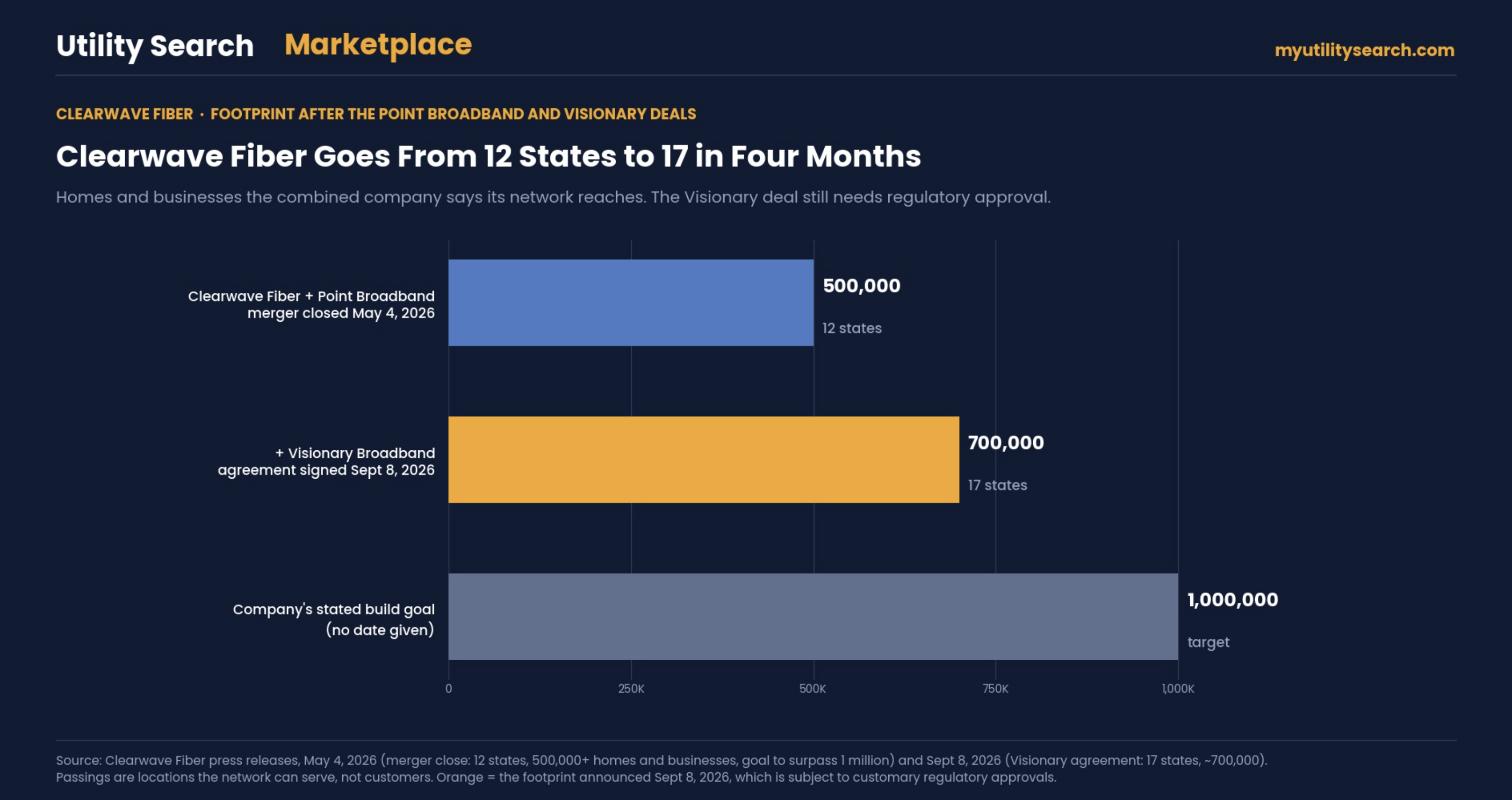
On September 8, 2026, Clearwave — the company formed by Clearwave Fiber and Point Broadband — signed a definitive agreement to combine with Visionary Broadband. The combined business would reach approximately 700,000 homes and businesses across 17 states. Visionary contributes Wyoming, Colorado, Montana, New Mexico and Washington, a western footprint with no overlap with the existing Southeast and Midwest markets.
David Armistead, chief executive of Clearwave, leads the combined company; Visionary chief executive Brian Worthen takes on growth in the West. Longtime investors GTCR and Berkshire Partners back the transaction, which is still subject to customary regulatory approvals. No closing date has been announced.
How the company got here: a four-year timeline
- 2022: spun out of Cable One (consumer brand Sparklight) as a dedicated fiber builder rather than a cable operator.
- May 4, 2026: the Point Broadband merger closes, creating a 12-state operator reaching more than 500,000 homes and businesses, with a stated goal of surpassing 1 million.
- September 8, 2026: the Visionary Broadband agreement is signed, taking the platform to 17 states and about 700,000 locations, pending approvals.
Two combinations in four months is fast even by 2026 standards, and it fits the wider pattern we track in our telecom consolidation tracker: private-equity-backed independents buying scale while the largest cable operators shed rural systems.
Who are Point Broadband and Visionary Broadband?
Neither sister brand sells under the Clearwave Fiber name today, and the pricing models are not the same. Point Broadband builds fiber in small-town and rural America and keeps its own brand after the merger. We ran an Orange Beach, Alabama address through its checkout on September 23, 2026 and got three plans, all requiring eBill and AutoPay, all with no contract and no early termination fee:
| Point Broadband plan | Speed | First 12 months | Rate after 12 months | Typical speeds measured |
|---|---|---|---|---|
| Extreme | Up to 1 Gbps | $49/mo + $200 gift card | $89/mo | 952 down / 959 up, 14 ms |
| Ultra | Up to 500 Mbps | $39/mo + $100 gift card | $79/mo | 525 down / 533 up, 14 ms |
| Performance Plus | Up to 300 Mbps | $29/mo | $69/mo | 293 down / 291 up, 14 ms |
That table is the single most useful thing on this page if you are choosing between the two brands. Clearwave Fiber’s Broadband Facts label states its price is not an introductory rate, and every plan card carries a no-automatic-price-increase badge. Point Broadband’s label says the opposite in plain type: the rate rises after a 12-month introductory period, by $40 a month on the gig plan. Same owner, same investors, two different philosophies about year two — and the Visionary combination puts both under one roof.
Visionary Broadband, the third brand in the group, has served the Rocky Mountain West since 1994 with both fiber and fixed wireless, and was the first broadband provider in a dozen rural Wyoming communities. Its residential lineup runs from an Essential tier up to 600 Mbps through to a 5 Gig tier, with pricing quoted by address rather than published.
What the deal means for your bill
Nothing immediately for Clearwave Fiber customers. The agreement is signed, not closed, and no price changes, plan changes or brand retirements have been announced. Existing customers keep their plan and their bill until the companies say otherwise.
What is worth watching after a close of this kind: whether the separate brands eventually fold into one, whether Clearwave Fiber’s no-automatic-increase promise survives a pricing review or gives way to Point Broadband’s introductory-rate model, and whether support moves to a shared center. Those are the three places consolidation usually shows up on a household bill, and none of them has been announced here. If you are signing up now, save your order confirmation showing the rate and the no-price-increase language.
Clearwave Fiber vs cable internet in the same towns
| What you’re comparing | Clearwave Fiber | Typical cable plan |
|---|---|---|
| Upload speed | Matches download on every tier | Usually 5–10% of download |
| Data cap | None | Often 1–1.2 TB, with overage charges |
| Contract | None | Often 12–24 months to hold the rate |
| Price after 12 months | Advertised as no automatic jump | Promo rate typically steps up |
| Equipment | $10/mo router, or bring your own | $10–$15/mo modem-router rental |
| Availability | Address by address, four states | Near-universal in the same cities |
Pros and cons
Clearwave Fiber pros: symmetrical speeds on every plan, no data caps, no annual contract, a simple four-tier lineup, gift-card promotions on the two fastest tiers, and an advertised commitment to no automatic price increase after a year.
Clearwave Fiber cons: a small footprint in four states, a $10 monthly router charge and a $10 AutoPay requirement that together add $20 to the advertised rate, one-time connection and dispatch fees that are only quoted at the address, and a pending combination that adds uncertainty about who will own the network a year from now.
What to check before you sign
Run the Clearwave Fiber address lookup first, because everything else depends on it. Then confirm four numbers at checkout: the one-time Fiber Connect fee, any dispatch charge, whether the router charge applies if you bring your own equipment, and the gift-card terms, which on most promotions require the account to stay in good standing for a set number of days before the card is issued. Finally, compare that all-in monthly figure against what you pay today rather than against the advertised rate.
Clearwave Fiber for business: Business Class Internet, Dedicated Internet and Metro Ethernet
Clearwave Fiber sells three business connectivity products — Business Class Internet (symmetrical up to 1 Gig, no data caps, local support), Dedicated Internet (symmetrical up to 10 Gig with a service-level agreement and scalable bandwidth) and Metro Ethernet (E-Line and E-LAN private connections between locations, up to 10 Gig, SLA included) — plus a SmartBiz security and backup add-on and three tiers of business phone. As of September 28, 2026 none carry a published price; every business account is quoted by address or at 866-902-3880. Against the residential 1 Gig at $49.99 on this page, expect Business Class to quote above it and Dedicated Internet well above it, because the SLA and the dedicated bandwidth are the product.
| Business product | Price | What it is |
|---|---|---|
| Business Class Internet (symmetrical up to 1 Gig) | Quoted by address | No data caps; local support |
| Dedicated Internet (symmetrical up to 10 Gig) | Quoted | SLA with performance commitments; scalable |
| Metro Ethernet (E-Line / E-LAN, up to 10 Gig) | Quoted | Private site-to-site; SLA included |
| SmartBiz add-on | Quoted | 24/7 security, backup connectivity, device management |
Source: the provider’s own business pages (Sparklight: FCC broadband label F0003474327SPG2B10024999B0), read September 28, 2026. Business pricing is quoted by address and term; treat these as the published starting points.
What the business plan adds over the residential one: a service-level agreement with priority repair, static IP options, commercial-use terms and business support. If downtime does not cost you money, the residential plan at the same address is the cheaper answer — see business internet providers compared and what business internet costs.
Business shopper? Compare business internet at your address or talk to a specialist.
Frequently asked questions
What is Clearwave Fiber?
It is a regional 100% fiber internet provider serving parts of Georgia, Florida, Illinois and Kansas, offering symmetrical speeds from 100 Mbps to 7 Gig with no data caps and no annual contract. It was spun out of Cable One in 2022 as a dedicated fiber builder.
Who owns Clearwave Fiber?
It operates as part of Clearwave, formed when Point Broadband and Clearwave Fiber merged on May 4, 2026, and backed by investment firms GTCR and Berkshire Partners. In September 2026 the company signed an agreement to combine with Visionary Broadband, pending regulatory approval.
How much does Clearwave Fiber cost?
Clearwave Fiber pricing depends on your market. The national plans page lists $34.99 for 100 Mbps, $50 for 250 Mbps, $60 for 500 Mbps and $70 for 1 Gig with AutoPay, while a Savannah, Georgia address quoted $24.99, $34.99, $44.99 and $49.99 for the same tiers on September 23, 2026. Add a mandatory $8.78 carrier cost recovery fee, $10 a month without AutoPay, an optional $10 router, optional $10 C-Fi Wi-Fi, an optional $7 service plan and a one-time $50 Fiber Connect fee.
Does Clearwave Fiber have data caps or contracts?
No. The company advertises no data caps, no overage charges and no annual contract, and states there is no automatic price jump after 12 months.
Is Clearwave Fiber available at my address?
Only in parts of 27 Georgia markets, 15 Illinois markets, 10 in Kansas and 8 in Florida. The address tool only autocompletes locations already on the network, so if your address does not appear as you type, service has not reached it yet.
What is happening with the Visionary Broadband merger?
On September 8, 2026 the companies signed a definitive agreement to combine into a 17-state platform reaching about 700,000 homes and businesses. It still needs customary regulatory approvals, and no closing date or price change has been announced.
Will my bill change because of the merger?
Not until the deal closes, and no pricing changes have been announced. Keep your order confirmation showing your rate, then watch for notices about brand, plan or billing changes after a close.
Is Point Broadband cheaper than Clearwave Fiber?
For the first year, often yes: Point Broadband quoted $29 to $49 a month in Orange Beach, Alabama versus $24.99 to $49.99 for Clearwave Fiber in Savannah. From month 13 the picture flips, because Point Broadband’s rate rises to $69 to $89 while Clearwave Fiber advertises no automatic increase. Compare year two, not month one.
How do I contact Clearwave Fiber?
New-service questions, including addresses the lookup tool cannot find, go to 866-404-3751. Customer support is listed on the Broadband Facts label as (877) 293-2973, and existing customers can use the account login and support center on the provider’s site.
Does Clearwave Fiber offer business internet?
Yes. Clearwave Fiber sells Business Class Internet (symmetrical up to 1 Gig), Dedicated Internet (up to 10 Gig with an SLA) and Metro Ethernet (up to 10 Gig), plus SmartBiz security and business phone. As of September 28, 2026 all business pricing is quoted by address.
Compare internet, energy & home security at your address
Sources
- Clearwave and Visionary Broadband Sign Agreement to Combine, Expanding Fiber Platform to 17 States — press release, September 8, 2026.
- Point Broadband and Clearwave Fiber Close Merger — press release, May 4, 2026 (12 states, 500,000+ locations).
- Clearwave Fiber residential plans and pricing and cities served, read September 23, 2026.
- FCC National Broadband Map — independent availability check by address.
- Point Broadband and Visionary Broadband — footprint and plan tiers, read September 23, 2026.
- Live checkout quotes and FCC Broadband Facts labels captured by Utility Search Marketplace: a Savannah, Georgia address on clearwavefiber.com and an Orange Beach, Alabama address on shop.point-broadband.com, both September 23, 2026.
Keep going
- Telecom consolidation tracker: every major broadband deal of 2026
- Cable One’s Vyve acquisition and what it means for rural broadband
- Fidium Fiber plans, prices and availability
- Quantum Fiber internet review
- Frontier Internet plans and prices after the Verizon deal
- Internet plans with a real price lock
- Google Fiber plans, prices and cities