Blog
Who Serves My Address? The Best 2026 Fiber Shake-Up Guide

Updated on September 5, 2026
By The Utility Search Marketplace Team · 20+ years in consumer home services
If you are wondering who serves my address for internet in 2026, you are not alone — and the answer may have changed without you noticing. A wave of deals closed over the past year has reshuffled which company owns the fiber and cable lines running to millions of U.S. homes. Your provider’s name, your plan, even who you call for support can shift when a network changes hands. This guide explains what changed, why it matters for your bill, and how to find out who serves my address right now.
Why “who serves my address” changed in 2026
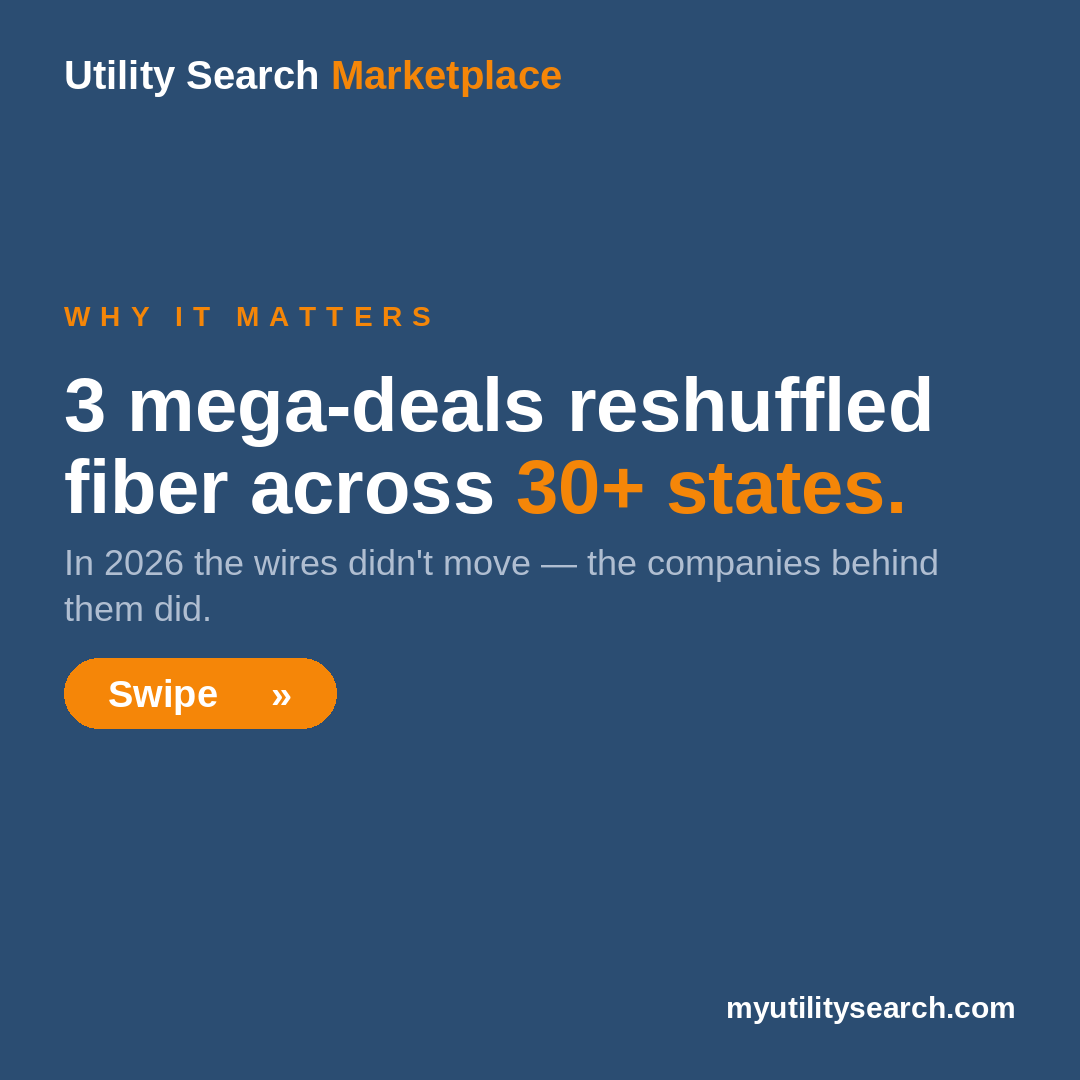
Three of the largest broadband deals in years closed or advanced in a tight window, and together they moved fiber footprints across more than 30 states:
The deals that reshuffled the map
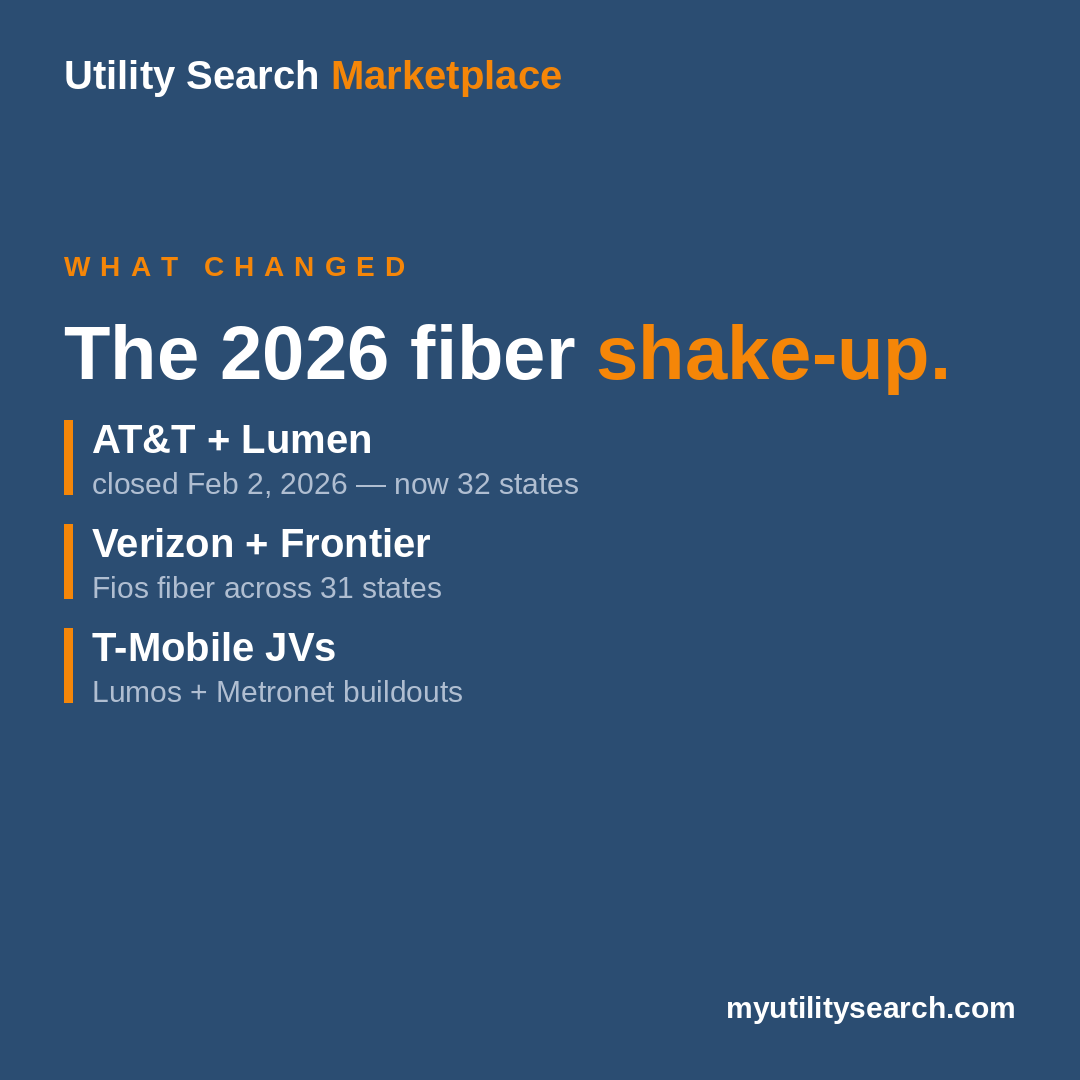
- AT&T closed its $5.75 billion purchase of Lumen’s mass-market fiber business on February 2, 2026, adding more than 1 million subscribers and over 4 million fiber locations across new metros, and expanding AT&T Fiber to 32 states.
- Verizon completed its roughly $20 billion acquisition of Frontier, extending Verizon Fios across 31 states.
- T-Mobile expanded through fiber joint ventures — Lumos (with EQT) and Metronet (with KKR) — pushing toward 12–15 million fiber households by 2030.
Cable shifted too: Charter announced a $34.5 billion deal for Cox Communications, the largest private cable firm in the country. The upshot is simple — the company that serves my address today may not be the one that served it a year ago, even if nothing changed inside my house.
What it means for you when the owner of your line changes
When a network changes hands, most customers keep service running without interruption, but several things can shift over time:
- Billing and brand: your plan may transition to the new owner’s brand, with a new app, login, and support line.
- Plans and pricing: introductory rates and plan tiers are often restructured after a transition.
- New options: an acquisition can bring fiber to an address that only had cable or DSL before — a chance to upgrade.
- Bundles: the new owner may push converged mobile-plus-internet bundles that change the math on what you pay.
None of this happens overnight, but it is worth knowing who serves my address so you can spot a better deal when the transition reaches you.
How to find out who serves my address right now
Ownership changes are easy to miss because the wires do not move — only the company behind them does. To confirm who serves my address today:
- Check your most recent bill for the current provider name, which may differ from the one you signed up with.
- Enter your exact address in a coverage tool — serviceability is address-specific and can differ house to house.
- Look for new fiber: if AT&T, Verizon, or a T-Mobile fiber venture recently expanded near you, fiber may now be available where it was not before.
- Compare across providers rather than renewing automatically, since a recent buildout may have added a faster or cheaper option.
Is your plan keeping up?
If your results are lower than you’re paying for, you may have faster options at your address. Compare internet plans available where you live — fiber, cable, and 5G, side by side.
Who Serves My Address FAQ
How do I find out who serves my address for internet?
Check your latest bill for the current provider name, then enter your exact address in a coverage tool to see every provider that reports service there. Because serviceability is address-specific, the fastest way to know who serves my address is to compare by your exact location rather than your ZIP code alone.
My internet provider changed names — what happened?
Your line was likely part of one of the 2026 broadband acquisitions. AT&T absorbed Lumen’s consumer fiber, Verizon absorbed Frontier, and several T-Mobile fiber ventures expanded. Service usually continues uninterrupted, but billing, branding, and plan options can change after the transition.
Will my bill go up after my provider is acquired?
Not automatically, but introductory rates and plan tiers are often restructured after a network changes hands. When the transition reaches your address, it is a good moment to compare current plans rather than letting an old rate roll over.
Did the 2026 deals bring fiber to new areas?
Yes. AT&T expanded AT&T Fiber to 32 states and set a goal of about 60 million fiber locations by 2030, and Verizon and T-Mobile both extended fiber footprints. An address that only had cable or DSL before may now have a fiber option worth checking.
Should I switch providers after a buildout near me?
It is worth comparing. A new fiber buildout can add a faster or cheaper option than your current plan, and converged mobile-plus-internet bundles from the new owners can change the value calculation. Compare what actually serves your address before renewing.
Keep going
Once you know who serves your address, see the best internet provider for working from home in 2026 to match a plan to how you work. If a move is what triggered the question, our guide to setting up utilities at a new address covers the right order — or book a free utility consultation and let a specialist sort it out with you.
To see which providers report service at your exact address, check the FCC’s National Broadband Map, the official federal record of broadband availability.
Sourcing note: Deal details reflect 2026 reporting and company releases from AT&T, Broadband Breakfast, Fierce Network, Telecompetitor, and RCR Wireless on the AT&T–Lumen close (Feb 2, 2026), the Verizon–Frontier acquisition, the T-Mobile fiber joint ventures, and the Charter–Cox agreement. Availability varies by address. myutilitysearch.com earns a referral fee from some providers; comparisons are free to you, and providers paying us does not change what we recommend.