Blog
Ripple Fiber Is Becoming Verizon: What the $1.5B Eaton Deal Means for You

Updated on August 10, 2026
Ripple Fiber is being folded into Verizon — and if you are one of its customers, that is the headline that matters. In a $1.5 billion deal announced in July 2026, the wholesale platform Eaton Fiber is acquiring Ripple’s network, while Verizon takes over Ripple’s existing customers and part of its network in the Carolinas. Our take: this is good news for fiber availability, but if you are a Ripple customer, treat the transition as a moment to re-check your plan — not a set-it-and-forget-it renewal.
How we make money: MyUtilitySearch is a utility marketplace and may earn a commission when you compare or switch internet providers through us. We only benefit if you find a better deal — so this is the plain-English version of a confusing deal.
Our take on the Ripple Fiber deal
- What is happening: Eaton Fiber buys the network; Verizon takes the customers (in NC & SC).
- Why it is good: it accelerates fiber to 1M+ new locations and puts customers on a national carrier.
- Where to be careful: promo rates can reset in a transition — check your renewal and compare options.
Compare internet, energy & home security at your address
What the Ripple Fiber deal actually is
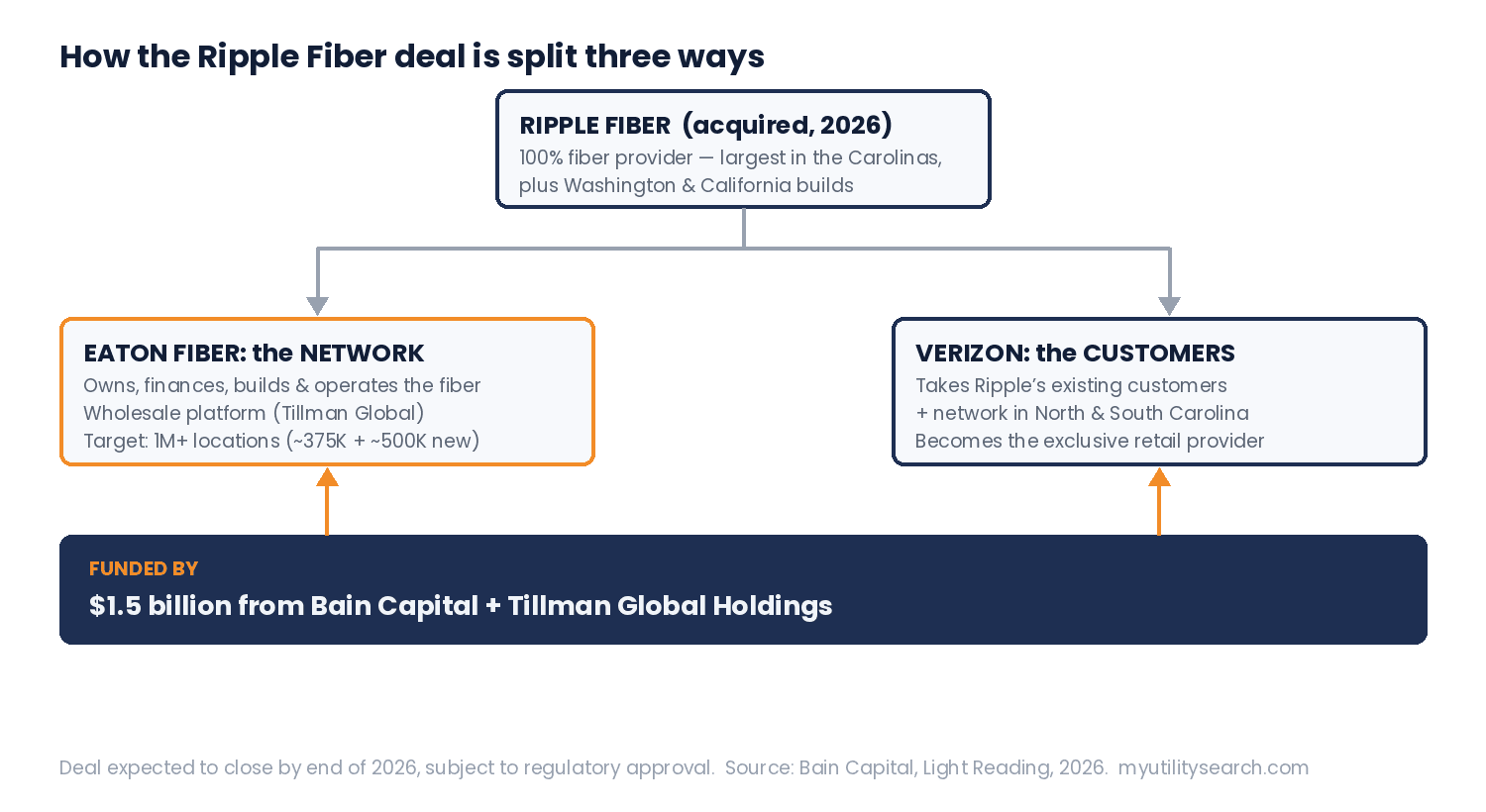
This deal is confusing because it splits three ways, so here is the plain version. Bain Capital and Tillman Global Holdings are putting in $1.5 billion. Eaton Fiber — a wholesale fiber platform owned by Tillman — acquires and will build and operate Ripple’s network, targeting more than one million locations outside Verizon’s current footprint (analysts peg it at roughly 375,000 locations from Ripple Fiber plus about 500,000 new builds). And Verizon takes Ripple’s existing customers plus a slice of network in North and South Carolina, becoming the exclusive retail provider there. Ripple Fiber, as a consumer brand, goes away.
What it means if you are a Ripple customer
If you have Ripple today — most likely in the Carolinas — your service is set to transition to Verizon over time, and both companies have promised continuity, so you should not lose your connection. The fiber in the ground does not move; what changes is the name on the bill, the plan structure, and the app. The thing to watch is pricing: when a regional provider is absorbed by a national carrier, promotional rates and terms often reset. That does not make it a bad deal — Verizon fiber is well-regarded — but it does make your transition the right time to confirm what you will pay and compare it against anything else available at your address.
Where Ripple Fiber operates (and who is affected)
| Market | Ripple Fiber presence | What happens in the deal |
|---|---|---|
| The Carolinas | Ripple’s largest footprint | Customers move to Verizon; NC/SC network to Verizon |
| Washington | ~200,000 locations targeted | Network stays with Eaton Fiber |
| California | ~100,000 locations targeted | Network stays with Eaton Fiber |
So the Verizon customer transition is really a Carolinas story; in Washington and California, Ripple’s footprint stays on the Eaton Fiber platform rather than moving to Verizon retail.
Our take: good for coverage, but check your renewal
Zoom out and the Ripple Fiber deal is a textbook example of the fiber consolidation sweeping the industry — the same trend behind the Frontier, Ziply, and AT&T fiber deals. On balance we think it is a net positive: it gets fiber to more homes faster and puts customers on a financially strong carrier. But we would be doing you a disservice not to flag the trade-off: every independent provider that gets absorbed is one less price competitor in the market. That is exactly why our advice on the Ripple Fiber transition is to treat your renewal as a shopping moment. Loyalty rarely gets rewarded automatically; comparing does.
What past fiber deals tell us
This is not the first time a beloved regional fiber brand has been absorbed by a national carrier, and the pattern is instructive. When Ziply, Brightspeed, and others rolled up smaller networks, the fiber usually kept working and speeds held — the friction showed up in billing: introductory rates expiring, plan tiers renamed, and autopay or equipment terms changing. None of that is unique to this deal, and none of it is a reason to panic. It is simply why the smart response to any acquisition is the same: read the transition notice, note the date your current price ends, and line up a comparison before you commit to the new provider’s plan. A merger is the one moment when switching costs are lowest, because you were going to review your service anyway.
How to check your options
Whether or not you are on Ripple, the move is the same: know what actually serves your address. Availability changes block by block, and a deal like this doesn’t change who can wire your building today.
- Confirm your address options — fiber, cable, and fixed-wireless providers vary by location.
- Note your current price and renewal date so a reset doesn’t catch you off guard.
- Compare the Verizon plan you’ll be offered against the best alternative before you re-sign.
Compare internet, energy & home security at your address
Ripple Fiber deal FAQ
Is Ripple Fiber being acquired by Verizon?
Not exactly. Ripple Fiber is being acquired by Eaton Fiber, a wholesale platform owned by Tillman Global, in a deal funded by $1.5 billion from Bain Capital and Tillman. Verizon separately takes Ripple’s existing customers and part of its network in North and South Carolina, becoming the retail provider there.
Will my Ripple Fiber service change?
Over time, yes. Ripple customers are expected to be migrated to Verizon’s fiber platform, with the companies promising service continuity. Your fiber line does not move, but your provider, plan, and billing eventually become Verizon.
When does the Ripple Fiber deal close?
It is expected to close by the end of 2026, subject to regulatory approvals. Customer transitions happen gradually after that, so nothing changes overnight.
Where does Ripple Fiber operate?
Ripple’s largest presence is in the Carolinas, with active builds in Washington state (about 200,000 locations) and California (nearly 100,000), plus a North Carolina Outer Banks expansion. Only the Carolinas customers go to Verizon; the rest of the network stays with Eaton Fiber.
Will my internet bill go up after the Ripple Fiber acquisition?
Not automatically, but watch your renewal. Promotional rates and terms often reset when a smaller provider is absorbed by a national carrier, so check your plan details as the transition happens and compare alternatives before you re-sign.
Do I have to switch to Verizon?
If you are a Ripple customer in the affected areas, your account is set to transition to Verizon — but you are never locked in. If a competing provider serves your address, you can switch at any time.
Why is Ripple Fiber being sold?
The deal reflects a broader fiber-consolidation trend: with high interest rates and tight capital, a wholesale-plus-retail model (Eaton builds, Verizon sells) is a capital-efficient way to expand fiber fast. Ripple’s proven build engine accelerates it.
Is this good or bad for customers?
It is mixed. Consolidation expands fiber availability and puts customers on a large, stable carrier — but fewer independent providers can mean less price competition. The practical move is to treat your renewal as a shopping moment, not an automatic renewal.
The bottom line
The Ripple Fiber acquisition hands the network to Eaton Fiber and the customers to Verizon, backed by $1.5 billion and expected to close by the end of 2026. For most Ripple customers it means a gradual move to Verizon fiber — a good network, but a moment to check your price. Don’t auto-renew into it blind; compare what serves your address first.
Compare internet, energy & home security at your address
Sources & further reading
- Bain Capital — $1.5B investment in Eaton Fiber (official)
- Light Reading — Eaton Fiber acquires Ripple Fiber
- Lightwave — Verizon accelerates fiber build via the deal
- Fierce Network — the $1.5B collaboration explained