Blog
Best AT&T Fiber Plans 2026: Pricing, Speeds & Review


Updated on September 5, 2026
By the myutilitysearch.com editorial team · Last updated: July 18, 2026
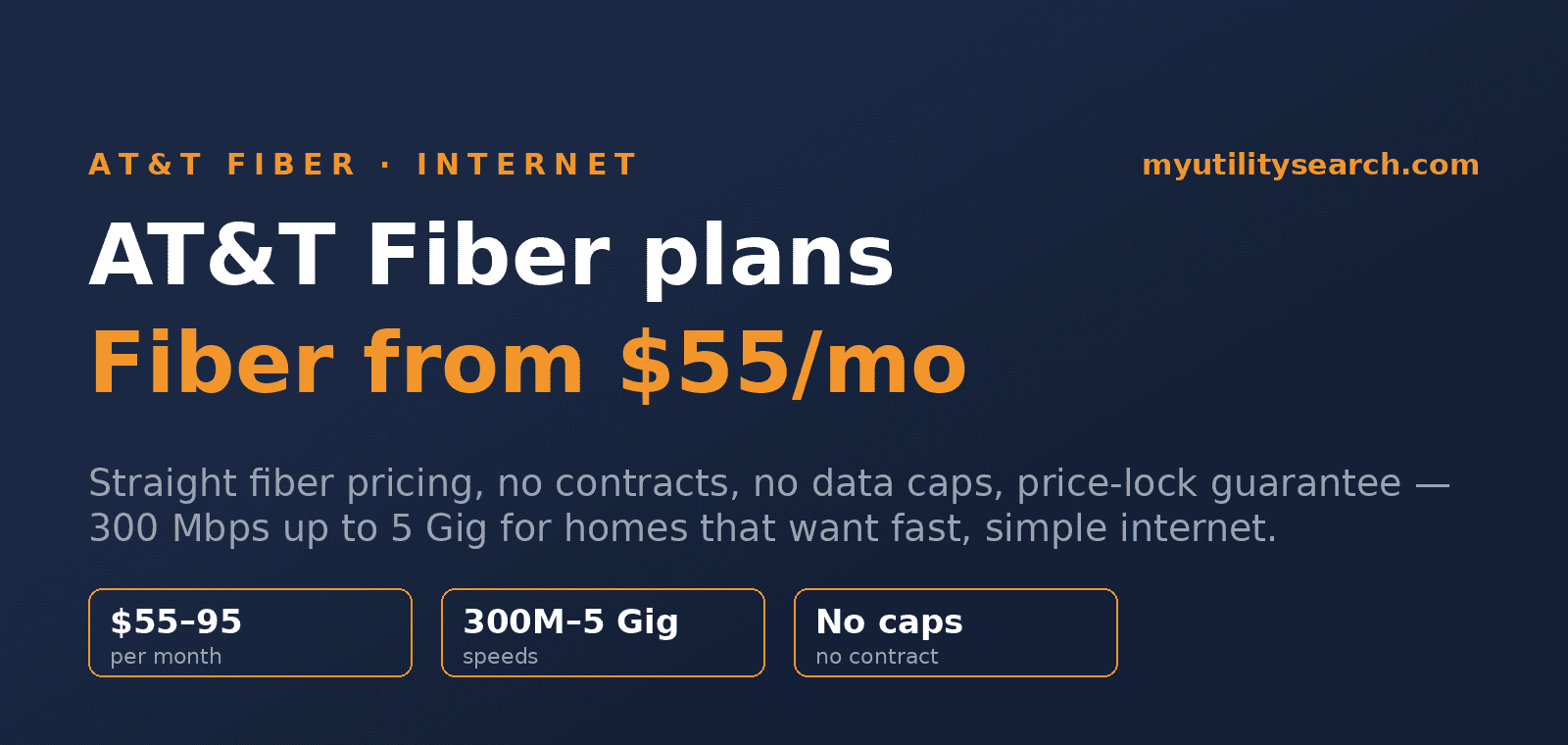
The best AT&T Fiber plan for most homes is Internet 500 at $65/mo — enough speed for a busy household without paying for a full gig. AT&T Fiber plans run from $55/mo for 300 Mbps up to $95/mo for 5 Gig, and every tier comes with no annual contract, no data caps, a price-lock guarantee, and a Wi-Fi gateway included. Below we compare all four AT&T Fiber plans, explain which speed you actually need, break down availability and installation, and lay out where AT&T Fiber beats cable — plus how bundling with AT&T wireless drops the price.
AT&T Fiber plans and pricing (2026)
AT&T sells four straightforward fiber speed tiers, all on symmetrical fiber, meaning upload speeds match download. Here is the full AT&T Fiber plans lineup for 2026:
| Plan | Price | Speed (down/up) | Best for |
|---|---|---|---|
| Internet 300 | $55/mo | 300 / 300 Mbps | 1-3 people, streaming & browsing |
| Internet 500 | $65/mo | 500 / 500 Mbps | Most households — the value pick |
| Internet 1 Gig | $80/mo | 1,000 / 1,000 Mbps | Heavy use, big families, WFH |
| Internet 5 Gig | $95/mo | 5,000 / 5,000 Mbps | Power users, large smart homes |
Every one of these AT&T Fiber plans includes unlimited data, no term contract, an included gateway, and AT&T’s price-lock guarantee, which holds your monthly rate steady instead of jumping after a promo period. Bundle any tier with an AT&T wireless plan and the price drops — the 1 Gig plan, for example, can fall to around $60/mo, and entry pricing with a qualifying bundle can reach as low as $35/mo. That price-lock is a real differentiator: most cable providers advertise a low promo rate that climbs sharply after 12 months, while AT&T Fiber holds steady.
Which AT&T Fiber plan is best for you?
Speed needs come down to how many people and devices share the connection. Internet 300 comfortably handles a couple of people streaming, video calls, and browsing. Internet 500 is the sweet spot for most families — enough headroom for 4K streaming on several screens plus work-from-home traffic, without overpaying. Internet 1 Gig makes sense for large households, frequent large uploads, or homes with many smart devices, while Internet 5 Gig is overkill for almost everyone except serious power users and creators moving huge files daily. Because all AT&T Fiber plans are symmetrical, even the entry tier uploads far faster than comparable cable, which matters for video calls, cloud backups, and streaming to others.
Stat: Every AT&T Fiber plan is symmetrical — a 300 Mbps plan uploads at 300 Mbps, versus roughly 10-35 Mbps upload on similarly priced cable internet.
AT&T Fiber vs. cable internet
Where it is available, fiber generally beats cable on upload speed, latency, and reliability. Here is how AT&T Fiber stacks up against typical cable service:
| Feature | AT&T Fiber | Typical cable |
|---|---|---|
| Upload speed | Symmetrical (up to 5,000 Mbps) | 10-35 Mbps on most tiers |
| Data caps | None | Often 1.2 TB |
| Contract | None | Sometimes required |
| Price lock | Yes, guaranteed | Promo rate then increase |
| Availability | Fiber footprint only | Very wide |
The catch is availability: AT&T Fiber only reaches addresses inside its fiber build-out. If your home is covered, the AT&T Fiber plans are among the best value in home internet. If not, cable or 5G home internet may be your realistic options.
AT&T Fiber availability, installation, and fees
AT&T Fiber covers a growing footprint across more than 20 states, concentrated in metro and suburban areas AT&T has wired for fiber — but coverage is street-level, so two neighbors can have different options. Professional installation is typically included or low-cost: a technician runs the fiber to your home and sets up the included gateway, usually within a week or two of ordering. There are no equipment-rental fees on the standard gateway, no data-cap overages, and no early-termination fees, because none of the AT&T Fiber plans require a contract. If you move, AT&T Fiber can usually transfer with you as long as the new address sits inside the fiber footprint. Before ordering, run an address check — it is the only way to confirm the exact speed tiers and price available at your specific home.
Is AT&T Fiber worth it?
For most households that can get it, yes. The combination of symmetrical speed, no data caps, no contract, and a genuine price-lock guarantee makes AT&T Fiber one of the strongest values in home internet, and it consistently earns high marks in customer-satisfaction studies. The main reasons to hesitate are availability — fiber has to physically reach your address — and the fact that the top 5 Gig tier is far more speed than a typical home will ever use. For the average family, Internet 500 delivers the best balance of speed and price among the AT&T Fiber plans. If you already have AT&T wireless, the bundle discount makes fiber even harder to beat; if fiber is not offered at your address, compare 5G home internet and cable before deciding.
What real customers say about AT&T Fiber
AT&T Fiber consistently tops the industry in customer satisfaction. It leads the fiber segment with an ACSI score of 79 and a #1 ranking four years running, and J.D. Power named AT&T #1 for residential wired internet in its North Central and West regions in 2025. Here is the sentiment behind those scores, drawn from customer reviews and forums:
What customers praise:
- Fast, symmetrical speeds that actually match the advertised numbers.
- No data caps and no contracts across the AT&T Fiber plans.
- A reliable connection with strong day-to-day uptime.
Common gripes:
- Periodic price increases (recent bumps around $5/mo) and trimmed autopay or paperless discounts.
- Occasional outages that sting more given the premium price.
- Fiber simply is not available at every address, so many shoppers cannot get it even when they want to.
The price-lock guarantee on current AT&T Fiber plans is the company’s direct answer to those increase complaints — worth confirming your exact rate terms at sign-up.
Enter your ZIP or address to check AT&T Fiber availability and compare its plans against every other provider at your home — side by side on price and speed.
Compare providers at my address →
Frequently asked questions about AT&T Fiber plans
How much do AT&T Fiber plans cost?
AT&T Fiber plans range from $55/mo for 300 Mbps to $95/mo for 5 Gig, with 500 Mbps at $65/mo and 1 Gig at $80/mo. Bundling with AT&T wireless can lower the price to as little as $35/mo.
Do AT&T Fiber plans have data caps or contracts?
No. Every AT&T Fiber plan includes unlimited data with no annual contract, plus a price-lock guarantee and a Wi-Fi gateway at no extra charge.
Are AT&T Fiber plans symmetrical?
Yes. Upload speeds match download speeds on all tiers, so a 1 Gig plan delivers roughly 1,000 Mbps in both directions — a major advantage over cable.
Which AT&T Fiber plan is best?
For most homes, Internet 500 ($65/mo) is the best value. Choose Internet 300 for light use, or 1 Gig if you have a large household or heavy upload needs.
Is AT&T Fiber available at my address?
AT&T Fiber is only available inside its fiber footprint. Check your address to confirm availability, since the same street can have fiber on one block and not another.
Keep going
- Best fiber internet near me — find fiber from every provider at your address.
- Best 5G home internet — the wireless alternative if fiber is not available.
- Fiber vs. cable vs. 5G — how the three home-internet types compare.
- Best internet for working from home — why upload speed matters for remote work.
- Best cheap internet — the lowest-price plans from every provider.
- AT&T Fiber availability, footprint & market guide
Methodology: pricing and speeds are compiled from AT&T’s published fiber plans as of July 2026 and vary by address and promotion. Always confirm the current offer and availability at your address before ordering.