Blog
Best Internet for Streaming: Speed & Picks

Updated on October 1, 2026
6 min read
The best internet for streaming is any reliable plan that delivers about 25 Mbps of download speed per simultaneous 4K stream — so a 100–300 Mbps fiber or cable plan handles most homes with room to spare. Consistency matters more than a huge headline speed: a steady 200 Mbps fiber line streams 4K better than a congested “gig” connection that slows every evening.
Key takeaways
How much internet speed do I need for streaming?
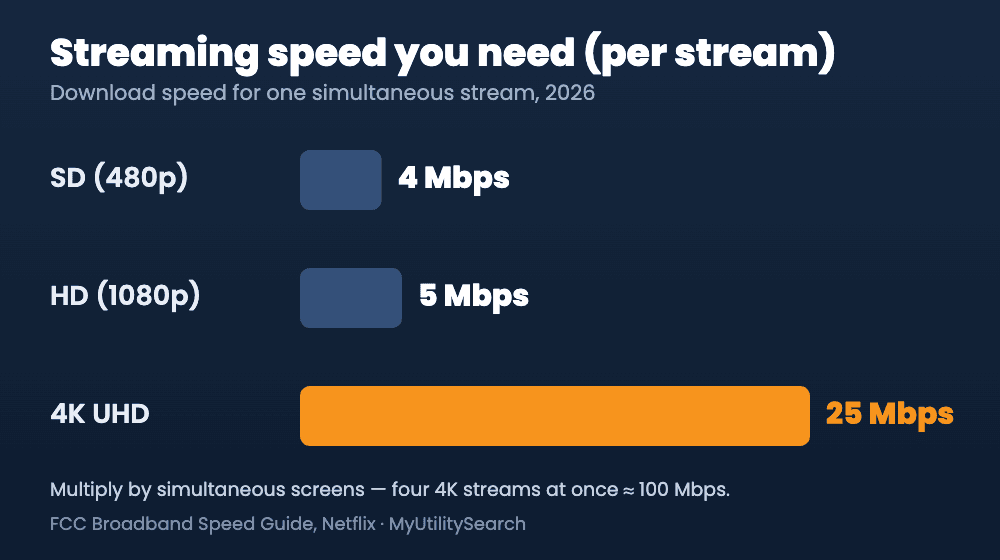
You need about 25 Mbps of download for each 4K stream running at the same time, and roughly 5 Mbps per HD stream. Those are the numbers the streaming services themselves publish, so plan around your busiest moment — the evening when several screens are on at once — not your quietest.
| Video quality | Recommended download per stream | Source |
|---|---|---|
| SD (480p) | 3–4 Mbps | FCC Broadband Speed Guide |
| HD (1080p) | 5 Mbps | Netflix / YouTube |
| 4K UHD (Netflix) | 15 Mbps | Netflix |
| 4K UHD (YouTube) | 20 Mbps | YouTube |
| 4K UHD (Disney+) | 25 Mbps | Disney+ |
Stat block: Netflix recommends 15 Mbps for Ultra HD, YouTube recommends 20 Mbps for 2160p, and Disney+ recommends 25 Mbps for 4K — so 25 Mbps per stream is the safe planning number that covers every major app. (Netflix, YouTube, Disney+)
Definition — “speed per stream”: The download bandwidth one screen uses while playing video. Add up every screen that streams at the same time to size your plan. Four TVs each playing 4K at once ≈ 100 Mbps of the busy-hour demand, not your whole plan.
What is the best internet for streaming by provider?
The best internet for streaming is a fiber plan where you can get one, because fiber delivers symmetrical speeds and the steadiest performance at peak hours. Where fiber isn’t available, cable streams 4K well, and 5G home internet is a solid no-fiber fallback. The table below compares leading providers on the plan most streaming households actually buy.
| Provider | Type | Starting plan (speed / price*) | Data cap | Best for |
|---|---|---|---|---|
| AT&T Fiber | Fiber | 300 Mbps / $35 mo | None | Best-value fiber |
| Frontier Fiber | Fiber | 500 Mbps / $44.99 mo | None | Symmetrical upload |
| Verizon Fios | Fiber | 300 Mbps / $59.99 mo (less with mobile) | None | Northeast fiber |
| Google Fiber | Fiber | 1 Gig / $70 mo | None | Symmetrical gigabit |
| Xfinity | Cable | 300 Mbps / $40 mo | Unlimited on new plans | Wide availability |
| Spectrum | Cable | 100 Mbps / $30 mo | None | No-contract cable |
| T-Mobile 5G Home | Fixed wireless | 133–415 Mbps / $50 mo | No hard cap | No fiber or cable |
*Starting/promotional prices with autopay as of August 2026; actual price, speed, and availability depend on your address. Verify on the provider’s page before you buy.
For most streamers, AT&T Fiber’s 300 Mbps plan is the sweet spot on price and reliability where it’s available; Spectrum is the easiest no-contract cable option; and T-Mobile 5G Home Internet is the pick when neither fiber nor cable reaches you.
Best internet for streaming, by household size
The best internet for streaming scales with how many 4K screens run at once, so match your plan to your busy hour, then add headroom for game downloads, video calls, and smart‑home devices.
- 1–2 people, one 4K TV: 100 Mbps is plenty.
- Family with two 4K TVs: 200–300 Mbps covers two simultaneous 4K streams plus phones and laptops.
- Large household, 3+ 4K TVs: 500 Mbps–1 Gig keeps multiple streams and gaming smooth.
- Creators who stream out (Twitch/YouTube Live): choose fiber for its fast, symmetrical upload.
What is the cheapest internet for streaming?
The cheapest reliable internet for streaming is usually Spectrum’s 100 Mbps plan at about $30/month or AT&T Fiber’s 300 Mbps plan at about $35/month where fiber is available — both stream multiple 4K screens without a data cap. Avoid the temptation to over-buy: a 200–300 Mbps plan streams 4K to several TVs at once, so a gigabit plan is only worth it for very large households or heavy gaming. When you price options, compare the all-in cost — base rate plus any equipment fee and the price after the promo period ends — because a slightly higher fiber plan with no data cap often beats a “cheaper” capped plan once overages are counted.
Does download or upload matter more for streaming?
For watching video, download speed is what matters — every per-stream number above is a download figure. Upload only becomes important when you send video the other direction: livestreaming, video calls, or uploading large files. If your household does a lot of that, fiber’s symmetrical upload is worth paying for; pure viewers can ignore upload.
Wired vs. Wi-Fi for streaming
A wired Ethernet connection to your main TV, streaming box, or console gives the most consistent, lowest-latency playback because it avoids the interference and signal drop-off that cause Wi‑Fi buffering. If running a cable isn’t practical, put your router in the open near your most-used screens and consider a mesh system for large homes.
Stat block: Streaming reached 48.6% of total U.S. TV viewing in May 2026, more than cable and broadcast combined, per Nielsen’s The Gauge — so your internet plan, not your cable box, is now the backbone of home entertainment. (Nielsen)
Is your plan keeping up?
Compare the real plans and prices available at your address in about a minute.
Compare internet, energy & home security at your address
Frequently asked questions
What is the best internet for streaming?
The best internet for streaming is a reliable fiber plan around 300 Mbps, such as AT&T Fiber or Frontier Fiber, because fiber delivers steady speeds at peak hours. Where fiber isn’t available, a 300 Mbps cable plan (Xfinity, Spectrum) or T-Mobile 5G Home Internet also streams 4K well.
How much internet speed do I need for 4K streaming?
Budget about 25 Mbps of download per 4K stream. Netflix recommends 15 Mbps, YouTube 20 Mbps, and Disney+ 25 Mbps for Ultra HD, so 25 Mbps per simultaneous 4K screen covers every major app.
Is 100 Mbps enough for streaming?
Yes. A 100 Mbps plan comfortably handles two to three 4K streams at once plus everyday browsing. Larger households running several 4K TVs, downloads, and gaming at the same time are better on 300–500 Mbps.
Does streaming need fast upload?
No. Watching video is almost entirely a download activity. Fast upload only matters if you livestream, make frequent video calls, or upload large files — in which case fiber’s symmetrical speeds help.
Is fiber or cable better for streaming?
Both stream 4K well. Fiber offers faster upload and more consistent speeds during busy evening hours, while cable is widely available and priced competitively. Pick fiber if it reaches your address; otherwise cable is a strong choice.
Do data caps affect streaming?
They can. Heavy 4K streaming uses a lot of data, and a few providers still cap usage. Most fiber plans and new cable plans are now uncapped — see how internet data caps and overage fees work before you commit.
Compare internet, energy & home security at your address