Blog
Deregulated Electricity States: Why Shopping Your Rate Is the Best Way to Beat Rising Bills in 2026

If your power bill keeps creeping up, you’re not imagining it. The U.S. residential electricity rate hit 17.65¢ per kilowatt-hour in early 2026 — up roughly 17% in just four years. But here’s what most households miss: if you live in one of the deregulated electricity states, you don’t have to accept your utility’s default rate. You can shop competing suppliers and lock in a lower price, the same way you’d compare internet or insurance. This guide breaks down what every state pays, which states let you choose, and how to turn that choice into real savings.
The 30-second version: The national residential average is 17.65¢/kWh (EIA, Feb 2026), ranging from about 11.64¢ in North Dakota to roughly 43¢ in Hawaii. In deregulated electricity states like Texas, Ohio, Pennsylvania, and Massachusetts, you can switch suppliers to beat your area’s default rate — often the single biggest lever on your bill.
What the average electricity rate looks like across the country
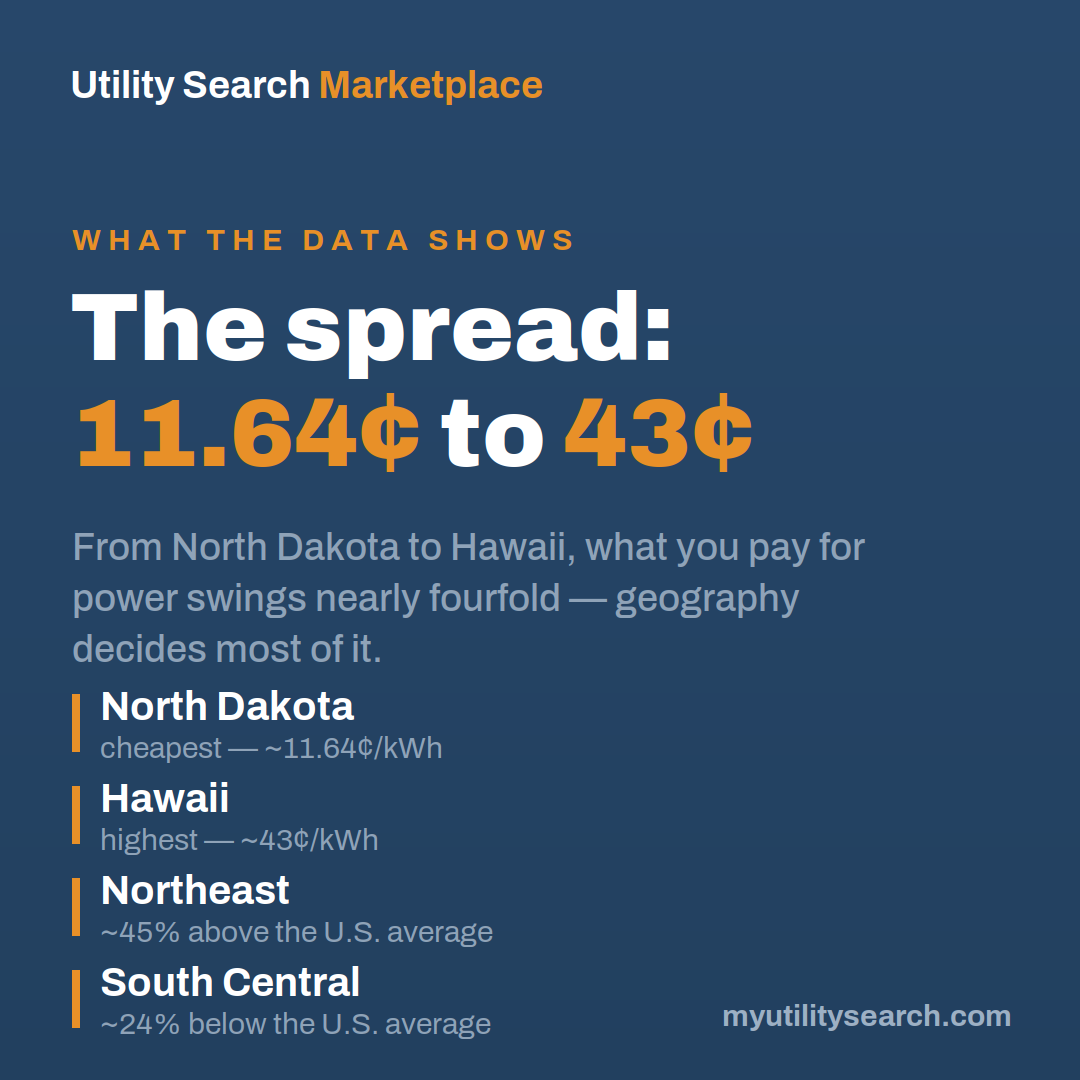
Electricity prices vary more than almost any other household cost. According to the U.S. Energy Information Administration (EIA), the gap between the cheapest and most expensive states is nearly fourfold. Geography is the single biggest predictor of what you pay — states with abundant hydro, wind, or natural gas tend to sit well below the national average, while island and import-dependent grids sit far above it. Electricity isn’t the only deregulated fuel, either — Georgia’s natural gas choice program lets households shop their gas supplier the same way.
Rate snapshot — EIA, February 2026 (residential):
- National average: 17.65¢/kWh
- Lowest: North Dakota ~11.64¢/kWh
- Highest: Hawaii ~43¢/kWh
- Northeast region runs ~45% above the national average; the South Central region ~24% below it.
Why electricity rates keep climbing
The steady increase isn’t random. Three forces are pushing rates up across nearly every market:
- Fuel and infrastructure costs — natural gas price swings flow straight through to your rate, and utilities are investing heavily in “hardening” the grid against extreme weather.
- Surging demand — record data-center construction and electric-vehicle adoption are driving electricity consumption to new highs, tightening supply.
- Delivery fees — much of the increase shows up not in the energy itself but in the rising delivery charges on your bill.
That demand story matters for shoppers: as wholesale pressure builds, the spread between a default “price to compare” and a competitively shopped rate tends to widen — which makes choosing a supplier more valuable, not less.
Which are the deregulated electricity states?
In a regulated state, one utility handles everything and your rate is set by regulators — there’s nothing to shop. In deregulated electricity states, the market is split: your local utility still delivers the power and fixes outages, but you choose which supplier sells you the electricity itself. That’s where competition can lower your rate.
States with meaningful residential retail choice include Texas, Ohio, Pennsylvania, Illinois, Massachusetts, New Jersey, New York, Maryland, Connecticut, Maine, Rhode Island, New Hampshire, Delaware, and the District of Columbia, among others.
Important honesty check: “Deregulated by law” does not always mean “you can choose where you live.” Several states only offer retail choice in certain utility territories or under specific conditions. Always confirm choice is available at your address before assuming you can switch. Your state’s public utility commission is the authority on this.
The Texas example: what choice actually does
Texas is the clearest case. Its competitive ERCOT market has more than 100 retail providers, and that competition keeps prices notably low — Texas commercial rates run roughly 10% below the national average. The tradeoff is real, though: variable-rate plans can spike during extreme weather, so the headline “average” hides genuine volatility. The takeaway isn’t “Texas is cheap” — it’s “in a competitive market, the plan you pick matters as much as where you live.”
How to lower your electric bill in a deregulated state
If you can choose your supplier, here’s the order of operations that saves the most:
- Shop your supply rate first. This is the biggest lever. Compare offers against your utility’s default “price to compare” and switch if a competing fixed rate beats it.
- Lock in a fixed rate when prices are low. A 12-month fixed plan protects you from seasonal spikes; spring and fall typically bring more competitive offers than peak summer or winter.
- Then reduce usage to compound the savings. LED bulbs, a smart thermostat, and sealing air leaks can cut consumption 10–25%. At 17¢/kWh, trimming 200 kWh a month saves over $400 a year.
- Check for time-of-use rates. Running laundry and the dishwasher after peak hours can shave a few cents per kWh off those loads.
Paying Too Much for Electricity?
Rates change constantly, and loyalty rarely pays. Compare electricity plans available at your address — fixed-rate, variable, and green options, side by side.
Frequently asked questions
What does it mean to live in deregulated electricity states?
It means the electricity market in your state is open to competition: your utility still delivers power and handles outages, but you can choose a separate supplier for the energy itself — and shopping that supplier is how you lower your rate.
Will switching suppliers in a deregulated state interrupt my power?
No. The physical delivery doesn’t change — the same utility maintains the lines and responds to outages. Only the company you buy your energy from changes, so there’s no interruption when you switch.
How much can I actually save by shopping my rate?
It depends on your state’s default rate and current market offers, but supply is typically the largest controllable part of your bill. Comparing plans before your contract renews is the highest-impact step in deregulated electricity states.
How do I know if my address qualifies for electricity choice?
Confirm with your state’s public utility commission or a comparison tool that checks by ZIP code, since choice can be limited to certain utility territories even within a deregulated state.
The bottom line
Rising prices are largely out of your hands — but in deregulated electricity states, your rate isn’t. Shopping your supplier is the fastest way to push back against the climb, and pairing a competitive fixed rate with lower usage compounds the savings. Start by checking whether choice is available at your address, then compare offers against your utility’s default rate.
Sources: U.S. Energy Information Administration (Electric Power Monthly, Feb 2026 release). Rates update monthly; figures current as of the February 2026 EIA data.
By the MyUtilitySearch team