Blog
Payless Power Review 2026: Prepaid Plans, Deposits & Is It Good?


Updated on September 29, 2026
14 min read
Payless Power is a Fort Worth–based Texas electricity provider best known for prepaid, no-deposit, no-credit-check service, and it also sells cheaper postpaid plans to customers who pass a credit check. On a live Oncor-territory quote pulled September 21, 2026, Payless Power prepaid plans cost 18.6¢–18.7¢ per kWh at 1,000 kWh a month, while its postpaid plans cost 15.3¢–15.6¢. That gap is the real price of skipping a deposit: about $32 a month for a typical home.
Last updated September 21, 2026 · Prices pulled from a live account.paylesspower.com enrollment quote for ZIP 75078 (Prosper, TX — Oncor delivery). 12-month prepaid Electricity Facts Label effective September 13, 2026.
TL;DR — key takeaways
- Who: Young Energy LLC, doing business as Payless Power, a Texas retail electric provider (REP #10110) founded in 2005 and headquartered in Fort Worth.
- Plans at ZIP 75078: two prepaid plans (6 and 12 months) and four postpaid plans (6, 12, 24 and 36 months), all fixed-rate. No indexed or variable plans.
- Prepaid price: 18.6–18.7¢/kWh at 1,000 kWh ($186–$187 a month). The advertised 17.1–17.2¢ is the 2,000-kWh price.
- Postpaid price: 15.3–15.6¢/kWh at 1,000 kWh ($153–$156 a month) — cheaper than TXU Energy’s Simple Rate 12 (16.6¢) at the same ZIP on the same day.
- The trade-off: prepaid costs about $1 more a month at 500 kWh, about $32 more at 1,000 kWh and about $64 more at 2,000 kWh than the matching postpaid plan.
- Prepaid fine print (EFL): $0.85 daily charge, a $15 monthly credit only at 500 kWh or less, 9.7¢ energy charge, $49 early termination fee on the 12-month plan.
- Prepaid rules (disclosure statement): up to $75 to open the account, $20 minimum payment, a $4.95 fee on payments under $75 (waived on autopay), a $30 reconnection fee, and disconnection once the balance drops below $0.
What is Payless Power?
Payless is a retail electric provider (REP) in the deregulated Texas market. Like every Texas REP, it buys wholesale power and sells it to homes, while your local utility — Oncor, CenterPoint or AEP Texas — owns the poles and wires, reads the meter and restores outages. Payless’s niche is customers who want to avoid a deposit or a credit check, which it serves with pay-as-you-go prepaid electricity.
It is not a prepaid-only company. Payless also sells traditional postpaid plans with a monthly bill and no deposit for customers with approved credit. Its enrollment page says that if a postpaid applicant would owe a deposit, the company steers them to a prepaid plan instead. Payless says it serves more than 400 deregulated Texas communities.
Payless Power rates and plans (September 2026)
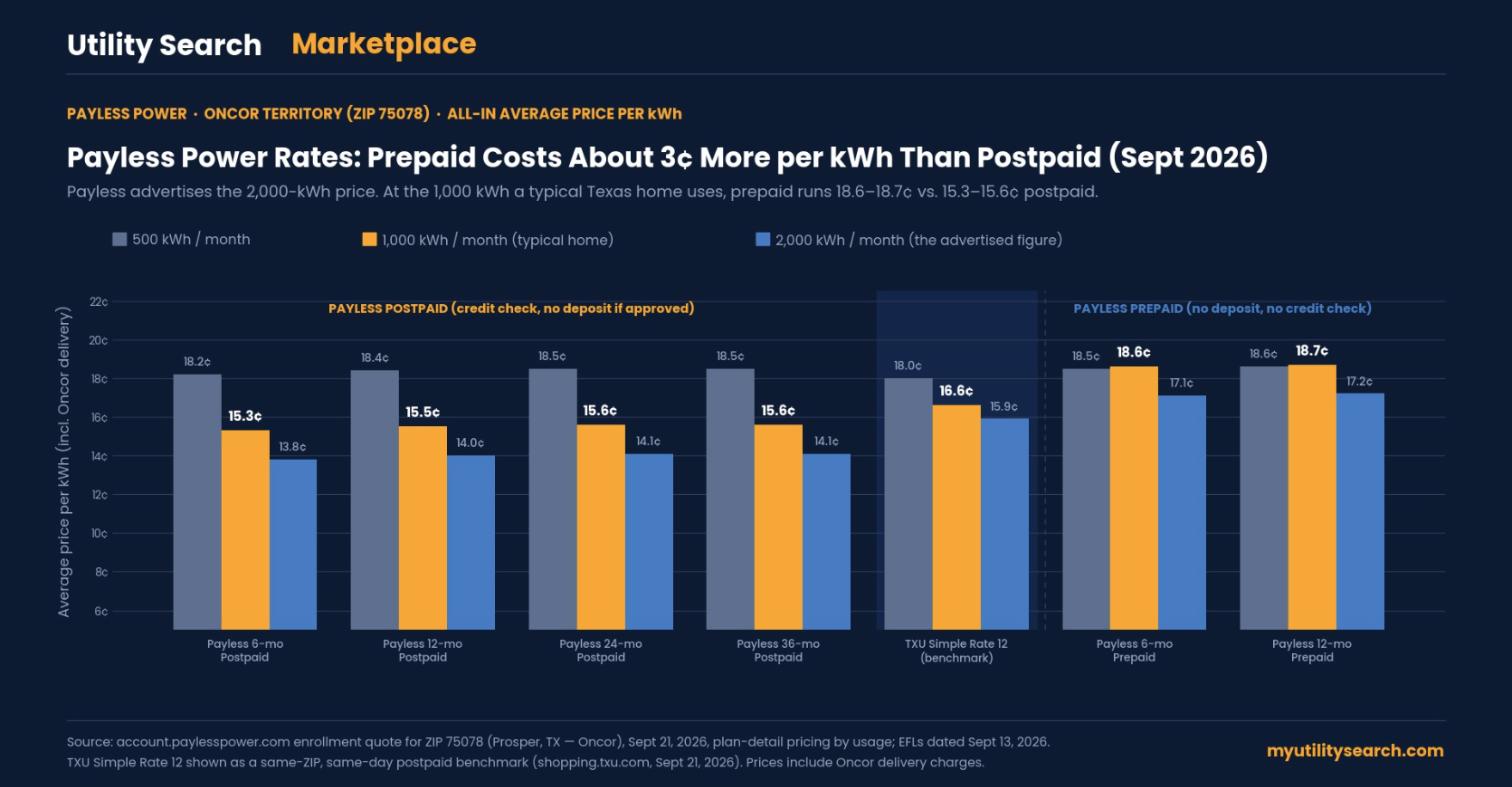
These are every Payless residential plan offered for ZIP 75078 on September 21, 2026, with the average all-in price at three usage levels from each plan’s detail panel. Prices include Oncor delivery charges.
| Plan | Type | Term | 500 kWh | 1,000 kWh | 2,000 kWh | Bill at 1,000 kWh |
|---|---|---|---|---|---|---|
| 6 Month – Postpaid | Postpaid, fixed | 6 months | 18.2¢ | 15.3¢ | 13.8¢ | $153 |
| 12 Month – Postpaid (recommended) | Postpaid, fixed | 12 months | 18.4¢ | 15.5¢ | 14.0¢ | $155 |
| 24 Month – Postpaid | Postpaid, fixed | 24 months | 18.5¢ | 15.6¢ | 14.1¢ | $156 |
| 36 Month – Postpaid | Postpaid, fixed | 36 months | 18.5¢ | 15.6¢ | 14.1¢ | $156 |
| 6 Month – Prepaid | Prepaid, fixed | 6 months | 18.5¢ | 18.6¢ | 17.1¢ | $186 |
| 12 Month – Prepaid (recommended) | Prepaid, fixed | 12 months | 18.6¢ | 18.7¢ | 17.2¢ | $187 |
The plan cards on the Payless site show only the 2,000-kWh price — 17.2¢ and 17.1¢ for prepaid, 13.8¢ to 14.1¢ for postpaid. Most Texas homes use 850–1,150 kWh a month, so the 1,000-kWh column is the one to compare.
What happens when you check a real Payless Power address?
To see what Payless actually costs, we entered ZIP 75078 on the Payless enrollment page on September 21, 2026 and opened the detail panel for every plan. Here is what the quote showed beyond the headline numbers.
| What the ZIP 75078 quote showed | Detail |
|---|---|
| Plans offered | Two prepaid (6 and 12 months) and four postpaid (6, 12, 24 and 36 months). The 12-month plan was marked “Recommended” in both groups. |
| Advertised price | Every plan card shows the 2,000-kWh average, with a footnote: “2,000 kWh Price Displayed.” |
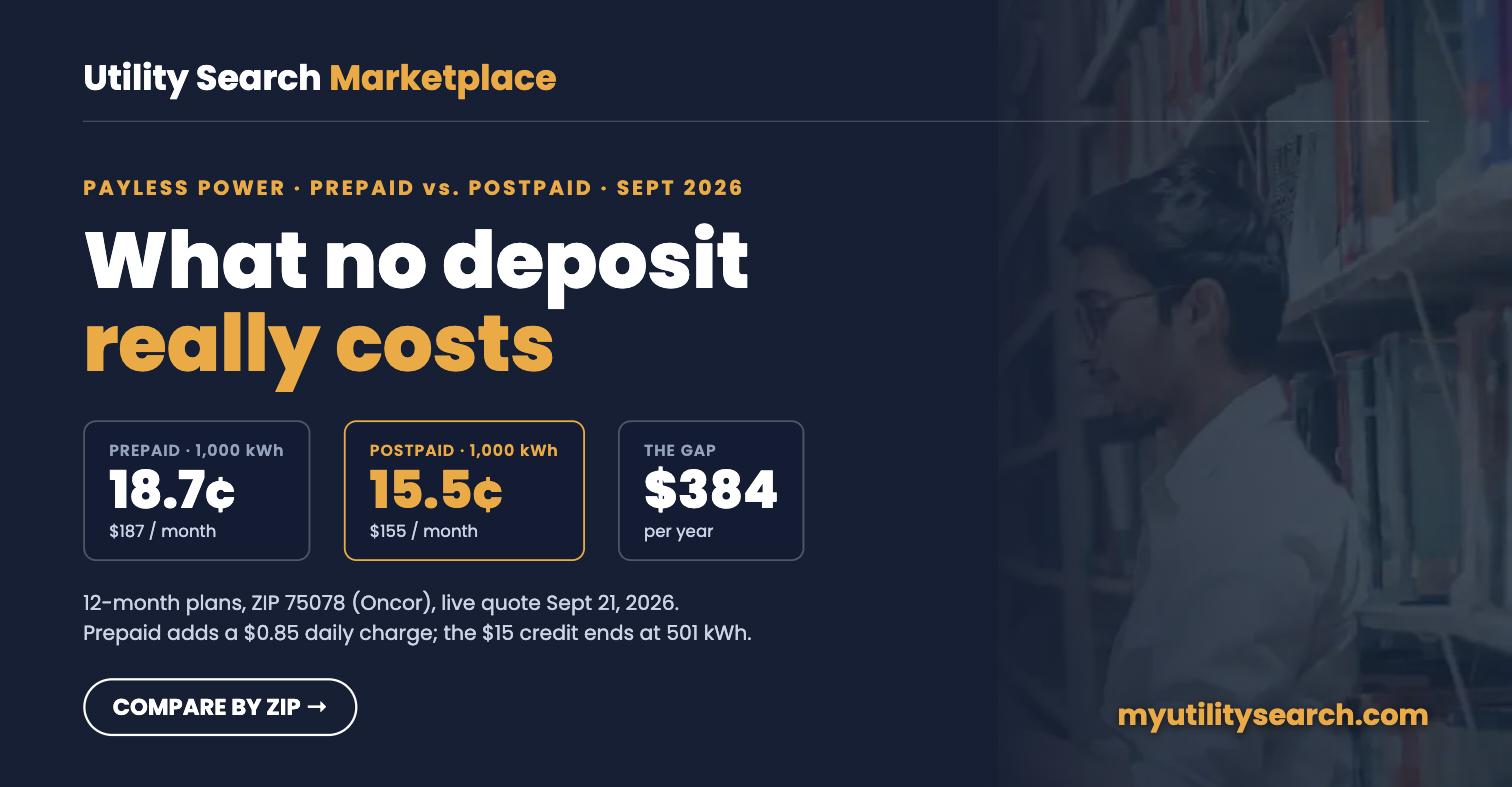
| Prepaid vs. postpaid at 1,000 kWh | $187 vs. $155 on the 12-month plans — $32 a month, or $384 a year, more for prepaid. |
| Prepaid vs. postpaid at 500 kWh | $93 vs. $92 — essentially the same price for a small apartment. |
| Prepaid vs. postpaid at 2,000 kWh | $344 vs. $280 — $64 a month more for prepaid. |
| How prepaid billing works | Payless debits your balance each day for usage from two days earlier and sends a daily text or email with kWh used, balance and the estimated days until you need to pay. |
| Statements | Free month-end statement on prepaid showing the prior month’s cost and average rate. Paper bills are not available on prepaid. |
| Deposit and credit | Prepaid: no deposit, no credit check. Postpaid: no deposit with approved credit. |
| Rate type | All six plans are fixed-rate. Payless says it does not sell indexed plans whose prices move through the day. |
| Early termination fee | $49 on the 12-month prepaid plan, per its EFL. |
| Documents | Each plan links an Electricity Facts Label, Terms of Service, Your Rights as a Customer and, for prepaid, a Prepaid Disclosure Statement. |
What the Payless Power prepaid Electricity Facts Label says
The Electricity Facts Label (EFL) for the 12 Month – Prepaid plan in Oncor territory, effective September 13, 2026, breaks the price into five parts. Every average price on the plan card can be rebuilt from these lines.
| EFL line (12 Month – Prepaid, Oncor) | Amount |
|---|---|
| Daily charge | $0.85 per day (about $25.50 in a 30-day month) |
| Monthly credit | $15.00 off when usage is 500 kWh or less (prorated if under 30 days) |
| Energy charge | 9.7¢ per kWh |
| Oncor delivery charge | 6.0295¢ per kWh, passed through |
| Oncor monthly charge | $4.06 per month, passed through |
| Contract term / type | 12 months, fixed price |
| Early termination fee | $49 |
| Renewable content | 23.9% (statewide average: 37.2%) |
Run the math at 1,000 kWh and you get $25.50 + $4.06 + (1,000 × 15.73¢) = $186.86, or 18.7¢ per kWh — exactly the plan-card figure. At 2,000 kWh it is $344.15 (17.2¢). Every kWh you use costs about 15.7¢ once delivery is added, and the $0.85 daily charge adds roughly $310 a year no matter how little power you use.
The 500-kWh credit cliff
The $15 credit is why prepaid looks cheap at 500 kWh and expensive at 1,000. At exactly 500 kWh the bill works out to about $93.21. Use 501 kWh and the credit disappears, so the bill jumps to about $108.37 — $15 more for one extra kWh. It is the same kind of cliff we found on TXU Energy’s usage-credit plans, just at the low end instead of the high end.
That credit also explains the postpaid comparison. Payless’s postpaid prices rise only about 12.4¢ for each extra kWh, which implies an energy charge a few cents below prepaid’s 9.7¢. We have not seen the postpaid EFL, so treat that as our reading of the price table; the prepaid numbers above come straight from the label.
Prepaid vs. postpaid at Payless: which should you pick?
If you can pass a credit check, Payless’s postpaid plans are the better deal for almost every household. The 12-month postpaid plan saved $32 a month over the 12-month prepaid plan at 1,000 kWh, and it beat TXU Energy’s plainest 12-month plan by $11 a month at the same ZIP on the same day.
Prepaid makes sense in three situations. First, if a deposit would otherwise be required — Texas providers commonly ask for one when credit is thin, and it can run a few hundred dollars. Second, if you live in a small apartment using around 500 kWh, where the premium nearly disappears. Third, if you want daily usage alerts and would rather top up weekly than face a monthly bill. Our guide to no-deposit electricity in Texas compares the other ways around a deposit.
How prepaid electricity works at Payless
Enrollment takes about four minutes online or by phone at 1-866-963-9353, and there is no credit check. Existing customers reach customer service at 1-888-963-9363, Monday through Friday, 9 a.m. to 5 p.m. Central. To open the account, the Prepaid Disclosure Statement requires a connection balance of up to $75; after that, payments must be at least $20. Payless Power says service is typically connected within one to six hours on a smart meter, and same-day connection is available Monday through Saturday when the account is funded before 6:00 PM.
After that, Payless Power deducts your usage from the balance daily, about two days after you use it. You get a daily text or email with your kWh, balance and estimated days of power left. You can top up online, by phone, through autopay, or in cash at MoneyGram locations (receive code 14715). Any payment under $75 carries a $4.95 processing fee unless it comes through autopay, so larger or automatic top-ups are cheaper. A returned or declined payment costs $29.
Payless Power’s “disconnection balance” is $0. Its disclosure says you are warned two days before the balance is expected to go negative, and daily alerts start once fewer than five days of service remain. If usage drains the balance faster than forecast, disconnection can come as little as one day after the low-balance warning.
There is one useful protection in the Terms of Service: if the balance hits zero on a weeknight, a weekend or any time payments and customer service are unavailable, Payless keeps the power on and lets the balance go negative until business hours resume. To reconnect after a disconnection, you pay off any negative balance, bring the account back to a positive balance of up to $75, and pay a $30 reconnection fee that is spread in daily installments. Payless says reconnection typically takes about two hours once paid.
Prepaid service in Texas is governed by the Public Utility Commission of Texas under its prepaid-service rule (§25.498). Under Payless’s disclosure, deferred payment plans are available if a balance reaches −$50 or more during an extreme weather event, when a state of disaster is declared, or if you were underbilled by $50 or more. Prepaid is not available to customers designated Critical Care or Chronic Condition, and it requires a smart meter plus a working phone or email for alerts.
Compare internet, energy & home security at your address
How to lower your Payless bill
Start by asking whether you really need prepaid. If your credit may qualify, apply for a postpaid plan first; at 1,000 kWh that choice alone saves about $384 a year. If you do go prepaid, turn on autopay: it avoids the $4.95 fee on payments under $75 and keeps a missed top-up from turning into a $30 reconnection fee.
Next, compare on the 1,000-kWh price, not the 2,000-kWh price on the plan card. Watch your daily alerts in summer, when air conditioning can push a Texas home past 1,500 kWh and drain a prepaid balance quickly. Finally, you can track your 15-minute usage through Smart Meter Texas, and compare any Payless Power offer against the full market on Power to Choose, the state’s official comparison site.
Is Payless Power legit and a good provider?
Yes. Payless Power is a licensed Texas REP (certificate #10110) that has operated since 2005. It was named a Top 3 Best REP in Texas for 2024 by Texas Electricity Ratings, and it shows a 4.5-star average across more than 14,000 reviews on its own site. Those reviews are collected by the company, so read them alongside independent sources.
The strengths are fast connections, clear daily balance messages, fixed-rate plans only and postpaid pricing that was competitive at our test ZIP. The weaknesses are a prepaid premium that grows with usage, a $0.85 daily charge, a renewable share below the state average, a $4.95 fee on non-autopay payments under $75, no paper bills on prepaid and plan cards that lead with the 2,000-kWh price. For renters who need power fast without a deposit, Payless Power does the job well; for anyone who can pass a credit check, its postpaid plans are the smarter buy.
Where is Payless Power available?
Payless Power serves the deregulated parts of Texas: Oncor territory (Dallas–Fort Worth and much of West and Central Texas), CenterPoint (Houston), AEP Texas Central (Corpus Christi and South Texas) and AEP Texas North (Abilene and nearby). It is not available where electricity is not deregulated, including Austin, San Antonio, El Paso and most rural co-op areas. Prices differ by utility, so enter your own ZIP rather than relying on our Oncor quote.
Who owns Payless Power?
Payless Power is the trade name of Young Energy LLC, a privately held company founded in 2005 by brothers Brandon, Byron and Brian Young. It is headquartered in Fort Worth, Texas.
How to switch, contact or cancel
To switch to Payless Power, enroll online at the Payless site or call 1-866-963-9353; your new provider handles the switch, and you do not need to cancel your old one. If a switch-hold is on the meter, it must be cleared first. Payless says requests made before 1:00 PM on a utility business day are processed by 8:00 PM that day.
To cancel, end service in your myAccount portal or call customer service, and pay any outstanding balance. Payless Power’s FAQ says an early termination fee applies if 15 or more days remain on your contract, unless you provide proof that you moved. On the 12-month prepaid plan the EFL sets that fee at $49; check the label for other terms. You cannot transfer a Payless account to a new address; you open a new account instead.
Payless Power for business: commercial plans through Electric Choice
Payless Power is a prepaid residential provider and does not sell business electricity itself. As of September 28, 2026 its Texas business page hands commercial shoppers to Electric Choice, a comparison platform, with a ZIP-code form and a notice that “you will be leaving Payless Power’s website” to shop fixed-rate or variable-rate business plans from other suppliers. No rates, terms, deposits or eligibility limits are published for business, and the same-day-connection guarantee on this page is residential. A business that wants a prepaid, no-deposit model has no commercial equivalent here; price a fixed 12–24-month contract from the suppliers on our providers page instead.
| Business product | Price | Notes |
|---|---|---|
| Payless Power business electricity | Not sold directly | Referred to Electric Choice’s comparison shop |
| Electric Choice (partner platform) | Quoted by ZIP | Fixed-rate or variable-rate business plans from other suppliers |
| Prepaid / no-deposit for business | Not offered | Residential product only |
Source: the supplier’s own business pages (and NRG Business’s Texas small-commercial terms of service, REP #10011, for the NRG brands), read September 28, 2026. Commercial electricity is priced per meter; treat these as the published starting points.
What a commercial contract adds over the residential plan on this page: a price built from your meter’s 12-month usage and load factor rather than a published rate card, term choices from 12 to 36 months or longer, a base charge and pass-through structure that differ from the residential EFL, and exit terms that scale with the months remaining. Compare every business quote as an all-in price at your real usage — the method is in our cheapest business electricity guide and the supplier field is compared in business electricity providers.
Business shopper? Compare business electricity providers, read how the cheapest business contracts are built, or talk to a commercial specialist.
Payless Power FAQ
How much does Payless Power cost per kWh?
At ZIP 75078 (Oncor) on September 21, 2026, Payless Power prepaid plans cost 18.6–18.7¢ per kWh at 1,000 kWh and postpaid plans cost 15.3–15.6¢. The advertised 17.1–17.2¢ prepaid and 13.8–14.1¢ postpaid prices are 2,000-kWh averages.
Does Payless require a deposit or credit check?
Not for prepaid. Payless Power prepaid plans need no deposit and no credit check. Postpaid plans run a credit check and charge no deposit with approved credit; if a deposit would be due, Payless offers prepaid instead.
Is prepaid more expensive than postpaid at Payless?
Yes, at most usage levels. On matching 12-month plans, prepaid cost about $1 more a month at 500 kWh, $32 more at 1,000 kWh and $64 more at 2,000 kWh on our September 2026 quote.
How does Payless prepaid billing work?
You open the account with a connection balance of up to $75, and Payless Power deducts each day’s usage about two days later. You get a daily text or email showing kWh used, your balance and the estimated days until a payment is needed. Later payments must be at least $20.
What happens if my Payless balance runs out?
Once the balance falls below $0, service can be disconnected as soon as one day after the low-balance warning. To reconnect, you pay any negative balance, restore a positive balance of up to $75 and pay a $30 reconnection fee spread in daily installments.
Does Payless Power disconnect prepaid service on weekends?
Not normally. Payless Power’s Terms of Service say that if your balance hits zero on a weeknight, weekend or when customer service is closed, service stays on and the balance goes negative until business hours resume.
How fast can Payless turn on my electricity?
Usually within one to six hours on a smart meter. Same-day connection is available Monday through Saturday when you fund the account before 6:00 PM; later, Sunday and holiday orders connect the next morning.
Does Payless Power charge a daily fee on prepaid?
Yes. The 12-month prepaid EFL lists a $0.85 daily charge, about $25.50 a month, plus a $15 monthly credit that applies only when you use 500 kWh or less.
Is Payless Power legit?
Yes. Payless Power is the trade name of Young Energy LLC, a PUCT-licensed Texas retail electric provider (REP #10110) based in Fort Worth and operating since 2005.
Is comparing Payless Power on this site free?
Yes. Comparing Payless Power and other Texas providers at your address on myutilitysearch.com is free, and your rate is the same as enrolling direct.
Does Payless Power offer business electricity?
Not directly. As of September 28, 2026 Payless Power refers Texas business shoppers to Electric Choice, a third-party comparison platform, to shop fixed- or variable-rate commercial plans from other suppliers. It publishes no business rates or terms and its prepaid model is residential only.
Compare internet, energy & home security at your address
Sources
- account.paylesspower.com — live enrollment quote and plan-detail pricing for ZIP 75078 (Oncor), September 21, 2026.
- Payless Power Electricity Facts Label, 12 Month – Prepaid, Oncor service area, effective September 13, 2026 (charges, credit, ETF, renewable content).
- Payless Power Prepaid Disclosure Statement (Version 5, May 1, 2026) and Residential Prepaid Terms of Service (Version 15) — connection balance, fees, disconnection and deferred-payment rules.
- paylesspower.com — FAQ, How It Works, Prepaid vs. Postpaid and About Us pages (fees, connection times, company details), accessed September 21, 2026.
- shopping.txu.com — TXU Energy Simple Rate 12 quote for ZIP 75078, September 21, 2026 (benchmark).
- Public Utility Commission of Texas — REP licensing and prepaid service rules.
- Power to Choose — the state’s official electricity plan comparison site.
- Smart Meter Texas — interval usage data for Texas smart meters.
Keep going
- No-deposit electricity in Texas: every way around a deposit
- Utility deposits and credit checks: what providers can ask for
- Does paying utilities build credit?
- TXU Energy review: plans, EFLs and the $100 cliff
- Texas electricity rates by city and utility
- Cheapest electricity in Texas right now
- Waco electricity rates: compare plans in Oncor territory
- 4Change Energy review: Maxx Saver Value vs flat-rate plans
- Reliant Energy review: Prepaid Power vs. fixed plans