Blog
AT&T POTS Line Shutdown: When the Copper Landline Phase-Out Hits You (2026 Timeline)

Updated on September 22, 2026
9 min read
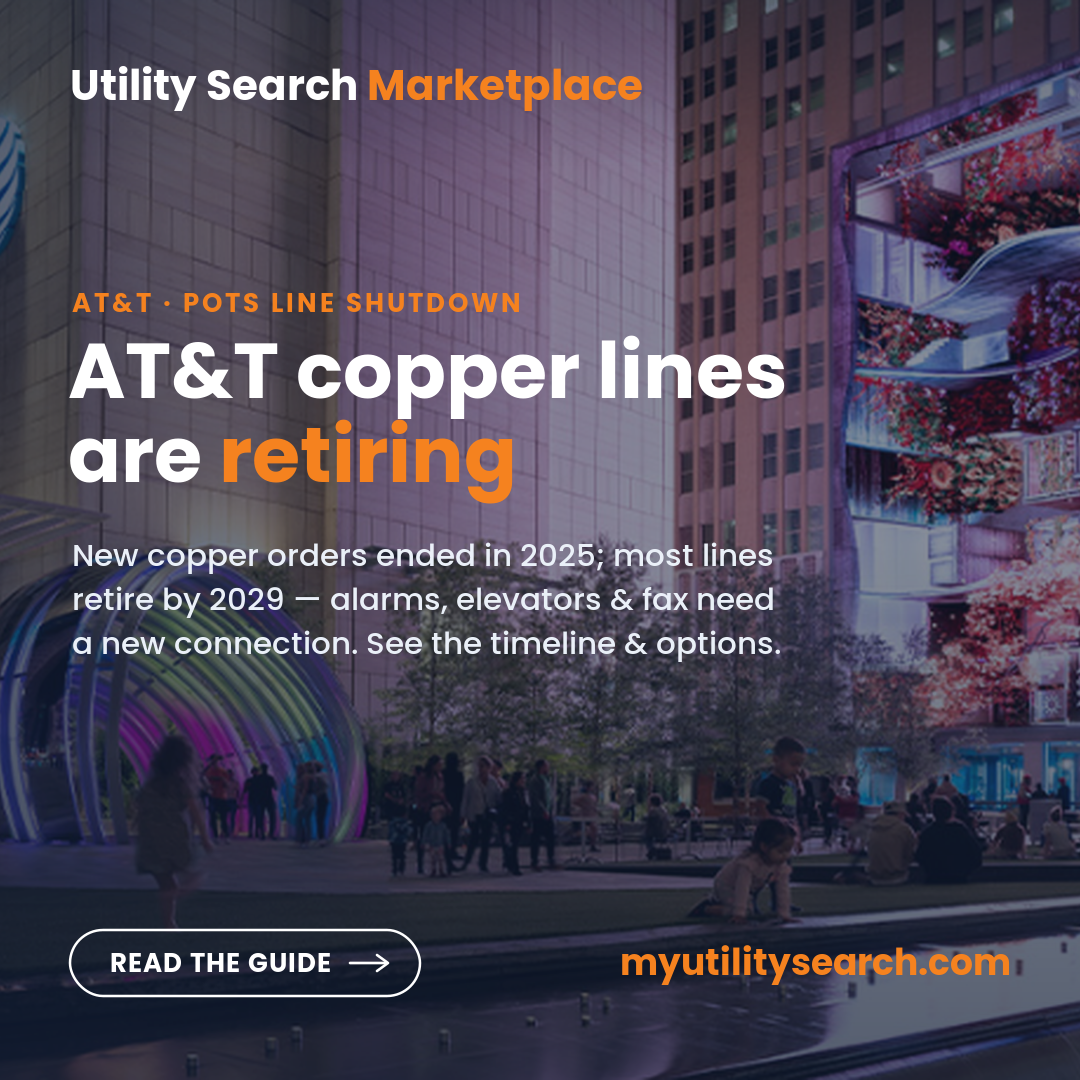
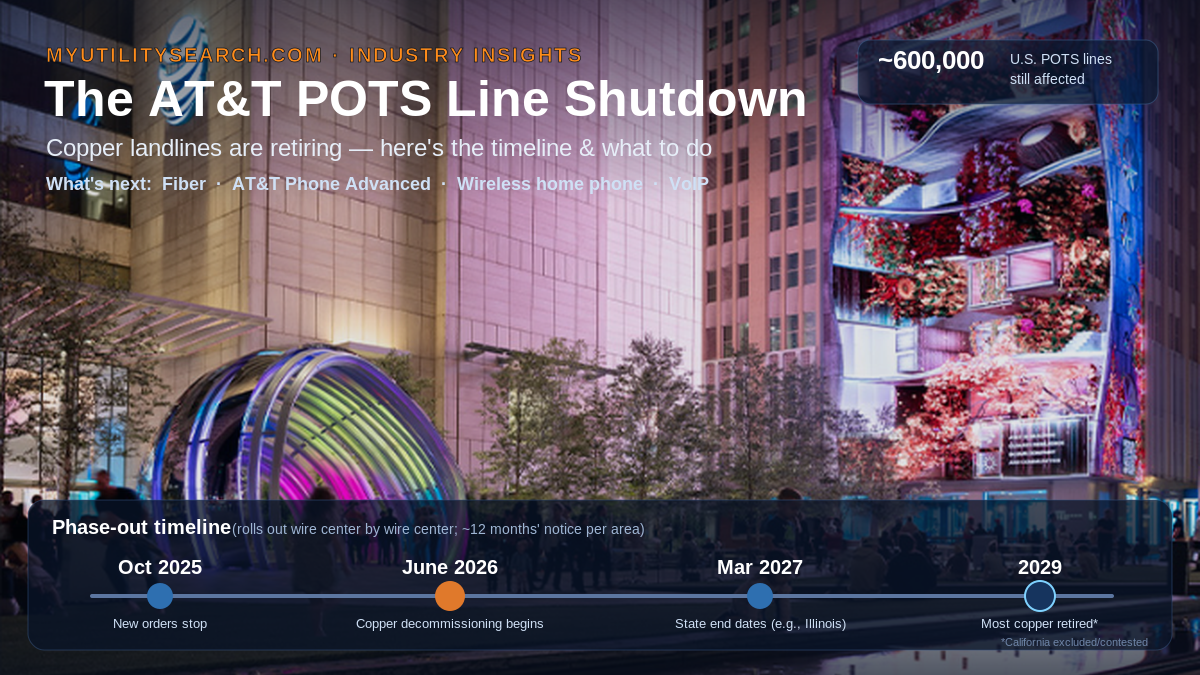
The AT&T POTS line shutdown has already begun. AT&T stopped accepting new copper landline orders on October 15, 2025, begins permanently decommissioning copper in roughly 500 wire centers in June 2026, and plans to retire the large majority of its copper network by the end of 2029. Existing customers are being moved to fiber, wireless, or VoIP — usually with about 12 months’ notice and the option to keep their number.
TL;DR — the AT&T copper landline phase-out at a glance
- Oct 15, 2025 — AT&T stopped taking new copper (POTS) orders and stopped processing moves, adds, and changes in affected areas.
- June 2026 — Physical decommissioning of copper begins in ~500 wire centers (about 10% of AT&T’s footprint).
- 15 November 2026 — the largest FCC-approved tranche (18 states, ~90,000 customers) can be discontinued from this date.
- 1 June 2027 — California’s 360 approved wire centers (~199,000 customers) can follow.
- End of 2029 — AT&T plans to retire the large majority of its copper network.
- What to do — Inventory every device on the line, expect a notice letter (~12 months), choose a replacement, and port your number before your area is cut over.
Copper retirement status: August 2026
Last verified 24 August 2026.
Where things stand right now
- AT&T has FCC approval to discontinue legacy voice across more than 30% of its roughly 4,600 copper wire centers, and grandfathering approval covering more than 85%.
- AT&T’s stated target is to exit legacy copper across the large majority of its wireline footprint by the end of 2029.
- Consumer upgrades began summer 2026 in phased rollouts. AT&T says fewer than 2% of eligible customers still use legacy copper voice.
- The FCC removed most federal friction in March 2026 and asserted express preemption over state rules that block discontinuance. Three appeals are pending.
What is POTS, and why is AT&T shutting it down?
POTS (Plain Old Telephone Service) is the traditional analog landline that runs over AT&T’s copper wires. AT&T is retiring it because the copper network is aging, expensive to maintain, and serves a shrinking base of customers while the company shifts investment to fiber and 5G wireless.
Definition: POTS / copper landline
POTS is the standard analog voice line that has powered home and business phones for over a century. It draws power from the phone company’s copper line, so it keeps working during a power outage. Many non-phone systems — fire alarm panels, elevator emergency phones, security and medical-alert devices, fax machines, and some point-of-sale and SCADA equipment — were built to run on a POTS line, which is why the shutdown reaches far beyond home phones.
Three things are driving the AT&T copper retirement: cost (century-old copper is far more expensive per line than fiber or wireless), strategy (AT&T is concentrating capital on higher-margin fiber and 5G), and regulation — in March 2026 the FCC streamlined the rules for retiring copper, clearing the runway for the 2026–2029 shutdown.
Which AT&T customers are affected, and when
| FCC action | Scope | Discontinuance allowed on or after |
|---|---|---|
| Auto-granted 13 Jan 2026 | Wire centers serving ~90,000 customers in 18 states — AL, AR, FL, GA, IN, KS, KY, LA, MI, MO, MS, NC, OH, OK, SC, TN, TX, WI | 15 November 2026 |
| DA 26-306 (31 Mar 2026) | Business POTS, portions of Charlotte, NC | 1 June 2026 |
| DA 26-502 (19 May 2026) | 29 wire centers in GA, KY, LA, MS, SC, TN | 30 June 2026 |
| DA 26-539 (29 May 2026) | 360 California wire centers — ~184,000 residential and ~15,000 business customers | 1 June 2027 |
| DA 26-724 (13 Jul 2026) | Portions of 39 wire centers in 14 states | 12 September 2026 |
Further filings were made on 28 July and 14 August 2026, and a discontinuance took effect 9 August 2026. (California’s approval is per DA 26-539; the latest tranche per DA 26-724.)
The risk is not just losing a home phone; it is losing service on any device wired to that line: home and business fire alarm panels and burglar alarms, elevator emergency phones, medical-alert devices, fax machines, modems, point-of-sale terminals, gate systems, and some SCADA equipment.
What your state commission can still do
| State | Status |
|---|---|
| California | Contested. The CPUC denied AT&T’s carrier-of-last-resort withdrawal in June 2024 and its COLR rulemaking (R.24-06-012) is still open. AT&T sued; a federal judge denied its preliminary injunction on 17 July 2026, so COLR obligations stay in force. AT&T has a preemption petition and an ETC forbearance petition pending at the FCC (WC Dockets 26-125 and 26-123). The CPUC has petitioned the Ninth Circuit to vacate the FCC’s order. |
| Illinois | Underway. AT&T sent customer letters in November 2025 and March 2026; service ends on or after 15 March 2027. Illinois law lets the ICC require AT&T to keep serving customers who lack a reliable alternative. |
| Ohio | Statutory process intact. ORC 4927.10 requires 120 days’ notice to PUCO and affected customers, and PUCO can compel continued service for up to two years if no reasonable, comparably priced alternative with 911 access exists. |
| Texas | Permissive. Texas wire centers were in both the January and August 2026 grants. No blocking state action found. |
| New Jersey | Notice-based. BPU Mass Migration Rules require 60 days’ notice to the Board and 30 days to customers. |
| Pennsylvania / New York | Verizon territory. Verizon has copper retirement notices on file; no 2026 blocking order located from either commission. |
The cross-cutting caveat: the FCC’s March 2026 order was written to override exactly these state rules. Whether it survives is the open question — three petitions for review are pending in the Fifth, Sixth and Ninth Circuits, with the CPUC seeking outright vacatur.
How will you know your line is being shut down?
AT&T notifies affected customers by mail. Customers typically receive about 12 months of notice before service in their area ends, and many areas get more than one letter. In Illinois, for example, letters went out in late 2025 and again in March 2026 with a March 15, 2027 end date. If you get one of these letters, it is real — do not ignore it, and do not wait until the final month to switch. Consumer advocates such as the Citizens Utility Board note that AT&T is generally not supposed to strand customers who have no alternative service — but the safest move is to confirm your options early.
Compare internet, energy & home security at your address
What replaces a copper landline, and what it costs
| Product | How it works | 2026 price |
|---|---|---|
| AT&T Phone (VoIP) | Requires an AT&T internet plan at extra cost; 25+ calling features; E911 location | From $24.99/mo for 12 months; real-world ongoing range reported at $35–$45/mo |
| AT&T Phone – Advanced | Runs over cellular and/or broadband, no separate internet plan required; keeps your number and handsets via a wireless receiver; up to 6 devices; 24-hour battery backup; E911 | From $45/mo, $50/mo with broadband failover, plus a reported $189 equipment fee |
| Traditional copper landline | — | New service only in parts of California and Nevada |
| AT&T Lifeline | Income-qualified | Parts of California, Kansas and Nevada only |
Definition: the thing that actually changes in your house
Copper POTS is line-powered: the phone company’s own wires carry the electricity, which is why a corded landline works in a blackout. Every replacement is powered from your house instead. Your phone will not work during a power cut without battery backup — and battery backup is something providers must offer, at your expense, not something they must give you.
FCC rules require providers of facilities-based, fixed residential voice service that is not line-powered to offer backup power for at least 8 hours of standby, and 24 hours since February 2019 — “at the subscriber’s option and expense” (FCC 15-98). The annual disclosure obligation that accompanied this sunset on 1 September 2025.
Note the fine print on AT&T Phone – Advanced: its 24-hour battery “will not power any devices connected to the equipment.” Cordless handsets, your modem and your router all need their own power.
Alarm systems, elevators and medical alerts are not protected
This is the part of copper retirement that gets least coverage and causes most harm.
In its March 2026 order the FCC declined to require G.711 codec compatibility for life-safety alarm systems, calling it impracticable where the discontinuing carrier relies on a third party’s replacement service. It only encourages carriers to configure IP networks to prevent alarm signalling failures. The order also notes the 2025 sunset of the earlier “key applications” compatibility protections for devices using low-speed modems.
Commenters cited roughly 5 million installed dialer-protocol alarm panels nationally. The FCC declined special protections, pointing to over-the-top IP and wireless alternatives.
Who needs to act before their switch date:
- Burglar and fire alarm panels using dialer protocols — the highest-risk category
- Elevator emergency phones — code-mandated two-way communication built on analog lines
- Medical alert and PERS devices, pacemaker monitors, and other medical monitoring equipment
- Fax machines and analog modems
- Anyone in a rural area — the CPUC, TURN and Rural County Representatives of California all argued AT&T Phone – Advanced fails on indoor coverage in rural zones
Contact your alarm or medical-device provider before your service switches, not after. Compatibility is now your problem, not the carrier’s.
What should you do right now?
- Inventory every device on each copper line — phones, alarms, elevators, fax, medical alerts, POS, gates.
- Watch your mail for an AT&T discontinuance letter and note the end date for your area.
- Check what’s available at your address — AT&T Fiber, wireless, or a POTS-replacement device.
- Choose a replacement that supports your life-safety and analog equipment, not just voice.
- Schedule the cutover and port your number before the copper end date so you avoid a service gap.
Frequently asked questions about the AT&T POTS line shutdown
When will landline service be phased out?
There is no single national date. AT&T targets exiting legacy copper across the large majority of its wireline footprint by the end of 2029. In practice it is happening wire center by wire center: FCC approvals already cover more than 30% of AT&T’s roughly 4,600 copper wire centers, with the largest tranche allowing discontinuance from 15 November 2026 and California’s 360 wire centers from 1 June 2027.
Will I get notice before my landline is disconnected?
Yes, for discontinuance — carriers must notify affected customers before filing with the FCC, and AT&T’s practice is a year-long transition with letters, email, SMS and calls. In Illinois that meant letters in November 2025 and March 2026 for a March 2027 end date. For copper retirement specifically, the FCC’s March 2026 order confirmed end-user notice was never required by the network-change rules — it is carrier practice, not a rule.
Will 911 still work?
Yes, but not during a power outage unless you have battery backup. Every qualifying replacement service must support 911, and E911 conveys your location automatically. As Illinois’s Citizens Utility Board warns, that still “may struggle if you cannot verbally communicate your location.”
Will the AT&T POTS shutdown affect my home alarm or medical-alert device?
Yes, if that device runs on a copper line — and it is not protected. The FCC declined to require codec compatibility for life-safety alarms and the earlier low-speed-modem protections sunset in 2025. Call your alarm or medical-device provider before your switch date.
Can I keep my phone number?
In almost all cases, yes. AT&T Phone – Advanced, fiber voice, and third-party POTS-replacement services all support porting your existing number, so you can switch off copper without changing your phone number.
Can my state stop it?
Some can, for now. Ohio’s PUCO can compel continued service for up to two years; Illinois’s ICC can require service where no reliable alternative exists; California’s COLR rules survived a court challenge in July 2026. But the FCC’s March 2026 order expressly claims preemption over exactly these rules, and three appeals are pending.
The AT&T POTS line shutdown is running wire center by wire center, not on one national date — so the date that matters is the one in your mailbox, and the time to move your alarms, medical devices and number is before it arrives.
Compare internet, energy & home security at your address
Keep going
- Frontier Verizon merger: what changed — copper retirement is a merger condition in several states
- Charter Cox merger: what it means for customers
- Telecom consolidation, explained
- Best home security systems — for readers whose alarm panel is about to lose its line
- AT&T fiber internet — the replacement most customers are steered to
- Best 5G home internet — the wireless alternative in rural areas
- Telecom layoffs by company — the SEC-filed headcount numbers behind the industry’s shrinking workforce