Blog
AT&T fiber expansion in 2026: is faster internet coming to your area?

Updated on September 5, 2026
By The Utility Search Marketplace Team · 20+ years in consumer home services
AT&T fiber expansion is one of the bigger stories in home internet right now, and if you’ve been stuck on slower service, it’s worth knowing whether faster fiber is headed your way. The company is growing its footprint three different ways at once — building new fiber in its own territory, building into entirely new territory through a partnership, and buying an established network outright. Here’s what’s driving the AT&T fiber expansion, where it’s actually being green-lit, and — since we don’t sell AT&T — how to weigh it against the other options at your address.
Three ways AT&T is expanding (built, partnered, and bought)
Most coverage lumps “AT&T fiber expansion” into one number, but it’s really three separate engines, and which one reaches you changes what to expect:
The first engine of the AT&T fiber expansion is organic construction in AT&T’s traditional territory — the roughly 21 states where AT&T has always had wireline service (much of the South, parts of the Midwest and West). This build is accelerating sharply. After reaching about 800,000 new locations in the final quarter of 2025, AT&T’s in-region pace hit 3 million locations for full-year 2025, and the company expects to ramp to 4 million by the end of 2026 and then 5 million locations per year through the end of the decade. AT&T has also said it plans to build to roughly 1 million additional locations annually starting in 2026, citing tax provisions in recently passed federal legislation.
The second is Gigapower — a joint venture with BlackRock that builds AT&T Fiber into markets outside AT&T’s legacy footprint. This is how fiber reaches places AT&T historically never wired. It’s a genuinely different expansion path, and it’s why some communities that never had AT&T service are suddenly seeing AT&T Fiber announcements.
The third is acquisition. In 2026 AT&T agreed to acquire substantially all of Lumen’s mass-market fiber business for about $5.75 billion — roughly 1 million existing fiber customers and more than 4 million fiber locations across 11 states, in metros including Denver, Las Vegas, and Minneapolis. That’s how a footprint scales overnight: build where you already are, partner to reach new ground, and buy where it’s faster than building.
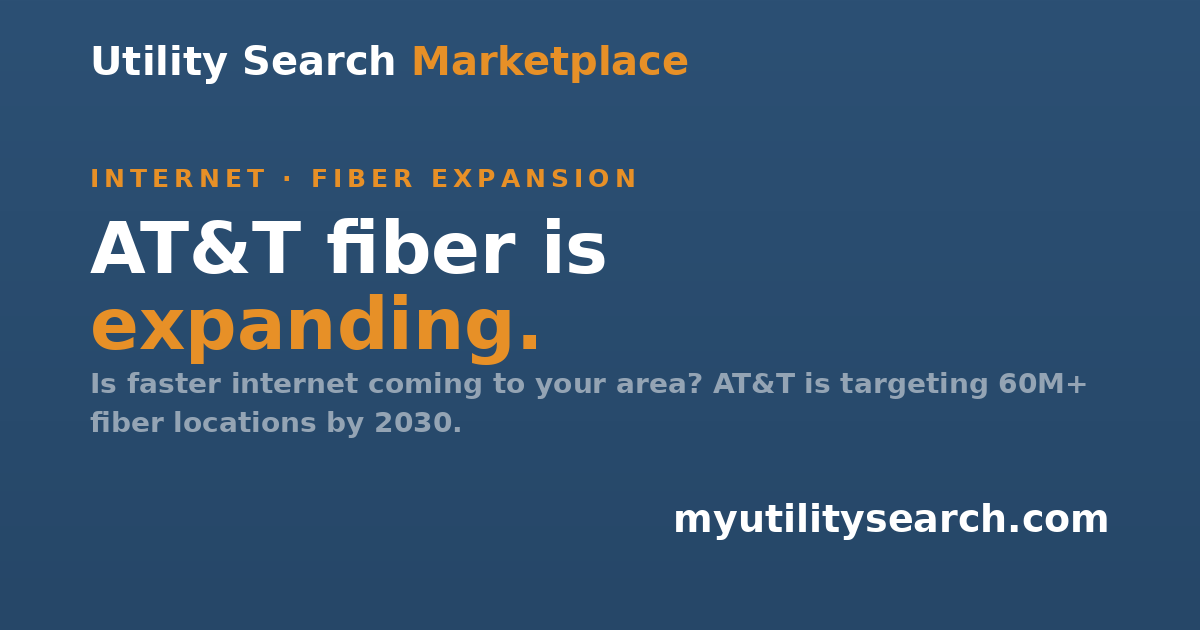
Add it all up and the AT&T fiber expansion left AT&T with fiber to more than 32 million locations at the end of 2025, targets more than 40 million by the end of 2026, and aims for 60 million-plus by 2030.
Where the new markets are being green-lit
The AT&T fiber expansion doesn’t come with a single master list of every city it’s building in — announcements arrive piecemeal through press releases, local news, and earnings calls. But the confirmed expansion picture in 2025–2026 includes:
Traditional-footprint metros where AT&T Fiber keeps growing: Atlanta, Charlotte, Raleigh, Nashville, Memphis, Louisville, Lexington, Birmingham, Mobile, New Orleans, Little Rock, Charleston, and Florida metros including Jacksonville, Orlando, Miami, and Fort Lauderdale.
Gigapower (new-territory) builds through the BlackRock joint venture — including expansion in Florida’s Orlando area and the Panhandle, reaching communities outside AT&T’s historic service area.
Lumen-acquisition metros that will convert to AT&T Fiber after the deal closes, such as Denver, Las Vegas, and Minneapolis, plus other markets across the 11 Lumen states.
Florida investment specifically: AT&T put nearly $5.5 billion into its Florida network from 2020–2024 — including more than $300 million in Tampa–St. Petersburg–Clearwater, more than $175 million each in Palm Bay–Melbourne–Titusville and Pensacola–Ferry Pass–Brent, and more than $150 million in Port St. Lucie — and recently expanded fiber to about 28,000 additional Central Florida homes.
A useful reality check: in many of these markets AT&T isn’t the only fiber builder. Regional players and other carriers are often building the same neighborhoods at the same time, which is good for you — more competition usually means better pricing — but it also means the “best” fiber at your address isn’t always the one with the biggest national headline.
What the AT&T fiber expansion means for you
If the AT&T fiber expansion reaches your address, the practical upside is real: fiber generally delivers faster upload speeds and lower latency than the copper or cable it replaces, which matters for video calls, large file transfers, and homes with many connected devices. AT&T has also leaned on a “converged” pitch — bundling fiber with its 5G wireless — so expansion often arrives alongside bundle offers.
The honest caveat: the AT&T fiber expansion makes headlines, but announcements about national totals — or even your metro — don’t tell you whether fiber is live on your street. Buildouts roll out neighborhood by neighborhood, “coming soon” can mean months, and a Gigapower build follows a different timeline than a traditional-footprint one. The only reliable check is your specific address.
How to compare it against your other options
The AT&T fiber expansion is good news, but more choice only helps if you compare it well:
Check what’s actually available at your address today — fiber availability varies block by block, even within a covered ZIP code, and even between AT&T’s own build types.
Compare fiber against cable and fixed-wireless on real-world reliability and the total monthly price after promo periods end, not just the headline speed.
When more than one fiber builder is active in your area, compare them head to head — the newest entrant sometimes has the better introductory pricing. If you recently saw a big provider headline like the Frontier-Verizon merger, the same rule applies: the national news rarely matches what’s live on your block.
If you’re in a deregulated market where you also choose your electricity and can bundle services, factor the whole household picture — sometimes the best internet decision pairs with other switches.
Because availability and pricing are intensely local, a side-by-side of what’s truly offered where you live beats any national headline — which is the comparison our site is built to make.
Is your plan keeping up?
If your results are lower than you’re paying for, you may have faster options at your address. Compare internet plans available where you live — fiber, cable, and 5G, side by side.
FAQ
Is AT&T fiber expanding in 2026?
Yes. The AT&T fiber expansion is accelerating in 2026 through three channels: organic construction in its traditional territory (ramping to 4 million new locations in 2026 and 5 million per year after), the Gigapower joint venture with BlackRock that builds into new territory, and the acquisition of Lumen’s mass-market fiber business. AT&T targets more than 40 million fiber locations by the end of 2026 and 60 million-plus by 2030.
What is AT&T Gigapower?
Gigapower is AT&T’s joint venture with BlackRock that builds AT&T Fiber in markets outside AT&T’s traditional wireline territory. It’s how AT&T Fiber reaches communities the company never historically served.
What new markets is AT&T building fiber in?
AT&T doesn’t publish one comprehensive list, but confirmed activity spans traditional-footprint metros (Atlanta, Charlotte, Nashville, Jacksonville, Orlando and more), Gigapower builds in new territory (including Florida’s Orlando area and Panhandle), and Lumen-acquisition metros like Denver, Las Vegas, and Minneapolis once that deal closes.
How do I know if AT&T fiber is available at my address?
National and even metro totals don’t reflect street-level availability. Check your specific address — fiber can be live on one block and not the next within the same ZIP code, and AT&T’s different build types (traditional vs. Gigapower) roll out on different timelines.
Is fiber better than cable or fixed-wireless?
Fiber typically offers faster uploads and lower latency, which helps with video calls and many connected devices. But the best choice depends on what’s actually available and the after-promo price where you live — compare all three.
What was the AT&T Lumen acquisition?
In 2026, AT&T agreed to acquire substantially all of Lumen’s mass-market fiber business for about $5.75 billion — roughly 1 million fiber customers and more than 4 million fiber locations across 11 states.
Sources: AT&T Q4 2025 earnings call and Q1 2026 Form 8-K (SEC filings); AT&T “Acquire Lumen’s Mass Markets Fiber Business” 8-K (May 2025, $5.75B / 4M locations / 11 states); AT&T policy announcement on accelerated fiber deployment (Oct 2025); AT&T Florida investment disclosures (2025). Figures are company-reported targets and totals; verify current availability directly before making a decision.