Blog
AT&T Fiber Internet: Best Plans, Prices & Availability 2026


Updated on September 28, 2026
10 min read
What is AT&T Fiber internet?
AT&T Fiber is AT&T’s fiber-to-the-home internet, and one of the fastest, most reliable home services in the country. Because it’s true fiber, AT&T Fiber internet delivers symmetrical upload and download speeds — a big advantage over cable, whose uploads lag far behind. Plans run from 300 Mbps up to a 5 Gbps residential tier, all with unlimited data and no annual contract.
AT&T Fiber plans and prices (2026)
AT&T Fiber pricing is refreshingly simple — the rate you sign up for is the rate you keep. Confirm current pricing at your address before you order.
Price check, September 28, 2026 (McKinney, TX address): AT&T Fiber promo pricing is now 300 Mbps $35, 500 Mbps $50, 1 GIG $65 (up from $50) and 5 GIG $110 (up from $95), after the $10/mo AutoPay-with-bank-account and paperless discount. Regular prices are $60 / $75 / $90 / $135. No data caps, no contract, no equipment fees; a Wi-Fi 7 All-Fi Pro package is $25/mo extra. The plan table is updated; some passages below still cite the older $50 Gig figure.
Updated August 2026: On June 7, 2026, AT&T simplified its fiber lineup to four tiers — 300 Mbps, 500 Mbps, 1 GIG and 5 GIG — and retired the old 2 Gig plan. Households that bundle AT&T wireless can drop fiber to as low as $35/mo and save up to $420/year, with Internet Backup included at no extra cost.
| Plan | Speed (symmetrical) | Typical price* | Best for |
|---|---|---|---|
| Internet 300 | 300 Mbps | ~$35/mo | Most households — the value pick |
| Internet 500 | 500 Mbps | ~$50/mo | Busy homes, several remote workers |
| Internet 1000 | 1 Gbps | ~$65/mo | Heavy streaming and big households (most popular) |
| Internet 5000 | 5 Gbps | ~$110/mo | Max performance where multi-gig is live |
*Prices vary by market; check current pricing on the AT&T Fiber plans page. All fiber tiers are symmetrical — uploads match downloads.
Looking for the plan-by-plan breakdown? See our best AT&T Fiber plans compared — tier-by-tier pricing, who each plan fits, and the fine print.
How fast is AT&T Fiber? Speeds explained
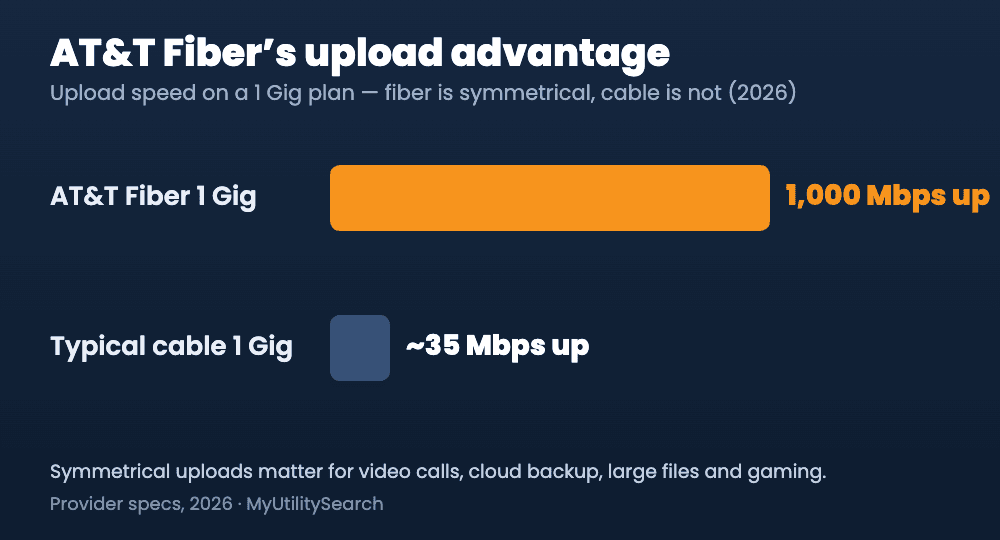
Short answer: AT&T Fiber is symmetrical — your upload speed matches your download speed on every tier, from 300 Mbps up to 5 Gbps. That’s the big structural advantage over cable: a cable “gig” plan downloads fast but usually uploads at only about 35 Mbps, while AT&T Fiber 1 Gig uploads at a full ~1,000 Mbps. For anything you send out — video calls, cloud backup, large file uploads, live streaming, competitive gaming — fiber is in a different class.
Here’s what each AT&T Fiber tier comfortably handles:
- 300 Mbps — 4K streaming on several TVs, video calls and everyday use for a typical household.
- 500 Mbps — busy homes with multiple remote workers and heavy simultaneous streaming.
- 1 Gig — large households, frequent large uploads and future-proofing (the most popular tier).
- 5 Gig — power users, home servers and multi-gig setups where the wiring can keep up.
Fiber also delivers lower, steadier latency (typically single-digit to low-teens milliseconds) than cable or wireless, and it doesn’t slow down at peak evening hours the way shared cable nodes can — so the speed you pay for is closer to the speed you actually get.
AT&T Fiber 2026 market landscape: new builds, competitors & product updates
AT&T runs the largest fiber network in the U.S. and is expanding it faster than any rival. It passed 30 million fiber locations in 2025 and is targeting roughly 40 million locations by the end of 2026, so an address that showed “not available” a few months ago is worth re-checking.
- New builds: growth is concentrated in the South, Midwest and West, plus open-access fiber through Gigapower (AT&T’s joint venture) reaching markets beyond its traditional footprint.
- New competitor entrants: overbuilders like Metronet, Brightspeed, Frontier (now merging with Verizon), Google Fiber and Ziply are lighting up the same towns, while T-Mobile and Verizon push 5G home internet — more competition usually means better AT&T promos locally.
- Product updates: AT&T added All-Fi Pro (Wi-Fi 7 gateway and mesh) and keeps bundling wireless discounts and reward-card offers on the gig tiers — part of why 2026 pricing fell sharply, with 1 Gig dropping to about $50/mo.
How Starlink is reshaping AT&T’s tier structure
Satellite internet from Starlink (about $120/mo for 100–200+ Mbps) does not threaten AT&T’s multi-gig fiber — nothing over-the-air matches symmetrical 5 Gig with low latency. Where Starlink bites is the low end and rural edge: addresses AT&T has not reached with fiber. AT&T’s answer is two-pronged — keep entry fiber aggressive (about $35 for 300 Mbps) and route non-fiber addresses to AT&T Internet Air, its 5G home-internet service. The net effect on the ladder: the bottom rung gets cheaper and a wireless option slots in beneath fiber, while the top (1–5 Gig symmetrical) is where fiber quietly wins and holds its price.
Where is AT&T available?
AT&T Fiber reaches roughly 21 states, concentrated in its service territory across the South, Midwest and West. In our provider-footprint database, AT&T is mapped across roughly 6,000 U.S. ZIP codes — but fiber is built street by street, so “available in your ZIP” isn’t the same as “available at your address.” Check the FCC Broadband Map or enter your ZIP to confirm what’s serviceable where you live.
AT&T footprint: the ZIP codes we track
We track roughly 6,000 AT&T ZIP codes across the U.S. Each dot below is one ZIP in our coverage data, clustered around AT&T’s fiber and legacy service territory in the South, Midwest and West.

AT&T Fiber vs AT&T Internet Air
AT&T sells two very different products. AT&T Fiber is wired fiber with symmetrical speeds and the lowest latency — the one to choose when it’s available. AT&T Internet Air is 5G fixed-wireless home internet for addresses fiber hasn’t reached yet; it’s convenient and no-contract, but speeds and latency vary with the cellular network. See how the technologies compare in our fiber vs cable vs 5G guide.
Compare internet, energy & home security at your address
AT&T Fiber pros and cons
| Pros | Cons |
|---|---|
| Fully symmetrical speeds up to 5 Gbps | Fiber availability is limited to built-out areas |
| No data caps, no annual contract | Internet Air (5G) is the only option where fiber isn’t live |
| No price increase after 12 months | Multi-gig tiers get expensive |
| Wi-Fi router included | Coverage concentrated in AT&T’s 21-state territory |
Is AT&T Fiber good for working from home?
AT&T Fiber is one of the best work-from-home connections you can get — symmetrical uploads handle video calls, big file transfers, cloud backups and VPNs without the upload bottleneck of cable. For the full picture, see our guide to the best internet for working from home, and compare the cable brands like Xfinity and Spectrum, or check 1 Gig internet plans.
Is your plan keeping up?
If your results are lower than you’re paying for, you may have faster options at your address. Compare internet plans available where you live — fiber, cable, and 5G, side by side.
AT&T Fiber for business: AT&T Business Fiber plans and prices
AT&T Business Fiber runs on the same fiber as the residential service, with symmetrical speeds and business terms. As of September 28, 2026 the business plans page lists 300 Mbps at $60 a month ($70 after the promotional period), 500 Mbps at $100 ($110), 1 Gig at $140 ($160), 2 Gig at $185 and 5 Gig at $285, with no annual contract and free installation. Against the residential 1 Gig rate of $65 verified at a McKinney, Texas address the same day, the business 1 Gig plan is about 2.15× the price — roughly $900 a year for the SLA, static IP options and priority support.
| Business plan | Monthly price | Terms |
|---|---|---|
| Business Fiber 300 | $60 ($70 regular) | No annual contract; free install |
| Business Fiber 500 | $100 ($110 regular) | No annual contract; free install |
| Business Fiber 1 Gig | $140 ($160 regular) | No annual contract; symmetrical |
| Business Fiber 2 Gig | $185 | No annual contract; symmetrical |
| Business Fiber 5 Gig | $285 | No annual contract; symmetrical |
Source: the provider’s own business plans page, read September 28, 2026. Business pricing is quoted by address and term; treat these as the published starting points.
What the business plan adds over the residential one: a service-level agreement with priority repair, static IP options, commercial-use terms and business support. If downtime does not cost you money, the residential plan at the same address is the cheaper answer — see business internet providers compared and what business internet costs.
Business shopper? Compare business internet at your address or talk to a specialist.
AT&T Fiber internet FAQ
How fast is AT&T Fiber?
AT&T Fiber offers symmetrical speeds from 300 Mbps up to 5 Gbps, meaning uploads match downloads. The most popular tier is 1 Gig (about 1,000 Mbps down and up), which handles heavy streaming, large households and frequent big uploads with room to spare.
Is AT&T Fiber’s upload speed really the same as the download?
Yes. Unlike cable — where a gig plan typically uploads at only about 35 Mbps — AT&T Fiber is symmetrical, so a 1 Gig plan uploads at roughly 1,000 Mbps. That’s a major advantage for video calls, cloud backup and gaming.
Is AT&T Fiber internet good?
Yes — AT&T Fiber is consistently one of the top-rated home internet services. It offers fully symmetrical speeds (uploads match downloads) from 300 Mbps to 5 Gbps, no data caps, no annual contract, and no price increase after 12 months. The main limit is availability — fiber has to reach your address.
How much is AT&T Fiber internet?
AT&T Fiber runs from $35/mo for 300 Mbps up to $95/mo for 5 Gbps, with 1 Gig around $50/mo. Unlike most providers, the price you sign up for doesn’t jump after a promo period, and the Wi-Fi router is included.
What is the difference between AT&T Fiber and AT&T Internet Air?
AT&T Fiber is wired fiber-to-the-home with symmetrical speeds; AT&T Internet Air is 5G fixed-wireless internet for addresses where fiber isn’t available. Fiber is faster and more consistent; Internet Air is the fallback where fiber hasn’t been built.
Does AT&T Fiber have a data cap or contract?
No. AT&T Fiber plans have unlimited data with no cap and no annual contract, so you can cancel anytime with no early termination fee.
Is AT&T Fiber good for working from home?
Yes — its symmetrical upload speeds make it excellent for video calls, large file transfers, cloud backups and VPNs, which is exactly where cable internet falls short. If AT&T Fiber is at your address, it’s a top work-from-home pick.
How do I cancel AT&T internet?
AT&T Fiber is no-contract, so you can cancel anytime by phone or through your account with no early termination fee. Before you switch, check which providers serve your address so you don’t lose coverage — enter your ZIP to compare.
Does AT&T offer business fiber?
Yes. AT&T Business Fiber is sold at 300 Mbps ($60), 500 Mbps ($100), 1 Gig ($140), 2 Gig ($185) and 5 Gig ($285) a month as of September 28, 2026, with no annual contract and free installation; promotional rates step up $10 to $20 after the promo period. Speeds are symmetrical and plans include business support and static IP options.
Compare internet, energy & home security at your address
Keep going
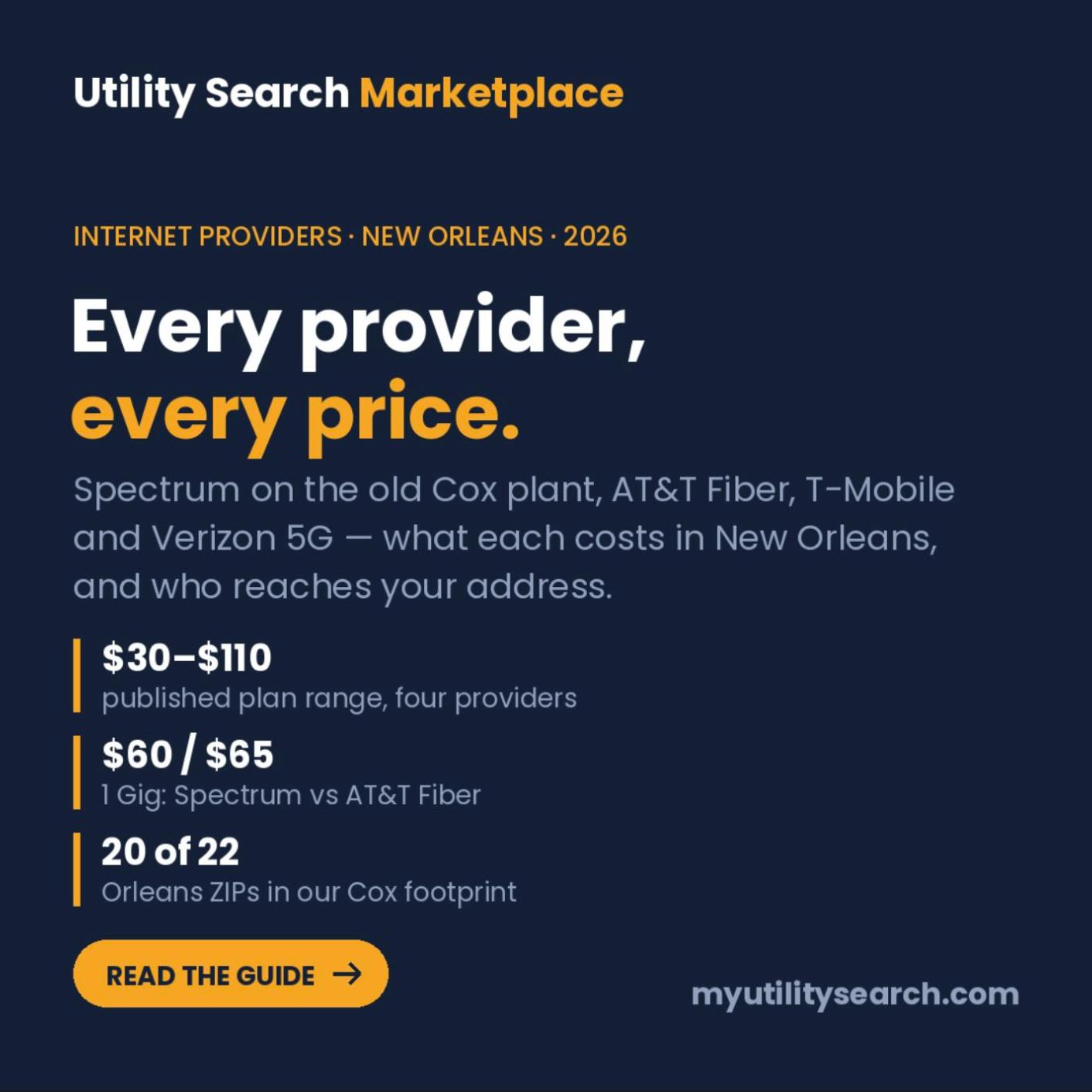
- Internet providers New Orleans — AT&T Fiber against Spectrum (ex-Cox) and 5G, priced and footprinted
- Xfinity internet: plans, prices & availability
- Spectrum internet: plans, prices & availability
- Optimum internet: plans, prices & availability
- Fiber vs cable vs 5G home internet
- Best internet for working from home
- Test your internet speed
- AltaFiber internet: plans, prices & availability
- Breezeline internet: plans, prices & availability
- Astound Broadband: plans, prices & availability