Blog
Internet Price Increases in 2026: The Running Tracker (AT&T, Spectrum & More)

Updated on August 24, 2026
If you have seen an internet price increase on your bill this summer, you are not imagining it. Several major providers changed pricing or restructured their plans between June and July 2026 — and three promotional offers expire within the next eleven days. Here is exactly what changed, what you will pay once the promo ends, and what to do before July 31.
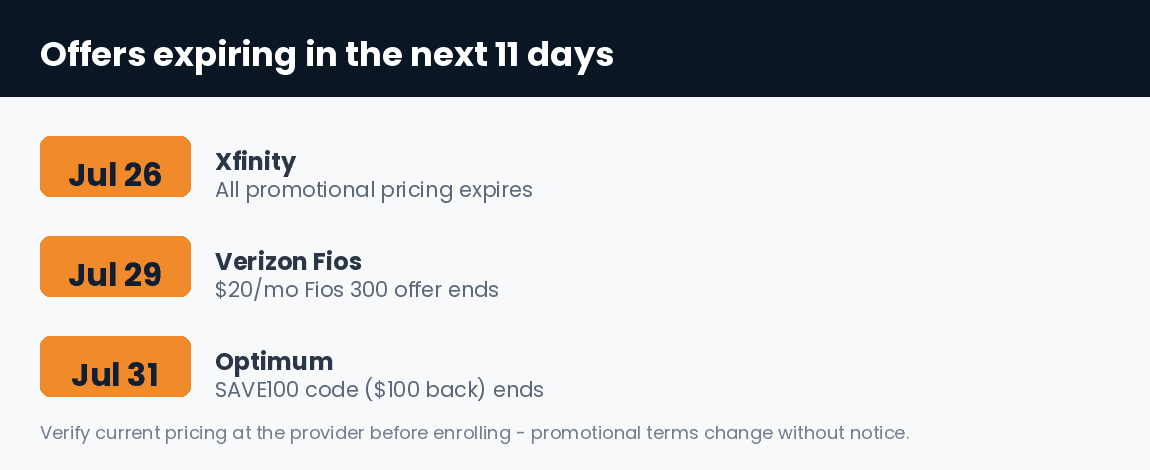
TL;DR: AT&T rebuilt its fiber lineup on June 7 — the entry tier is now 300 Mbps and 2 GIG is gone. Spectrum applied a July rate adjustment of about $3–$4 per month. Xfinity promo pricing expires July 26, Verizon’s $20 Fios 300 offer ends July 29, and Optimum’s SAVE100 code ends July 31. The number that matters most is not the promo price — it is the standard rate that replaces it.
Last updated: July 20, 2026 · Reviewed by the MyUtilitySearch team
Internet price increases 2026: the running tracker (updated August 19)
Every confirmed 2026 internet price change, newest first. Bookmark this — it’s updated as providers move:
| Provider | What changed | Effective | Who’s affected |
|---|---|---|---|
| AT&T Internet | ~$5/mo increase on older/grandfathered internet plans (customer notices) | Aug 16, 2026 | Legacy plan holders — current fiber lineup unaffected |
| Spectrum | +$10/mo on legacy Flagship, Ultra & Gig tiers (with speed boosts); TV Essentials +$4 ($31→$35) | On bills through July–Aug 2026 | Legacy plans only; current pricing plans unaffected |
| Cox | No merger-driven change at close; plans migrate to Spectrum pricing market by market | Close week of Aug 18, 2026 | Cox customers — watch transition notices; see our Charter–Cox guide |
| Starlink | Residential price increases rolled out in June 2026 | June 2026 | See our Starlink price increase breakdown |
An internet price increase is easiest to avoid before it lands. If you were planning to switch or renegotiate, the calendar matters more than usual this month. Promotional pricing is not a permanent rate, and when these windows close the replacement offer may be materially different.
AT&T rebuilt its fiber lineup in June
This is the most significant structural change of the year, and it affects anyone comparing plans from an older article. Effective June 7, 2026, AT&T simplified its fiber lineup to four tiers: 300 Mbps, 500 Mbps, 1 GIG and 5 GIG.
Two things changed that older comparisons still get wrong. The entry plan moved from 100 Mbps to 300 Mbps, and the 2 GIG tier no longer appears in the lineup. If you are reading a plan table that lists either, it is out of date.
| AT&T fiber plan | Speed | Promo (year 1) | Standard |
|---|---|---|---|
| Internet 300 | 300 Mbps | $35/mo | $60/mo |
| Internet 500 | 500 Mbps | $50/mo | $75/mo |
| Internet 1000 | 1 GIG | $50/mo | $90/mo |
| Internet 5000 | 5 GIG | $95/mo | $135/mo |
The buying tip most people miss: at promotional pricing, 500 Mbps and 1 GIG are both $50 a month. If you are choosing between them, 1 GIG is the obvious pick — twice the speed at the same promotional price. That gap only reappears at the standard rate, where 1 GIG runs $15 more.
AT&T fiber plans carry no equipment fees, no data caps and no annual contract, and 1 GIG and 5 GIG include a $200 reward card when you order online.
Spectrum’s July internet price increase
The clearest internet price increase this month came from Spectrum, which applied a rate adjustment in July 2026 — roughly $3 per month on standard internet and about $4 per month on legacy or grandfathered tiers. Charter has confirmed adjustments without publishing a tier-by-tier table, so treat the exact figure on your account as the authority.
Current advertised pricing is $30 for 100 Mbps, $40 for 500 Mbps and $60 for 1 Gig. One detail worth knowing: the $40 and $60 prices are online-exclusive. Order by phone or in a store and those same tiers are $50 and $70.
Spectrum Internet Assist, the low-income tier, also changed — it is now 50 Mbps at $25 per month, up from 30 Mbps at $20, with a $15 tier available to some qualifying households.
Context worth having: Charter lost roughly 120,000 internet subscribers in Q1 2026. A rate adjustment during subscriber losses usually means retention offers are available to customers who call and ask.
What you actually pay after the promo ends
This is the single most useful number in any internet comparison, and almost nobody publishes it. An internet price increase rarely arrives as an announcement — it arrives when your promotional period quietly ends.
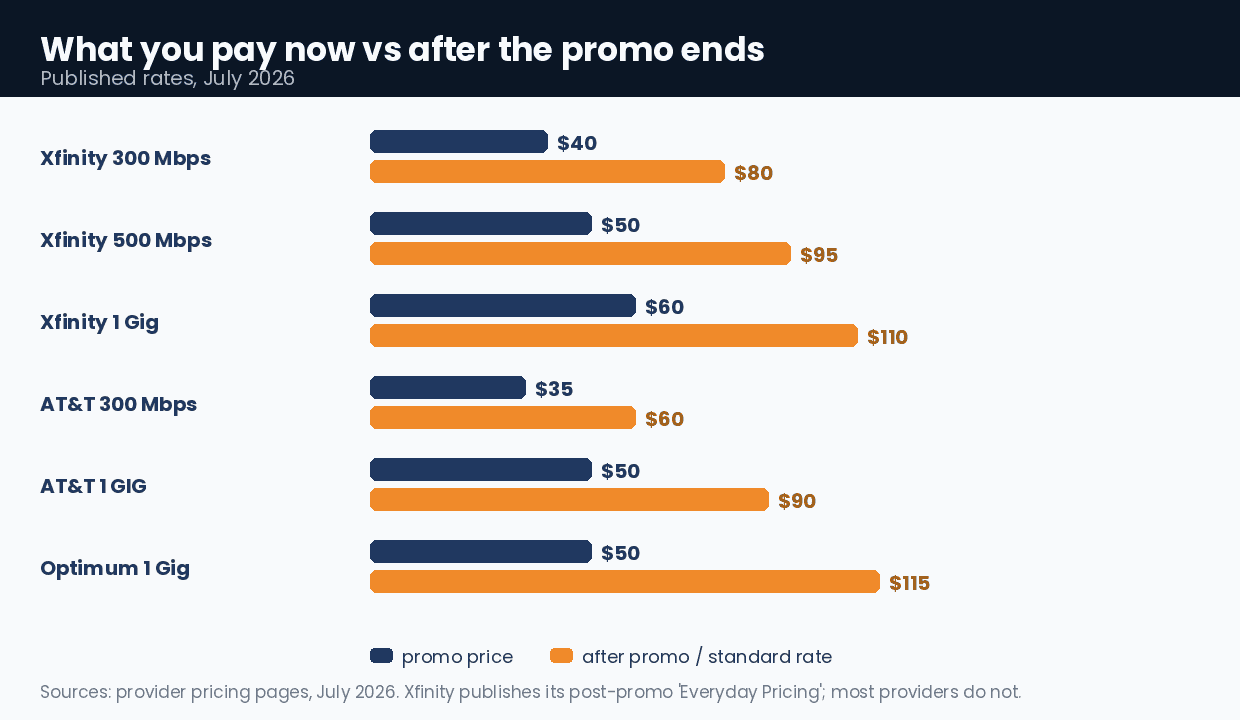
Xfinity is unusual in publishing its post-promotional rates outright, calling them Everyday Pricing: $80 for 300 Mbps, $95 for 500 Mbps, $110 for 1 Gig and $140 for 2 Gig. Those figures are worth knowing before you sign, because they are what you pay in month 13.
This is where most of the internet price increase complaints originate. The pattern repeats across providers. Optimum advertises 1 Gig at $50 promotional against a $115 standard rate. AT&T’s 1 GIG runs $50 promotional and $90 standard. In most cases the price roughly doubles.
The fine print behind most internet price increases
- Optimum’s “5-year price lock” has an escalator. The rate card states pricing holds for 60 months, after which the price rises by up to $15 per month per year until standard rates are reached. The gateway is $0 for 12 months, then up to $5 more per year.
- Optimum’s advertised price assumes bank payment. The autopay discount is $10 with ACH or debit, $5 with debit, and $0 with a credit card — so paying by card costs $10 more than the advertised rate.
- A $6.00 monthly Network Enhancement Fee appears on Optimum’s rate cards but not on the marketing page that advertises no hidden fees.
- Cox still enforces a data cap — 1.25 TB per month, with overage at $10 per additional 50 GB and no rollover. It is the only hard cap among the major providers we track, and adding a Cox Mobile line lifts it.
- Astound caps its cheaper tiers too — 400 GB at 300 Mbps and 1 TB at 600 Mbps, with unlimited data only at 1000 Mbps and above. Astound is widely described as having no caps, which is only true at the top tier.
- Verizon Fios charges a $99 setup fee, but includes the router and taxes in the displayed price, and locks pricing for 3 to 5 years depending on tier — the longest price protection of any provider here.
What to do when your internet price rises
- Find out when your promo ends. This is the date most likely to trigger an internet price increase on your account. Check your bill or account page for the promotional end date. That date, not today’s advertised price, determines what you will pay.
- Ask for the standard rate in writing before you sign anything new. If a provider will not tell you what month 13 costs, that is information in itself.
- Call retention if you are already a customer. Providers losing subscribers are markedly more willing to extend promotional pricing to customers who ask.
- Compare what is actually available at your address. Fiber availability changed considerably in 2026, and the provider that was cheapest two years ago often is not now.
- Order online where it matters. Spectrum’s $40 and $60 tiers and AT&T’s $200 reward card are online-exclusive.
Prices and promotional terms change frequently and vary by address. Verify current pricing directly with the provider before enrolling.
Internet price increase FAQs
Why did my internet bill go up in 2026?
The most common reason is that a promotional period ended and your account moved to the standard rate, which is often roughly double. Separately, Spectrum applied a July 2026 rate adjustment of about $3 per month on standard internet and $4 on legacy tiers.
What changed with AT&T internet plans?
Effective June 7, 2026, AT&T simplified its fiber lineup to 300 Mbps, 500 Mbps, 1 GIG and 5 GIG. The entry tier moved from 100 Mbps to 300 Mbps, and the 2 GIG plan no longer appears in the lineup.
What does Xfinity cost after the promo ends?
Xfinity publishes post-promotional Everyday Pricing of $80 per month for 300 Mbps, $95 for 500 Mbps, $110 for 1 Gig and $140 for 2 Gig. Promotional pricing runs $40 to $90 depending on tier and term.
Which internet deals expire in July 2026?
Xfinity promotional pricing expires July 26, Verizon’s $20 per month Fios 300 offer ends July 29, and Optimum’s SAVE100 promotional code ends July 31.
Do any internet providers still have data caps?
Yes. Cox applies a 1.25 TB monthly cap with $10 per 50 GB overage, and Astound caps its lower tiers at 400 GB and 1 TB. AT&T, Spectrum, Xfinity, Verizon Fios and Optimum do not cap the plans reviewed here.
Can I negotiate a lower internet bill?
Often yes, particularly with providers losing subscribers. Contact the retention department, reference a competitor’s current price at your address, and ask whether promotional pricing can be extended before you cancel.
Is this internet price increase permanent?
Mostly, yes — but not uniformly. A rate adjustment like Spectrum’s becomes your new baseline and does not reverse. A promotional expiry, by contrast, is often negotiable: providers routinely extend or re-offer promotional pricing to customers who contact retention before cancelling, particularly in a quarter where they are losing subscribers.
The structural change at AT&T is a different category again. Retiring the 100 Mbps entry tier and the 2 GIG plan is not an internet price increase in the ordinary sense — the entry price actually improved on a per-megabit basis, since $35 now buys 300 Mbps rather than 100. Whether that helps you depends entirely on whether you needed the speed.
The practical takeaway across all of it: the advertised price is a marketing number with an expiry date attached. The standard rate is the number you will live with. Compare providers on the second one, and any internet price increase that arrives in month 13 will not be a surprise.
Keep going
- How to lower your internet bill
- Compare the best internet providers for 2026
- AT&T Fiber review
- Spectrum internet plans
- Xfinity internet review
- How internet data caps and overage fees work
- Find the best internet for your area
How to tell a real increase from a promo expiring
Not every jump on your statement is an internet price increase in the strict sense. Two very different things produce the same feeling: a rate change the provider applies across a tier, and a promotional discount rolling off on schedule. The first is imposed on you; the second was always going to happen on a date printed in your original order.
You can separate them by pulling the previous month’s bill and comparing the line items rather than the total. A true internet price increase moves the base service line. An expiring promotion removes a credit while the base line stays flat. Equipment and regulatory-recovery fees are a third category again, and they move independently of both.
For context on whether your area has alternatives worth calling about, the FCC’s National Broadband Map lists providers reporting service at your address. And if you want to sanity-check how broadband pricing is moving against everything else you buy, the Bureau of Labor Statistics Consumer Price Index tracks internet service as its own category — useful for knowing whether your internet price increase is typical or an outlier.
AT&T Price Increase — August 2026 Update (updated August 4, 2026)
AT&T is raising home-internet prices by $5/month effective August 16, 2026. It applies to AT&T Internet (fiber and copper) for accounts established between June 2024 and July 2025, and to the low-income Access from AT&T copper plan, which rises from $15 to $20/month. Customers were notified in the “News You Can Use” section of their July bills. It joins a wave of 2026 increases — Spectrum +$10 on legacy plans and Starlink +$5 to $10.
| Provider | Increase | Who / what | Effective |
|---|---|---|---|
| AT&T Internet (fiber & copper) | +$5/mo | Accounts opened Jun 2024–Jul 2025 | Aug 16, 2026 |
| Access from AT&T (copper) | $15 → $20/mo | Low-income plan | Aug 16, 2026 |
| Spectrum (legacy) | +$10/mo | Flagship/Ultra/Gig | On bills by Jul 2026 |
| Starlink Residential | +$5 to $10/mo | Most plans | Jun 18, 2026 |
Internet Price Increase 2026: Provider FAQ
Is AT&T raising internet prices in August 2026?
Yes. AT&T is raising home-internet prices $5/month effective August 16, 2026.
Who is affected by the AT&T price increase?
AT&T Internet (fiber and copper) accounts established June 2024 through July 2025, and the low-income Access from AT&T copper plan.
How much does Access from AT&T cost after the increase?
The Access from AT&T copper plan rises from $15 to $20/month.
When does the AT&T increase take effect?
August 16, 2026; customers were notified in the “News You Can Use” section of July bills.
How can I avoid the AT&T price increase?
Compare plans and competing providers at your address before the change; switching or renegotiating can offset the $5 bump.