Blog
Xfinity Internet Review 2026: Coverage, Plans & Equipment


Updated on September 28, 2026
12 min read
Last updated September 28, 2026 — prices re-read on xfinity.com the same day.
What is Xfinity internet?
Xfinity is Comcast’s consumer internet brand and the most widely available cable provider in the country. It delivers xfinity internet over a hybrid fiber-coaxial network — the same lines as cable TV — reaching a large share of U.S. homes. Plans range from roughly 300 Mbps to 2 Gbps download in most areas, with a fiber-fed 10 Gbps tier in select neighborhoods. Every plan is month-to-month with no early termination fee.
Xfinity internet plans and prices (September 2026)
As of September 28, 2026, Xfinity publishes three residential speed tiers on its 5-Year Price Guarantee — 300 Mbps at $45 a month, 500 Mbps at $60 and 1 Gig at $70 — plus a one-year introductory 300 Mbps offer at $40. All three locked prices require a new Xfinity Internet account, autopay from a stored bank account and paperless billing, and the current offer is dated to end October 25, 2026. The 1.2 Gig and 2 Gig tiers exist in many areas but are priced by address rather than on the national page, so they are listed here without a number.
| Xfinity plan | Download speed | Price (September 28, 2026) | Guarantee | Best for |
|---|---|---|---|---|
| 300 Mbps — intro | 300 Mbps | $40/mo | 1 year, then regular rate | Renters and anyone who expects to move within a year |
| 300 Mbps | 300 Mbps | $45/mo | 5 years | Email, streaming, one or two remote workers |
| 500 Mbps | 500 Mbps | $60/mo | 5 years | Working and learning from home on several devices |
| 1 Gig | 1,000 Mbps | $70/mo | 5 years (Peacock Premium included 2 years) | Streamers, gamers, larger households |
| 1.2 Gig / 2 Gig | 1,200 / 2,000 Mbps | Priced by address | Varies by offer | Ultra-connected homes in select areas |
| NOW Internet (prepaid) | 200 / 10 Mbps | $30/mo, taxes and fees included | Month to month, pause anytime | Budget, second homes, short stays |
| Internet Essentials / Essentials Plus | 75 / 100 Mbps | $14.95 / $29.95 per month | Ongoing for qualifying households | SNAP, Medicaid, NSLP or housing-assistance households at or below 200% FPL |
Source: xfinity.com internet-service, deals, 5-year-price-guarantee, NOW Internet and Internet Essentials pages, read September 28, 2026. Locked prices are for new Xfinity Internet customers with autopay from a stored bank account and paperless billing; paying by card instead adds $10 a month. Taxes, fees and installation are extra and not covered by the guarantee. Every current plan includes the Xfinity Gateway and unlimited data; the 5-year plans add one Xfinity Mobile Select line free for a year. Pricing is regional; confirm at your address.
What changed since our July 2026 read
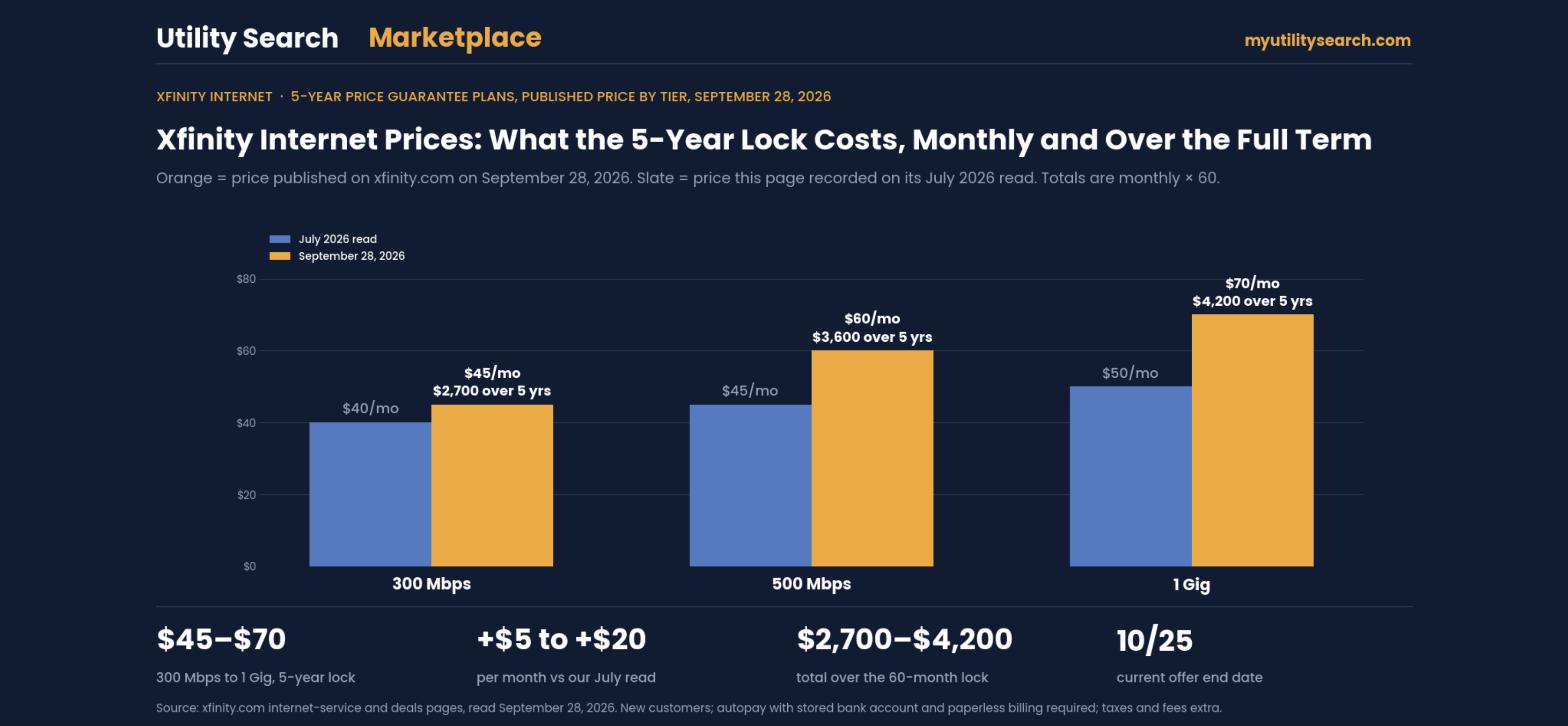
When this page was last built in July 2026, the 5-year lock ran $40, $45 and $50 for 300 Mbps, 500 Mbps and 1 Gig. On September 28, 2026 the same three tiers are published at $45, $60 and $70 — $5, $15 and $20 a month higher. Over a 60-month lock that is $300, $900 and $1,200 more than a customer who signed in July will pay for identical speed. Two other things moved: the 1.2 Gig and 2 Gig tiers dropped off the national price page (they are quoted by address now), and Xfinity retired data caps on every current plan, so the old “1.2 TB in many markets” warning only applies to legacy accounts.
What Xfinity internet costs over the full 5-year lock
The 5-Year Price Guarantee is the reason Xfinity internet is worth pricing as a term number rather than a monthly one. Multiply the locked rate by 60 months and the three tiers cost $2,700, $3,600 and $4,200 before taxes, fees and any card-payment surcharge. The one-year $40 intro looks cheaper for 12 months, but Xfinity does not publish the regular rate it steps up to, so its five-year total cannot be computed from the offer page — treat it as a short-term price, not a long-term one.
| Plan | Locked monthly price | 12 months | 60 months (full lock) | Per Mbps per month |
|---|---|---|---|---|
| 300 Mbps (5-year) | $45 | $540 | $2,700 | 15.0¢ |
| 500 Mbps (5-year) | $60 | $720 | $3,600 | 12.0¢ |
| 1 Gig (5-year) | $70 | $840 | $4,200 | 7.0¢ |
| 300 Mbps (1-year intro) | $40 | $480 | Not computable — regular rate unpublished | 13.3¢ in year one |
| NOW Internet 200 Mbps | $30 (taxes included) | $360 | $1,800 if the price holds | 15.0¢ |
The chart below plots the same Xfinity internet numbers as cents per megabit, which is the fairest way to compare a $45 plan with a $70 one. The 1-year intro and NOW Internet are in slate because neither carries the 60-month guarantee.
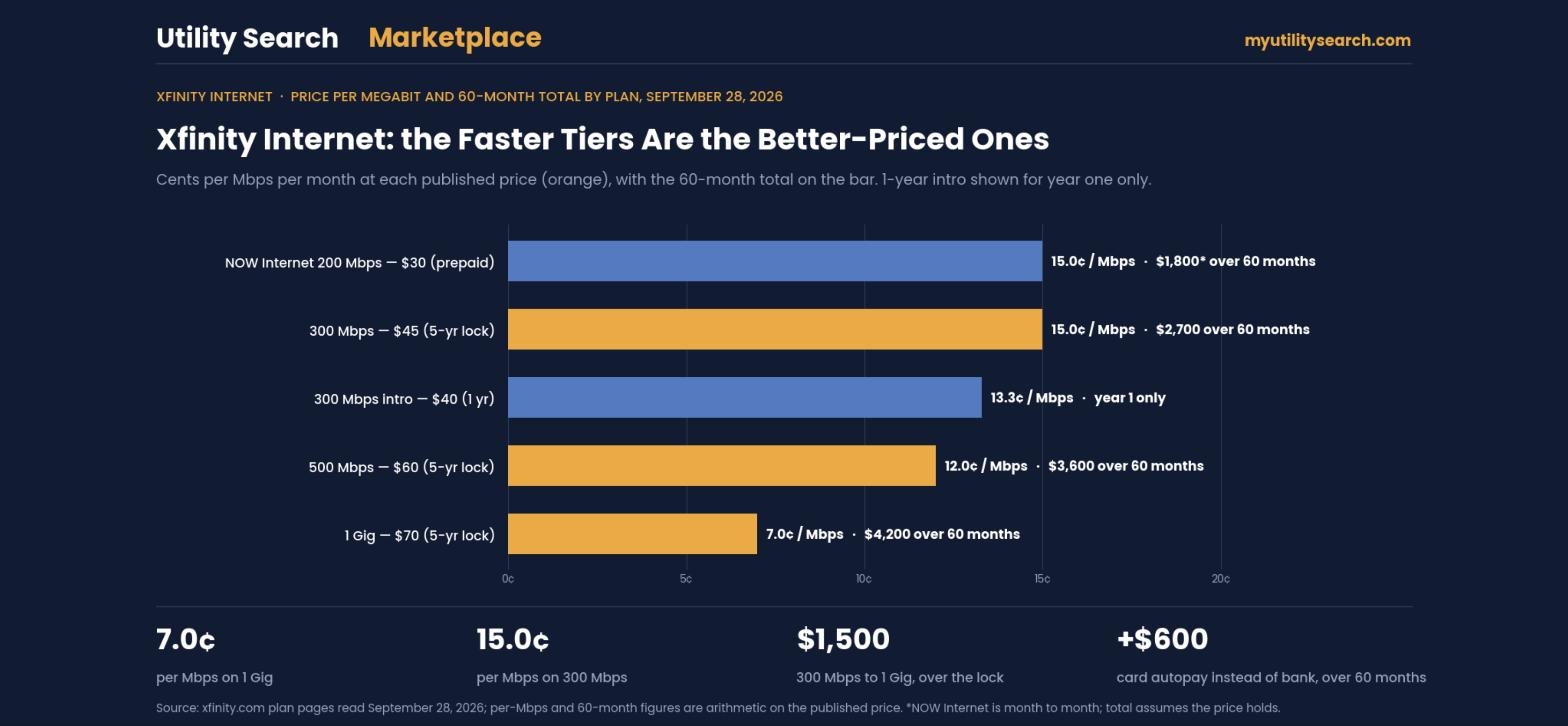
Read the last column and the pattern is obvious: the 1 Gig tier costs 7¢ per megabit while 300 Mbps costs 15¢. If you will use the speed, the top of the ladder is the best-priced plan Xfinity sells. If you will not, the $25 a month between 300 Mbps and 1 Gig is $1,500 over the lock, which is the real cost of buying speed you do not need.
Xfinity internet fees, equipment and the autopay rule
Xfinity’s advertised price is closer to the bill than most cable offers because the gateway and unlimited data are included, but four lines still sit outside the locked rate. The guarantee covers the base monthly rate only.
| Cost line | Amount | What Xfinity says |
|---|---|---|
| Xfinity Gateway (Wi-Fi equipment) | Included | “Included at no additional cost” on 5-year plans; refurbished gateway on NOW Internet |
| Data | Unlimited | “All new Xfinity Internet plans include unlimited data”; legacy plans keep a 1.2 TB limit |
| Autopay without a stored bank account | +$10/mo | Locked price assumes bank autopay and paperless billing; card autopay pays $10 more |
| Taxes, fees, installation | Extra, varies | “Taxes, fees, and installation charges are extra and subject to change” — not published on the offer page |
| Contract / early termination | None | No annual contract; cancel anytime without penalty, even inside the 5-year lock |
| Extras | $0 | One Xfinity Mobile Select line free for 12 months on 5-year plans; Peacock Premium for 24 months on Gig |
The line that catches people is the autopay rule. Xfinity’s $45, $60 and $70 assume the payment comes from a checking account; a debit or credit card on autopay is $55, $70 and $80. Over the lock that is another $600. Set the bank account up at signup rather than switching later, and keep paperless billing on, because both conditions attach to the guaranteed rate.
Which Xfinity internet plan should you pick?
- One or two people, streaming and email: 300 Mbps at $45 on the 5-year lock. Take the $40 one-year intro only if you expect to move within 12 months.
- Two remote workers or a family on several screens: 500 Mbps at $60. It is the tier where video calls stop competing with 4K streams.
- Gamers, creators, four-plus heavy users: 1 Gig at $70 — the cheapest per-megabit plan Xfinity sells, with Peacock Premium for two years.
- Tight budget or a temporary address: NOW Internet at $30 with taxes included, or Internet Essentials at $14.95 if the household qualifies.
Whatever the tier, the same three conditions attach to every locked Xfinity internet price: a new account, bank-account autopay and paperless billing. Confirm the exact price and speed at your address before you sign up, because Xfinity’s cable footprint and offers vary street by street.
Where is Xfinity available?
Xfinity is one of the most widely available providers in the U.S. In our provider-footprint database, Xfinity is mapped across roughly 6,300 U.S. ZIP codes — but “available in your ZIP” isn’t the same as “available at your address,” because cable footprints vary street by street. In many of those ZIPs Xfinity competes head-to-head with fiber (AT&T, Verizon Fios) or another cable operator; in others it’s the only high-speed wired option. Check the FCC Broadband Map or enter your ZIP to confirm what’s serviceable where you live.
Xfinity footprint: the ZIP codes we track
We track roughly 7,900 Xfinity ZIP codes across the U.S. Each dot below is one ZIP in our coverage data, clustered around the metros Xfinity’s cable network reaches — the Northeast corridor, Chicago, Seattle, the Bay Area, Denver, Atlanta, Houston and Florida.

Xfinity data caps
Many Xfinity markets apply a 1.2 TB monthly data cap; going over costs $10 per additional 50 GB, up to about $100/mo. As of 2026, Xfinity removed the cap for customers on its 5-Year Price Guarantee or xFi Complete plans, marketing those as unlimited. If you’re a heavy user, confirm whether your plan includes unlimited data. See our guide to internet data caps and overage fees.
Xfinity pros and cons
| Pros | Cons |
|---|---|
| Very wide availability | Uploads far slower than downloads |
| Fast downloads, up to 2 Gbps | Locked $45 / $60 / $70 prices are for new customers on bank autopay |
| No term contract; no early termination fee | Promo pricing rises after intro period (unless on the 5-year lock) |
| Free Wi-Fi included; 5-year price-lock option | Fiber rivals offer symmetrical speed where available |
Is Xfinity good for working from home?
Xfinity is a solid work-from-home option where fiber isn’t available: fast downloads and wide coverage handle video calls, streaming, and multiple devices. The trade-off is upload speed — cable uploads are much lower than downloads, so heavy uploaders (large file transfers, cloud backups) may prefer fiber. For the full picture, see our guide to the best internet for working from home, and compare 1 Gig internet plans if you need more speed. Rural or fiber-less? See whether Starlink is worth it.
Is your plan keeping up?
If your results are lower than you’re paying for, you may have faster options at your address. Compare internet plans available where you live — fiber, cable, and 5G, side by side.
Xfinity for business: Comcast Business internet plans and prices
Comcast Business is the commercial arm of the same network. As of September 28, 2026 its plans page lists 300 Mbps at $70 a month, 500 Mbps at $100, 1.25 Gig at $150 and 2 Gig at $180 on a one-year agreement, with equipment included on the gig plans and SecurityEdge included. An optional five-year price lock raises those to $110, $140, $190 and $220. Against Xfinity’s residential 1 Gig promotional rate of $70, the business 1.25 Gig plan is about 2.1× the price — about $960 a year for the SLA and business support.
| Business plan | Monthly price | Terms |
|---|---|---|
| Business Internet 300 | $70 (5-yr lock $110) | 1-year agreement |
| Business Internet 500 | $100 (5-yr lock $140) | 1-year agreement |
| Business Internet 1.25 Gig | $150 (5-yr lock $190) | 1-year agreement; equipment included |
| Business Internet 2 Gig | $180 (5-yr lock $220) | 1-year agreement; equipment included |
Source: the provider’s own business plans page, read September 28, 2026. Business pricing is quoted by address and term; treat these as the published starting points.
What the business plan adds over the residential one: a service-level agreement with priority repair, static IP options, commercial-use terms and business support. If downtime does not cost you money, the residential plan at the same address is the cheaper answer — see business internet providers compared and what business internet costs.
Compare business internet at your address
Business plans are quoted by address and term. See which providers reach your storefront or office before you sign anything.
Xfinity internet FAQ
Is Xfinity internet good?
Xfinity is a solid choice where fiber isn’t available — its cable network delivers fast downloads (up to 2 Gbps) and very wide coverage. The trade-offs are slower upload speeds and a locked price that depends on bank autopay, paperless billing and a new account. If you want symmetrical speed, compare fiber options at your address first.
Why is my Xfinity internet slow?
The usual causes are being on a lower speed tier than your household needs, cable congestion during peak evening hours, or an aging modem. If your connection is consistently slower than advertised, it can be worth comparing faster plans or other providers available at your address.
How do I cancel Xfinity internet?
You can cancel Xfinity by calling Comcast or through your online account; note that discounted rates sometimes require a term. Before you cancel, check which providers serve your address so you can switch without a coverage gap — enter your ZIP to compare.
How much does Xfinity internet cost?
As of September 28, 2026, Xfinity internet costs $45 a month for 300 Mbps, $60 for 500 Mbps and $70 for 1 Gig on the 5-Year Price Guarantee, or $40 for 300 Mbps on a one-year offer, all for new customers with bank autopay and paperless billing (card autopay adds $10). NOW Internet is $30 prepaid with taxes included and Internet Essentials is $14.95 for qualifying households. The 1.2 Gig and 2 Gig tiers are priced by address.
Does Xfinity require a contract?
No — Xfinity internet is month-to-month with no early termination fee. It also offers an optional 5-Year Price Guarantee that locks your rate for 60 months.
Does Xfinity have a data cap?
Not on current plans. Xfinity states that all new Xfinity Internet plans include unlimited data with no monthly usage limit, as of September 28, 2026. Only customers still on an older, limited plan are subject to the legacy 1.2 TB monthly limit.
What are Xfinity’s fastest speeds?
Most areas offer up to 2 Gbps download over cable, with a fiber-fed 10 Gbps tier in select neighborhoods. Upload speeds reach up to about 200 Mbps.
Is Xfinity fiber or cable?
Xfinity is primarily a cable (hybrid fiber-coaxial) provider, though it offers fiber-based multi-gig service in a limited number of areas.
Does Xfinity offer business internet?
Yes, through Comcast Business. As of September 28, 2026 the plans are 300 Mbps ($70), 500 Mbps ($100), 1.25 Gig ($150) and 2 Gig ($180) a month on a one-year agreement, with an optional five-year price lock at $110 / $140 / $190 / $220. Gig plans include equipment and SecurityEdge.
Does the Xfinity 5-year price guarantee cover the whole bill?
No. As of September 28, 2026 the guarantee covers the base monthly rate only — $45, $60 or $70 for 300 Mbps, 500 Mbps or 1 Gig. Taxes, fees and installation are extra and can change, paying by card instead of a stored bank account adds $10 a month, and the locked price is for new Xfinity Internet customers. Equipment and unlimited data are included in the rate.
Compare internet, energy & home security at your address
If you already know you want Xfinity and just need to pick a tier, our guide to the best Xfinity internet plans ranks every current plan by household size and price.
Sources
- Xfinity — Internet service and plans (300 Mbps $45, 500 Mbps $60, 1 Gig $70; offer ends 10/25) — read September 28, 2026
- Xfinity — Internet deals (one-year 300 Mbps at $40; conditions) — read September 28, 2026
- Xfinity — 5-Year Price Guarantee (base rate only; $10/mo without stored-bank autopay; gateway and unlimited data included) — read September 28, 2026
- Xfinity — NOW Internet ($30/mo, 200/10 Mbps, taxes and fees included) — read September 28, 2026
- Xfinity — Internet Essentials ($14.95 and $29.95 tiers; eligibility) — read September 28, 2026
- Xfinity — Data caps (no caps on current plans; 1.2 TB on legacy plans) — read September 28, 2026
- FCC National Broadband Map — address-level availability
Keep going
- Ting fiber — the flat-rate fiber alternative to Xfinity in Charlottesville, Westminster and Wake County
- Sonic internet — the $49.99 fiber alternative to Xfinity in the Bay Area, checked at a live address
- Hotwire internet — the bulk fiber alternative in South Florida condos where Xfinity is the retail option
- Spectrum internet: plans, prices & availability
- Fiber vs cable vs 5G home internet
- Optimum internet: plans, prices & availability
- AT&T Fiber internet: plans, prices & availability
- Best internet for working from home
- 1 Gig internet plans explained
- Internet data caps & overage fees
- Test your internet speed
- AltaFiber internet: plans, prices & availability
- Breezeline internet: plans, prices & availability
- Astound Broadband: plans, prices & availability
- Xfinity internet speed tiers explained — how much speed your household actually needs