





Blog
T-Mobile Home Internet: Plans, Prices & Review 2026

Updated on October 25, 2026
14 min read
Best for most households: Amplified at $60 a month ($45 with a T-Mobile phone line) — uncapped speeds up to about 498 Mbps, enough for several people working from home, locked for five years with the gateway included. Take Rely only for one or two light users; take All-In only if you want the fastest tier and the perks. If fiber or cable reaches your address, compare it first: 5G home internet speeds depend on tower load where you live. See what else serves your address. Prices as checked September 28, 2026.
TL;DR — T-Mobile Home Internet at a glance
- What it is: a 5G wireless home internet service that runs over T-Mobile’s cellular network — no cable or fiber line to your house.
- Plans & price: three tiers — Rely, Amplified and All-In — from $35 to $70/mo with AutoPay (an extra $10–$15/mo without a T-Mobile voice line).
- No strings: no annual contract, no data caps, no equipment fees, and a 5-Year Price Guarantee.
- Speeds: typical downloads of 133–498 Mbps. The entry Rely plan is now capped at 354 Mbps; Amplified and All-In are uncapped.
- Setup: a self-install gateway you plug in yourself in about 15 minutes — no technician visit.
What is T-Mobile Home Internet?
Short answer: T-Mobile Home Internet (officially T-Mobile 5G Home Internet) is a wireless broadband service that delivers your home Wi-Fi over the same 5G network that powers T-Mobile phones. Instead of a cable or fiber cable running to your house, T-Mobile ships you a Wi-Fi gateway that pulls a signal from the nearest tower and broadcasts it through your home. Because there’s no wired line to install, you set it up yourself in minutes and you’re never locked into a contract.
That wireless approach is what makes T-Mobile Home Internet different from providers like Xfinity, Spectrum or Cox. There are no professional-installation fees, no rented modem line items, and the price you sign up at is the price you keep. The trade-off is that speed depends on your distance from the tower and how busy that tower is — so real-world performance varies more than it does on fiber.
T-Mobile Home Internet plans and prices (2026)
Short answer: There are three plans. Prices below are the AutoPay rate; the lower figure applies if you also have a qualifying T-Mobile voice line.
| Plan | Price (AutoPay) | With voice line | Speed | Standout |
|---|---|---|---|---|
| Rely | $50/mo | $35/mo | Capped at 354 Mbps | Cheapest way in |
| Amplified | $60/mo | $45/mo | Uncapped (up to ~498 Mbps) | Best all-rounder |
| All-In | $70/mo | $55/mo | Fastest, uncapped | Streaming perks + mesh |
Every plan includes the Wi-Fi gateway, unlimited data, and the 5-Year Price Guarantee. Wireless customers on select plans can also get a $15/mo credit, which is what brings the effective cost of the entry plan down to the mid-$30s. The top All-In plan adds a Hulu subscription, Paramount+ Essential, advanced cybersecurity, a mesh Wi-Fi extender, 24/7 tech support, and a complimentary gateway upgrade after three years.
How much does T-Mobile Home Internet cost per month?
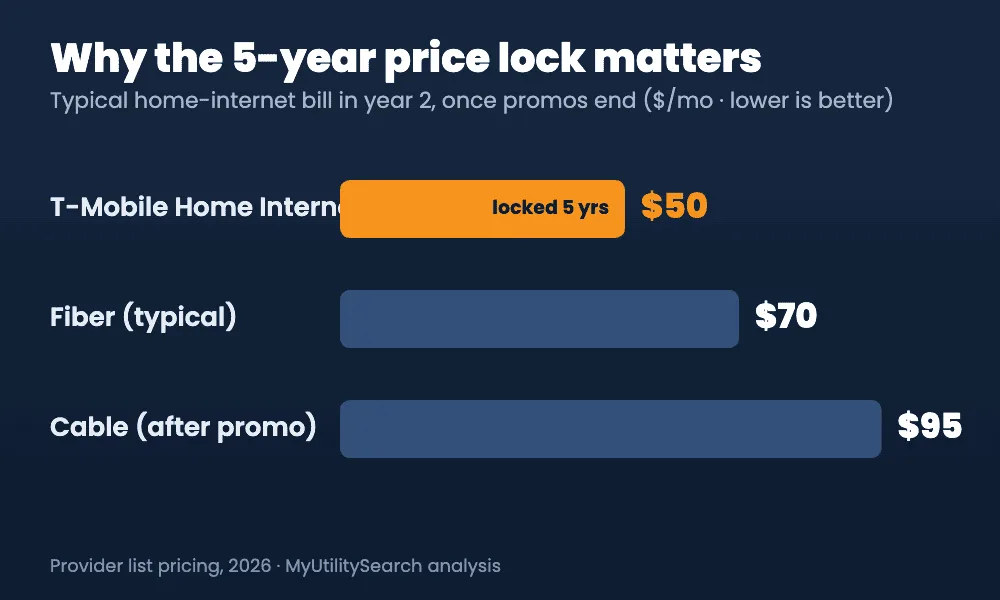
Short answer: Between $35 and $70 a month, all in. Unlike cable, that number doesn’t balloon after a promo period — there are no equipment rentals, no data-overage charges, and no surprise year-two hike, because the 5-Year Price Guarantee freezes your rate. The main variables are (1) whether you pay by AutoPay and (2) whether you bundle a T-Mobile phone line, which unlocks the lowest pricing and the $15/mo credit.
Is T-Mobile Home Internet good and worth it?
Short answer: For most households it’s a strong value — especially if you’re tired of cable price increases or you can’t get fiber. T-Mobile Home Internet consistently rates well for customer satisfaction because the pricing is honest: what you sign up for is what you pay. It’s a particularly good fit for renters (no install, take it with you when you move), suburban and rural homes underserved by wired providers, and anyone who wants a predictable bill.
Where it’s a weaker fit: households that need rock-solid, symmetrical gigabit speeds for heavy uploading, competitive gaming with the lowest possible latency, or homes far from a T-Mobile tower where the signal is thin. Fiber still wins on raw consistency. But for typical streaming, video calls, browsing and casual gaming across several devices, T-Mobile Home Internet is more than enough.
How fast is T-Mobile Home Internet?
Short answer: Typical download speeds land between 133 and 498 Mbps, with uploads of 12–55 Mbps and latency around 16–28 ms. In June 2026, T-Mobile introduced its first-ever speed cap: the entry Rely plan now maxes out at 354 Mbps for new customers (existing Rely subscribers are grandfathered). The Amplified and All-In plans remain uncapped, so if you want the network’s full speed you’ll want one of those two.
Those speeds comfortably handle 4K streaming on multiple TVs, video conferencing, and downloads. The bigger performance factor is location: because it’s wireless, your actual speed depends on tower distance and congestion, and it can dip at peak evening hours. T-Mobile’s 15-day money-back guarantee exists precisely so you can test real speeds in your home risk-free.
What is the T-Mobile 5-Year Price Guarantee?
Short answer: It’s a promise that T-Mobile won’t raise your internet rate for five years from sign-up. Taxes, government fees and any plan upgrades you choose are excluded, but the core monthly price is locked. That’s the headline advantage over cable, where introductory rates routinely jump $20–$30 a month once the 12-month promo ends. With T-Mobile Home Internet there is no promo cliff to budget around.
Does T-Mobile Home Internet have a contract, data cap, or equipment fee?
Short answer: No, no, and no. There is no annual contract — you can cancel anytime. There is no data cap and no overage fee; data is unlimited on every plan. And the Wi-Fi gateway is included at no monthly charge, unlike the $10–$15/mo modem rentals many cable providers add. Setup is a 15-minute self-install, so there’s no technician fee either.
T-Mobile Home Internet vs cable and fiber
Against cable (Xfinity, Spectrum, Cox), T-Mobile wins on price transparency, no contracts and no data caps, while cable often edges it on peak download speed and consistency. Against fiber (including T-Mobile’s own T-Mobile Fiber), fiber wins on raw speed, symmetrical uploads and reliability, but it isn’t available everywhere and can carry higher pricing. If fiber is on your street, compare it directly; if it isn’t, T-Mobile 5G Home Internet is one of the best wireless alternatives to overpriced cable.
T-Mobile Home Internet vs other wireless and satellite options
Short answer: T-Mobile Home Internet competes most directly with Verizon 5G Home Internet and, in rural areas, with satellite services like Starlink. Against Verizon 5G Home, the two are close on price and both offer no-contract wireless service, so availability and measured speed at your specific address are usually the deciding factors. Against Starlink, T-Mobile Home Internet is far cheaper and much lower-latency wherever its 5G reaches, while Starlink pulls ahead only in remote areas with no cellular coverage. For a data-backed look at how these connection types actually perform, the FCC’s Measuring Broadband America program tracks real-world latency and consistency across fiber, cable, 5G and satellite. You can also confirm live pricing and qualify your address on the official T-Mobile 5G Home Internet plans page. The practical takeaway: if T-Mobile 5G Home Internet is available and fast at your address, it’s usually the best value among wireless options.
How do I check availability and sign up?
Short answer: Availability is address-specific because it depends on tower capacity in your area. Enter your address on T-Mobile’s site to see if your home qualifies, pick a plan, and the gateway ships to you. Plug it in near a window for the best signal, follow the app’s guided setup, and you’re online in about 15 minutes. The 15-day money-back guarantee means you can confirm the speeds work for your household before committing.
T-Mobile for business: T-Mobile Small Business Internet plans and prices
T-Mobile sells the same 5G fixed-wireless service to businesses under two plans. As of September 28, 2026 Small Business Grow starts at $35 a month for solo operators and teams under 10, with a Wi-Fi 7 gateway and a 15-minute self-setup through the T-Life app; Unlimited Business Internet is $50 a month with a qualifying business voice line, with a five-year price guarantee, no annual contract, a business-grade Wi-Fi 7 gateway, built-in firewall, VPN and content filtering, remote management, a static IP upgrade and up to three mesh nodes, and professional installation as an option. A $35 device connection charge applies to both. T-Mobile does not publish typical speeds for the business plans, and addresses ineligible for 5G may be offered 4G LTE. Against the residential $70 with autopay on this page, the $50 bundled business plan is cheaper — but only with a business voice line.
| Business plan | Monthly price | Terms |
|---|---|---|
| Small Business Grow | From $35 | Under 10 employees; Wi-Fi 7 gateway; self-setup; $35 connection charge |
| Unlimited Business Internet | $50 with a qualifying voice line | 5-year price guarantee; no annual contract; static IP upgrade; firewall/VPN; pro install optional |
Source: the provider’s own business pages, read September 28, 2026. Business pricing is quoted by address and term; treat these as the published starting points.
What the business plan adds over the residential one: business support, static IP options, commercial-use terms and, on the wireless products, a longer price guarantee or priority data. Fixed wireless and satellite are best treated as a primary line only where fiber and cable do not reach, and as a backup line everywhere else — see business internet providers compared and what business internet costs.
Business shopper?
compare business internet at your address or talk to a specialist.
Frequently asked questions
Is T-Mobile Home Internet good for gaming?
For casual and most online gaming, yes — latency typically runs 16–28 ms, which is fine for the vast majority of titles. Competitive players who need the lowest, most consistent ping may still prefer fiber, since wireless latency can vary with tower congestion.
Is T-Mobile Home Internet really unlimited?
Yes. Every T-Mobile Home Internet plan includes unlimited data with no cap and no overage fees. Home internet traffic can be deprioritized behind phone traffic during congestion, but there is no hard data limit.
Can I use my own router with T-Mobile Home Internet?
You can. The included gateway handles both the 5G modem and Wi-Fi, but you can put it in a passthrough/bridge-style setup and connect your own router if you prefer your own mesh system.
Does T-Mobile Home Internet work in a power outage?
No. Like any home internet, the gateway needs power, so it goes down in an outage unless you run it on a battery backup (UPS). Your phone’s cellular data is the fallback.
How much does T-Mobile Home Internet cost with a phone plan?
Bundling a qualifying T-Mobile voice line drops the price to as low as $35/mo on Rely and unlocks a $15/mo credit on select plans, making it one of the cheapest ways to get home internet.
Does T-Mobile offer business internet?
Yes. T-Mobile Small Business Grow starts at $35 a month and Unlimited Business Internet is $50 a month with a qualifying business voice line as of September 28, 2026, with a five-year price guarantee, no annual contract, a Wi-Fi 7 gateway, a static IP upgrade and a $35 device connection charge.
Which T-Mobile Home Internet plan is best for multiple people working from home?
Amplified is the right fit for most remote-work households: it removes the speed cap on Rely and typically reaches several hundred Mbps, which handles multiple video calls at once. If two or more people upload large files or stream on camera all day, check whether T-Mobile Fiber or another fiber provider serves your address, since 5G home internet upload speeds are lower and vary with tower load.
Is T-Mobile Home Internet better than Starlink on a budget?
Usually, if you can get it. T-Mobile Home Internet starts at $35 to $50 a month with the gateway included and no equipment cost, while Starlink Residential plans start at $55 a month plus a kit. Starlink is the better choice only where T-Mobile 5G home internet is not available at your address or the signal is weak.
Does T-Mobile Home Internet have a data cap?
No. All three plans include unlimited data with no annual contract. T-Mobile may prioritize home internet traffic below phone customers when a tower is congested, which can slow speeds at busy times but does not cap your usage.
T-Mobile Home Internet questions, answered
What people ask about T-Mobile Home Internet, in their own words, answered as of October 2026.
Rely vs Amplified vs All-In: which T-Mobile Home Internet plan should I pick?
Rely ($50, or $35 with a T-Mobile phone line) is the plan for one or two people who stream and browse; its speed is capped and it ships the older gateway. Amplified ($60/$45) removes the cap, adds the Wi-Fi 7 gateway and is the right default for a family or anyone working from home. All-In ($70/$55) is Amplified plus a mesh access point, Hulu and Paramount+ and T-Mobile’s premium support tier; it only pays off if you would buy those streaming services anyway. All three carry the five-year price guarantee.
Is T-Mobile Home Internet good for working from home?
Yes for video calls, email, cloud apps and VPN use, provided the signal at your address tests Good or Excellent in the T-Mobile app. Uploads run 12 to 55 Mbps, which is enough for several simultaneous calls. The two things to check: your employer’s VPN works over carrier-grade NAT (most do, a few older ones do not), and the gateway sits at the window with the strongest signal. If your job depends on large uploads all day, fiber at the same address is the better buy; if the choice is T-Mobile or cable with a 10 Mbps upload, T-Mobile usually wins.
Is T-Mobile Home Internet hardwired? Can I plug in by Ethernet?
The connection to your home is wireless, over T-Mobile’s 5G network, so there is no line to the house and no installation. Inside the home it is hardwired if you want: every gateway has Ethernet ports, so a desktop, console or your own router can be cabled in. Hardwiring devices to the gateway removes Wi-Fi as a variable and is the first thing to try if speeds feel inconsistent.
Why did my T-Mobile Home Internet go from $20 to $35, and is it still worth it?
The $20 figure was a promotional rate for customers on T-Mobile’s top phone plans; when that promotion ended or the phone plan changed, the line reverted to the standard bundled price of $35 for Rely. At $35 it is still the cheapest unlimited, no-contract, no-equipment-fee home internet most addresses can get, and the five-year price guarantee now stops further increases. If the household does not have a T-Mobile phone, the standalone Rely price is $50, and that is the number to compare against cable or fiber at your address.
How much does T-Mobile Home Internet cost per month for two people?
Rely at $50 a month, or $35 if either of you carries a T-Mobile phone line, with taxes and fees included in the price and no equipment charge, so the bill is the advertised number. Two people streaming in HD, gaming and working from home fit comfortably on Rely unless the signal at the address tests weak, in which case Amplified’s uncapped speed and better gateway are worth the $10.
What are the pros and cons of T-Mobile Home Internet?
Pros: no contract, no data cap, no equipment fee, taxes included, a five-year price lock, self-install in ten minutes, and you can take the gateway with you when you move. Cons: speed depends on tower congestion and distance, so it swings more than wired service; uploads are modest; it is deprioritized behind phone traffic at busy times; and it is not sold at every address even inside T-Mobile’s coverage because T-Mobile limits sign-ups per tower.
Can I get TV through T-Mobile Home Internet?
T-Mobile does not sell a cable-style TV package. All-In bundles Hulu (with ads) and Paramount+ at no extra charge, and T-Mobile phone customers can add YouTube TV or other streaming services at a discount through T-Mobile’s app. For live local channels, a streaming service such as YouTube TV ($83 a month) or an over-the-air antenna fills the gap; both work fine over the connection.
What are the T-Mobile Home Internet gateway specs?
Amplified and All-In ship the current Wi-Fi 7 gateway: tri-band Wi-Fi 7, two 2.5 Gb Ethernet ports, a 5G radio that supports T-Mobile’s low-band, mid-band and Ultra Capacity spectrum, and app-guided placement. Rely ships the previous Wi-Fi 6 gateway with two gigabit Ethernet ports. Neither has a phone jack or a battery; a UPS keeps the gateway running in a power outage. All-In adds a Wi-Fi 7 mesh point for larger homes.
What is signing up for T-Mobile Home Internet like?
Enter the address, T-Mobile checks capacity on the serving tower, and if there is room you order online or in a store; the gateway arrives in a few days or you carry it out of the store the same day. Plug it in near a window, follow the app’s signal meter to the best spot, and the connection is live within ten minutes. There is no credit check for a deposit on most accounts, no installer visit, and a 15-day test period in which you can return the gateway for a full refund.
How fast is T-Mobile Home Internet, really?
T-Mobile quotes typical downloads of 87 to 415 Mbps and uploads of 12 to 55 Mbps on Amplified and All-In; Rely is capped lower. In practice, a home in strong Ultra Capacity coverage sees 200 to 400 Mbps and a home on the edge of coverage sees 50 to 100 with more variation at peak hours. The app’s signal score before you order is the best predictor; if it reads Fair, expect the low end.
Also searched as: Tmobile home internet, T Mobile home internet, T-Moblile home internet and T-Mobile internet for home. They all mean T-Mobile 5G Home Internet.
Also compare energy, home security and home warranty at your address
Electricity plans in 14 deregulated states. Security and warranty nationwide.
Keep going
- AT&T Internet Air review — how AT&T’s single plan stacks up against Rely
- Verizon 5G Home Internet plans and prices — the same $50/$60/$75 price points, different speed promises
- Starlink vs T-Mobile Home Internet: which wins?
- T-Mobile Fiber: plans, prices & how it compares
- MetroNet fiber review — T-Mobile’s fiber flagship
- Spectrum internet plans & prices
One thought on “T-Mobile Home Internet: Plans, Prices & Review 2026”