Blog
Amazon Leo Pricing: What Is Confirmed, What Is Not, and How It Compares to Starlink

Updated on September 9, 2026
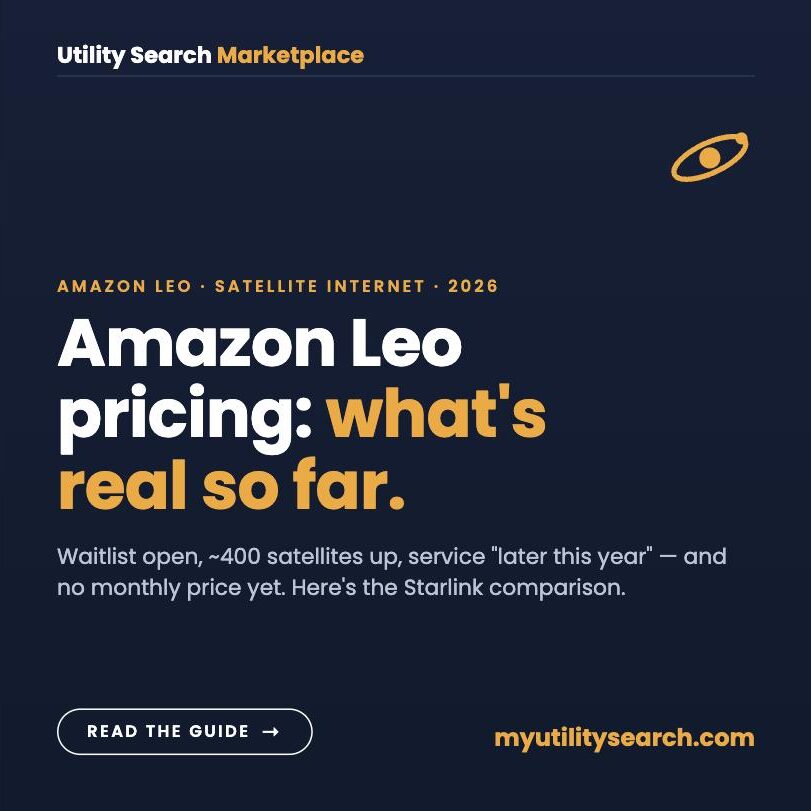
Amazon Leo pricing has not been announced. As of September 2026 Amazon has confirmed three things: a residential waitlist is open at leo.amazon.com, commercial service in the U.S. is planned to start “later this year,” and the standard home dish is designed to sell for under $400. No monthly plan price exists yet. The nearest reference point is Starlink, which charges $55–$130 a month for residential service plus $349 for the standard kit. Everything below separates what Amazon has said from what the internet has guessed.
Last updated: 6 September 2026. Amazon Leo pricing will change the day Amazon publishes a rate card — this page is refreshed monthly until it does.
TL;DR — Amazon Leo pricing in September 2026
- Monthly price: not announced. Amazon has published no residential plan pricing. Any dollar figure you see is an estimate.
- Dish price: “under $400” for the standard Leo Pro terminal, per Amazon. Starlink’s standard kit is $349; its Mini is $199.
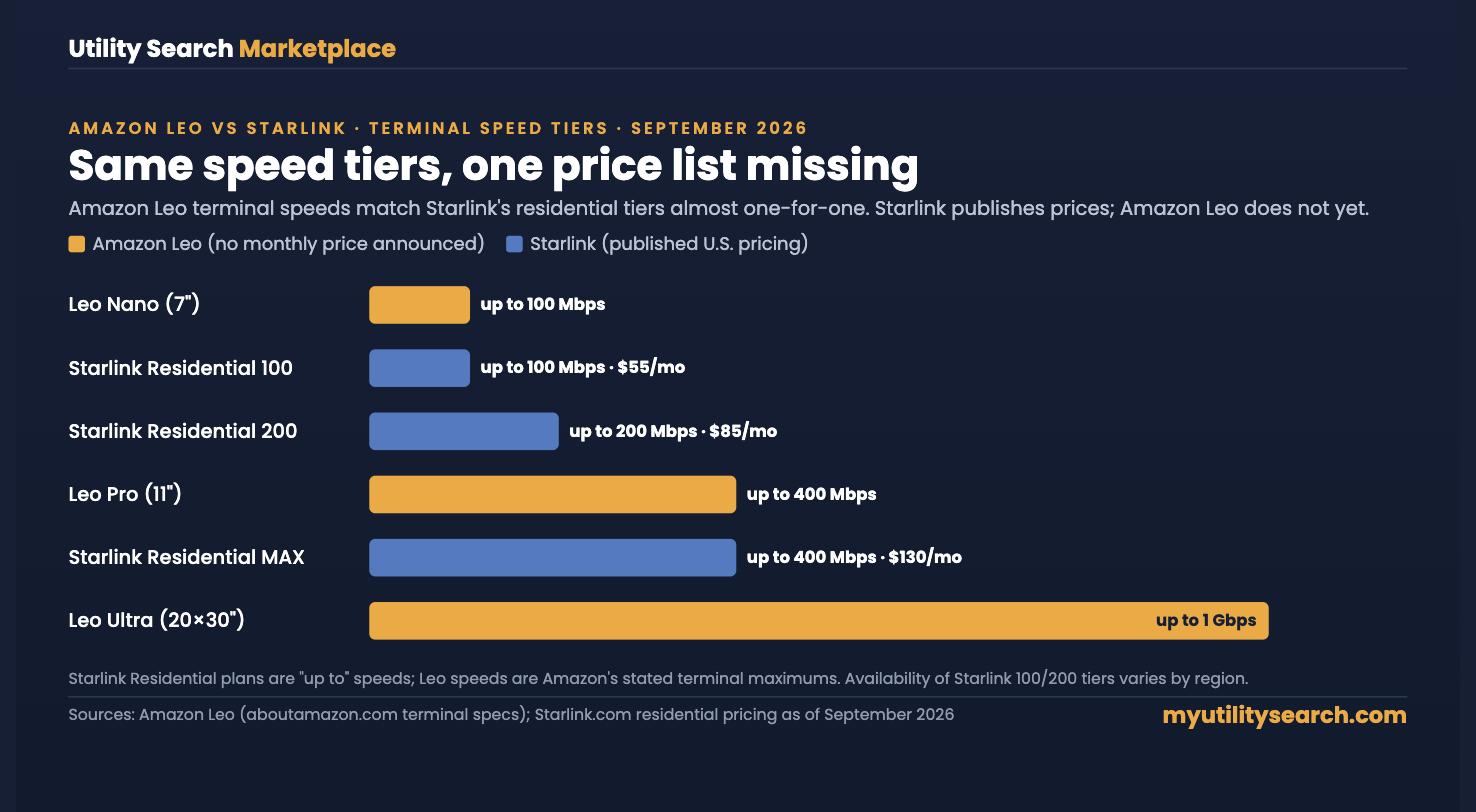
- Speeds: 100 Mbps (Nano), 400 Mbps (Pro), 1 Gbps (Ultra) — the same tiers Starlink sells at $55, $85 and $130 a month.
- Timing: about 400 satellites in orbit, service “later this year.” The FCC waived the July 2026 half-constellation deadline in June; the 2029 full-deployment deadline stands.
- Waitlist: open now at leo.amazon.com for U.S. households. No deposit, no card.
- Subsidized pricing is coming first. Arkansas signed the first state BEAD agreement with Amazon Leo in June 2026 — 1,700 rural locations, which carry a low-cost plan obligation.
What is Amazon Leo pricing right now?
Amazon Leo pricing today is a terminal price target and nothing else. Amazon has said repeatedly that it wants Leo to be affordable and that the standard residential antenna should cost customers less than $400. It has not published a monthly plan, a data policy, an installation fee, or a contract term. Here is the full list of what is confirmed versus what is still open.
| Line item | Status | What Amazon has said |
|---|---|---|
| Monthly residential plan | Not announced | Nothing. Amazon’s only pricing language is “affordable” and “bridge the digital divide.” |
| Standard dish (Leo Pro) | Target stated | “Less than $400” to produce and sell, per Amazon’s 2025 terminal reveal. |
| Compact dish (Leo Nano) | Not announced | 7-inch portable unit, up to 100 Mbps; positioned as the low-cost entry point. |
| Enterprise dish (Leo Ultra) | Not announced | Roughly 20 × 30 inches, up to 1 Gbps; sold to business, government and aviation customers. |
| Data caps | Not announced | No fair-use or cap policy published. |
| Contract | Not announced | No term or early-termination language published. |
| Subsidized (BEAD) service | Partly known | BEAD rules require a low-cost plan option at funded locations; Arkansas executed the first Leo agreement in June 2026. |
What has changed since the rebrand — the dated record
The Amazon Leo pricing question keeps coming back because the launch keeps getting more real. The dated developments, from Amazon’s own announcements and FCC filings:
- November 2025 — Project Kuiper becomes Amazon Leo. Amazon rebrands the constellation, opens leo.amazon.com with a “join the list” residential signup, and names the three terminals: Leo Nano, Leo Pro and Leo Ultra.
- April 2026 — Amazon agrees to buy Globalstar for roughly $11.6 billion, adding spectrum and a direct-to-device (phone) path targeted for 2028. The deal is expected to close in 2027.
- June 8, 2026 — FCC waives the July 30 deadline. Amazon no longer has to have 1,616 satellites up by July 30, 2026. The catch: satellites launched after that date lose spectrum priority until Amazon proves it can hit the halfway mark, with priority restored automatically by March 2028 at the latest. The July 30, 2029 deadline for all 3,232 first-generation satellites stands.
- June 11, 2026 — Arkansas executes the first state BEAD agreement with Amazon Leo. About 1,700 locations and 4,200 residents, funded with $1.76 million in BEAD dollars plus more than $580,000 of Amazon match — roughly $1,400 per location all-in.
- July 2, 2026 — Amazon Leo passes 375 satellites in orbit after an Atlas V launch, and says it now has enough capacity to begin broadband service. Independent trackers count about 396 including test units.
- September 2026 — Amazon says commercial service starts “later this year.” ULA Vulcan launches begin adding 45 satellites per mission. Still no residential price.
Amazon Leo terminals and speeds: what the “under $400” dish buys you
Amazon Leo pricing starts with the hardware because the hardware is the only thing Amazon has priced. Three customer terminals are planned, and each maps to a speed ceiling. The Leo Pro is the residential dish that most waitlist households will receive.
| Terminal | Size | Top speed | Who it is for | Price |
|---|---|---|---|---|
| Leo Nano | 7 × 7 in | Up to 100 Mbps | Portable, RV, backup, budget rural | Not announced |
| Leo Pro | 11 × 11 in | Up to 400 Mbps | Standard home internet | Target under $400 |
| Leo Ultra | ~20 × 30 in | Up to 1 Gbps | Enterprise, government, aviation, maritime | Not announced |
Two design facts matter for eventual Amazon Leo pricing. First, Amazon builds the terminal chip and the satellites in-house and has committed more than $10 billion to the program, which is the same vertical-integration play SpaceX used to drive Starlink’s kit from $599 to $349. Second, the satellites use optical inter-satellite links and orbit slightly higher than Starlink’s, which Amazon says lets each satellite cover more ground — a capacity argument, and capacity is what determines whether a provider can afford a $55 tier or has to hold at $120.
Amazon Leo pricing vs Starlink: the only real comparison available
Is Amazon Leo cheaper than Starlink? Nobody can answer that yet, because one side of the comparison is blank. What you can do is line up Starlink’s current U.S. rate card against Leo’s announced tiers so you know what “competitive” would have to mean. Starlink’s residential pricing as of September 2026, next to what Amazon Leo pricing has confirmed:
| Plan | Starlink (published) | Amazon Leo (announced) |
|---|---|---|
| Entry residential ~100 Mbps | Residential 100 — $55/mo (select regions) | Leo Nano tier — price not announced |
| Mid residential ~200 Mbps | Residential 200 — $85/mo (select regions) | No matching tier announced |
| Top residential ~400 Mbps | Residential MAX — $130/mo | Leo Pro tier — price not announced |
| Standard dish | $349 (free rental promos in some areas) | “Under $400” |
| Compact dish | Starlink Mini — $199 | Leo Nano — not announced |
| Portable / RV plans | Roam 100 GB $55, Roam 300 GB $80, Roam Unlimited $175 | Not announced |
| Congestion charge | $100+ one-time in high-demand cells | Not announced |
| Contract | None; 30-day return | Not announced |
| Satellites in orbit | ~9,000+ | ~400 |
The honest read on Amazon Leo pricing: Amazon has priced the dish at parity, not below. “Under $400” versus $349 is not a discount. If Amazon Leo pricing is going to win customers from Starlink, it will have to do it on the monthly bill or on bundling — and Amazon has a Prime membership with more than 200 million members to bundle into. That is the variable to watch, not the dish.
Compare internet, energy & home security at your address
What should you do while Amazon Leo pricing is unknown?
Join the waitlist and keep shopping. Waiting on Amazon Leo pricing costs nothing and commits you to nothing; Amazon uses it to sequence which addresses get terminals first once service opens. What you should not do is wait for Amazon Leo pricing before fixing a bad connection today, because the first year of any LEO service goes to a limited set of cells and a limited number of terminals.
- Rural address with no cable or fiber: do not wait on Amazon Leo pricing — Starlink is available at roughly 99% of U.S. addresses today. Compare it against T-Mobile Home Internet and Verizon 5G Home first — fixed wireless is usually $35–$60 a month with no dish to buy.
- You are in a BEAD-funded location: if your state awarded your address to Amazon Leo (Arkansas is first; more states are re-bidding satellite locations this fall), the subgrant carries a mandatory low-cost plan. Ask your state broadband office what the low-cost tier is — that is the first real Amazon Leo pricing anyone will see.
- You have cable or fiber already: satellite is a backup product for you, not a replacement. Latency on LEO runs 30–60 ms in practice versus under 20 ms on fiber, and the dish costs more than a year of a cheap cable tier.
- You want a portable unit: the Leo Nano is the one to wait for. Until it ships, Starlink Mini with a Roam plan is the only comparable product.
Who is Amazon Leo, and why does it matter for prices?
Amazon Leo is Amazon’s low-Earth-orbit satellite internet network, formerly Project Kuiper. It is owned outright by Amazon.com, Inc., and runs from a headquarters in Redmond, Washington, with satellite production in Kirkland and terminal processing in Florida. The first-generation constellation is licensed for 3,232 satellites; the FCC has since approved a larger second phase. Commercial customers already signed include JetBlue (in-flight Wi-Fi from 2027), Delta (from 2028), DIRECTV, Australia’s NBN, and South Africa’s Herotel. The residential U.S. launch is the piece still missing a price — which is why Amazon Leo pricing searches keep climbing.
Why the ownership matters: Amazon has never run a consumer subscription product at a loss for long without bundling it — Prime Video, Prime Music and Amazon Photos all became membership features. The most likely shape of Amazon Leo pricing at scale is a standalone plan plus a Prime discount, which is exactly how Amazon attacked Netflix, Spotify and Google Photos.
Amazon Leo pricing FAQ
How much will Amazon Leo internet cost per month?
Amazon has not announced a monthly price for Amazon Leo residential internet as of September 2026. The only price Amazon has stated is a target of under $400 for the standard Leo Pro dish. Starlink, the closest competitor, charges $55 to $130 a month for residential plans.
Is Amazon Leo cheaper than Starlink?
Not yet knowable. Amazon Leo pricing for the dish (“under $400”) is roughly at parity with Starlink’s $349 standard kit, not below it. Whether the monthly bill undercuts Starlink’s $55–$130 range is the open question, and a Prime bundle is the most likely lever.
When will Amazon Leo be available for home internet?
Amazon says commercial service begins “later this year” in 2026, starting with the U.S., Canada, the U.K., France and Germany. About 400 satellites are in orbit; the full 3,232-satellite first generation is due by July 2029. Early availability will be limited to specific coverage cells and waitlist order.
How do I join the Amazon Leo waitlist?
Go to leo.amazon.com and use the “join the list” form for residential service. It requires an address and an email, no deposit and no payment card. Amazon uses the list to decide which addresses receive terminals first when service opens.
Does Amazon Leo have data caps or contracts?
Amazon has published no data cap, fair-use policy, contract term, or early-termination fee for Amazon Leo. Starlink’s residential plans are unlimited with a fair-use policy and no contract, which sets the bar Amazon Leo pricing will be judged against.
Who owns Amazon Leo?
Amazon.com, Inc. owns Amazon Leo outright. It was launched in 2019 as Project Kuiper and renamed Amazon Leo in November 2025. Amazon has committed more than $10 billion to the constellation and agreed in April 2026 to acquire Globalstar for about $11.6 billion to add spectrum and phone connectivity.
That is the whole of Amazon Leo pricing as of September 2026: a sub-$400 dish, a free waitlist, and a monthly rate Amazon has not said out loud. When it does, this page will carry the number the same day — and you can already compare every provider that serves your address right now.
Compare internet, energy & home security at your address
Sources
Every figure above can be checked against the primary document:
- Amazon Leo — official site and residential waitlist — “join the list” signup, terminal names.
- Amazon, Amazon Leo newsroom — terminal specs (Nano/Pro/Ultra), “375+ satellites” mission update, aviation and enterprise agreements.
- FCC, DA 26-553 (June 2026) — conditional waiver of the July 30, 2026 half-constellation milestone; 2029 deadline retained.
- GeekWire, “FCC gives Amazon Leo more leeway,” June 8, 2026 — waiver conditions, satellite count, “commercial service this year.”
- Broadband Breakfast, “Arkansas first state to execute BEAD agreement with Amazon Leo,” June 11, 2026 — 1,700 locations, $1.76M BEAD, $580K+ Amazon match.
- Starlink, residential plans and pricing — $55/$85/$130 tiers, $349 standard kit, $199 Mini, Roam pricing (verified September 2026).
Keep going
- Starlink internet plans and prices — every current tier, kit and fee
- Starlink vs T-Mobile Home Internet — satellite against 5G fixed wireless
- Best internet for rural areas — what actually reaches unserved addresses
- HughesNet internet review — the geostationary alternative and its data caps
- Best 5G home internet — Verizon, T-Mobile and AT&T Internet Air compared
- Satellite direct-to-device explained — where Amazon’s Globalstar deal fits
- Starlink news and timeline 2026 — price increases, IPO, launches