Blog
T-Mobile vs Starlink 2026: Prices, Speeds and Which Is Better at Your Address

Updated on October 28, 2026
8 min read
Starlink vs T-Mobile Home Internet — if you’re outside a cable or fiber coverage area, these are your two best options in 2026.
For the latest rural internet availability data, check the FCC Broadband Availability Map to see which providers serve your address.
Both have improved dramatically.
Both are genuinely usable for streaming, working from home, and video calls.
But they’re built differently — and the right choice depends entirely on where you live and how you use the internet.
Here’s the full breakdown.
The Quick Answer
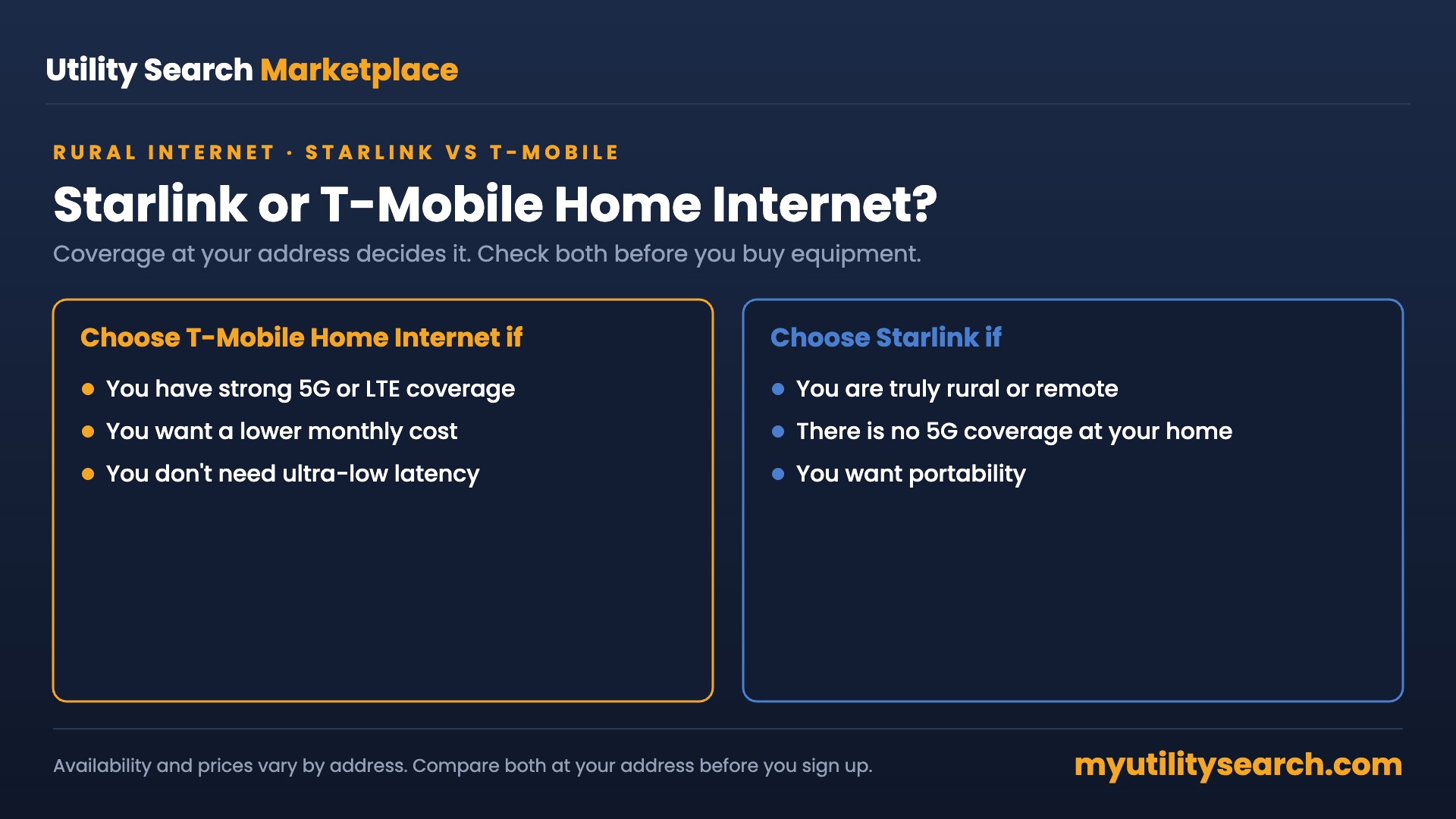
Choose T-Mobile Home Internet if you’re within a strong 5G or LTE coverage area, want lower monthly cost, and don’t need ultra-low latency.
Choose Starlink if you’re in a truly rural or remote area with no 5G coverage, need the most reliable connection regardless of weather, or want portability.
Pricing Comparison
T-Mobile Home Internet
- Price: $50/month (with autopay, no contract)
- Equipment: Gateway router included — no upfront cost
- Contract: Month-to-month
- Data: Unlimited, no caps
Starlink
- Residential: $55, $85 or $130/month (100 Mbps, 200 Mbps, MAX; raised June 2026)
- Equipment: about $349 for the Starlink kit (often discounted)
- Contract: Month-to-month (pause anytime)
- Data: Unlimited, but speeds may deprioritize during peak congestion
- Portability add-on: $25/month extra for use away from home address
T-Mobile is significantly cheaper — $50/month vs $85/month for Starlink’s 200 Mbps plan plus a kit of about $349. Over 2 years, T-Mobile Rely saves you roughly $1,200 compared to Starlink.
But that price difference only matters if T-Mobile actually works well at your location.
Speed Comparison
T-Mobile Home Internet Speeds
- Download: 72–245 Mbps (typical real-world)
- Upload: 15–30 Mbps
- Latency: 30–60ms
- Depends heavily on local tower congestion and 5G vs LTE signal strength
Starlink Speeds
- Download: 100–250 Mbps (standard residential)
- Upload: 10–20 Mbps
- Latency: 20–40ms (low-earth orbit satellites — dramatically better than old satellite internet)
- More consistent across rural areas with clear sky view
On paper, speeds are similar. In practice, Starlink tends to be more consistent in truly rural areas where T-Mobile’s tower coverage thins out.
Latency: The Gaming & Video Call Question
Old satellite internet (HughesNet, Viasat) had 600–800ms latency — completely unusable for gaming or video calls.
Starlink changed everything. Its low-earth orbit satellites deliver 20–40ms latency — comparable to cable internet.
T-Mobile is in the same ballpark at 30–60ms in good coverage areas. Both are perfectly usable for Zoom, gaming, and streaming.
If gaming is your priority, Starlink has the edge on consistency — especially in areas where T-Mobile towers get congested in the evenings.
Coverage: Where Each Works
T-Mobile Home Internet Coverage
Available in 50 million+ homes across the US. Strongest in suburban and semi-rural areas within range of a 5G or 4G LTE tower. Check availability at your address before ordering — it varies significantly by location.
Starlink Coverage
Available virtually everywhere in the continental US, Alaska, Hawaii, and most of Canada. If you can see a clear patch of sky, you can get Starlink. This is the real differentiator — it works in places where no terrestrial internet exists.
If you’re in a genuinely remote location — a farm, cabin, mountain property — Starlink is often the only real option.
Reliability & Weather Performance
T-Mobile performance depends on tower congestion. During peak hours (evenings, weekends), speeds can drop noticeably. During severe weather, signal can be affected.
Starlink is affected by heavy rain, snow, and especially obstructions (trees, buildings). SpaceX ships a snow-melting dish that handles most winter conditions. Most users find it highly reliable except during the most severe storms.
Setup & Equipment
T-Mobile sends a gateway router. Plug it in, connect your devices. Setup takes 10 minutes. No drilling, no pointing dishes.
Starlink requires mounting the dish with a clear, unobstructed sky view. The Starlink app shows you the ideal placement location. Most homeowners can self-install, but it’s more involved than T-Mobile.
Who Should Choose T-Mobile Home Internet?
- Anyone with solid T-Mobile 5G or LTE signal at their address
- Budget-conscious households — $50/month is hard to beat
- Renters or people who move frequently (easy to set up anywhere)
- Suburban households without fiber or cable options
Who Should Choose Starlink?
- Rural homes beyond T-Mobile’s reliable coverage footprint
- Farms, ranches, cabins, or remote properties
- RV travelers and off-grid users (with portability plan)
- Anyone who needs the most consistent performance regardless of terrain
Starlink vs T-Mobile Home Internet: the questions people ask, answered
What rural and suburban shoppers type when they are choosing between Starlink and T-Mobile, in their own words, answered as of October 28, 2026.
Which is better in 2026, Starlink or T-Mobile Home Internet?
If T-Mobile 5G Home Internet is available at your address with a strong signal, it is usually the better value: $50 to $70 a month with AutoPay (Rely, Amplified, All-In), no contract, the gateway included, and $35 to $40 when bundled with a qualifying T-Mobile phone plan. Starlink wins where T-Mobile is unavailable or its signal is weak, which covers much of rural America: it works almost anywhere with a clear view of the sky, at a higher price.
How much does Starlink cost compared with T-Mobile?
Starlink Residential plans rose in June 2026 to $55 (100 Mbps), $85 (200 Mbps) and $130 (MAX) a month, plus a dish kit that lists around $349 and is frequently discounted; Roam (portable) runs $55 for 100 GB, $80 for 300 GB and $175 unlimited. T-Mobile’s home plans are $50, $60 and $70 a month with AutoPay, equipment included. Over two years a typical Starlink Residential 200 plan costs about $1,200 more than T-Mobile Rely, including the kit.
Why is my T-Mobile Home Internet slow, and would Starlink be faster?
T-Mobile home internet shares a cell tower’s capacity with phones, and households in busy or fringe areas commonly see 25 to 100 Mbps instead of the advertised 87 to 415 Mbps range; moving the gateway to an upstairs window facing the tower often helps. Starlink’s speed depends on the sky, not a tower: most residential users see 50 to 200 Mbps with 25 to 60 ms latency. If your T-Mobile speeds are consistently under 25 Mbps, Starlink is likely faster at your address.
Is the Starlink dish better than the T-Mobile gateway?
They solve different problems. The Starlink dish needs a clear view of the northern sky and a mount on a roof, pole or ground, but works at nearly any rural address; the T-Mobile gateway sits indoors and needs only cell signal. The Starlink hardware is a purchase you keep; the T-Mobile gateway is included and returned if you cancel. In storms both can slow, Starlink in heavy rain or snow and T-Mobile when towers lose power.
Starlink Roam or T-Mobile for an RV or second home?
Starlink Roam is built for that: $55 for 100 GB or $80 for 300 GB a month, pausable when you are not traveling, usable anywhere in the country. T-Mobile Home Internet is tied to your registered address, and its separate Away plans are limited. For a cabin with T-Mobile coverage, a T-Mobile plan at that address is cheaper; for an RV that moves, Roam is the practical choice. Check what serves a fixed address in the address check above.
Also searched as: tmobile vs starlink 2026, starlink vs t-mobile home internet, is starlink better than t-mobile, starlink roam vs t-mobile and why is t-mobile home internet slow. They all mean the comparison on this page.
FAQs: Starlink vs T-Mobile Home Internet
Is Starlink better than T-Mobile for rural areas?
In most truly rural areas — yes. T-Mobile requires decent cellular tower coverage, which thins out quickly in remote locations. Starlink works wherever you can see the sky. For farms, ranches, and remote properties, Starlink is usually the superior choice.
Can I use Starlink for gaming?
Yes. Starlink’s 20–40ms latency is low enough for most online gaming. It’s not as fast as fiber, but it’s a massive improvement over old satellite internet and is fully functional for competitive gaming in most cases.
Does T-Mobile Home Internet work everywhere?
No — it requires adequate 4G LTE or 5G tower coverage. T-Mobile lets you check your address before ordering. In areas with weak cellular signal, speeds will be disappointing. Always verify coverage at your specific address.
Is Starlink worth $85 a month?
If you have no other good internet options, absolutely. $85 a month for the 200 Mbps plan in a location that previously had no broadband is transformative. If you have T-Mobile coverage available, the $70/month savings may make T-Mobile the smarter choice.
Can I use T-Mobile Home Internet and Starlink together?
Some households use both for redundancy — Starlink as the primary connection with T-Mobile as a backup. This is overkill for most users but makes sense for remote work-critical households.
Final Verdict
Starlink vs T-Mobile Home Internet 2026 is the most relevant comparison for rural residents.
In the Starlink vs T-Mobile Home Internet 2026 comparison, both have expanded their rural coverage significantly.
Compare Internet Options in Your Area — Free
Not sure which internet provider is available at your address?
At MyUtilitySearch.com, you can compare every internet provider available in your zip code — including Starlink, T-Mobile Home Internet, fiber, and cable options — with real pricing and no-pressure shopping.
You can also check out our full guide to the best internet providers in 2026 for a complete comparison across all connection types.
Also compare energy, home security and home warranty at your address
Electricity plans in 14 deregulated states. Security and warranty nationwide.
Are you a commercial customer?
Business internet, phones and IT for an office, store or multi-site location are quoted by address, not from a posted rate. Call our business internet desk at (866) 328-7973, or use BOX by TechGuidance to see every serviceable business connection at your location.
Keep going
- Verizon 5G Home Internet plans — how the third fixed-wireless carrier prices against T-Mobile
- T-Mobile Home Internet: full plans, prices & review
- Is Starlink worth it?
- Starlink internet review
- How Starlink took over the world
- Find the best internet for your area
- Starlink news and timeline 2026
- Amazon Leo pricing: what is confirmed vs Starlink