





Blog
The Three Leaks in the Coax: Cable Internet Alternatives and the One Threat Cable Can’t Encrypt

Updated on October 1, 2026
7 min read
By Christopher Burg · Last updated: August 2026
The main cable internet alternatives are fiber, 5G home internet (fixed wireless from carriers like T-Mobile and Verizon), and satellite service like Starlink. Fiber usually wins on speed and price where it’s built; 5G home internet is the cheapest wireless swap; Starlink fits rural addresses with no wired option. Which one actually beats cable depends entirely on your address.
Key takeaways
- The three real cable internet alternatives in 2026 are fiber, 5G home internet, and satellite.
- Fiber is the strongest head-to-head swap where available; 5G home internet is usually the cheapest. See the cheapest internet plans across all three types.
- For decades the cable industry’s problem was people taking its signal without paying — a problem it engineered away.
- Its problem now is the opposite: customers leaving the coax for these alternatives — the one leak encryption can’t close.
- The only way to know which alternative fits is to compare what’s actually live at your address.
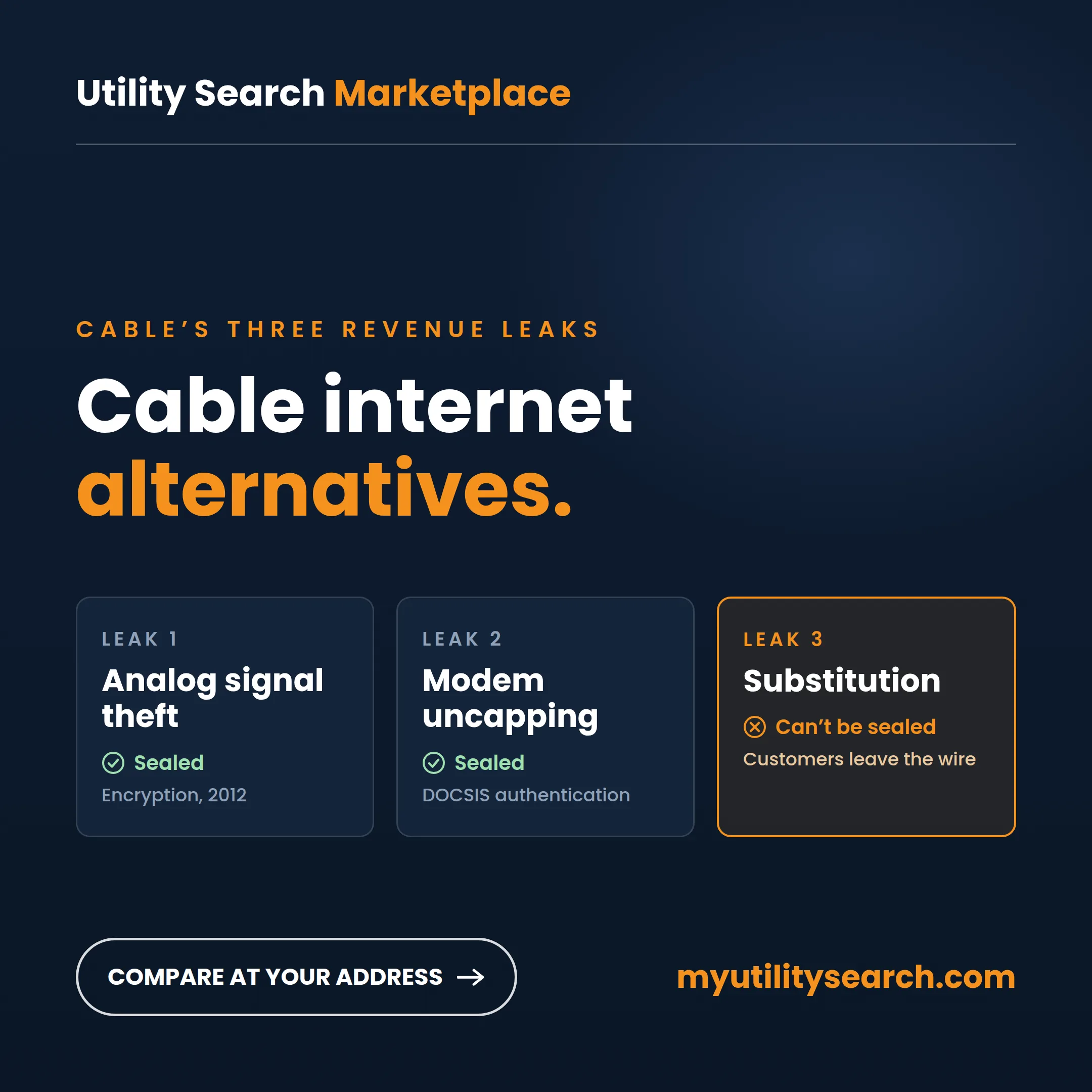
For forty years, the cable industry fought a single enemy: the openness of its own wire. Coax was a shared, physical medium, and every home it passed was a potential leak. The industry closed those leaks one by one — brilliantly, and at enormous cost. What follows is the short history of how they did it, and why the newest leak is the one they can’t patch. That last leak is where your cable internet alternatives come in.
Leak one: analog TV theft, and the $6 billion the coax bled
Before cable was encrypted, the wire itself was the vulnerability. At its peak, the industry estimated signal theft at more than $6 billion a year in unrealized revenue, with millions of U.S. homes receiving service without paying (source: NCTA). To size that: contemporary reporting noted that figure was roughly half of Comcast’s entire 2002 revenue.
It happened because analog coax leaked by design. The two most common methods were removing the filters at the cable box, or splicing the line upstream of those filters and running a new drop — then splitters fed one paid connection to extra TVs or entire neighboring units. In shared housing, a single hookup quietly served several homes.
The numbers show how architecture, not enforcement, was the fix. Analog theft ran around 4.65% of homes passed in a 2005 survey, down from 11.5% in 2000 — while digital cable, broadband, and phone service already showed theft rates under 1% (source: NCTA survey data). Digital didn’t leak the way analog did.
The regulatory hinge came on October 10, 2012, when the FCC issued a Report and Order allowing cable operators to encrypt the basic service tier on all-digital systems (FCC). Before that, rules had prohibited basic-tier encryption, so anyone could see those channels by connecting the coax to a TV. As systems finished going all-digital across roughly 2012–2015, operators encrypted everything and could switch service on or off remotely — no truck, no filter to remove. The “just screw the coax back on” era ended. Leak one: sealed.
Leak two: DOCSIS uncapping, and the road to federal prison
When cable became an internet pipe, the wire leaked again — this time as bandwidth. Uncapping meant tampering with a modem’s configuration so it ran faster than the plan allowed, or impersonated a paying account. It peaked on early DOCSIS 1.x networks and worked by spoofing the config file the modem loaded when it registered.
The industry closed this leak the same way it closed the first: by building authentication into the network. Operators made the system verify the config file’s authenticity at registration using a checksum a user can’t forge, then layered on BPI+, Early Authentication Encryption in DOCSIS 3.0, and CMTS-side enforcement. On today’s DOCSIS 3.1 networks, casual uncapping is effectively dead.
The people who commercialized it didn’t fare well. The best-known case: TCNiSO, whose owner distributed modem-hacking hardware and software from 2003 to 2009, helping thousands obtain service without paying and earning up to $1 million in revenue. He was convicted on seven counts of wire fraud and sentenced to three years in federal prison, plus a $50,000 fine and restitution (U.S. Department of Justice). Leak two: sealed, and prosecuted.
Definition — 5G home internet (fixed wireless access, or FWA): Home internet delivered over a cellular network instead of a wire. A carrier-supplied gateway receives a 5G signal and shares it over Wi-Fi. No coax, no fiber line to the home — which is exactly why it sits outside everything the cable industry built to protect the coax.
Leak three: the one cable can’t encrypt
Here’s the pattern in the first two leaks: someone was taking cable’s signal off cable’s wire, and cable re-engineered the wire to stop them. Encryption worked because the customer still needed the coax.
The third leak breaks that assumption. Today’s pressure on cable isn’t theft — it’s substitution. Customers aren’t stealing the signal; they’re leaving the wire entirely for cable internet alternatives that never touch coax: fiber to the home, 5G home internet over a cellular network, and low-earth-orbit satellite like Starlink. You cannot encrypt your way out of a customer who simply chose a different pipe. That’s why substitution is the leak cable can’t close — and why comparing cable internet alternatives is now a normal, legitimate shopping decision rather than anything to hide.
The real cable internet alternatives, compared
Typical figures for these cable internet alternatives vary by address and change often — treat them as ballpark and confirm current offers before you switch.
| Option | Typical monthly | Typical speed | Latency | Best for |
|---|---|---|---|---|
| Cable | $50–$100+ | 100–1,200 Mbps | Low (~15–30 ms) | Widely available baseline |
| Fiber | $50–$80 | 300–5,000 Mbps | Lowest (~5–15 ms) | The strongest swap where it’s built |
| 5G home internet (FWA) | $50–$70 | 100–300 Mbps | Moderate/variable (~30–60 ms) | Cheapest wireless switch; strong-signal addresses |
| Satellite (Starlink) | ~$120 | ~50–250 Mbps | Higher (~25–60 ms) | Rural addresses with no wired option |
The takeaway from the table: of the three cable internet alternatives, fiber is the clean head-to-head winner when you can get it, 5G home internet is usually the cheapest way off cable, and satellite exists to solve the “no wire at all” problem. None of that is knowable in the abstract — it’s an address-level question.
Compare internet, energy & home security at your address
How to choose a cable internet alternative for your address
You don’t need to guess. Work through the cable internet alternatives in this order:
- Check fiber first. If a fiber provider is live at your address, it’s usually the best value and the lowest latency — the strongest of the cable internet alternatives. Availability is street-by-street, so confirm your specific address, not just your city.
- If no fiber, weigh 5G home internet. It’s typically the cheapest switch, but performance depends on your signal to the nearest tower. Look for a plan with a trial window — T-Mobile Home Internet is the best-known example — so you can test real speeds in your home before committing.
- If you’re rural with no wired option, consider satellite. Starlink costs more and adds some latency, but for an address with no cable or fiber, it turns “no broadband” into “broadband.”
- Match the connection to how you actually use it. Heavy video calls and competitive gaming reward fiber’s stability; general streaming and browsing run fine on FWA. Buy for your real usage, not the biggest number.
- Compare what’s actually available before you cancel anything. Provider maps overstate coverage. Check the live options at your exact address first.
The honest bottom line: cable spent two decades proving it could engineer its way out of theft. It can’t engineer its way out of you having real cable internet alternatives — and today you usually do.
Cable internet alternatives: FAQ
What is the cheapest cable internet alternative?
5G home internet (fixed wireless) is usually the cheapest cable internet alternative where it’s available, often $50–$70/month with no separate equipment fee. Fiber can be similarly priced and faster where it’s built.
Is 5G home internet as good as cable?
For everyday streaming, browsing, and video calls, 5G home internet is usually comparable to cable. It can be more variable than a wired connection, so signal strength at your address matters — a plan with a trial period lets you confirm before switching.
Is Starlink a good cable alternative?
Starlink is a strong option for rural addresses with no cable or fiber. It costs more (around $120/month) and adds some latency, so in areas that already have fiber or cable, a wired alternative is usually the better value.
Will switching from cable hurt my internet speed?
It depends which alternative you choose. Fiber typically matches or beats cable; 5G home internet and satellite can be slower or more variable. Compare the cable internet alternatives available at your address before deciding.
How do I find which cable internet alternatives are available where I live?
Availability is address-specific, not city-wide. Enter your address in a comparison tool that returns the providers actually serving your location, then compare the cable internet alternatives on price, speed, and latency.
Compare internet, energy & home security at your address
Keep going
- Cable internet: how it works, speeds & best providers
- Fiber internet near me: compare fiber, cable & 5G at your address
- T-Mobile Home Internet: plans, prices & review
- Starlink internet: plans, prices, speeds & availability
- Best Starlink setup for rural areas: plans, cost & alternatives
- Shop deregulated energy rates in your state
- Compare home security options


One thought on “The Three Leaks in the Coax: Cable Internet Alternatives and the One Threat Cable Can’t Encrypt”