Blog
Starry Internet Just Cut Gigabit to $45 With a 3-Year Price Lock — and Sends Everyone Else to Verizon

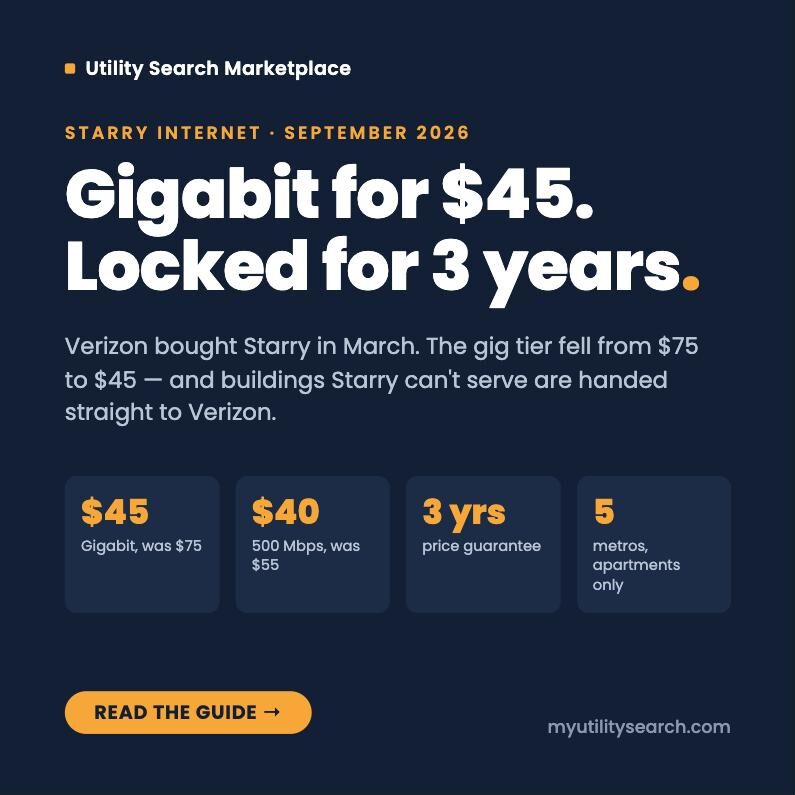
Starry internet is having the strangest good year of its life. On September 9, 2026, starry.com lists Starry Gigabit at $45 a month with a three-year price guarantee and the Wi-Fi router included — down from the $75 that Allconnect, HighSpeedInternet.com and most comparison sites still quote. Starry 500 fell from $55 to $40, and Starry 200 holds at $30. The reason is the logo: since March 2026 Starry has been “A Verizon Company,” and when we ran two real apartment addresses through its checker, the ones Starry could not serve were handed straight to Verizon.
That is the whole story in one screen. Starry internet — the Boston rooftop-wireless startup that went public in 2022, filed Chapter 11 in 2023 and was called “on life support” by analysts as recently as last fall — now has the cheapest advertised gigabit in New York, Boston, Los Angeles, Denver and Washington, D.C., and a parent with 17 million broadband connections behind it. If you live in one of the buildings it reaches, it is the best-value plan in the city. If you don’t, the same form quietly sells you Verizon.
Last updated: 9 September 2026. Prices pulled from starry.com and its New York and Boston city pages on September 9, 2026, plus two live address checks (Chelsea, Manhattan and North Station, Boston) run the same day; Verizon facts from Verizon’s October 8, 2025 acquisition release and July 24, 2026 second-quarter results; refreshed monthly.
TL;DR — Starry internet in September 2026
- New rate card (starry.com, Sep 9, 2026): Starry 200 $30 · Starry 500 $40 · Starry Gigabit $45, each “with Debit Discount” (pay by credit card and add $5). Three-year price guarantee, router included, free professional install, no contract, no data cap, 30-day money-back, up to $200 credit toward your old provider’s cancellation fee.
- What changed: Gigabit was $75 and 500 Mbps was $55 as recently as the Allconnect (Jul 16) and HighSpeedInternet.com (Aug 4) 2026 listings. The cut is 40% on the gig tier. Uploads stay at 50 Mbps on most plans ($5 Upload Boost doubles it); Gigabit reaches 250 Mbps up in “select locations.”
- Who owns Starry now: Verizon. Announced October 8, 2025, closed March 2026, price undisclosed, roughly 100,000 apartment customers at signing. The site header now reads “Starry — A Verizon Company.”
- The catch we found: Starry internet is building-by-building, not block-by-block. Two large Manhattan and Boston apartment towers both returned “Starry isn’t available at your address,” then auto-redirected to verizon.com/home/internet in 12 seconds. Check your exact building before you plan around the $45.
What are the Starry internet plans and prices right now?
Three plans, three prices, one asterisk. Every Starry internet price on the site is quoted “with Debit Discount,” which Starry’s own help pages and the comparison sites describe as $5 off for paying with a debit or prepaid card. Pay with a credit card and the ladder is $35, $45 and $50. There is no separate AutoPay discount to lose, no equipment rental line, and no installation charge; Starry’s support center says flatly that “the advertised price is what you pay.”
| Plan | Speed (down / up) | Price with Debit Discount | Price by credit card | Was (mid-2026 listings) | Terms |
|---|---|---|---|---|---|
| Starry 200 | Up to 200 / 50 Mbps | $30/mo | $35/mo | $30 | 3-yr price guarantee, router included, no contract |
| Starry 500 (“Most Popular”) | Up to 500 / 50 Mbps | $40/mo | $45/mo | $55 | 3-yr price guarantee, router included, no contract |
| Starry Gigabit | Up to 1,000 / 50 Mbps (250 up in select locations) | $45/mo | $50/mo | $75 | 3-yr price guarantee, router included, no contract |
| Upload Boost (add-on) | Doubles upload to 100 Mbps | +$5/mo | +$5/mo | +$5 | Optional, any plan |
| Starry Connect (affordable-housing program) | Up to 30 Mbps | $15/mo | $15/mo | $15 | Participating buildings only |
Two details worth reading twice. First, the three-year price guarantee is printed on every plan card, not buried in a promo footnote — Starry’s older offer, per Allconnect, held the price for 12 months, so the lock tripled at the same time the price fell. Second, the “Summer is the time to upgrade to faster internet at a better value” banner and a support article that reads “for a limited time, faster speeds are available for our best price ever” both frame this as a promotion. Nothing on the site names an end date. Lock it while the card still says $45.
What happens when you check a real Starry address?
We ran two addresses through starry.com’s “Check for Starry in your building” form on September 9, 2026, the way a renter would. The first was a large rental tower on West 31st Street in Chelsea, Manhattan — a neighborhood Starry’s own New York page lists as served. The second was a high-rise on Nashua Street by North Station in Boston, Starry’s home market. The form wants a building address and then, in red, a unit number; it will not run without one.
Both came back the same way: a crossed-out map pin, “Starry isn’t available at your address,” and beneath it, “Don’t worry, we’ll transfer you to Verizon for the next available plan. You will be redirected in 12 seconds.” The countdown ran, and the tab landed on verizon.com/home/internet with a “source=starry” tag in the URL. Ten months ago a failed Starry check ended with a waitlist form. Today it ends with a Verizon 5G Home or Fios order page.
That tells you two things about Starry internet in 2026. The footprint is real but narrow — Starry serves the buildings where it has installed rooftop gear and in-building wiring, and a tower one block away can be a miss — and Verizon is treating starry.com as a front door for its own broadband. Neither is a reason to skip the check. It is a reason to run your exact address in our internet comparison tool first, see everything that reaches the building, and then run Starry’s form to confirm whether the $45 gig is one of them.
Who owns Starry internet now, and what did Verizon buy?
Verizon announced the deal on October 8, 2025 and closed it in March 2026 without disclosing a price. What it bought was small in subscribers — “nearly 100,000” apartment customers, against Verizon’s own 5-million-plus fixed-wireless base at the time — and specific in kind. Starry’s network puts millimeter-wave base stations on tall rooftops, receivers on the roofs of apartment buildings roughly a mile away, and wiring down to each unit, which lets it serve a 200-unit building without trenching a street or hanging fiber in a hallway. Verizon’s Joe Russo called the architecture “less expensive to build, quicker to deploy,” and one that “uniquely addresses the complexities of urban settings.”
The strategy behind it is on Verizon’s earnings slides. Verizon wants 8 to 9 million fixed-wireless subscribers by 2028 and fixed-wireless availability to 90 million households, and its second-quarter 2026 report showed 193,000 fixed-wireless net adds, 155,000 fiber adds and about 17.1 million FWA-plus-fiber connections in total. Apartment buildings are the part of that map where cable still wins by default, because a 5G receiver in a window on the 14th floor is a worse product than a Starry rooftop link. Starry was Verizon’s shortcut into that segment; analysts at Recon Analytics called the deal a “lifeline” for a company that was “flatlining.”
For customers, the visible changes so far are the ones above: the “A Verizon Company” header, the price cut, the three-year lock, and the Verizon handoff on failed checks. Starry’s own support notice still says “Nothing changes today” — billing, the Starry app and the 24/7 support team are unchanged, and the plans are still sold under the Starry brand. Whether Verizon eventually folds Starry buildings into Verizon 5G Home pricing, or keeps the cheaper Starry card as an apartment-only product, has not been announced.
Compare internet, energy & home security at your address
How does Starry internet compare to Verizon 5G Home, Fios, Xfinity and Spectrum?
Here is the field a renter in a Starry building actually chooses from. Verizon 5G Home is now Starry’s sibling, so the comparison is partly Verizon against Verizon; Fios, Xfinity, Spectrum, Optimum and Astound are the wired incumbents across the five Starry metros.
| Option in a Starry city | Speed (down / up) | Price | Price hold | Equipment & fees |
|---|---|---|---|---|
| Starry Gigabit | Up to 1,000 / 50 Mbps (250 up select) | $45 debit ($50 credit card) | 3-year guarantee | Router, install, support included; no contract, no cap |
| Starry 500 | Up to 500 / 50 Mbps | $40 debit ($45 credit card) | 3-year guarantee | Same |
| Starry 200 | Up to 200 / 50 Mbps | $30 debit ($35 credit card) | 3-year guarantee | Same |
| Verizon 5G Home / Plus / Ultimate | Up to 100–300 / 8–20 Mbps | $50 / $60 / $75 AutoPay; $35–$60 with a Verizon mobile line | 3 / 4 / 5-year guarantee | Router included; Amazon gift card promos |
| Verizon Fios 1 Gig | 940 / 880 Mbps fiber | $80 AutoPay ($90 base) | 5-year guarantee | $99 setup unless bundled with mobile |
| Xfinity 1 Gig | 1,000 / 35 Mbps cable | $50 (5-yr lock w/ AutoPay + paperless; varies by market) | 5-year | xFi gateway extra or bring your own |
| Spectrum Internet Premier | 500 / 20 Mbps cable | ~$40 first year | 12 months, then +$10–20 | Modem included; Wi-Fi router extra |
| T-Mobile Home Internet | Varies (5G) | $35–$70 AutoPay, best with a T-Mobile line | Price lock on select plans | Gateway included |

Read across the gigabit row and the argument makes itself. Starry internet’s $45 gig is $35 under Fios, $5 under Xfinity’s locked promo and $30 under Verizon’s own 5G Home Ultimate, which tops out at 300 Mbps. Starry’s weak spot is the upload: 50 Mbps is better than Verizon 5G Home’s 8–20 Mbps and roughly even with cable, but far from Fios’s 880 Mbps symmetrical. If you upload large video for a living, Fios or a fiber MDU provider is still the right buy. If you stream, game and take video calls, 50 Mbps up (100 with the $5 Upload Boost) is plenty, and the $35-a-month gap over three years is $1,260.
Where is Starry internet available?
Five metros, building by building: New York City and Hudson County, NJ; Boston; Los Angeles; Denver; and Washington, D.C. Starry’s New York page names the neighborhoods it has lit, and the list is long — Hudson Yards, the Lower East Side, East Village, Chelsea, West Village, Tribeca, Chinatown, the Upper West Side, Harlem, Washington Heights and Inwood in Manhattan; Clinton Hill, Williamsburg, Bushwick, Bed-Stuy, Crown Heights and Prospect Heights in Brooklyn; Mott Haven, Fordham, Parkchester and Riverdale in the Bronx; Long Island City, Astoria, Jackson Heights and Jamaica in Queens; and Hoboken, Weehawken and Jersey City across the river.
“Lit neighborhood” does not mean every building in it. Starry internet requires a receiver on your building’s roof and wiring to your unit, which the landlord has to agree to. That is why our Chelsea check failed in a neighborhood on the list, and why the single-family-home checkbox on the form exists — Starry briefly tested houses in Columbus, Ohio, and has since pulled back to apartments only. Allconnect estimates Starry reaches about 1.7% of U.S. households. The practical rule: if your building already has Starry, you will usually know, because the leasing office lists it; if it doesn’t, the checker will tell you in one screen.
How fast and how reliable is Starry internet?
Starry internet is fixed wireless, but not the kind that shares a phone tower with 50,000 handsets. Its base stations use licensed 24 GHz spectrum — Starry bought 104 licenses covering 51 markets in the FCC’s 2019 auction — along with 37 GHz and unlicensed 60 GHz, aimed at a receiver on the apartment building’s roof about a mile away. From the roof down, it is ordinary Ethernet or coax to a Starry Wi-Fi router in your unit. Because the wireless hop is point-to-point and the last stretch is wired, per-unit speeds are far more stable than 5G home internet’s, which is why Starry can sell a gigabit tier at all.
Starry claims 99.9% network reliability and 4.9-out-of-5 customer reviews on its own site; its Net Promoter Score, per Verizon’s acquisition release, is “nearly double the industry average.” Independent numbers are older: HighSpeedInternet.com’s speed-test sample from 2022–23 averaged 122 Mbps down, 93 Mbps up and 25 ms latency, before the current gig tier was widely sold. The known weakness of millimeter-wave is weather — Starry’s support center concedes that heavy rain, snow or fog “can have an impact on signal range” and says it is designed around that. Uploads are the other limit: 50 Mbps on every plan by default, 100 with Upload Boost, 250 only where the building’s link supports it.
How did Starry get here — Aereo’s founder, a SPAC, a bankruptcy and Verizon
Starry was founded in Boston by Chet Kanojia, the engineer whose earlier company, Aereo, lost a Supreme Court fight with the TV networks in 2014. Starry launched commercial service in Boston in December 2017 at $50 for 200 Mbps, expanded to New York, Los Angeles, Denver and Washington, and went public in March 2022 through a SPAC merger with FirstMark Horizon at a valuation that briefly topped $1.6 billion. Eight months later it laid off half its staff; on February 20, 2023 it filed for Chapter 11, and it emerged that year as a private company with new owners, a smaller map and no capital to expand it.
What kept Starry alive through all of that was the product: apartment residents who had it liked it, and building owners liked a provider that did not need to trench. Verizon’s October 2025 offer bought that technology and its 100,000 subscribers for an undisclosed sum, and the closing in March 2026 coincided with a leadership change at Verizon itself — Dan Schulman had just replaced Hans Vestberg as CEO with a mandate to grow broadband. The Starry brand, the app and the Boston support team survived. The price list, as of this summer, got better.
Is Starry internet worth it?
Yes, if your building has it — and that condition is doing all the work. At $45 for a gig with the router, install and support included, no contract, no cap and a three-year price guarantee, Starry internet is the cheapest gigabit plan in every one of its five metros as of September 2026, and it now has Verizon’s balance sheet behind the promise. The 50 Mbps upload and the weather sensitivity of millimeter-wave are the honest trade-offs; for most apartment households neither will register.
The 30-day money-back guarantee makes the decision cheap to test, and the $200 early-termination credit covers the exit from Xfinity, Spectrum or Optimum if you are mid-contract. The one thing to watch is the “limited time” language on the price cut: the three-year guarantee protects customers who sign now, not the card itself, so if you are in a Starry building and on the fence, the fence is the expensive place to be.
Starry internet FAQ
How much does Starry internet cost per month?
As of September 9, 2026, Starry internet is $30 for 200 Mbps, $40 for 500 Mbps and $45 for Gigabit, each with Starry’s Debit Discount; paying by credit card adds $5. Every plan includes the Wi-Fi router, free professional installation, a three-year price guarantee, no contract and no data cap. Upload Boost, which doubles upload speed to 100 Mbps, is $5 more.
Who owns Starry internet?
Verizon. It announced the acquisition of Starry on October 8, 2025 and completed it in March 2026 for an undisclosed price. Starry had roughly 100,000 apartment customers in New York, Boston, Los Angeles, Denver and Washington, D.C. at the time. Starry still operates under its own brand, and starry.com now carries the tag line “A Verizon Company.”
Is Starry internet good?
For an apartment building that has it, yes. Starry is fixed wireless from a rooftop receiver with a wired connection to each unit, so speeds are far steadier than 5G home internet, and it claims 99.9% reliability and a Net Promoter Score about double the industry average. The limits are a 50 Mbps upload on most plans and some sensitivity to heavy rain, snow or fog.
Did Starry internet cut its prices?
Yes. In mid-2026 Starry Gigabit was listed at $75 and Starry 500 at $55 on Allconnect and HighSpeedInternet.com. On September 9, 2026, starry.com shows Gigabit at $45 and 500 Mbps at $40 with the Debit Discount, with a three-year price guarantee on both. Starry’s site calls it a limited-time offer without naming an end date.
Is Starry better than Verizon 5G Home Internet?
On speed and price, yes: Starry Gigabit is $45 for up to 1,000 Mbps, while Verizon 5G Home Ultimate is $75 with AutoPay for up to 300 Mbps, and both are now Verizon products. Verizon 5G Home wins on availability, because it works anywhere Verizon has 5G coverage, and on discounts for Verizon mobile customers ($35–$60 with a phone line). If your building has Starry, take Starry; if it does not, Starry’s own checker will send you to Verizon.
How do I cancel Starry internet?
Sign in at account.starry.com, choose “Manage My Plan,” and cancel or pause; there is no contract and no early-termination fee, and you can also reach support 24/7 by phone at 888-231-9403 or at support@starry.com. Return the Starry router when service ends to avoid an equipment charge. New customers also get a 30-day money-back guarantee.
Does Starry require a contract, deposit or credit check?
No contract and no early-termination fee; plans are month to month and can be paused. Starry does not advertise a deposit or credit check, and its support center says there are no hidden fees and no installation fee. Most new customers are also eligible for up to a $200 account credit to cover a previous provider’s cancellation fee.
Where is Starry internet available?
Apartment buildings in New York City and Hudson County, NJ; Boston; Los Angeles; Denver; and Washington, D.C. Service is building-specific — it requires Starry’s rooftop receiver and in-unit wiring — so a neighborhood on Starry’s list can still include buildings it does not serve. Enter your building address and unit number at starry.com to confirm; if Starry cannot serve it, the form redirects you to Verizon’s plans.
That is Starry internet in September 2026: a $45 gigabit with a three-year lock that most comparison sites have not caught up to, a Verizon parent that turned a failed availability check into a sales lead, and a footprint that still comes down to whether your landlord signed. Check the building first, then compare everything else that reaches it before you decide.
Compare internet, energy & home security at your address
Sources
- Starry, Home Internet plans (viewed September 9, 2026) — Starry 200 $30, Starry 500 $40, Starry Gigabit $45 “with Debit Discount”; 3-year price guarantee; router included; Upload Boost $5; up to 250 Mbps upload in select locations; $200 early-termination credit; 30-Day Happy Interneting Guarantee; 4.9/5 reviews “as of 9/9/26.”
- Starry, New York City page and Boston page — same rate card; served-neighborhood list; live availability checks at 435 West 31st Street, New York, NY 10001 and 1 Nashua Street, Boston, MA 02114 on September 9, 2026 returned “Starry isn’t available at your address… we’ll transfer you to Verizon” and redirected to verizon.com/home/internet.
- Starry Support, Are There Any Additional Fees? — “The advertised price is what you pay. There are no hidden fees and no installation fees.”; Update: Verizon’s Planned Acquisition of Starry — “Nothing changes today.”
- Verizon, “Verizon accelerates fixed wireless broadband expansion with acquisition of Starry” (October 8, 2025) — nearly 100,000 MDU customers; Boston, Denver, Los Angeles, New York, Washington, D.C.; 8–9 million FWA subscribers and 90 million households by 2028; Joe Russo quote.
- Broadband Breakfast, “Verizon Closes Starry Acquisition” (March 2026) and Light Reading, “Verizon to boost MDU biz as Starry deal closes” — close in March 2026, price undisclosed, MDU strategy, Tony Skiadas quote.
- Verizon, second-quarter 2026 results (July 24, 2026) — 193,000 fixed-wireless net adds, 155,000 fiber net adds, 348,000 broadband net adds, approximately 17.1 million FWA and fiber connections.
- Fierce Network, “Verizon buys Starry — what you need to know” (October 2025) — Roger Entner “lifeline” and “flatlining” quotes; Starry founded 2014, public 2022, bankrupt 2023.
- RCR Wireless, “Verizon acquires Starry Internet amid leadership transition” (October 29, 2025) — 24 / 37 / 60 GHz phased-array rooftop architecture, ~1.5 km reach, pre-cut $30–$75 ladder, Vestberg-to-Schulman transition.
- Wikipedia, Starry Internet — Boston launch December 2017 at $50 for 200 Mbps; 104 licenses for 24 GHz spectrum across 51 markets in 25 states (July 2019); SPAC with FirstMark (March 2022); October 2022 layoffs; Chapter 11 filed February 20, 2023.
- Allconnect, Starry Internet (July 16, 2026) — pre-cut ladder (100 $30, 200 $30, 300 $45, 500 $55, Gigabit $75), $5 Debit Discount, 12-month price hold, $200 buyout, ~1.7% of U.S. households; HighSpeedInternet.com, Starry Internet — same ladder plus Connect $15/30 Mbps; 2022–23 speed tests 122 / 93 Mbps, 25 ms.
Keep going
- Verizon 5G Home Internet — the plan Starry’s checker sends you to when your building misses
- Verizon Fios — the $80 symmetrical gig for renters who need the upload
- Hotwire internet — the other apartment-only provider, with its FCC labels decoded
- Best 5G home internet — where Starry’s rooftop wireless ranks against T-Mobile, Verizon and AT&T Internet Air
- Fiber vs cable vs 5G — why the upload number decides it
- Internet providers in Denver and Los Angeles — everything else that reaches a Starry building in two of its five metros
- Utilities-included apartments — when the building’s internet deal beats shopping on your own