Blog
Utilities Included Apartments: What’s Covered, What It Costs & What You Can Still Choose

Updated on October 1, 2026
10 min read
Utilities included apartments bundle some or all of your monthly utility bills — most often water, sewer, trash, and sometimes internet or electricity — into a single rent payment. Utilities included apartments buy convenience, but they usually cost more than paying bills yourself, and they can quietly take away your right to shop for better rates.
TL;DR — Key takeaways
- Utilities included apartments almost always cover water, sewer, and trash; electricity and internet are the two bills most worth checking, because they are the two you can actually shop.
- A typical apartment’s full utility stack runs about $150–$275 per month in 2026, so an all-bills-paid rent premium larger than that is a losing trade.
- Federal rules (FCC 22-12) ban buildings from signing exclusive revenue-sharing deals with one internet provider — in many buildings you can still bring your own ISP, even when “free WiFi” is included.
- In deregulated states like Texas, Ohio, Pennsylvania, Illinois, New Jersey, and New York, renters with their own electric meter choose their own electricity plan. Master-metered buildings choose for you.
- Light users (studios, singles, travelers) usually lose money in utilities included apartments; heavy users (big households, work-from-home, EV charging) can come out ahead in utilities included apartments.
What Does “Utilities Included” Actually Mean?
In utilities included apartments, the landlord holds the utility accounts and recovers the cost through your rent — either as a flat bundle (“all bills paid”) or as a capped allowance where you reimburse overages. You never see a separate bill, but you also never see the rate you’re paying.
Definition box — four terms that decide what you actually pay:
- All-bills-paid (ABP): every core utility — electric, water, sewer, trash, often internet — is folded into one rent number. Common in Texas and Sun Belt student and workforce housing.
- Master meter: one utility meter serves the whole building. The landlord buys the power or water and splits the cost among tenants. You cannot choose the provider on a master-metered service.
- RUBS (Ratio Utility Billing System): the landlord allocates the master bill by formula — square footage, occupants, or unit count — instead of measured usage. Legal in most states with disclosure rules.
- Bulk internet agreement: the property buys internet for every unit at a wholesale rate from one provider and bakes it into rent or a fee. You get “included WiFi,” but the building picked the provider.
If a listing says “utilities included,” your first question should be: which meter is mine, and which bills stay in my name? The answer determines everything else in this guide.
Which Utilities Are Usually Included — and Which Almost Never Are?
Utilities included apartments rarely include everything. Here’s the honest breakdown of what utilities included apartments tend to cover in 2026 listings:
| Utility | How often it’s included | Who chooses the provider |
|---|---|---|
| Water & sewer | Very often | Landlord (municipal — no choice anyway) |
| Trash & recycling | Very often | Landlord |
| Natural gas | Sometimes (older master-metered buildings) | Landlord |
| Electricity | Sometimes (ABP & master-metered buildings) | You — if your unit has its own meter in a deregulated state |
| Internet / WiFi | Increasingly (bulk agreements) | You — in many buildings, even when WiFi is “included” |
| Streaming / TV | Rarely | You |
| Renters insurance | Never | You |
The pattern matters: the utilities that are almost always included (water, sewer, trash) are the ones nobody can shop anyway. The two bills with real money on the table — electricity and internet — are exactly the ones where “included” can cost you your choice.
How Much Extra Do Utilities Included Apartments Cost?
The U.S. average residential electric bill is about $160 per month at roughly 18.8¢ per kWh, per the U.S. Energy Information Administration (EIA) — but apartments run well below that average because units are smaller and share walls.
Here’s the typical monthly utility stack for an apartment renter paying their own bills in 2026:
| Bill | Studio | 1-bedroom | 2-bedroom |
|---|---|---|---|
| Electricity | $55–$95 | $90–$135 | $117–$179 |
| Water/sewer/trash (when billed) | $40–$70 | $50–$80 | $60–$95 |
| Internet | $40–$80 | $40–$80 | $50–$90 |
| Total | $135–$245 | $180–$295 | $227–$364 |
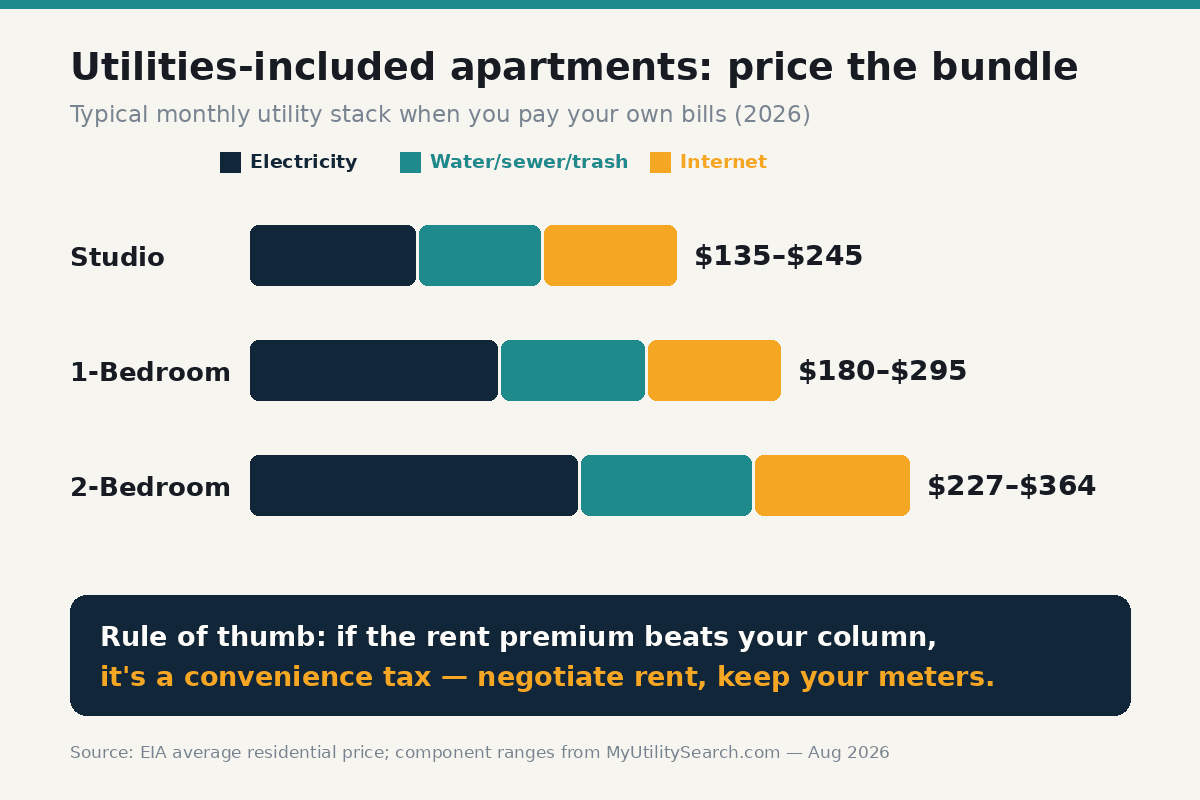
Stat block: A typical one-bedroom renter paying their own utilities spends roughly $180–$295 per month on the full stack in 2026, with electricity ($90–$135) the largest single line.
So the math on utilities included apartments is simple: compare the rent premium against that stack. If utilities included apartments near you rent for $250 more than a comparable unit where you pay your own bills, and your realistic usage is $190, you’re donating $60 a month — $720 a year — for convenience. Flip the numbers (heavy AC use in a Texas summer, three roommates streaming, an EV on a charger) and the bundle can genuinely win, because the landlord absorbs your overage.
There’s a market wrinkle in 2026 that makes this comparison newly important: with 39.8% of U.S. rental listings offering concessions (Zillow, August 2026) — and Dallas at 65.6%, Austin at 65.1%, Houston at 55.7% — utilities included apartments are increasingly marketed as a concession in themselves. Treat it like one: it’s a number, not a vibe. Price it.
Can You Choose Your Own Internet in Utilities Included Apartments?
Usually yes — more often than renters assume. Since the FCC’s 2022 order (FCC 22-12), broadband providers are banned from signing exclusive revenue-sharing deals with apartment buildings, and buildings must disclose exclusive marketing arrangements in plain language. Your building can market one provider; in most cases it cannot legally be the only provider allowed to serve you.
What this means in practice inside utilities included apartments:
- “Free WiFi included” is usually a bulk agreement. The property bought wholesale service from one ISP for every unit. You can typically still order your own separate line from any provider that has wiring in the building — you’ll just keep paying the bulk fee inside your rent.
- Exclusive access is what’s prohibited; exclusive wiring is what’s real. If only one ISP has ever wired the building, your practical choice is one provider plus 5G home internet — which is exactly where fixed-wireless from T-Mobile and Verizon has become the renter’s escape hatch.
- Ask the leasing office two questions: “Which providers have active service in this building?” and “Is internet bulk-billed, and can I opt out?” Get the answer in writing before you sign.
Stat block: Under FCC 22-12 (adopted February 2022), exclusive and graduated revenue-sharing agreements between ISPs and apartment buildings are prohibited, and sale-and-leaseback arrangements over in-building wiring are banned.
Can You Choose Your Electricity Provider in an Apartment?
In deregulated states — Texas, Ohio, Pennsylvania, Illinois, New Jersey, New York, and others — the answer comes down to one thing: your meter.
- Individually metered unit: the electric account is in your name, and you choose your provider and plan exactly like a homeowner. In Texas, that means shopping retail electric providers; in Ohio or Pennsylvania, choosing a supplier against the utility’s default rate. Most modern apartments are individually metered.
- Master-metered or submetered building: the landlord holds the account, and allocation rules (like the Public Utility Commission of Texas’s submetering and RUBS regulations) govern how the cost is split. You cannot switch providers — your only lever is usage.
This is the piece almost every national “utilities included” guide skips, and it’s worth real money: an individually metered renter in a deregulated market who never shops simply pays the default rate. The spread between default and competitive plans is routinely several cents per kWh — on 700–900 kWh of summer usage, that’s $15–$40 a month for ten minutes of comparison shopping.
Definition box — choice ZIPs vs monopoly ZIPs: we map, ZIP by ZIP, where renters actually have both electricity choice and multiple internet providers (“choice ZIPs”) versus where one provider controls a service (“monopoly ZIPs”). Same city, different ZIP, different leverage.
Compare internet, energy & home security at your address
Utilities Included vs Paying Your Own: Which Saves Money?
Run your own numbers, but across thousands of utilities included apartments the pattern is consistent:
| Renter profile | Utilities-included apartment | Pay your own | Why |
|---|---|---|---|
| Studio, single, light usage | ❌ Usually loses | ✅ Usually wins | Premium exceeds a $135–$245 stack |
| 1BR, work-from-home | Depends | Depends | WFH electricity + fast internet narrow the gap |
| 2BR+, family or roommates | ✅ Often wins | ❌ Often loses | Landlord absorbs heavy AC/heat usage |
| Texas summer, big cooling load | ✅ Can win big | ❌ Bill spikes | July–September usage doubles |
| Deregulated-state rate shopper | ❌ Loses the choice | ✅ Wins twice | You keep the right to switch plans |
Three rules of thumb for judging utilities included apartments:
- Price utilities included apartments against the table above, not against fear of a surprise bill. The stack for your unit size is knowable.
- Never trade away a bill you can shop for a bill you can’t see. In a choice ZIP, your electricity and internet are negotiable assets; inside a utilities included apartment they’re invisible.
- Use concessions season. In a market where two-thirds of Dallas listings are offering deals, you can often get the free month and keep your own meters — ask for the concession in rent, not in bundled bills.
How to Spot Fairly Priced Utilities Included Apartments
There’s a fast way to judge utilities included apartments without a spreadsheet. Find two or three comparable units in the same ZIP where tenants pay their own bills, and note the rent gap. Then price the included stack honestly for your usage — not the landlord’s brochure average.
- Gap under $150/month for a 1-bedroom: utilities included apartments are priced fairly or better; heavy summer usage makes it a clear win.
- Gap of $150–$250: roughly break-even. The deciding factors are whether internet is genuinely included (worth $40–$80) and whether you’d otherwise shop a cheap electricity plan.
- Gap over $250: you’re paying a convenience tax. Negotiate — in a concession-heavy 2026 market, many operators will move the number or unbundle.
Two more checks separate fair utilities included apartments from expensive ones. First, ask whether the bundle is a flat rate or an allowance: allowance deals (“$100 utility cap, overages billed back”) shift the risk back to you while still charging the premium. Second, in deregulated states, ask what electricity rate sits inside the bundle — a master-metered building buying at commercial rates and allocating by RUBS can quietly pass through more per kWh than you’d pay shopping your own plan in the same ZIP.
Stat block: In August 2026 the typical U.S. asking rent is $1,962 (Zillow), so a $200 utilities bundle represents roughly 10% of the median rent decision — worth ten minutes of math before you sign a 12-month lease.
7 Questions to Ask Before Signing a Utilities Included Apartment Lease
- Which utilities exactly are included, and which stay in my name?
- Is my unit individually metered, master-metered, or submetered?
- Is there a usage cap or allowance — and what’s the overage rate?
- Is internet bulk-billed? Which ISPs have active wiring in the building?
- Can I opt out of any bundled service, and does the rent change if I do?
- How were last year’s average utility costs for this unit calculated? (Ask for RUBS methodology if allocation-billed.)
- If I’m in a deregulated state: who chose the electricity plan, and what rate is it?
A landlord who can’t answer these isn’t hiding a scandal — but a renter who signs a utilities included apartment lease without asking is buying utilities at an unknown price, forever.
FAQ
What do utilities included apartments actually include?
In utilities included apartments, the landlord pays some utility accounts and recovers the cost through rent. The bundle almost always covers water, sewer, and trash; electricity, gas, and internet are included less often and vary by building. Always ask for the exact list in writing.
Are utilities included apartments cheaper than paying your own bills?
Usually not — utilities included apartments often cost more than self-paid bills. The full utility stack for most apartments runs $135–$364 per month depending on size, and ABP rent premiums often exceed realistic usage — especially for light users. Heavy users (large households, work-from-home, big cooling loads) are the exception and can come out ahead.
Can my apartment force me to use their internet provider?
Generally no. FCC rules adopted in 2022 prohibit exclusive revenue-sharing agreements between ISPs and buildings. Bulk-billed “included WiFi” is legal, but in most buildings you can still order your own line from another wired provider or use 5G home internet — you’ll just keep paying the bulk fee in rent.
Can renters choose their electricity provider?
Yes — in deregulated states, if the unit is individually metered, the account is in your name and you shop plans like any homeowner. In master-metered or submetered buildings the landlord holds the account and you cannot switch.
Is “all bills paid” the same as utilities included?
“All bills paid” is the strongest version of utilities included apartments: every core utility plus, often, internet is bundled. “Utilities included” without the ABP label frequently means only water, sewer, and trash — the cheapest bills — while you still pay electricity and internet yourself.
Compare internet, energy & home security at your address
Keep going
More renter guides to pair with this utilities included apartments breakdown:
- Hotwire internet — the biggest bulk-internet provider in Florida, and what the upgrades cost on top of rent or dues
- Best Internet Providers for Renters in 2026 — the roundup for when you can choose.
- First Apartment Utilities Checklist: What to Set Up & When — the move-in companion to this guide.
- Average Electric Bill 2026: By State & Home Size — benchmark your unit against your state.
- Deregulated Energy: Compare Suppliers by State — check if your state lets you pick your plan.
- Prepaid Home Internet: No-Contract, No-Credit-Check Plans — the renter-friendly internet fallback.
- Home Security for Renters: The Best No-Contract Guide — protection that moves out when you do.
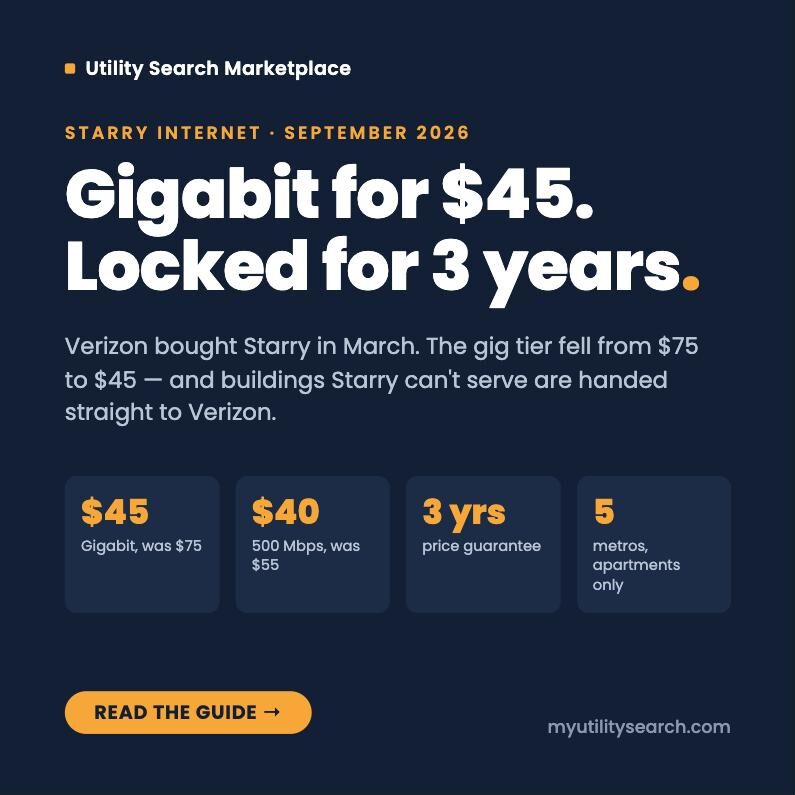
- Starry internet — the building-by-building provider whose $45 gig beats most bulk deals
Sources: U.S. Energy Information Administration (average residential price & bill); FCC 22-12, “Improving Competitive Broadband Access to Multiple Tenant Environments” (Feb 2022); Public Utility Commission of Texas submetering & allocated billing rules; Zillow Rental Market Report, Aug 18, 2026.