Blog
Ohio Submetering Rules: The 2026 Ruling Explained

Updated on September 5, 2026
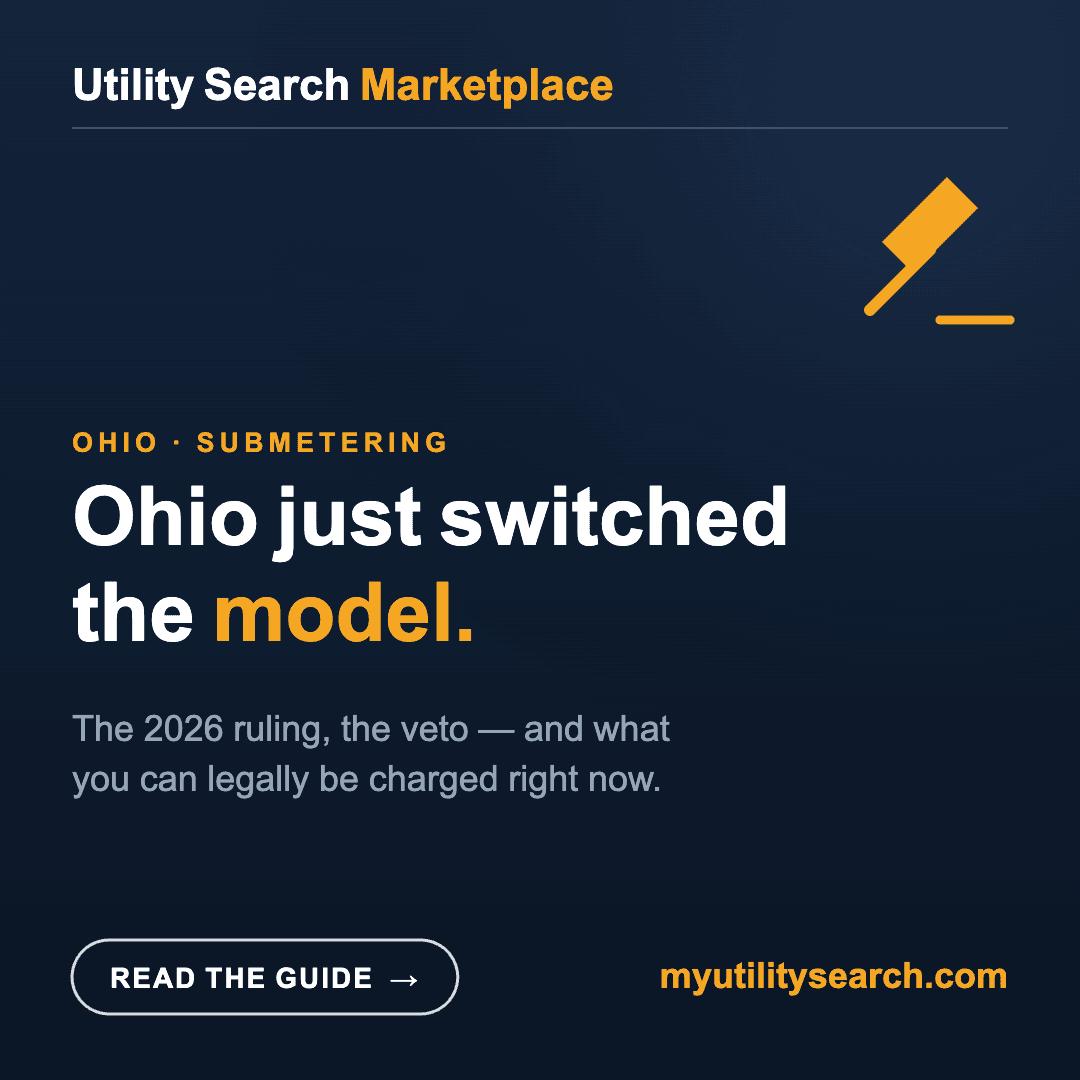
Ohio submetering rules changed on 22 April 2026, when the Ohio Supreme Court held that a company buying electricity and reselling it to apartment tenants through submeters is a public utility, regulated by PUCO. The legislature’s answer — a rate cap in HB 173 — was vetoed by Governor DeWine on 24 June 2026, so what a submetering company can charge is, right now, neither prohibited nor capped while the question sits on remand at PUCO and in the legislature. If a third-party company’s name is on your electric bill, that ruling is about them; if your landlord bills you directly, it does not squarely reach your arrangement.
Last verified: 23 August 2026. This is a moving story — PUCO implementation is live; we re-check this page every 90 days.
TL;DR — Ohio submetering after the 2026 ruling
- 22 April 2026: the Ohio Supreme Court held third-party submetering resellers are public utilities under R.C. 4905.03(C).
- The Court threw out PUCO’s long-standing three-part Shroyer test as “extratextual.”
- 24 June 2026: Governor DeWine vetoed HB 173, which would have capped submetered rates slightly below the standard residential rate.
- Markup is currently neither banned nor capped. The question is live at PUCO and in the legislature.
- The ruling reaches third-party resellers, not a landlord passing through the building’s cost.
- Submetered tenants are outside Ohio’s competitive retail market and municipal aggregation — a real cost that never shows on the bill.
What did the Ohio Supreme Court decide?
In re Complaint of Ohio Power Co. v. Nationwide Energy Partners, L.L.C., Slip Op. No. 2026-Ohio-1406 (No. 2024-0207), decided 22 April 2026, majority by Justice Patrick DeWine, 6-1-1. Appeal from PUCO Case No. 21-990-EL-CSS.
Holding: a company that buys electricity and resells it via submeters to apartment tenants is an “electric light company” and therefore a “public utility” under R.C. 4905.03(C). The Court abandoned PUCO’s three-part Shroyer test as an “extratextual” gloss and held that jurisdiction turns on the statutory text: tenants who purchase electricity are consumers of electricity, and a business supplying electricity is a public utility. Reversed and remanded to PUCO on the remaining claims — unlawful utility operation, uncertified CRES activity — and the electric-reseller tariff issue (Court News Ohio).
The margin that drove the case: the reseller bought at AEP Ohio’s commercial rate and billed tenants based on AEP Ohio’s higher residential rate. That spread was the business model.
Does the Ohio submetering ruling apply to my landlord?
The decision reaches third-party submetering companies that purchase and resell electricity. A landlord supplying utilities to its own tenants incident to the tenancy was not held to be a public utility. If a separate company’s name is on your electric bill, this ruling is about them. If it’s your landlord’s name and they’re passing through the building’s cost, the ruling does not squarely reach that arrangement.
Why Ohio was unusual — the national frame
To see why the Ohio submetering fight drew national attention, put it beside the other states. Ohio was not unusual for regulating submetering. It was unusual for not regulating it. Massachusetts bans residential electric submetering as resale. New York and Maryland require pre-approval. Texas, Illinois, Pennsylvania and Delaware permit it but ban markup. Ohio is the only state to switch enforcement models by court ruling in 2026 — see the full apartment submetering laws by state comparison.
The enforcement contrast
Ohio moved toward utility-regulator enforcement. Maryland and Delaware sit in landlord-tenant law — Maryland’s own regulation states a submetered occupant “is not entitled to have complaint or other customer rights before the Commission.” Massachusetts routes complaints to local boards of health. New Jersey is unclear. Ohio just gave its tenants a regulator that most states’ submetered tenants do not have.

What happened in the legislature
HB 173 passed both chambers in June 2026 and would have required submeterers to charge slightly below the standard residential rate. Governor DeWine vetoed it on 24 June 2026. From the veto message: “The Supreme Court of Ohio has recently held that submetering companies, which buy and resell electricity at a profit, are public utilities regulated by the Public Utilities Commission of Ohio,” and the bill would mean “Ohio, for the first time, would be legitimizing and legalizing this flawed submetering model.”
Companion SB 108 and a competing bipartisan HB 265 — which would define submeterers as public utilities — remain pending. No override has been recorded.
So what can you actually be charged in Ohio right now?
For Ohio submetering customers, markup is currently neither prohibited nor capped. HB 173’s cap died with the veto. The question sits on remand at PUCO and in the legislature. The live PUCO proceedings are the remand of Case No. 21-990-EL-CSS and the AEP Ohio electric-reseller tariff dockets 24-106-EL-ATA / 24-107-EL-AAM, where the Ohio Consumers’ Counsel has filed urging full implementation.
The Ohio submetering dockets to watch
Three proceedings decide what Ohio submetering looks like next. First, the remand of Case No. 21-990-EL-CSS — the complaint that produced the Supreme Court ruling, now back at PUCO to apply it. Second, the AEP Ohio electric-reseller tariff dockets, 24-106-EL-ATA and 24-107-EL-AAM, where the Ohio Consumers’ Counsel has filed urging full implementation. Third, the legislature: SB 108 (the vetoed HB 173’s companion) and the competing bipartisan HB 265, which would write submeterers into statute as public utilities.
Any one of those could set the first enforceable rate rule for Ohio submetering. Until one does, the ruling stands but the markup question stays open — which is why this page carries a 90-day refresh cadence.
The aggregation angle — what submetered Ohio tenants give up
A submetered building’s supply contract belongs to the property, so the tenant loses access to Ohio’s competitive retail market and to municipal aggregation programmes. In a state where aggregation is a genuine consumer benefit, being submetered means being outside it.
Compare internet, energy & home security at your address
What Ohio tenants should do
- Check whose name is on the electric bill — the utility’s, your landlord’s, or a third company’s. That single fact determines everything above.
- Compare your effective rate per kWh against AEP Ohio’s standard residential rate. The spread is the case.
- If a third-party reseller bills you, PUCO now has jurisdiction. Contact the Ohio Consumers’ Counsel.
- If your building is in a municipal aggregation area, find out what you’re being excluded from.
On the second step: your effective rate is your total bill divided by kWh used, and the comparison that matters is against AEP Ohio’s standard residential rate — the spread between those two numbers is exactly what the Supreme Court case was about. The Ohio Consumers’ Counsel maintains a dedicated Ohio submetering page and is the right first call if a third-party reseller bills your unit.
Ohio submetering FAQ
Is submetering legal in Ohio?
Yes. Submetering itself remains lawful. What changed in April 2026 is that a third-party company buying and reselling electricity to tenants is now a public utility under PUCO jurisdiction, so how those companies operate — and what they can charge — is being determined at PUCO and in the legislature.
Can a landlord or submetering company profit on my electricity in Ohio?
Right now, markup is neither prohibited nor capped. HB 173, which would have capped submetered rates slightly below the standard residential rate, was vetoed on 24 June 2026. The question is live on remand at PUCO and in pending bills SB 108 and HB 265.
What changed in April 2026?
The Ohio Supreme Court held in 2026-Ohio-1406 that a company buying electricity and reselling it to apartment tenants through submeters is an “electric light company” and therefore a public utility under R.C. 4905.03(C) — abandoning PUCO’s three-part Shroyer test and remanding the case to PUCO.
Does PUCO regulate my building now?
Only if a third-party reseller supplies your electricity. The ruling reaches companies that buy and resell power; a landlord passing through the building’s own cost incident to the tenancy was not held to be a public utility.
What was the Shroyer test?
PUCO’s long-standing three-part test for deciding whether a reseller was a public utility. In the April 2026 Ohio submetering ruling, the Supreme Court abandoned it as an “extratextual” gloss, holding that jurisdiction turns on the statutory text of R.C. 4905.03(C) instead.
What happened to HB 173?
It passed both chambers in June 2026 and was vetoed by Governor DeWine on 24 June 2026. No override has been recorded. Companion SB 108 and the competing bipartisan HB 265 remain pending.
Ohio submetering is the rare consumer story where the ground is still moving — the ruling stands, the cap died, and the next PUCO order could change this page. Check the last-verified date, and check whose name is on your bill.
Compare internet, energy & home security at your address
Keep going
- Apartment submetering laws by state — the full 50-state picture
- Ohio electricity rates — what direct-metered customers pay
- Columbus electricity rates — the market where the case arose
- Best electricity providers in Ohio — if you can shop your rate
- Ohio deregulated energy hub — how choice works in Ohio
- Why most Ohio residents are overpaying for electricity