Blog
Xfinity Internet Speed Tiers Explained

Updated on September 17, 2026
Xfinity internet speed tiers come in four national residential levels: 300 Mbps, 500 Mbps, 1 Gig and 2 Gig. Promotional pricing on Xfinity’s own site in August 2026 runs $40, $45 and $50 for the first three tiers under a five-year price guarantee, against everyday prices of $70, $85, $100 and $130. Prices vary by address. For most households the deciding factor is not download speed — even the entry tier is far more than a typical home uses — it is upload speed and WiFi coverage.
Last updated: 24 August 2026. Verify pricing at your address — it is address-specific.
TL;DR — Xfinity internet speed tiers at a glance
- Four tiers: 300 Mbps / 500 Mbps / 1 Gig / 2 Gig.
- Everyday (standard) prices: $70 / $85 / $100 / $130. Promo pricing is currently much lower.
- All tiers include unlimited data, the WiFi gateway, one free Xfinity Mobile line for 12 months, and no annual contract.
- The advertised price assumes autopay from a bank account. Pay by credit card and it’s $5/month more; skip autopay entirely and it’s $10 more.
- Xfinity does not publish upload speeds on its plan pages. If you upload — video, backups, multi-person video calls — look at X-Class, which is symmetrical.
- The FCC’s long-term goal is 1 Gbps down and 500 Mbps up. No standard Xfinity tier meets the upload half.
What are the Xfinity internet speed tiers?
| Tier | Download | Upload | Promo (Aug 2026) | Everyday price | Xfinity’s own positioning |
|---|---|---|---|---|---|
| 300 Mbps | 300 Mbps | ~100 Mbps* | $40–$45 | $70 | “For everyday use” |
| 500 Mbps | 500 Mbps | ~100 Mbps* | $45–$60 | $85 | “Keep up on all your devices” |
| 1 Gig | 1,000 Mbps | ~150–300 Mbps* | $50–$70 | $100 | “Made for busy households” |
| 2 Gig | 2,000 Mbps | ~200–500 Mbps* | $70–$100 | $130 | Power users |
| NOW Internet (prepaid) | 100–200 Mbps | not published | $30 flat | $30 | No credit check, no contract |
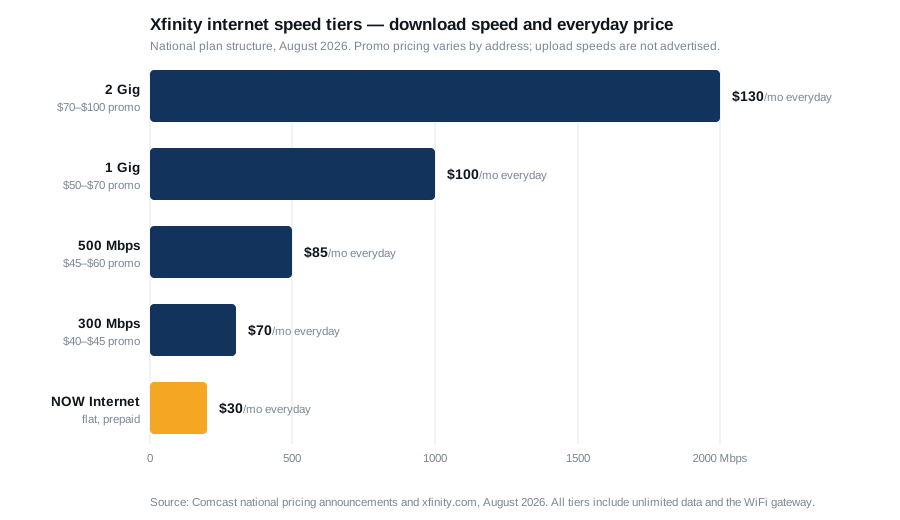
* Upload figures in this Xfinity internet speed tiers table are third-party estimates. Comcast does not advertise upload speeds on its consumer plan pages — a fact worth stating plainly, because it is the number that most often determines whether a plan feels fast.
Why the promo column is a range: pricing across the Xfinity internet speed tiers is address-specific. On the same day in August 2026, Xfinity’s own site showed $40/$45/$50 at a default address while two independent trackers showed $45/$60/$70. Both are real. The only price that matters is the one at your address.
Definition: promo price vs. everyday price
Since June 2025 Xfinity publishes both. The everyday price is the standard rate. The guarantee price is what you pay for one or five years, locked. The five-year guarantee has no annual contract and no cancellation penalty — it locks the rate without locking you in. Compare it with other providers in our internet price lock plans guide. What it does not lock is the Broadcast TV Fee and Regional Sports Fee, which sit outside promotional and minimum-term pricing and can rise while your “locked” rate stays flat. Those primarily affect TV and bundle customers, not internet-only.
How much internet speed do you actually need?
The FCC’s current broadband benchmark is 100 Mbps download and 20 Mbps upload, adopted 14 March 2024 — a fourfold increase over the 2015 standard of 25/3 (FCC). Its stated long-term goal is 1 Gbps down and 500 Mbps up.
The FCC’s household guide sets out tiers as Basic (3–8 Mbps), Medium (12–25) and Advanced (25+):
| Users or devices | Light use | Moderate use | High use |
|---|---|---|---|
| 1 user, 1 device | Basic | Basic | Medium |
| 2 users / devices | Basic | Medium | Medium–Advanced |
| 3 users / devices | Medium | Medium | Advanced |
| 4 users / devices | Medium | Advanced | Advanced |
- Light use — email, browsing, basic video, VoIP, internet radio
- Moderate use — light use plus one high-demand application: HD streaming, multiparty video conferencing, online gaming, or telecommuting
- High use — light use plus more than one high-demand application at the same time
The FCC’s own caveat is worth quoting: these are “rough guidelines and are not based on surveys or experiments.”
Here is the honest synthesis. By the FCC’s framework, a four-person high-use household needs “Advanced” — 25+ Mbps. Xfinity’s entry tier is 300 Mbps, twelve times that. Comcast rates the 300 Mbps plan for up to 100 connected devices.
So for the overwhelming majority of households, moving up the Xfinity internet speed tiers does not fix anything, because download speed was never the constraint. The two things that actually constrain your experience are upload speed and WiFi coverage inside your house. A $50 tier with a gateway in the right place beats a $130 tier with a gateway in a closet, every time.
Which of the Xfinity internet speed tiers fits your household?
| Household | Recommended tier | Why |
|---|---|---|
| Solo renter, light use | NOW Internet or 300 Mbps | Flat $30 prepaid, no credit check, no promo cliff — or 300 Mbps if you want the mobile line |
| 1–3 people, streaming and browsing | 300 Mbps | Comfortably handles multiple 4K streams plus work calls |
| 3–5 people, several 4K streams, gaming, work from home | 500 Mbps | The mainstream pick; headroom without paying gig prices |
| 5+ people, heavy simultaneous use, large downloads, many smart devices | 1 Gig | Xfinity’s own “busy households” positioning |
| Large-file creators, prosumer workloads | 2 Gig | Genuinely overkill for anyone else |
| Anyone who uploads heavily | X-Class | Symmetrical upload — see below. This is the real answer for creators, streamers and multi-person WFH |
X-Class — the tier that actually solves the upload problem
Comcast launched the world’s first DOCSIS 4.0 deployment under the X-Class Internet brand in October 2023, using the Full Duplex variant so upstream and downstream share the same spectrum block. The result is symmetrical speed.
| X-Class tier | Download | Upload |
|---|---|---|
| X-300 | 300 Mbps | 300 Mbps |
| X-500 | 500 Mbps | 500 Mbps |
| X-Gig | 1,000 Mbps | 1,000 Mbps |
| X-2Gig | 2,000 Mbps | 2,000 Mbps |
All include unlimited data and free gateway rental; X-Gig and X-2Gig add a 4K streaming box and Peacock Premium. X-500 and above require an Xfinity-supplied gateway (XB8 or newer) — no bring-your-own-modem at those tiers.
Availability of the X-Class Xfinity internet speed tiers is limited to DOCSIS 4.0 markets. As of mid-2026 that included Atlanta, Philadelphia, Colorado Springs, Sacramento, Denver, Seattle, Augusta, Miami and Pittsburgh, reaching millions of homes and expanding. Check your address.
If you have ever had a video call freeze while someone else was uploading, or waited an hour for a cloud backup, X-Class is the tier that fixes it — and a lower X-Class tier will feel faster than a higher standard tier.
Compare internet, energy & home security at your address
What else affects your bill?
Autopay is a penalty, not a discount — and the framing matters. Xfinity’s own five-year guarantee page states the price “requires paperless billing and automatic payments with stored bank account (or additional $10/mo charge applies).” Autopay from a credit card gets only $5. The advertised price already assumes you’re paying from a bank account.
Equipment. The WiFi gateway is included at $0 on the national plans. On legacy plans it rents at about $15/month. xFi Complete is $25/month and bundles the gateway, unlimited data, security features, a free gateway refresh every three years and coverage warranty. Bring-your-own-modem eliminates the rental — except on X-500 and above.
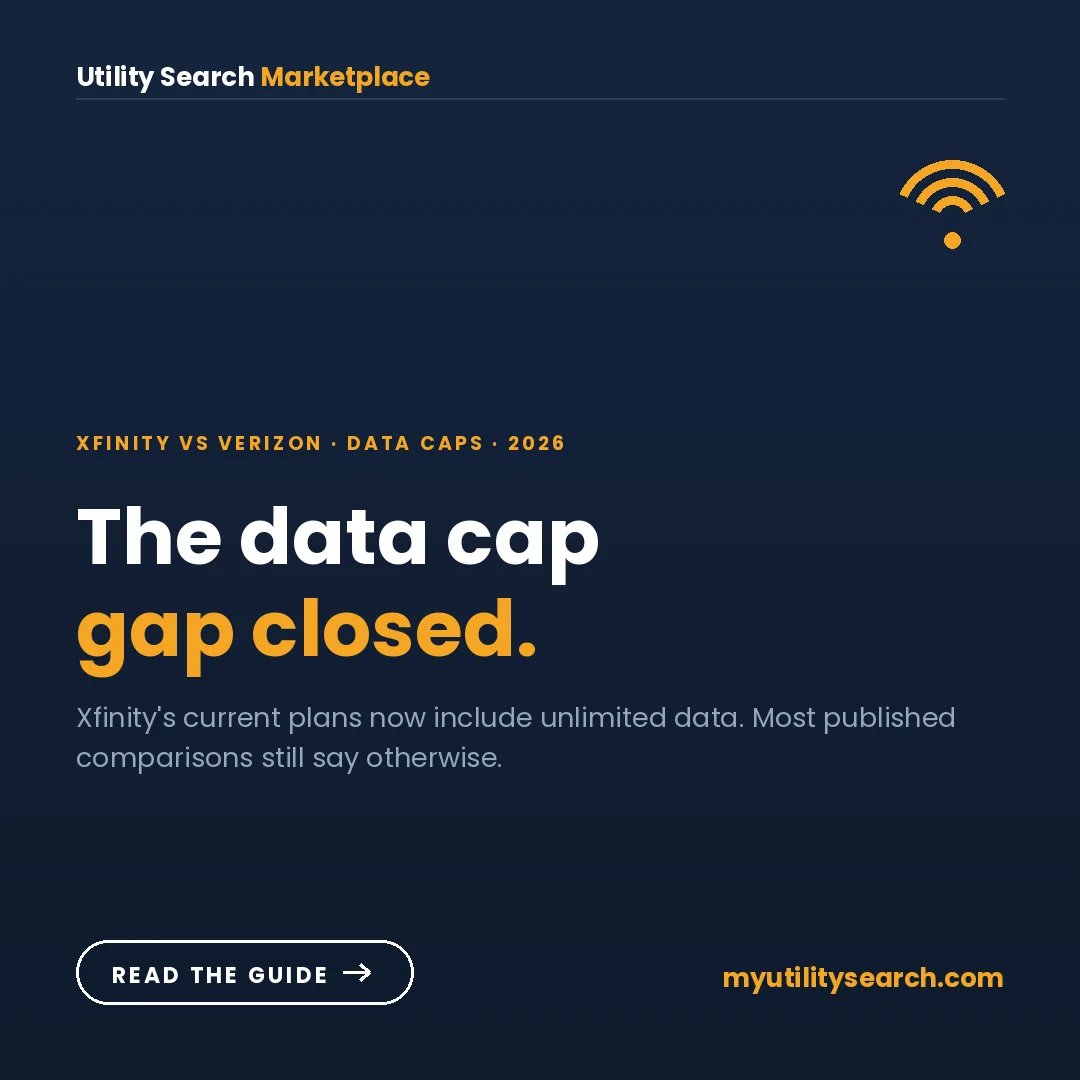
Data caps. Xfinity’s own page states “All Xfinity Internet plans now come with unlimited data,” and adds: “If you have an older plan, you may have a 1.2 TB data cap.” Where the cap still applies — legacy plans in the Central and Western divisions; the Northeast is unlimited by default — overage runs $10 per additional 50 GB, capped at $100/month, with an unlimited add-on at $30/month standalone or $25 inside xFi Complete.
Gateways. XB7 is WiFi 6. XB8 is WiFi 6E and is required for X-500 and above. XB10 is the first DOCSIS 4.0 gateway with WiFi 7, supporting up to 10 Gbps down and 6 Gbps up. There is no published mapping of which tier ships which gateway — in practice it depends on local inventory.
Installation. $100 professional, $0–$15 self-install — the same across all Xfinity internet speed tiers.
Xfinity internet speed tiers FAQ
What are Xfinity’s internet speed tiers?
Four residential tiers nationally: 300 Mbps, 500 Mbps, 1 Gig and 2 Gig, with everyday prices of $70, $85, $100 and $130. Promotional pricing under the five-year guarantee is currently well below those. A prepaid NOW Internet option offers 100–200 Mbps at a flat $30. Availability and pricing vary by address.
What are Xfinity’s upload speeds?
Comcast does not advertise upload speeds on its consumer plan pages. Third-party estimates put standard tiers roughly in the 100–300 Mbps range depending on tier and market. If upload matters to you, look at X-Class, which is symmetrical — the same speed up as down.
How many devices can a 300 Mbps Xfinity plan handle?
Comcast rates its 300 Mbps plan for up to 100 connected devices. For most households the practical limit is WiFi coverage, not the plan.
Does Xfinity still have a data cap?
Not on current plans — Xfinity states all its internet plans now come with unlimited data. Older legacy plans in the Central and Western divisions may still carry a 1.2 TB cap, with overage at $10 per 50 GB up to $100/month. Northeast markets are unlimited by default.
Is the Xfinity five-year price guarantee real?
Yes, and there is no annual contract or cancellation penalty. It locks your internet rate for five years. It does not lock the Broadcast TV Fee or Regional Sports Fee, which sit outside promotional pricing and mainly affect TV and bundle customers.
Which Xfinity tier is best for working from home?
For most remote workers, 300 or 500 Mbps is ample on download. The tier that actually improves video calls and cloud backups is X-Class, because upload is the constraint — and X-300 at symmetrical 300/300 will outperform a standard 1 Gig plan for that specific job.
That is the whole decision on Xfinity internet speed tiers: pick by upload and WiFi, not by the biggest download number — and check the price at your own address before you believe any of them.
Compare internet, energy & home security at your address
Keep going
- Midco internet — a regional cable ladder with 20–50 Mbps uploads next to symmetrical fiber at the same price
- Best Xfinity internet plans — which plan to actually buy
- Xfinity internet review — the full provider picture
- Internet data caps and overage fees — how caps work across providers
- Best internet for working from home — upload-first recommendations
- Best internet for large households — sizing for 5+ people
- Best internet for streaming — what 4K actually needs