Blog
100,000 Flock Cameras. One Question: Who Carries the Data?

Flock cameras are everywhere — and every one of these Flock Safety license-plate readers runs on a cellular network. A Flock camera is an automated license-plate reader (ALPR) — a solar-powered camera that photographs every passing vehicle and logs its plate. The company has crossed 100,000 cameras nationwide, the topic is on every news feed and platform this month, and one question keeps getting asked: what cellular network do Flock cameras use, and where does the data go? This is a plain-facts rundown of what these cameras collect, which wireless carriers move the data, and who the information reaches — sourced and attributed, no editorializing.
TL;DR — the wireless side of Flock cameras
- No Wi-Fi, no wires. Flock cameras are solar or battery powered and upload over commercial cellular LTE.
- Multiple carriers. Flock’s devices use major networks — Verizon, AT&T, and T-Mobile — depending on local coverage; an independent teardown found an AT&T LTE modem.
- Data lands in AWS. Plate reads and images upload to Amazon Web Services cloud storage, retained about 30 days by default.
- What is captured: license plates plus a “Vehicle Fingerprint” — make, model, color, and distinguishing features. Flock states it does not use facial recognition.
- Who can search it: 4,800+ law-enforcement agencies via Flock’s network; a “national lookup” setting has been the subject of lawsuits and 80+ city cancellations.
- Who funds it: Flock is a venture-backed company valued at $8.4 billion, led by investors including Andreessen Horowitz.
What cellular network do Flock cameras use?
Flock Safety cameras operate independently of Wi-Fi or hardwired cables, relying instead on commercial cellular networks to transmit captured data to the cloud. According to Flock’s own materials and public guidance from agencies that use them, the cameras are designed to work off-grid — solar or battery for power, cellular LTE for data.
The company does not rely on a single carrier. Reporting and user accounts indicate Flock devices use multiple major networks — Verizon, AT&T, and T-Mobile — chosen by local coverage, which is standard practice for cellular IoT hardware. An independent physical teardown of a Flock camera published by the Center for Human Rights and Privacy identified a NimbeLink Skywire LTE modem built on a Sierra Wireless module provisioned for AT&T. Flock has not publicly named a carrier, and hardware varies by generation and location, so the honest summary is: commercial LTE, multi-carrier, with documented AT&T hardware in at least one teardown.
How does the data travel from the street to a search bar?
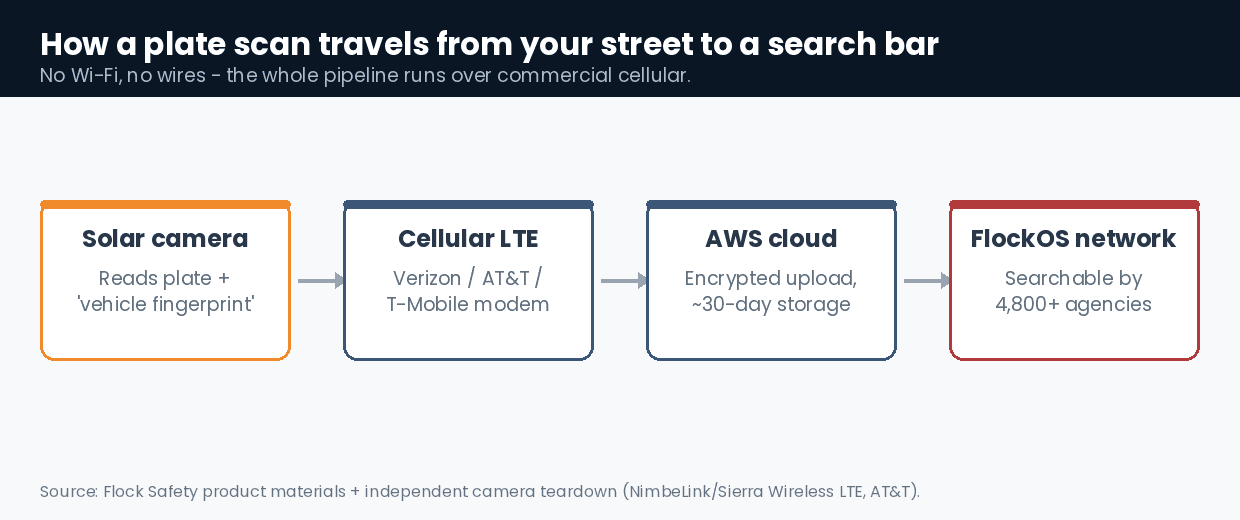
So what cellular network does Flock use in practice? The cellular link is what makes the whole system possible. Because the cameras are self-powered, the LTE connection lets them be installed anywhere — a rural county road, a neighborhood entrance, a highway on-ramp — with no local internet and no trenching. Captured reads and images upload over LTE into Amazon Web Services cloud storage. From there, authorized users can search the footage from anywhere, without needing physical access to the camera. In other words, the same wireless infrastructure that carries your phone calls is the backbone of the largest private license-plate network in the country. It is the connectivity story underneath the surveillance headline.
What information do Flock cameras collect?
According to Flock and to independent reporting, each camera records more than a plate number. The system captures what Flock calls a “Vehicle Fingerprint”:
- The license plate image and the state it is registered in
- Make, model, body type, and color of the vehicle
- Distinguishing features — roof racks, bumper stickers, aftermarket wheels, visible damage
- Whether a plate is covered or missing
- Date, time, and the camera’s location
Flock states the system works on cars, trucks, buses, and even bicycles, and that it does not use facial recognition — its searches are based on vehicle attributes, not biometric identification of people. Flock’s stated default is that data automatically deletes after 30 days unless local law requires otherwise. Independent reporting has noted that the granularity of the vehicle data is high enough to track a specific car’s movements over time, which is the crux of the public debate.
Who is the data shared with?
Flock’s customers are primarily law-enforcement agencies — the company reports partnerships with more than 4,800 of them, plus roughly 1,000 businesses. The point of contention is not the local use but the sharing between agencies. Many contracts have, by default, enabled a “national lookup” feature that lets law-enforcement agencies anywhere in the country query the data a given city collected.
That default has driven the 2026 backlash. Reporting and litigation this year allege that local plate data was accessed by federal agencies without cities’ authorization. A class-action lawsuit filed in San Francisco Superior Court alleges out-of-state and federal agencies — including ICE, CBP, FBI, and ATF — queried SFPD’s Flock cameras more than 1.6 million times over seven months. A separate audit reported that data from Dayton, Ohio’s cameras was searched more than 7,100 times for immigration-enforcement purposes, which the city’s own policy prohibited. By mid-2026, more than 80 cities had moved to cancel or suspend their Flock contracts. In January 2026, Flock introduced an administrative setting that lets an agency turn off all federal sharing with a single toggle. Flock has stated it does not itself share data with ICE and that sharing is controlled by the agencies that own the data.
We are reporting these as attributed claims from lawsuits, audits, and public reporting — not conclusions. The details are contested and, in the case of the lawsuits, unproven allegations.
Why are they collecting it, and why now?
Flock’s stated purpose is crime-solving: recovering stolen vehicles, supporting investigations, and assisting with Amber and Silver alerts. Agencies that adopted the cameras — including some in sanctuary cities — frequently cite stolen-vehicle recovery as the original reason.
The “why now” is a convergence of three things: cellular IoT hardware got cheap and reliable, solar power removed the need for wiring, and AI image recognition matured to the point where a camera can classify a vehicle in real time. Layer on more than $950 million in venture funding, and a national buildout became possible in just a few years.
How fast is the network growing, and who funds it?
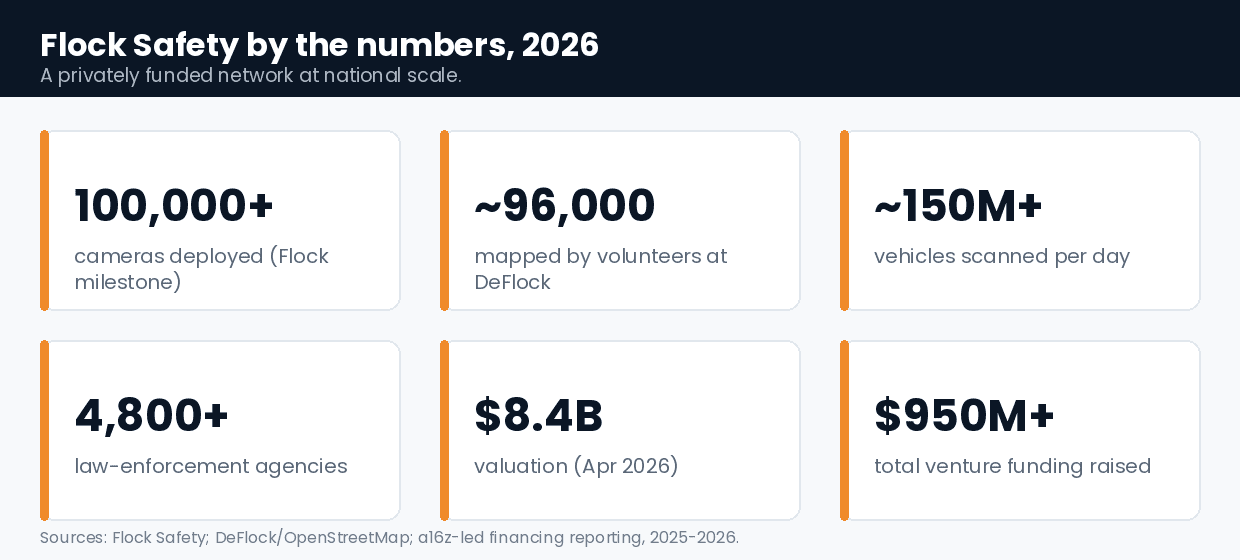
The growth is steep. Flock has crossed 100,000 cameras, deployed across more than 5,000 communities. The volunteer mapping project DeFlock has independently plotted roughly 96,000 of them on OpenStreetMap — about 82% of all license-plate readers it has mapped. Flock’s revenue crossed $300 million in annual recurring revenue, growing about 70% year over year.
The funding is private and substantial. In March 2025, Flock raised $275 million at a $7.5 billion valuation in a round led by Andreessen Horowitz, with participation from Greenoaks, Bedrock, Founders Fund, Kleiner Perkins, Tiger Global, and Y Combinator, among others. By April 2026 the company was reportedly valued at $8.4 billion. Total venture funding stands above $950 million, making it one of the best-funded companies in its category. For context on how much of America’s connectivity now runs through a handful of large players, see our telecom consolidation tracker.
What data platforms make sense of it all?
The question of what cellular network does Flock use has a second half: the cameras are only the sensors. The value is in the software that aggregates and searches the reads. Flock’s platform, Flock Nova (formerly FlockOS), is where agencies run queries, set up alerts on specific plates, and — through the lookup settings described above — reach beyond their own jurisdiction. This is the same pattern across modern surveillance technology: cheap distributed sensors feeding a centralized, searchable database. The cellular network is the connective tissue that makes a camera on a rural road part of a national system.
The same networks power your home, too
Cellular LTE is not just for cameras — it is increasingly how homes get internet. Compare 5G home internet and every wired option at your address, side by side on price and speed.
Compare internet at my address →Who owns Flock Safety, and who funds it?
Flock Safety is a private company founded in 2017 and led by co-founder and CEO Garrett Langley, an Atlanta entrepreneur who previously sold a prior company to Cox Enterprises. It is not publicly traded, so it answers to its investors rather than public shareholders.
Those investors are among the biggest names in venture capital. The March 2025 round that valued Flock at $7.5 billion was led by Andreessen Horowitz, with participation from Founders Fund — the firm co-founded by Peter Thiel — along with Greenoaks, Bedrock, Kleiner Perkins, Tiger Global, and Y Combinator. By April 2026 the company was reportedly valued at $8.4 billion, on more than $950 million raised.
How can you find Flock cameras near you?
Two volunteer-run tools have become the public’s answer to that question, and both are driving a surge of searches:
- DeFlock is a crowdsourced map that plots Flock camera locations on OpenStreetMap. Contributors have mapped roughly 96,000 of them — about 82% of all license-plate readers on the map.
- HaveIBeenFlocked.com is a searchable database built from Flock audit logs released through public-records requests. It lets you enter a plate and see whether — and by which agencies — it was queried.
Neither tool is affiliated with Flock. We link them as the sources behind the “flock camera map” and “have I been flocked” searches, not as an endorsement.
Are Flock cameras constitutional?
That question is now before the courts, and it is unsettled. Critics argue that continuously logging the movements of every passing car amounts to a warrantless search under the Fourth Amendment. Flock’s position is that photographing a license plate in public is not a search, since plates are already visible to anyone, and that its data is retained briefly and access-controlled.
Multiple lawsuits filed in 2026 are testing that boundary, and they remain unresolved. We are describing the arguments on both sides, not taking a position.
FAQ
What cellular network do Flock cameras use?
Flock cameras use commercial cellular LTE, not Wi-Fi or wired connections. Reporting indicates they use multiple carriers — Verizon, AT&T, and T-Mobile — depending on local coverage, and an independent teardown found an AT&T-provisioned LTE modem. Flock has not officially named a carrier.
Where does Flock camera data go?
Captured plate reads and images upload over LTE to Amazon Web Services (AWS) cloud storage, where they are retained about 30 days by default and can be searched by authorized law-enforcement users through Flock’s platform.
What information do Flock cameras collect?
License plate images and a “Vehicle Fingerprint” — make, model, color, body type, and distinguishing features like roof racks or bumper stickers — plus date, time, and location. Flock states it does not use facial recognition.
Does Flock share data with federal agencies?
Flock states it does not share data with ICE and that agencies control their own sharing. However, lawsuits and audits in 2026 allege federal and out-of-state agencies queried some cities’ data without authorization, prompting more than 80 cities to cancel or suspend contracts. Flock added a toggle to disable federal sharing in January 2026.
How many Flock cameras are there?
Flock has crossed 100,000 cameras across more than 5,000 communities. The volunteer project DeFlock has independently mapped roughly 96,000 of them.
Who funds Flock Safety?
Flock is a venture-backed company valued at about $8.4 billion as of April 2026, with more than $950 million raised. Its March 2025 round was led by Andreessen Horowitz.
Keep going
- Who owns America’s networks: the 2026 telecom consolidation tracker
- How 5G home internet uses the same cellular networks
- Compare internet providers at your address
- Why internet and connectivity prices are rising in 2026
- Verizon Fios plans, prices, and availability
- T-Mobile’s fiber arm and its recent acquisitions