Blog
T-Mobile acquisitions: every major fiber and spectrum deal (2020–2026)


Updated on September 5, 2026
By The Utility Search Marketplace Team · 20+ years in consumer home services
T-Mobile spent the last few years transforming itself from a wireless-only carrier into a converged fiber-and-5G competitor — partly by building, but largely by buying. This is a complete, sourced reference to T-Mobile acquisitions in fiber and spectrum from the 2020 Sprint merger through mid-2026, with deal values, close dates, and what each one actually added. Every figure here traces to a company filing or press release; sources are listed at the end.
The two strategies: spectrum vs. fiber
T-Mobile acquisitions fall into two distinct buckets, and it helps to separate them:
Spectrum and wireless acquisitions expand the airwaves and subscriber base behind its 5G network — this is the Sprint, Mint Mobile, and UScellular lineage.
Fiber acquisitions are a newer, deliberate push into wired home internet, almost always structured as 50/50 joint ventures with a private-equity partner (EQT, KKR) rather than outright buys — this is the Lumos and Metronet lineage.
The fiber JVs share a common shape: T-Mobile takes a 50% equity stake and the residential retail customers, while the acquired company becomes a wholesale network operator that keeps building. Through these partnerships, T-Mobile has said it expects to reach 12–15 million fiber households by the end of 2030.
T-Mobile acquisitions: spectrum & wireless
Sprint — 2020 — ~$26 billion (merger)
The foundational deal. T-Mobile’s merger with Sprint closed in 2020 and gave it the 2.5 GHz mid-band spectrum that underpins its 5G network lead. It also brought Sprint’s prepaid brands and the Assurance Wireless Lifeline business into the fold.
Ka’ena Corporation (Mint Mobile + Ultra Mobile + Plum) — ~$1.35 billion — FCC-approved April 2024
T-Mobile acquired Ka’ena, the parent of value brands Mint Mobile and Ultra Mobile (plus Plum), for up to $1.35 billion. The brands continue to operate separately. This was a subscriber and prepaid-brand play rather than a spectrum grab.
UScellular wireless operations & select spectrum — ~$4.3 billion — closed August 1, 2025
T-Mobile acquired substantially all of UScellular’s wireless operations — customers, retail stores, and certain specified spectrum assets — for approximately $4.3 billion (about $2.6 billion cash plus roughly $1.7 billion in assumed debt). The deal notably strengthened rural and regional coverage. UScellular retained a large share of its spectrum and towers, continuing as a separate infrastructure company renamed Array Digital Infrastructure. T-Mobile also entered a long-term lease on at least 2,100 retained UScellular towers, and concurrently closed the smaller “Iowa Transactions” (~$175 million) for several Iowa wireless operators.
T-Mobile acquisitions: fiber (joint ventures)
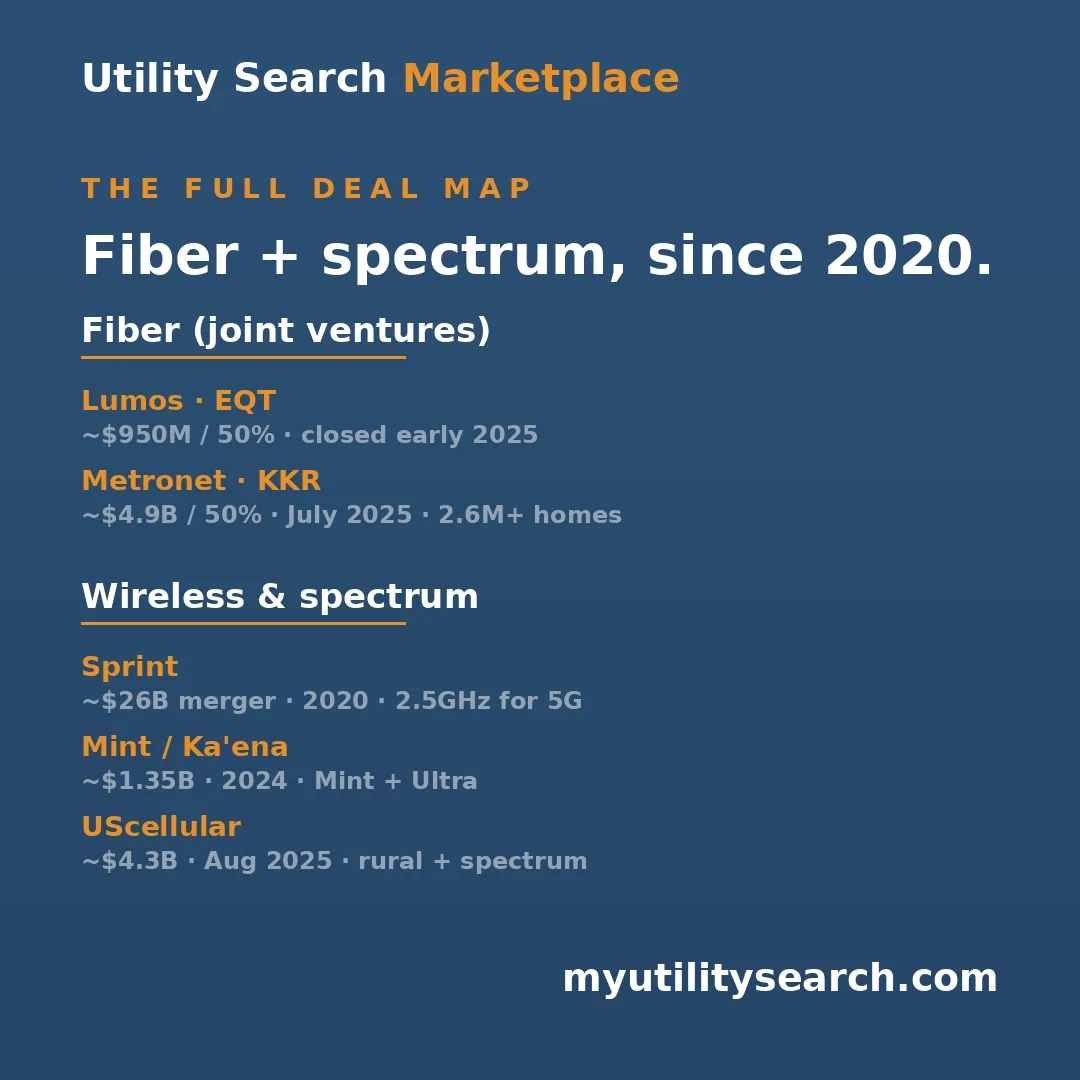
Lumos — with EQT — ~$950 million for 50% — announced April 2024, closed early 2025
T-Mobile’s first fiber footprint. Partnering with investment firm EQT, T-Mobile invested roughly $950 million for a 50% stake in a JV that acquired Mid-Atlantic fiber-to-the-home provider Lumos (then reaching about 320,000 households over 7,500 route miles). A further ~$500 million contribution is planned for 2027–2028. The JV targets 3.5 million homes passed by the end of 2028, with Lumos operating as a wholesale network and T-Mobile as anchor tenant.
Metronet — with KKR — ~$4.9 billion for 50% — announced July 2024, closed July 24, 2025
T-Mobile’s largest fiber deal. In a JV with KKR, T-Mobile invested about $4.9 billion for a 50% equity stake plus 100% of Metronet’s residential fiber retail operations and customers. Metronet — one of the largest independent fiber-to-the-home providers in the U.S. — reaches more than 2.6 million homes and businesses across 19 states over 42,000+ miles of fiber, and aims for 6.5 million homes passed by the end of 2030. Post-close, Metronet became a wholesale provider with T-Mobile Fiber handling residential service.
What the T-Mobile acquisitions add up to
Taken together, these T-Mobile acquisitions in spectrum (Sprint, Mint/Ka’ena, UScellular) cemented T-Mobile’s 5G and subscriber scale, while the fiber JVs (Lumos, Metronet) built a wired-home-internet business almost from scratch — targeting 12–15 million fiber households by 2030, on top of a 5G Home Internet fixed-wireless base serving millions more. For consumers, the practical upshot of these T-Mobile acquisitions is more places where T-Mobile competes for your home internet, and more pressure on incumbent cable and telephone providers. As always, what’s available — and at what price — comes down to your specific address.
Is your plan keeping up?
If your results are lower than you’re paying for, you may have faster options at your address. Compare internet plans available where you live — fiber, cable, and 5G, side by side.
FAQ
What companies has T-Mobile acquired recently?
The most significant T-Mobile acquisitions break down like this. On the wireless/spectrum side: Sprint (2020), Ka’ena/Mint Mobile (FCC-approved 2024), and UScellular’s wireless operations (closed August 2025). On the fiber side, through joint ventures: Lumos (with EQT, closed early 2025) and Metronet (with KKR, closed July 2025).
How much did T-Mobile pay for Metronet?
About $4.9 billion for a 50% equity stake in the KKR joint venture, plus 100% of Metronet’s residential fiber retail operations and customers.
Are T-Mobile’s fiber acquisitions outright purchases?
No — both Lumos and Metronet are structured as 50/50 joint ventures with a private-equity partner (EQT and KKR, respectively). T-Mobile takes the residential retail customers; the acquired company becomes a wholesale network operator.
How many fiber homes does T-Mobile plan to reach?
Through its fiber partnerships and joint ventures, T-Mobile has said it expects to reach 12–15 million fiber households by the end of 2030.
Did T-Mobile get spectrum from the UScellular deal?
Yes — the ~$4.3 billion deal included certain specified spectrum assets along with customers and stores, though UScellular (now Array Digital Infrastructure) retained a significant portion of its spectrum and towers.
Sources (verify live before publishing): T-Mobile newsroom & SEC 8-K filings: Metronet JV (Jul 2024 announce; Jul 24 2025 close), Lumos JV (Apr 2024), UScellular acquisition (May 2024 announce; Aug 1 2025 close); KKR / Metronet press releases (2.6M homes, 19 states, 42,000+ miles); FCC approval of Ka’ena/Mint Mobile (Apr 2024); Cleary Gottlieb deal summary (UScellular close, $4.3B, Iowa Transactions). Figures are company-reported; verify current details directly before relying on them.