Blog
Prepaid Home Internet: No-Contract, No-Credit-Check Plans (2026)

Updated on September 15, 2026
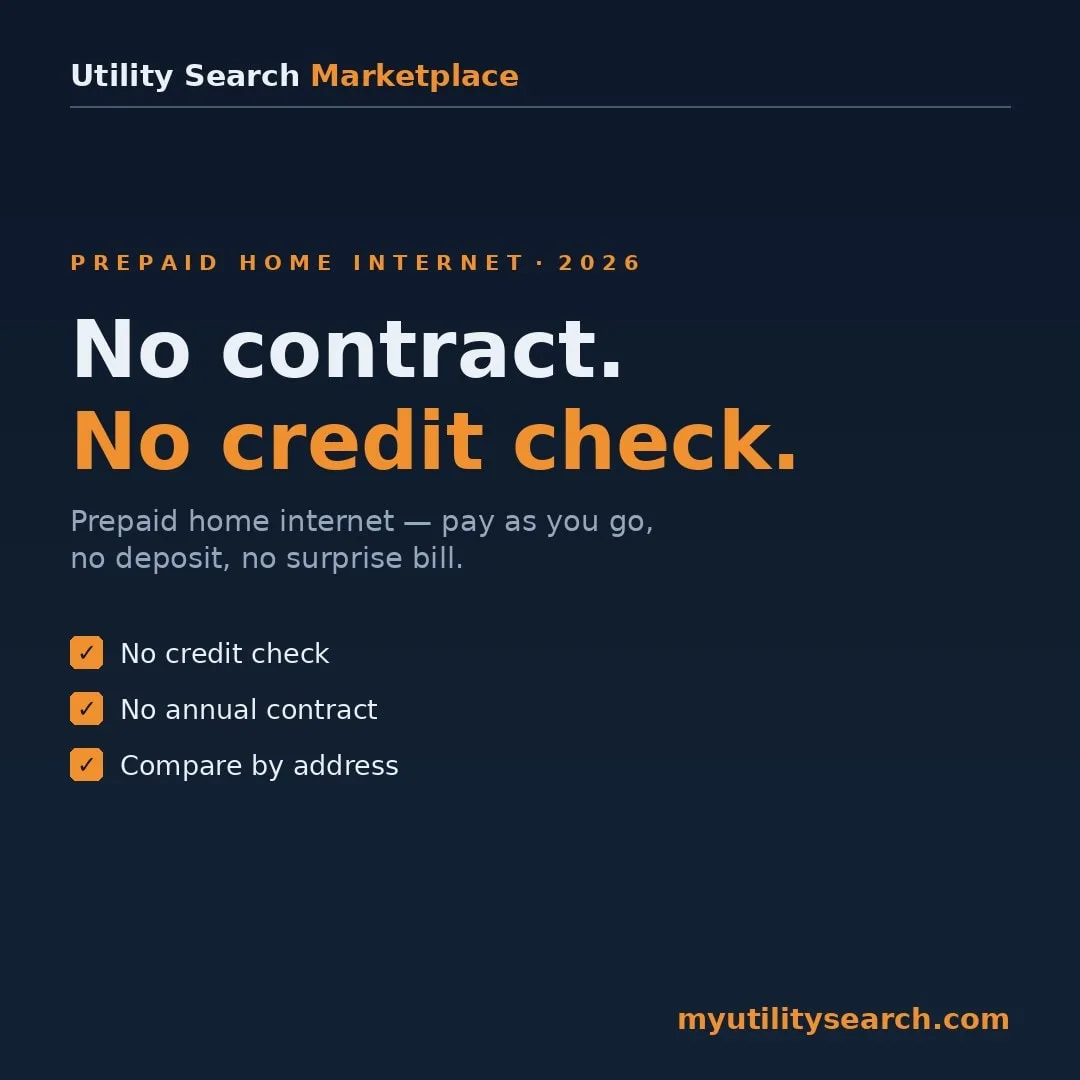
Prepaid home internet is pay-as-you-go home internet with no annual contract, no credit check, and no deposit. You pay for a month up front and renew when you choose. It suits renters, short leases, thin or no credit history, and anyone who wants a flat bill with no surprises — often delivered over 5G or cable.
TL;DR — prepaid home internet
- No contract, no credit check, no deposit — pay a month at a time.
- Usually 5G or cable; speeds and price vary by address.
- Great for renters, students, and anyone rebuilding credit.
- Compare prepaid home internet by address before you buy.

What is prepaid home internet?
Prepaid home internet flips the usual model: instead of a credit check, a contract, and a bill at the end of the month, you pay for service up front and it runs until the period ends. There is no early-termination fee because there is no term, and no deposit because there is nothing to secure. Most prepaid plans today ride on 5G home internet or cable networks, so availability and speed depend on your address.
Prepaid vs. postpaid: Postpaid bills you after you use the service and usually runs a credit check; prepaid home internet is paid in advance with no credit check, trading a possible deposit and contract for a slightly higher monthly price in some cases.
Who is prepaid home internet best for?
A pay-as-you-go plan suits anyone who values flexibility over a locked rate: renters on short leases, students, people with thin or damaged credit, and households that want a predictable flat charge. Because there is no contract, you can stop anytime without penalty — useful if you move often.
| Feature | Prepaid home internet | Standard (postpaid) |
|---|---|---|
| Credit check | No | Usually yes |
| Contract | None | Often 1–2 years |
| Deposit | None | Possible |
| Billing | Pay in advance | Billed after use |
How to get prepaid home internet at your address
Because prepaid home internet is usually 5G or cable, the first question is what is available where you live. Check your address, compare the prepaid and no-contract plans that reach it, and confirm the speed is enough for your household before you pay for the first month.
Compare options with our best internet providers guide, see how cable internet works, and check what is available in your area. Confirm coverage on the FCC National Broadband Map.
How much does prepaid home internet cost?
Pricing is refreshingly simple: one flat monthly charge, paid before the month starts, with no equipment lease buried in the fine print on many plans. Expect roughly $30 to $70 a month depending on the network and speed at your address, with 5G plans often landing in the middle of that range and cable prepaid at the lower end. Because you pay up front, there is no surprise overage bill and no deposit — the number you see is the number you pay.
The trade-off is that a pay-as-you-go plan sometimes costs a few dollars more per month than a locked two-year contract. For anyone who moves often, has thin credit, or simply wants to avoid a commitment, that small premium buys real flexibility.
5G vs. cable prepaid: which should you pick?
Two networks deliver most no-contract home internet, and the right one depends entirely on your address.
| Type | Best for | Watch for |
|---|---|---|
| 5G home internet | Renters and quick setup — self-install, no technician | Speed varies with signal and network congestion |
| Cable prepaid | Consistent speeds where cable is strong | May need a self-install kit; check coverage |
Check both at your exact address before you decide, since one may be far faster than the other on your street.
The move-friendly choice
No-contract service shines during a move, when you may not know how long you will be at an address. For the move itself, guides from professional movers help — College HUNKS’ full-service moving guide, U-Haul’s moving tips, and PODS’ moving blog all cover packing and logistics. What they leave to you is getting connected — and a prepaid plan you can start and stop without penalty is often the simplest way to do it. That is the helpful hand-off: they move your boxes, and this page helps you turn on the internet with no contract holding you down.
Prepaid home internet providers to compare
The prepaid market has grown well beyond a single option — most major carriers and cable companies now run a no-credit-check, pay-in-advance plan. Here is a snapshot of widely available prepaid home internet plans so you can see the landscape before you check your own address. Plans and pricing are as reported by HighSpeedInternet.com (2026); confirm current terms at your address, since availability and price vary by location.
| Provider | Type | Starting price | Top speed |
|---|---|---|---|
| Visible Home Internet | 5G (Verizon) | $25/mo | 200 Mbps |
| MINTernet (Mint Mobile) | 5G (T-Mobile) | $40/mo | 415 Mbps |
| Metro by T-Mobile | 5G | $50/mo | 318 Mbps |
| Xfinity NOW Internet | Cable | $30/mo | 200 Mbps |
| Sparklight FlexConnect | Cable | $45/mo | 600 Mbps |
| Cox StraightUp Internet | Cable | $50/mo | 100 Mbps |
| Brightspeed SimplePay | Fiber/DSL | $29.99/mo | 940 Mbps |
| CenturyLink Prepay | Fiber/DSL | $50/mo | 940 Mbps |
| EarthLink | Fiber/DSL | $39.95/mo | Up to 5 Gbps |
All of these skip the credit check and the annual contract; what differs is the network reaching your home and the speed you can get on it.
Prepaid 5G home internet
The fastest-growing corner of the market runs on the big wireless networks. Options like Visible Home Internet on Verizon, MINTernet on T-Mobile, Straight Talk, Metro, Total Wireless, and Tracfone deliver home internet over 5G with self-install — no technician, no landline. It is the easiest prepaid setup, which makes it ideal for renters and quick moves, but real-world speed depends on the 5G signal and congestion at your address, so coverage is the deciding factor.
Prepaid cable internet
Cable companies now offer prepaid tiers too: Xfinity NOW Internet, Sparklight FlexConnect, and Cox StraightUp Internet all provide pay-in-advance service with no credit check. Prepaid cable tends to deliver more consistent speeds than wireless where the cable network is strong, usually with a low-cost self-install kit rather than a technician visit.
Prepaid fiber and DSL
Prepaid fiber is rarer but it exists, and it is where the top speeds live. Brightspeed SimplePay and CenturyLink Prepay reach up to 940 Mbps, and EarthLink markets multi-gig fiber, all without a contract. If fiber is available at your address and speed matters — a house full of streamers, gamers, or remote workers — a prepaid fiber plan is the strongest option in the category.
How to choose among prepaid providers
Because every one of these plans depends on the network at your address, the smart move is to compare by location rather than by brand. Check which providers actually reach your home, weigh 5G against cable against fiber on speed and price, then pick the plan that fits your household. A quick address check turns this whole list into the two or three options you can really order today.
Compare prepaid & no-contract internet at your address
See which prepaid home internet plans reach your address — free, no markup.
Frequently asked questions
What is prepaid home internet?
It is home internet you pay for in advance with no contract, no credit check, and no deposit, usually delivered over 5G or cable.
Does prepaid internet require a credit check?
No. Skipping the credit check is one of the main reasons people choose it.
Is prepaid internet good for renters?
Yes. With no contract or deposit, it is ideal for short leases and frequent moves.
How fast is a prepaid plan?
Speeds vary by provider and address; 5G and cable prepaid plans commonly deliver enough for streaming and video calls.
Is prepaid internet more expensive?
Sometimes the monthly price is a little higher, but you avoid deposits, contracts, and early-termination fees.
Can I get a prepaid plan with no deposit?
Yes. Prepaid plans are paid in advance, so there is no deposit to secure the account.
What happens if I do not pay for the next month?
Service simply pauses at the end of the paid period. There is no penalty because there is no contract.
Is prepaid internet available everywhere?
No. It depends on 5G and cable coverage at your address, so check availability first.