Blog
No Deposit Electricity in 2026: Every Way to Skip the Deposit

Updated on October 1, 2026
10 min read
No deposit electricity is exactly what it sounds like: an electricity plan you can start without paying the $50–$500 security deposit many providers demand. In Texas there are three proven paths to it — prepaid plans with no credit check, PUCT deposit waivers, and simply passing the credit screen — and most renters qualify for at least one.
Best for most renters: a 12-month plan with the deposit waived. It’s the cheapest option over a full year. If your credit won’t clear or you need the lights on tonight, start prepaid and switch once you have 12 on-time months.
TL;DR — Key takeaways
- No deposit electricity comes three ways: prepaid (pay-as-you-go, no credit check), a deposit waiver you may have a legal right to, or approval on the standard credit screen.
- Texas deposits are capped by rule: a provider can’t charge more than roughly one-fifth of your estimated annual bill, and must refund your deposit with interest after 12 consecutive on-time payments (PUCT §25.478).
- You qualify for a waiver if you’re 65+ with no overdue electric balance, can show no more than one late payment in the last 12 months, or hold a family-violence certification from the Texas Council on Family Violence.
- Prepaid no deposit electricity usually costs more per kWh than a 12-month postpaid plan — it’s a bridge, not a forever plan.
- Same-day connection is standard in deregulated Texas: order before the provider’s cutoff (typically 5 p.m., Mon–Sat) and you have same-day lights tonight.
What Is No Deposit Electricity?
No deposit electricity is any plan that starts service at $0 upfront instead of holding your money as security. Providers charge deposits when they can’t verify payment history — which is why deposits land hardest on exactly the people who can least spare $300 at move-in: first-time renters, new arrivals to Texas, students, and anyone rebuilding credit.
Definition box — the three flavors:
- Prepaid (pay-as-you-go): you load money on the account first and usage draws it down daily. No credit check, no deposit, no long contract — the provider’s risk is zero, so yours is the fastest approval.
- Deposit waiver: a standard postpaid plan where the deposit is waived because you meet one of the conditions in PUCT rule §25.478 — age, payment history, or a protected status.
- Standard approval: good credit clears the screen and no deposit is requested. One credit inquiry can be compared against many providers at once.
In Texas you’ll hear this called a no deposit light company or same day lights. It’s the same thing: electricity service that starts without a deposit, usually the same day you order.
Why Do Electric Companies Charge Deposits — and How Much?
A deposit is the provider insuring itself against an unpaid final bill. Texas regulates it tightly, and knowing the numbers is your negotiating leverage:
Stat block: Under PUCT Substantive Rule §25.478, a residential electricity deposit may not exceed roughly one-fifth (20%) of your estimated annual billing — or the sum of your next two months’ estimated bills — and must be refunded with interest after 12 consecutive on-time payments.
In practice, Texas deposits typically run $50–$500 depending on home size and season. The provider must also tell you why a deposit was required. If the number seems inflated against your realistic usage, question it — the cap is the rule, not a courtesy.
3 Ways to Get No Deposit Electricity in Texas
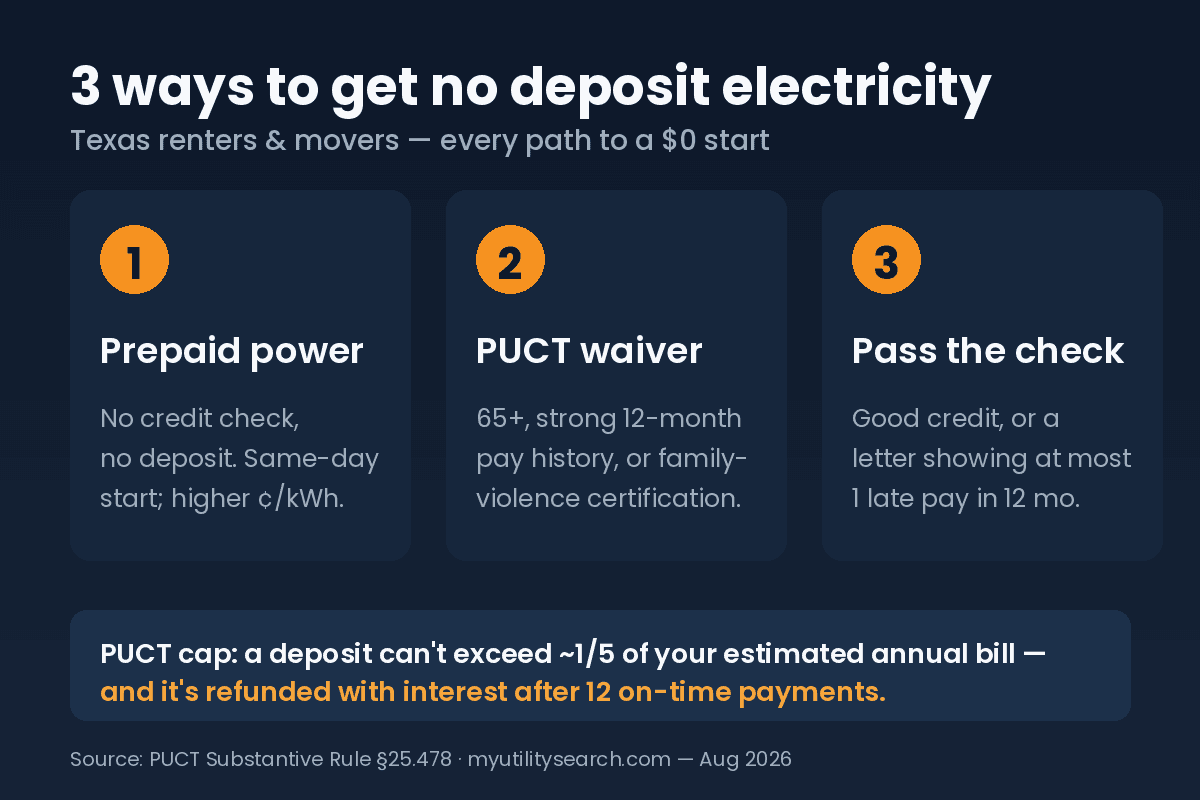
1. Prepaid, pay-as-you-go plans (no credit check at all). Providers like Payless Power skip the credit check entirely: you typically start with a small opening balance (around $40) instead of a deposit, and top up as you go. Enrollment takes minutes with just an address and ID, which makes prepaid the fastest no deposit electricity option for same-day movers.
2. Claim a deposit waiver you’re entitled to. The waiver table below is written into Texas regulation — providers don’t always volunteer it, but they must honor it when you qualify and ask.
3. Pass the credit screen once, compare everywhere. If your credit is fair or better, many 12-month plans simply waive the deposit on approval. Shopping through a marketplace means one soft screen measured against many providers instead of a fresh inquiry per application.
Texas Deposit Waivers: Who Qualifies Under PUCT Rules?
| Waiver path | What you need | Where it comes from |
|---|---|---|
| Age 65 or older | Valid ID showing age, and no overdue electric balance | PUCT §25.478 |
| Good payment history | Letter from your current/previous provider showing no more than one late payment in the last 12 months | PUCT §25.478 |
| Family-violence survivor | Certification letter from the Texas Council on Family Violence | PUCT §25.478 |
| Medically indigent | Qualification under the rule’s low-income medical provisions (ask the provider) | PUCT §25.478 |
Two practical notes. First, the payment-history letter is the workhorse waiver — if you’re switching providers and you’ve paid on time, request the letter from your old provider before you shop. Second, waivers apply to postpaid plans; prepaid products never charge deposits in the first place.
Prepaid vs Postpaid No Deposit Electricity: Which Should You Pick?
| Prepaid / pay-as-you-go | Postpaid with waiver or approval | |
|---|---|---|
| Credit check | None | Yes (or waiver documentation) |
| Upfront cost | Small opening balance (~$40) | $0 with waiver/approval |
| Typical price | Higher per kWh (often mid-to-high teens ¢) | Lower per kWh on 12-month terms |
| Contract | Usually none / flexible | Usually 12–36 months |
| Risk to watch | Service pauses when balance hits $0; daily fees on some plans | Early termination fee if you move mid-term (waivable with proof of move) |
| Best for | Bad or no credit, urgent same-day starts, short stays | Anyone who qualifies — cheaper over a full year |
Stat block: The trade is simple: prepaid no deposit electricity trades a higher rate for zero barriers, while a waived-deposit 12-month plan is usually the cheapest total cost — run both against your usage before choosing.
Compare internet, energy & home security at your address
Is No Deposit Electricity More Expensive?
Sometimes — and it’s worth doing the math instead of assuming. A prepaid plan running several cents above a comparable 12-month rate costs an extra $15–$35 a month at typical apartment usage of 700–900 kWh. Against that, a $300 deposit locked up for a year has real cost too, especially at move-in when cash matters most. The honest playbook for most renters: start prepaid if you need power today or can’t clear the screen, then switch to a cheaper 12-month plan once you’ve built 12 months of on-time history — at which point you qualify for the payment-history waiver and your next plan is deposit-free anyway. That two-step turns no deposit electricity from an emergency product into a strategy.
Renters in utilities-included apartments can skip this entirely — but if your unit is individually metered, the deposit question is yours, and so is the right to shop.
How to Start No Deposit Electricity Service Same-Day
- Confirm your address is in a deregulated area and individually metered (most Texas apartments are).
- Gather ID, service address, and move-in date — prepaid enrollment needs nothing else.
- If going postpaid, request your payment-history letter or have waiver documents ready before you apply.
- Compare plans by your actual usage (a 1-bedroom apartment typically runs 500–900 kWh/mo), not the teaser rate at 1,000 kWh.
- Order before the provider’s same-day cutoff — typically 5 p.m. Monday–Saturday — and power flows the same evening via smart meter.
- Calendar your 12th on-time payment — that’s the day a deposit refund (with interest) is due if you paid one, and the day the waiver letter becomes yours to claim.
No Deposit Electricity Outside Texas
The playbook travels, with local differences. In deregulated states like Ohio, Pennsylvania, Illinois, New Jersey, and New York, competitive suppliers frequently skip deposits entirely — it’s the regulated utility’s default service that more often requires one, with waiver rules set state by state. Prepaid products are rarer outside Texas because smart-meter penetration and market rules differ. If you’re moving between deregulated states, check the supplier’s deposit policy before assuming Texas rules apply — then compare what your new state’s supplier marketplace offers at your address.
Watch-Outs Before You Sign a No Deposit Electricity Plan
No deposit electricity is a legitimate product, but the fine print is where cheap plans stop being cheap. Five things to check before you enroll:
- Daily base fees on prepaid. Some pay-as-you-go plans charge a fixed daily fee on top of usage. On a light-usage studio, a $0.50/day fee is effectively three extra cents per kWh — compare the all-in rate, not the headline.
- Auto-disconnect thresholds. Prepaid service pauses quickly once your balance hits the minimum — often the same day. Turn on every low-balance alert the provider offers and keep an auto-reload card on file.
- Teaser pricing at exactly 1,000 kWh. Many advertised rates only apply at one usage point. A 1-bedroom apartment using 600 kWh can pay a very different effective rate on the same plan — always price no deposit electricity plans at your usage.
- Bill-credit gimmicks. Plans that hinge on hitting a usage window (say, a $100 credit only above 1,000 kWh) punish the small, efficient households most likely to want no deposit electricity in the first place.
- Early termination fees. Postpaid 12-month plans usually carry a $95–$300 ETF — but Texas rules let you leave penalty-free with proof of a move. Keep your lease or closing papers.
None of these are reasons to avoid no deposit electricity — they’re the reasons to compare plans side by side at your address rather than clicking the first ad that promises $0 down.
FAQ
What is no deposit electricity and how does it work?
No deposit electricity is service that starts without an upfront security deposit. It works three ways: prepaid plans that skip the credit check and draw from a balance you load; postpaid plans with the deposit waived under PUCT rules (age 65+, strong payment history, or family-violence certification); or standard approval when your credit clears the screen.
Can I get no deposit electricity with bad credit?
Yes. Prepaid pay-as-you-go plans require no credit check at all — approval is effectively instant with an ID and address. You’ll pay a small opening balance (around $40) instead of a deposit, and typically a higher rate per kWh than a 12-month postpaid plan.
How much is an electricity deposit in Texas?
Typically $50–$500. By rule it cannot exceed roughly one-fifth of your estimated annual billing (or two months of estimated bills), and it must be refunded with interest after 12 consecutive on-time payments per PUCT §25.478.
Who qualifies for a deposit waiver in Texas?
Customers 65 or older with no overdue electric balance; customers who can show no more than one late payment in the last 12 months (via a letter from their previous provider); qualifying survivors of family violence; and medically indigent customers under the rule’s provisions.
Is prepaid electricity the same as no deposit electricity?
Prepaid is one form of it — the form with no credit check. But postpaid plans can also be no deposit electricity when a waiver applies or your credit clears. If you qualify for a waiver, the postpaid route is usually cheaper over a year.
How do I get my electricity deposit back in Texas?
Under PUCT §25.478, your provider must refund the deposit with interest after 12 consecutive on-time payments. Put that date on your calendar. Providers don’t always send the refund automatically, so call and ask if it doesn’t show up.
Can I switch from prepaid to a regular plan without a deposit?
Usually, yes. After 12 months of on-time payments, ask your prepaid provider for a payment-history letter. A letter showing no more than one late payment in the last 12 months qualifies you for the waiver on a cheaper postpaid plan.
Does a prepaid electricity plan build my credit?
Not on its own. Prepaid plans skip the credit check, so they don’t hurt your score, but most providers don’t report on-time payments either. See Does Paying Utilities Build Credit? for the free way to get credit for those payments.
Which light companies turn on service the same day with no deposit?
Prepaid providers such as Payless Power connect the same day with no credit check if you order before the cutoff, typically 5 p.m. Monday through Saturday. A postpaid plan with a deposit waiver can also start the same day through your smart meter.
Compare internet, energy & home security at your address
Keep going
More ways to cut your startup costs and monthly bills:
- Payless Power Review: Prepaid Plans & Is It Good? — the no-credit-check prepaid option, reviewed.
- Deregulated Energy Texas: Best REP Electricity Plans — the full Texas provider hub.
- How to Switch Electricity Providers in Texas — the step-by-step once your 12 months of history are built.
- Utilities Included Apartments: What’s Covered & What You Can Still Choose — when the deposit question isn’t yours at all.
- Prepaid Home Internet: No-Contract, No-Credit-Check Plans — the same playbook for your internet bill.
- Houston Electricity Rates: Best Plans & Providers — compare rates in Texas’s biggest deregulated metro.
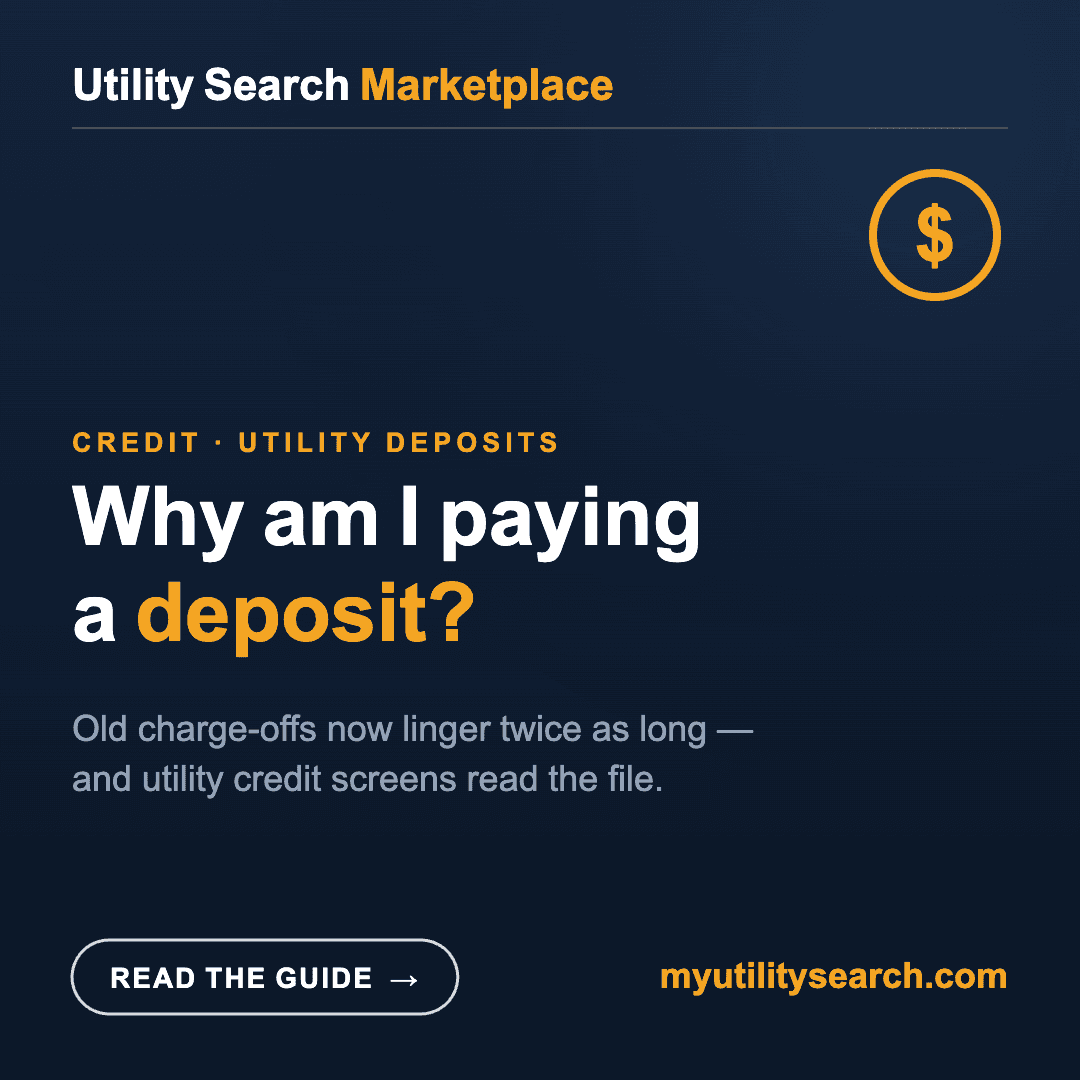
- Utility deposit credit check — why old charge-offs now trigger deposits, and how to avoid one
Sources: PUCT Substantive Rule §25.478 (Credit Requirements and Deposits); Public Utility Commission of Texas; provider disclosures. Verify current rates and terms at enrollment — prices change with the market.