Blog
Telecom Layoffs by Company: What the SEC Filings Show


Updated on August 28, 2026
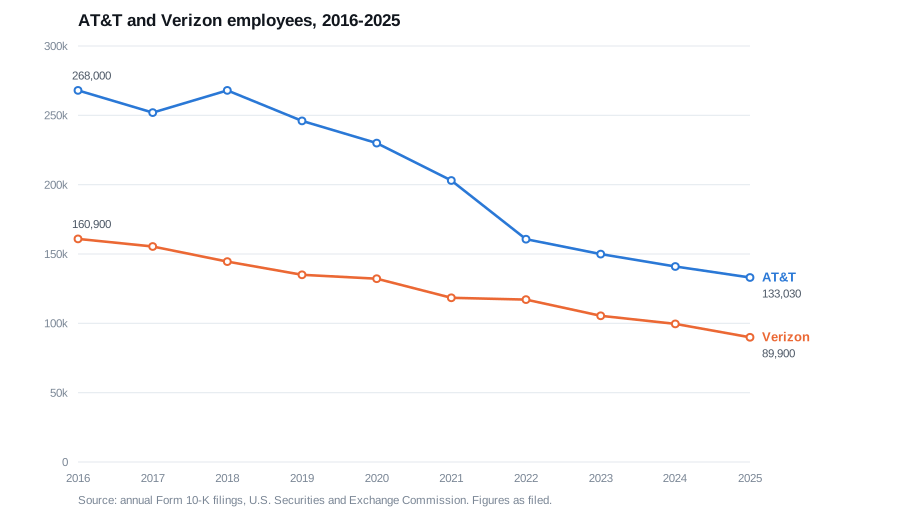
Between 2016 and 2025, AT&T’s reported headcount fell from about 268,000 to 133,030 and Verizon’s from 160,900 to 89,900 — a combined decline of roughly 206,000 positions at two companies. Almost none of it arrived as a layoff announcement. This page tracks telecom layoffs by company the only way it can be done accurately: every figure below is taken directly from the companies’ own annual 10-K filings with the Securities and Exchange Commission, with the filing and date cited for each year.
Last verified: 23 August 2026. Next scheduled update: after the FY2026 10-K filings in February 2027.
TL;DR — telecom layoffs by company, the ten-year picture
- AT&T: 268,000 → 133,030. Down 50.4% over ten years.
- Verizon: 160,900 → 89,900. Down 44.1%.
- Charter: 101,100 (2023) → 91,900 (2025).
- Lumen/CenturyLink: ~40,000 (2016) → ~24,000 (2025).
- Comcast is the outlier: 159,000 (2016) → 179,000 (2025), up over the decade despite recent declines.
- For scale: Challenger, Gray & Christmas counted 149,023 announced job cuts across the entire technology sector in the first seven months of 2026 — and Challenger tracks “Telecommunications” as a separate category, so telecom carriers are not even inside that number.
How to read this data
Definition: headcount vs. layoffs
A 10-K headcount figure is a snapshot on one date. The change between two snapshots captures everything: layoffs, attrition without backfill, divestitures, acquisitions, outsourcing, and reorganizations that delete a management layer. It is not a layoff count, and it should never be presented as one. What it is — and this is the useful part — is a number the company is legally obligated to report accurately, which announced layoff totals are not.
Three methodology notes that matter in any telecom layoffs by company count, and that most write-ups get wrong:
- AT&T changed its measurement date. Through the FY2023 10-K, AT&T reported headcount “as of January 31” of the following year. Starting with the FY2024 10-K it reports as of December 31. The FY2023 → FY2024 interval is therefore 11 months, not 12.
- Verizon changed its measurement basis. 2016–2019 figures are plain headcount; from 2020 onward they are full-time equivalent. That is a discontinuity in the series, not a cliff in the workforce.
- Divestitures are already excluded from recent years. WarnerMedia separated from AT&T on 8 April 2022; Verizon Media was sold to Apollo on 1 September 2021. Every figure from the FY2022 10-K forward is already clean of them. No manual adjustment is needed.
AT&T headcount, 2016–2025
| Fiscal year | Employees | Measured | 10-K filed |
|---|---|---|---|
| 2016 | 268,000 | 31 Jan 2017 | 17 Feb 2017 |
| 2017 | 252,000 | 31 Jan 2018 | 20 Feb 2018 |
| 2018 | 268,000 | 31 Jan 2019 | 20 Feb 2019 |
| 2019 | 246,000 | 31 Jan 2020 | 20 Feb 2020 |
| 2020 | 230,000 | 31 Jan 2021 | 25 Feb 2021 |
| 2021 | 203,000 | 31 Jan 2022 | 16 Feb 2022 |
| 2022 | 160,700 | 31 Jan 2023 | 13 Feb 2023 |
| 2023 | 149,900 | 31 Jan 2024 | 23 Feb 2024 |
| 2024 | 140,990 | 31 Dec 2024 | 12 Feb 2025 |
| 2025 | 133,030 | 31 Dec 2025 | 9 Feb 2026 |
Ten-year change: −134,970 (−50.4%) — the largest line in any telecom layoffs by company ledger.
The FY2025 10-K states: “As of December 31, 2025, we employed approximately 133,030 persons” — 43% of them union-represented. The ten-year starting point is the FY2016 10-K.
Worth a footnote before a reader flags it: AT&T reported approximately 268,000 in both the FY2016 and FY2018 10-Ks. That is not a transcription error. The Time Warner acquisition, which closed in June 2018, offset the reductions that happened in between.
The organic decline: from the FY2022 measurement (160,700) to FY2025 (133,030), AT&T shed 27,670 people across three consecutive annual declines of −6.72%, −5.94% and −5.65%. Measured instead from FY2023 (149,900), the decline is 16,870. Both are correct; they answer different questions. State which one you mean.
Verizon headcount, 2016–2025
| Fiscal year | Employees | Basis | 10-K filed |
|---|---|---|---|
| 2016 | 160,900 | headcount | 21 Feb 2017 |
| 2017 | 155,400 | headcount | 23 Feb 2018 |
| 2018 | 144,500 | headcount | 15 Feb 2019 |
| 2019 | 135,000 | headcount | 21 Feb 2020 |
| 2020 | 132,200 | FTE | 25 Feb 2021 |
| 2021 | 118,400 | FTE | 11 Feb 2022 |
| 2022 | 117,100 | FTE | 10 Feb 2023 |
| 2023 | 105,400 | FTE | 9 Feb 2024 |
| 2024 | 99,600 | FTE | 12 Feb 2025 |
| 2025 | 89,900 | FTE | 17 Feb 2026 |
Ten-year change: −71,000 (−44.1%).
The FY2025 10-K states: “Verizon has approximately 89,900 employees on a full-time equivalent basis as of December 31, 2025, 89% of whom are based in the U.S.” — 27% union-represented. The series starts at the FY2016 10-K.
Verizon’s then-CEO Hans Vestberg described the trajectory on the company’s Q2 2025 earnings call, answering an analyst question about why headcount had flatlined: “The headcount – we have been very, very good, and it’s going down all the time. So we have been very efficient in managing our resources.” (Via Light Reading, 22 July 2025.)
Charter, Comcast and Lumen
The picture of telecom layoffs by company is less complete for the cable operators. Charter Communications — “active full-time equivalent employees,” measured 31 December, per the FY2025 10-K:
| Year | Employees |
|---|---|
| 2023 | 101,100 |
| 2024 | 94,500 |
| 2025 | 91,900 |
The 2023 → 2024 decline is 6,600. Separately, Charter cut approximately 1,200 corporate roles in October 2025 — just over 1% of the workforce, concentrated in corporate, back-office and management layers, with sales and service spared — ahead of the Cox merger. Charter declined to comment on the report.
Comcast — the outlier in any telecom layoffs by company chart, and the reason you should not plot it alongside the carriers without a caveat (FY2025 10-K):
| Year | Employees | Year | Employees |
|---|---|---|---|
| 2016 | 159,000 | 2021 | 189,000 |
| 2017 | 164,000 | 2022 | 186,000 |
| 2018 | 184,000 | 2023 | 186,000 |
| 2019 | 190,000 | 2024 | 182,000 |
| 2020 | 168,000 | 2025 | 179,000 |
The 2020 dip and 2021 rebound are theme parks and venues closing and reopening, not connectivity restructuring. Comcast discloses only a consolidated figure — there is no breakdown by Connectivity & Platforms, Content & Experiences, NBCUniversal or Sky. Its only geographic detail: “Approximately 30% of our employees were located in over 30 countries outside the United States.”
In September 2025 Comcast announced it would retire its divisional structure — “Beginning in January, we will retire our Division structure” — effective January 2026. Two divisional headquarters closed: Central, at The Battery Atlanta in Cobb County, Georgia (240 positions), and West, in Centennial, Colorado (302 positions). 542 positions total, per WARN notices, the Colorado notice dated 15 October 2025 and including 72 financial analysts, 25 vice presidents and 24 finance managers.
Lumen Technologies (formerly CenturyLink) — rounded to the nearest thousand in the filings, so year-over-year deltas are low-precision (FY2025 10-K):
| Year | Employees | Year | Employees |
|---|---|---|---|
| 2016 | ~40,000 | 2021 | ~36,000 |
| 2017 | ~51,000 | 2022 | ~29,000 |
| 2018 | ~45,000 | 2023 | ~28,000 |
| 2019 | ~42,500 | 2024 | ~25,000 |
| 2020 | ~39,000 | 2025 | ~24,000 |
The 2016 → 2017 rise is the Level 3 acquisition, which closed in November 2017.
Compare internet, energy & home security at your address
Why telecom layoffs by company don’t show up in layoff trackers
Layoff trackers count announcements. These reductions largely weren’t announced, because they didn’t arrive in a form that requires an announcement:
- Attrition with no backfill
- Reorganizations that delete a management layer
- Roles moved to a vendor
- Reductions sized to stay under WARN notice thresholds
- Voluntary severance instead of an involuntary round
- Divestitures, where the jobs moved rather than vanished
Challenger, Gray & Christmas recorded 149,023 announced job cuts in the Technology sector in the first seven months of 2026, and 477,033 across all industries — down 41% from 806,383 in the same period of 2025, with announced hiring plans up 25% to 107,500 (Challenger July 2026 report). Challenger’s “Telecommunications” category is separate and recorded 3,333 cuts year-to-date.
Which is the comparison worth sitting with: AT&T and Verizon between them shed roughly 206,000 positions over the past decade — more than a full year of announced technology-sector cuts economy-wide, from two companies, in a sector that isn’t even counted in that number.
Methodology
Tracking telecom layoffs by company honestly means using the filings: every headcount figure comes from the “Employees” disclosure in Item 1 of the company’s annual Form 10-K, retrieved from SEC EDGAR. Filing dates are listed with each table. Where a company changed its measurement date or basis, the change is noted inline rather than smoothed.
No figure in this telecom layoffs by company dataset has been adjusted, estimated or interpolated. Where a company rounds (Lumen and Comcast, to the nearest 1,000), the rounded figure is reproduced as filed.
Announced-layoff figures come from Challenger, Gray & Christmas monthly reports and from contemporaneous trade reporting, and are labelled as such — they are not derived from the filings.
This dataset is free to cite and reproduce with attribution. If you use the chart, a link back is appreciated.
August 2026: the consolidation wave behind the next layoff cycle
Headcount cuts in telecom rarely announce themselves as layoffs — they arrive as “synergies” after deals close. August 2026 delivered two of the biggest triggers in years. On August 20–21, Charter completed its $34.5 billion acquisition of Cox Communications, combining the second- and third-largest U.S. cable operators under the Cox name with Spectrum as the consumer brand — the classic setup for overlapping-function reductions over the following quarters; our Charter–Cox merger guide tracks the customer side. In the same month, EchoStar’s Hughes satellite unit and its Dish TV and wireless subsidiaries filed for Chapter 11 reorganization — restructurings that historically precede workforce consolidation; see our Dish bankruptcy guide and EchoStar spectrum sale explainer. Add the January close of Verizon’s $20 billion Frontier acquisition and 2026 is shaping up as the heaviest consolidation year of the decade — the full picture lives in our telecom consolidation tracker. We’ll fold the resulting headcount disclosures into the tables above as the 10-K and 10-Q filings land.
Telecom layoffs by company: FAQ
How many people has AT&T laid off?
AT&T has not announced layoffs on this scale. Its reported headcount fell from about 268,000 in the FY2016 10-K to 133,030 in the FY2025 10-K — a decline of 134,970, or 50.4%. That change includes divestitures, attrition, outsourcing and reorganizations, not only layoffs.
Why don’t these numbers match layoff trackers?
Trackers count announced cuts. Most of this decline arrived through attrition without backfill, reorganizations, vendor transitions and reductions sized below WARN thresholds — none of which generate announcements.
Does the AT&T decline include WarnerMedia?
The 2021 → 2022 drop does; WarnerMedia separated on 8 April 2022. Every figure from the FY2022 10-K forward already excludes it, so no adjustment is needed for later years.
Why did Verizon’s numbers change basis in 2020?
Verizon reported plain headcount through 2019 and full-time equivalents from 2020 onward. It is a reporting change, not a workforce event.
Is Comcast cutting jobs too?
Comcast’s consolidated headcount is higher in 2025 (179,000) than in 2016 (159,000), though it has declined since 2019. It announced the retirement of its divisional structure in September 2025, effective January 2026, closing two divisional headquarters with WARN notices covering 542 positions in Georgia and Colorado.
Where can I check my own employer?
SEC EDGAR at sec.gov/edgar. Search the company, open the most recent 10-K, and read the “Employees” or “Human Capital” disclosure in Item 1. Compare it to the same section in an older filing. The filings are public and free.
That is the honest picture of telecom layoffs by company: the filings, as filed, with the discontinuities labelled — cite it freely, and check the current 10-K before you extend the series.
Compare internet, energy & home security at your address
Keep going
- Telecom consolidation, explained — the mergers behind the headcount
- Charter Cox merger: what it means for customers
- Frontier Verizon merger: what changed
- AT&T POTS line shutdown — the network retirement running alongside it
- T-Mobile acquisitions — the other consolidator
- AT&T Quantum Fiber merger — the $5.75bn Lumen fiber sale