Blog
Your Ameren Bill Jumped 39% This Summer — and an Auction Set the Price


Updated on September 5, 2026
The Ameren Illinois rate increase pushed the utility’s summer Price to Compare to 11.326 cents per kWh for June 1 through September 30, 2026 — roughly 39% higher than the same period in 2024. The cause sits in a wholesale capacity auction, not in your thermostat. In Illinois, the supply half of that bill is shoppable.
TL;DR — the Ameren Illinois rate increase at a glance
- Summer Price to Compare: 11.326 cents per kWh, June 1 through September 30, 2026 (Illinois Commerce Commission)
- That is about 39% above summer 2024, or roughly $16 more per 500 kWh than two years ago
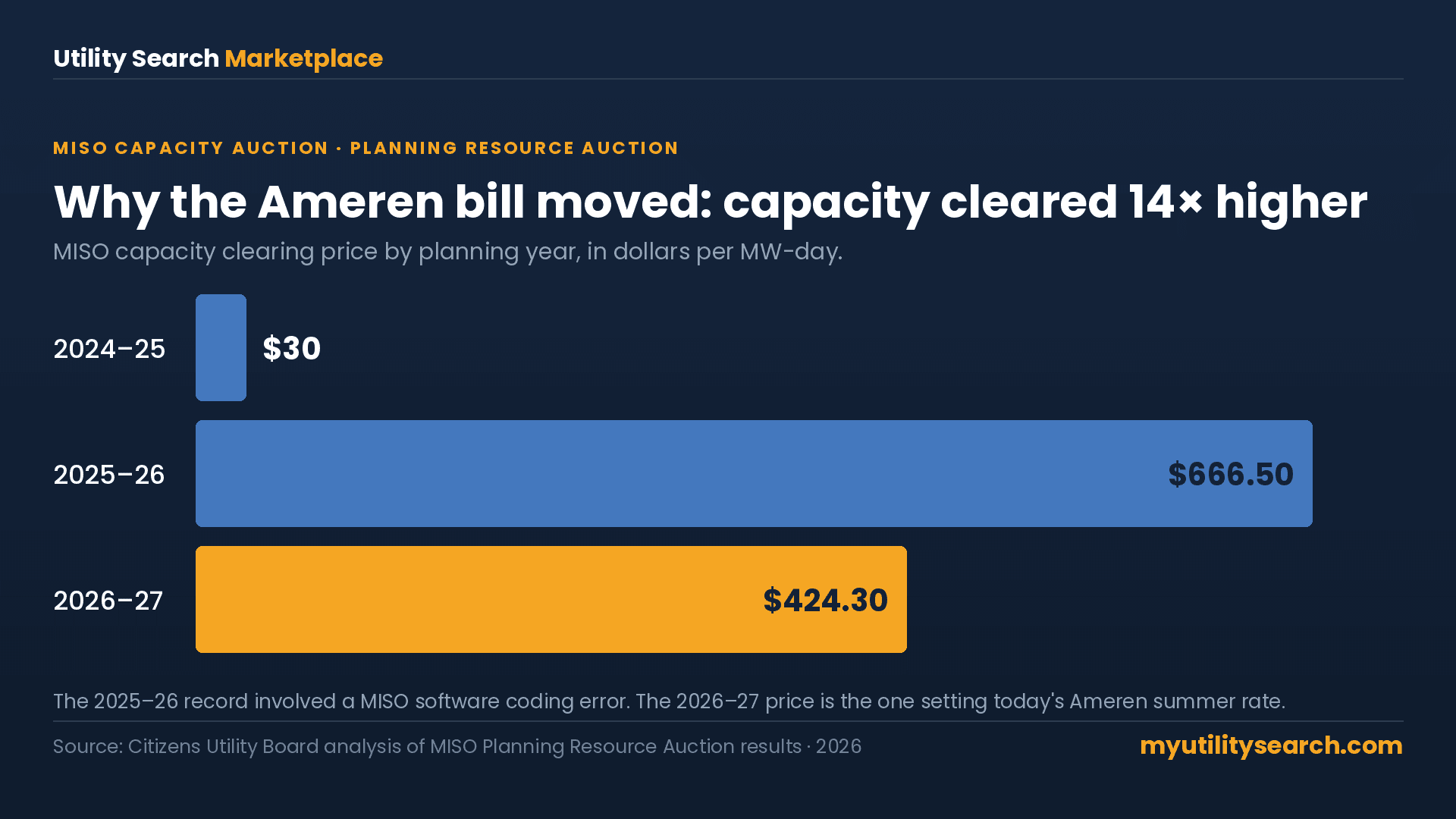
- Root cause: MISO’s capacity auction cleared $424.30 per MW-day for 2026-27, up from about $30 per MW-day in 2024
- What you control: the supply portion of an Illinois bill is shoppable; delivery charges are not
- Downstate only: Ameren serves central and southern Illinois. ComEd, in northern Illinois, is a separate market with a separate price
What the Ameren Illinois rate increase actually changed
Ameren Illinois publishes a number called the Price to Compare. The Illinois Commerce Commission tells shoppers to use it as the apples-to-apples benchmark when judging any competitive offer. For the summer 2026 period, that number is 11.326 cents per kWh on the first 800 kWh of usage, effective June 1 through September 30, 2026.
The Price to Compare is not your whole bill. It covers the supply and transmission portion — the part an alternative supplier is allowed to replace. Delivery charges stay with Ameren regardless of who sells you the electricity.
That distinction is the entire point of shopping. The Ameren Illinois rate increase raised the benchmark. It did not change the rule that you are allowed to beat the benchmark.
Price to Compare
- Electric Supply Charges plus Transmission Service Charge. It is the single number an Illinois customer uses to judge whether a competitive supplier’s offer is actually cheaper. If a supplier quotes below the Price to Compare for the same period, the supply line on your bill goes down. Delivery charges are unaffected either way.
Why did the Ameren Illinois rate increase happen?
The short answer is an auction held hundreds of miles upstream. The Ameren Illinois rate increase was not decided in Illinois at all.
Ameren Illinois buys capacity through MISO, the grid operator covering the central United States. MISO runs a Planning Resource Auction that sets a price for capacity — the commitment that generation will be there when demand peaks. For the June 2026 through May 2027 planning year, that auction cleared at $424.30 per MW-day. Two years earlier it cleared around $30 per MW-day.
| Planning year | MISO capacity clearing price | Note |
|---|---|---|
| 2024-25 | about $30 per MW-day | the old normal |
| 2025-26 | $666.50 per MW-day | a record, involving a software coding error |
| 2026-27 | $424.30 per MW-day | roughly 14 times the 2024 level |
Citizens Utility Board, the state’s consumer watchdog, points to four drivers behind the spike: new and proposed data centers pushing MISO’s forecasted load higher, a pricing methodology called the Reliability-Based Demand Curve that deliberately rewards higher prices with more generation, interconnection queue delays of roughly three and a half years that stall new clean generation, and continued reliance on coal and gas for more than 60% of summer capacity.
None of those are things a household or a small business can influence. All of them show up on the supply line of your bill.
It is worth naming what this is not. The Ameren Illinois rate increase is not a story about anyone using more electricity, and it is not a penalty for a particular kind of customer. It is a wholesale cost, set at auction a year in advance, passed through to every customer who has not chosen a competitive supplier. Ameren does not mark it up. That is precisely why shopping works: you are not negotiating with your utility, you are replacing the pass-through with someone else’s price.
How much is the Ameren Illinois rate increase costing you?
For a residential customer, Citizens Utility Board puts the difference at roughly $16 more per 500 kWh compared with two years ago. Scale that to a business running 10,000 kWh a month and the arithmetic gets serious quickly.
The Ameren Illinois rate increase is also seasonal in shape. Summer rates run higher than winter rates because summer peaks are what the capacity market is priced against. A rate locked in June looks different from one locked in November, which is why timing matters as much as the number itself.
Ameren or ComEd? Illinois runs two different markets
This trips up a lot of Illinois shoppers. The state has two large utilities sitting in two different grid regions:
Ameren Illinois covers central and southern Illinois and buys capacity through MISO. ComEd covers northern Illinois, including Chicago, and buys through PJM — a different grid operator running a different auction on a different schedule. Both regions set records in the same period, but the numbers are not the same and neither are the effective dates.
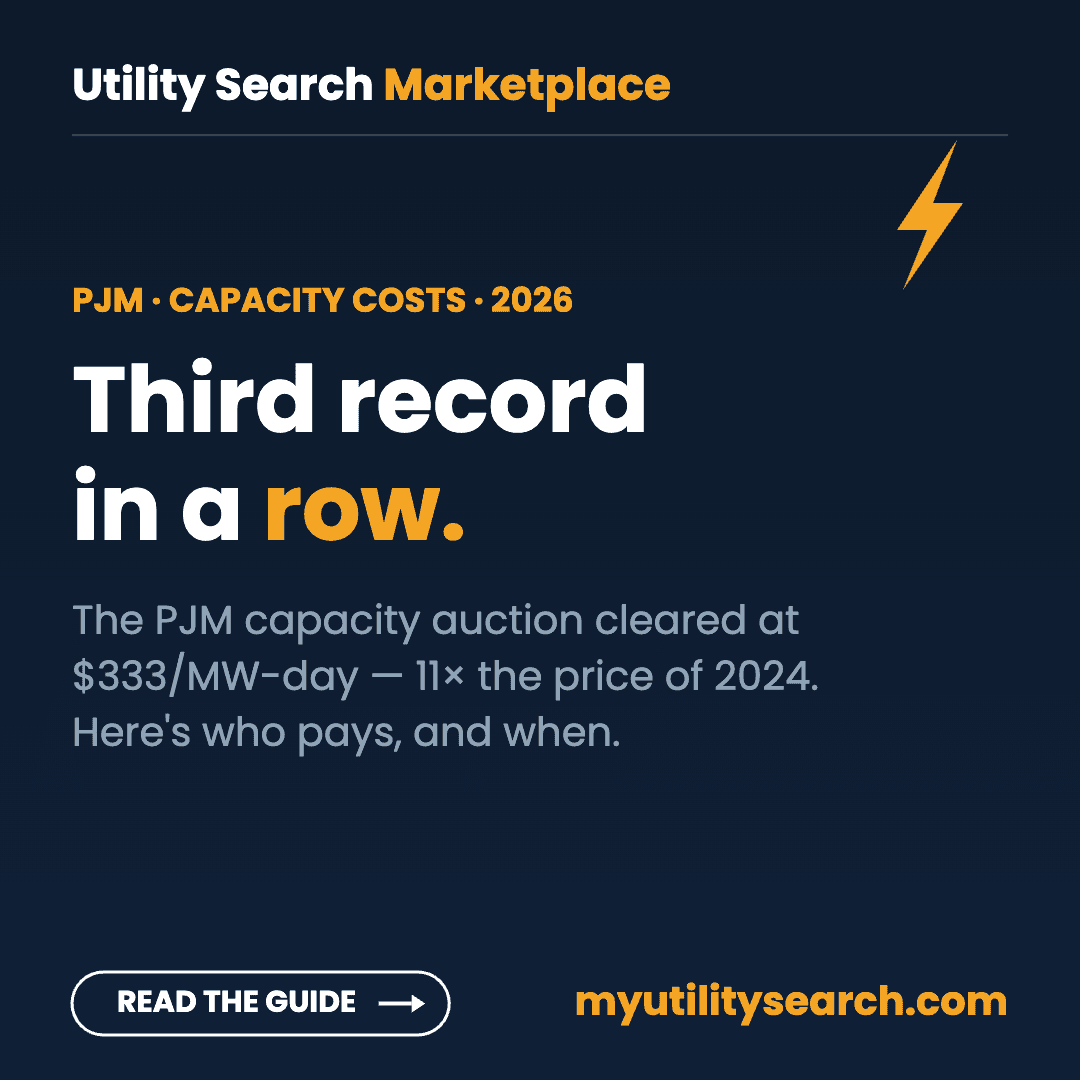
The Ameren Illinois rate increase applies only to Ameren’s downstate territory. Both auctions set records in the same stretch, and for overlapping reasons — data centers are reshaping load forecasts across the eastern half of the country. PJM’s 2027-28 auction cleared at $333.44 per MW-day, up from $28.92 four years earlier. MISO’s cleared higher still at $424.30. Different operators, different calendars, the same underlying squeeze — and an Ameren Illinois rate increase and a ComEd increase that arrive on separate schedules. What the two share is Illinois retail choice law. In both territories, customers may buy supply from an Alternative Retail Electric Supplier while the utility continues to deliver the power, read the meter, and restore service after a storm.
Compare internet, energy & home security at your address
What you can control about the Ameren Illinois rate increase
You cannot vote on a capacity auction. You can decide who sells you electricity. That is the whole of what a customer controls after an Ameren Illinois rate increase, and it is not nothing. Five steps, in order:
- Find your current Price to Compare. It is printed on your Ameren bill and posted on the Illinois Commerce Commission’s Plug In Illinois rate board. For summer 2026 it is 11.326 cents per kWh.
- Compare offers against that number for the same period. A supplier rate that looks good against a winter benchmark may lose against a summer one.
- Read the term length and the early termination fee before the rate. A low rate on a 36-month contract with a steep exit fee is a different product than the same rate on 12 months.
- Watch for introductory pricing that resets. The rate that matters is the one you will be paying in month seven, not month one.
- Calendar the expiration date the day you sign. Contracts that roll to a variable month-to-month rate at expiration are where most of the regret in this market lives.
For a business, add one more: ask whether the offer passes capacity costs through or fixes them. With capacity clearing above $400 per MW-day, that single structural question can matter more than a fraction of a cent on the energy rate.
A commercial account has more leverage against the Ameren Illinois rate increase than a household does. Capacity charges are assigned based on your demand during system peak hours, which means load shifting has a direct dollar value — moving a process off the afternoon peak can lower next year’s capacity obligation, not just this month’s bill. Ask any supplier quoting your account how capacity is billed under the contract, whether the rate is fixed or indexed, and what happens if your peak demand changes mid-term. A supplier that cannot answer those three questions cleanly is quoting you a number, not a strategy.
Timing is the other lever. Because the Ameren Illinois rate increase follows a seasonal reset, the comparison you run in August is against a summer benchmark that expires September 30. Know which period any quoted rate is being measured against before you sign.
FAQ
Is the Ameren Illinois rate increase permanent?
The specific Price to Compare is not — it resets on a seasonal schedule, with the summer 2026 rate running June 1 through September 30. The underlying pressure is more durable. Capacity prices are set by auctions that run a year ahead, and data center load growth in MISO shows no sign of reversing.
Can I avoid the Ameren Illinois rate increase by switching suppliers?
You can avoid part of the Ameren Illinois rate increase, not all of it. Switching replaces the supply and transmission portion of your bill with a competitive supplier’s rate. Delivery charges are set by Ameren and approved by the Illinois Commerce Commission, and no supplier can change them.
Does switching suppliers change who restores my power?
No. No part of the Ameren Illinois rate increase changes that. Ameren Illinois still owns the wires, reads the meter, and handles outages and emergencies. You still call Ameren when the lights go out. The only thing that changes is whose name is on the supply line of the bill.
Why is my neighbor’s ComEd rate different from mine?
Because ComEd sits in PJM and Ameren Illinois sits in MISO. Two grid operators, two capacity auctions, two clearing prices, two effective-date calendars. Same state, same choice law, different math.
Does the Ameren Illinois rate increase affect businesses differently?
Yes, in one important way. Commercial accounts are billed for capacity based on demand during peak hours, so the same wholesale increase lands harder on a business with a spiky load profile than on one that runs flat. That also means a business has more ways to respond — load shifting, demand management, and supply contracts that treat capacity separately from energy.
What is a good rate to compare against right now?
Anything below 11.326 cents per kWh for the June through September 2026 window beats staying on Ameren’s standard service on the supply line. Whether it is a good deal depends on the term, the exit fee, and what happens at expiration. Shopping that number is the one response to the Ameren Illinois rate increase that is entirely in your hands.
Compare internet, energy & home security at your address
Keep going
- Illinois Electricity Rates 2026: ComEd vs Ameren Compared
- Deregulated Energy Illinois: Best Electricity Suppliers
- ComEd Rate Increase: What Illinois Businesses Should Do
- Data Centers and Electric Bills: The 2026 Breakdown
- Champaign Electricity Rates: Best Plans and Price to Compare
- Electric Rate Increases 2026: Hikes and How to Offset Them
- PJM Capacity Auction: Guide to Rising 2026 Bills