Blog
MetroNet Fiber Internet: Plans, Prices & Review

Updated on September 28, 2026
10 min read
MetroNet internet is a 100% fiber-to-the-home service with symmetrical speeds from 150 Mbps up to 5 Gig, no data caps, and no annual contract. Plans run about $35–$120/mo. Now owned by a T-Mobile and KKR joint venture, MetroNet is one of the fastest-growing fiber builders in the Midwest and beyond.
TL;DR — key takeaways
- Type: 100% fiber, symmetrical upload and download.
- Plans: 150 Mbps, 1 Gig, 2 Gig, and up to 5 Gig.
- Price: about $35–$120/mo; no data caps, no contract (intro pricing rises after 12 months).
- Owner: T-Mobile / KKR joint venture (acquired 2025).
What is MetroNet internet?
MetroNet internet is a fiber-to-the-home provider building symmetrical fiber across the Midwest and Southeast. Because it is full fiber, upload matches download — ideal for remote work, big uploads, and gaming. Every plan includes unlimited data and month-to-month service, with optional price locks.
MetroNet internet plans and prices (2026)
Short answer: MetroNet is 100% fiber, so every plan is symmetrical (upload matches download) with no data caps and no contract. Tiers run from 150 Mbps to a blazing 5 Gig, and 1 Gig is just $49.95/mo — among the best fiber values anywhere. Intro pricing can rise after 12 months unless you lock a 1- or 3-year price-lock plan.
| Plan | Speed (symmetrical) | Price* | Best for |
|---|---|---|---|
| Fiber 150 | 150 / 150 Mbps | ~$34.95/mo | 1–2 people |
| Fiber 500 | 500 / 500 Mbps | ~$44.95/mo | Streaming households |
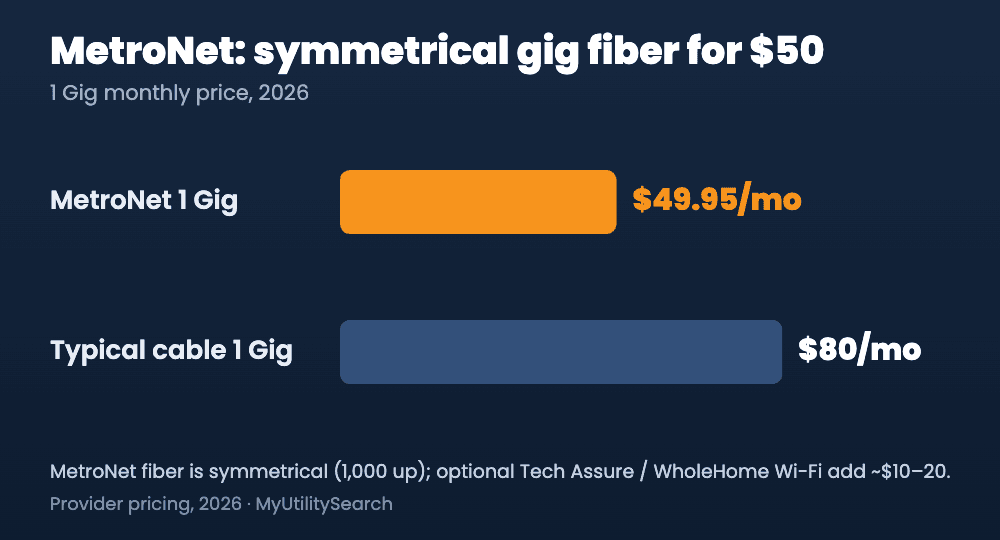
| Fiber 1 Gig | 1,000 / 1,000 Mbps | ~$49.95/mo | Families, remote work (best value) |
| Fiber 2 Gig | 2,000 / 2,000 Mbps | ~$69.95/mo | Power users, big households |
| Fiber 5 Gig | 5,000 / 5,000 Mbps | ~$109.95/mo | Max speed (select areas) |
*AutoPay pricing; rises after the 12-month intro unless you choose a price lock. No contracts, no data caps, no equipment rental. Two optional add-ons to watch on your bill: Tech Assure (~$9.95–$12.95/mo, covers service calls) and WholeHome Wi-Fi (~$9.95/mo) — skip them to keep the low headline price. Confirm the exact tiers and offer at your address on the official MetroNet site.
How fast is MetroNet? Symmetrical fiber explained
Short answer: Because MetroNet is 100% fiber, its speeds are symmetrical — upload matches download on every tier, from 150 Mbps up to 5 Gig. That’s a real edge over cable, whose uploads typically crawl at about 35 Mbps: for video calls, cloud backup, large uploads and gaming, MetroNet feels far faster than the download number alone suggests. For most homes the 500 Mbps or 1 Gig tier is the sweet spot, and at $49.95 for a symmetrical gig it’s one of the cheapest true-fiber gigs in the country.
Is MetroNet the same as T-Mobile Fiber?
Short answer: Effectively, yes — in most markets they’re two front doors to the same fiber. MetroNet is a joint venture of T-Mobile and KKR, and since the 2024 deal, residential fiber in MetroNet’s footprint is increasingly sold and supported as T-Mobile Fiber. MetroNet still builds and installs the network; T-Mobile handles residential sign-up and support, so when you go to order you’ll often be routed to T-Mobile Fiber’s checkout. The good news: it’s the same 100% symmetrical fiber, and the pricing lines up — about $35 (300 Mbps), $50 (1 Gig) and $70 (2 Gig) with AutoPay. Through T-Mobile Fiber you also get perks like 2 months free, a free Wi-Fi 6 router, free installation, no contracts and unlimited data.
MetroNet footprint (2026): the network reaches roughly 3 million homes and businesses across about 21 states and territories, covering 685 cities and 707 ZIP codes, delivering symmetrical speeds from 1 Gig up to multi-gig. Backed by T-Mobile and KKR, MetroNet is one of the fastest-growing fiber builders in the U.S., with plans to expand to 6.5 million homes by 2030 and construction underway in 100+ communities — so if fiber isn’t on your street yet, it may be soon.
MetroNet 2026 market landscape: ownership, fiber builds & competitors
MetroNet is a pure fiber-to-the-home overbuilder, and its ownership just changed: in 2025 a joint venture of T-Mobile and KKR completed its acquisition of MetroNet, pairing MetroNet’s fiber with T-Mobile’s scale to accelerate buildout — a tailwind for expansion and for T-Mobile-branded fiber in MetroNet markets.
- New builds: MetroNet is expanding into new suburbs and mid-size cities across the Midwest, South and Mountain West with all-fiber, symmetrical speeds.
- Product & pricing: symmetrical fiber from about $35/mo (150 Mbps) up to roughly $120/mo for multi-gig, no data caps and no annual contract.
- New competitor entrants: MetroNet competes with AT&T Fiber, cable incumbents like Xfinity and Spectrum, other fiber overbuilders such as Brightspeed and Kinetic, and 5G home internet from T-Mobile and Verizon.
How Starlink affects MetroNet’s tier structure
MetroNet targets suburban and mid-size addresses where wired options usually exist, so Starlink (about $120/mo satellite) is not a direct threat to its core market — it matters mainly at the rural edge. Because MetroNet sells symmetrical multi-gig fiber, its differentiation sits at the top of the ladder (speed and upload), while its $35 entry price defends the bottom against cable promos and fixed wireless.
Who owns MetroNet?
MetroNet is owned by a joint venture of T-Mobile and investment firm KKR, which acquired the company in 2025. MetroNet continues to operate under its own brand while expanding its fiber footprint.
Is MetroNet internet good and worth it?
MetroNet internet earns strong marks for symmetrical fiber speeds, unlimited data, and competitive pricing, and it is frequently rated well for value. It is worth it where its fiber has reached your address; the main watch-out is that introductory pricing steps up after the first year unless you lock it in.
How much does MetroNet internet cost per month?
MetroNet plans cost roughly $35–$120/mo: about $35 for 150 Mbps and up to around $120 for the top tier at full price. There are no data caps or contracts, though intro pricing increases after 12 months unless you choose a price lock.
Is MetroNet internet better than AT&T Fiber?
MetroNet and AT&T Fiber are both excellent symmetrical fiber services. MetroNet often undercuts on intro pricing and reaches smaller Midwest markets, while AT&T Fiber has a much larger footprint. Where both are available, it usually comes down to price and the current promotion.
Does MetroNet internet require a contract, deposit, or have a data cap?
MetroNet does not require a contract and has no data caps, so there are no early termination or overage fees. A credit check may apply at sign-up; optional 1- or 3-year price-lock plans are available to hold your rate.
How do I cancel or contact MetroNet?
You can cancel MetroNet anytime with no early termination fee through your online account or by contacting MetroNet support; return any provided equipment to avoid charges. To check availability or start service, use the MetroNet website. Comparing options? See our roundup of the best internet providers for 2026.
Is your plan keeping up?
If your results are lower than you’re paying for, you may have faster options at your address. Compare internet plans available where you live — fiber, cable, and 5G, side by side.
How reliable is MetroNet internet? Outages and service
Short answer: MetroNet runs a 100% fiber network with symmetrical speeds and no data caps, and fiber is inherently more reliable than cable or DSL. Fiber is immune to the electrical noise and neighborhood-node congestion that slow cable at peak hours, so MetroNet outages are relatively infrequent and usually tied to local construction cuts or a power loss at your home rather than network overload.
How do I check for a MetroNet outage?
Check the MetroNet app or your online account status page first, or call MetroNet support. A rule of thumb: if the whole neighborhood is down it is usually a construction cut or area power issue on MetroNet’s side; if only your home is affected, it is most often the ONT or router — power-cycle both before you call.
What is the MetroNet “Tech Assure” fee?
Many markets add a Tech Assure charge of about $12.95/mo that is effectively non-optional. It covers the router, equipment maintenance, internal wiring repairs, and technician visits. It is easy to miss in the advertised price, so add it to the plan rate when you compare MetroNet’s true monthly cost against other fiber providers.
Does the T-Mobile ownership change MetroNet service?
Day to day, no. MetroNet operates as the flagship of the T-Mobile Fiber family; most customers still see MetroNet on the bill and the truck, while the back end and future expansion are integrated with T-Mobile’s national fiber strategy. For customers that mainly means faster network expansion, not a change to current billing or local service.
Sources: MetroNet; T-Mobile / KKR joint venture announcement.
Compare internet, energy & home security at your address
Metronet for business: Business Fiber Standard vs Business Fiber Premium
Metronet Business sells two fiber products, both symmetrical and both available at speeds up to 5 Gig as of September 28, 2026, and neither carries a published price — every business account is quoted by address. Business Fiber Standard is the 100% fiber, no-data-cap, symmetrical service with 24/7/365 technical support. Business Fiber Premium adds what a business actually pays a premium for: business traffic prioritized ahead of Standard, a 99.99% uptime guarantee, a financially backed SLA covering availability, latency, jitter, packet loss and mean time to repair, and priority-level support. Against the residential 1 Gig at $49.95 on the table above, expect the Standard quote to sit above that and the Premium quote well above it; the SLA is the product.
| Business product | Price | What it adds |
|---|---|---|
| Business Fiber Standard (up to 5 Gig, symmetrical) | Quoted by address | No data caps; 24/7/365 support |
| Business Fiber Premium (up to 5 Gig, symmetrical) | Quoted by address | Traffic prioritized; 99.99% uptime; financially backed SLA; priority support |
| Managed Wi-Fi | Quoted | Add-on for either tier |
Source: the provider’s own business pages, read September 28, 2026. Business pricing is quoted by address and term; treat these as the published starting points.
What the business plan adds over the residential one: a service-level agreement with priority repair, static IP options, commercial-use terms and business support. If downtime does not cost you money, the residential plan at the same address is the cheaper answer — see business internet providers compared and what business internet costs.
Business shopper? Compare business internet at your address or talk to a specialist.
Frequently asked questions
Is MetroNet the same as T-Mobile Fiber?
Largely yes. MetroNet is a T-Mobile and KKR joint venture, and residential fiber in MetroNet markets is now sold and supported as T-Mobile Fiber — the same symmetrical fiber network, with pricing around $35 (300 Mbps), $50 (1 Gig) and $70 (2 Gig) plus perks like 2 months free and a free Wi-Fi 6 router.
Is MetroNet internet symmetrical?
Yes. MetroNet is 100% fiber, so upload speeds match download speeds on every plan, from 150 Mbps to 5 Gig — a big advantage over cable for uploading and video calls.
How much is MetroNet 1 Gig?
About $49.95/mo with AutoPay for symmetrical gig fiber, with no contract and no data caps. Optional Tech Assure and WholeHome Wi-Fi add-ons can raise the bill.
What is MetroNet’s Tech Assure fee?
Tech Assure is an optional ~$9.95–$12.95/mo plan covering service calls and equipment repairs. It’s not required, so decline it to keep the lowest price.
Is MetroNet internet good?
Yes — MetroNet internet offers symmetrical fiber speeds, no data caps, and no contract, making it a strong, well-priced choice for remote work and gaming where available.
How much is MetroNet internet per month?
About $35–$120/mo depending on the speed tier, with no data caps or contract. Intro pricing rises after 12 months unless you choose a price lock.
Who owns MetroNet?
A T-Mobile and KKR joint venture owns MetroNet, having acquired the fiber builder in 2025.
Does MetroNet have a data cap?
No. MetroNet has no data caps and no annual contract, so there are no overage or early termination fees.
Is MetroNet better than AT&T Fiber?
Both are top-tier symmetrical fiber. MetroNet often wins on intro price and reaches smaller markets; AT&T Fiber has wider coverage.
Does Metronet offer business internet?
Yes. Metronet Business sells Business Fiber Standard and Business Fiber Premium, both symmetrical at speeds up to 5 Gig, quoted by address as of September 28, 2026. Premium adds prioritized traffic, a 99.99% uptime guarantee, a financially backed SLA and priority support.
Compare internet, energy & home security at your address
Confirm current plans and pricing for your address on the provider’s official site and the FCC Broadband Facts label.
Confirm current plans and pricing for your address on the provider’s official site and the FCC Broadband Facts label.
Metronet is now part of the T-Mobile fiber joint venture; see our T-Mobile Fiber plans and prices review for how the branded plans compare.