Blog
Ziply Fiber Internet: Plans, Prices & Review

Updated on September 28, 2026
8 min read
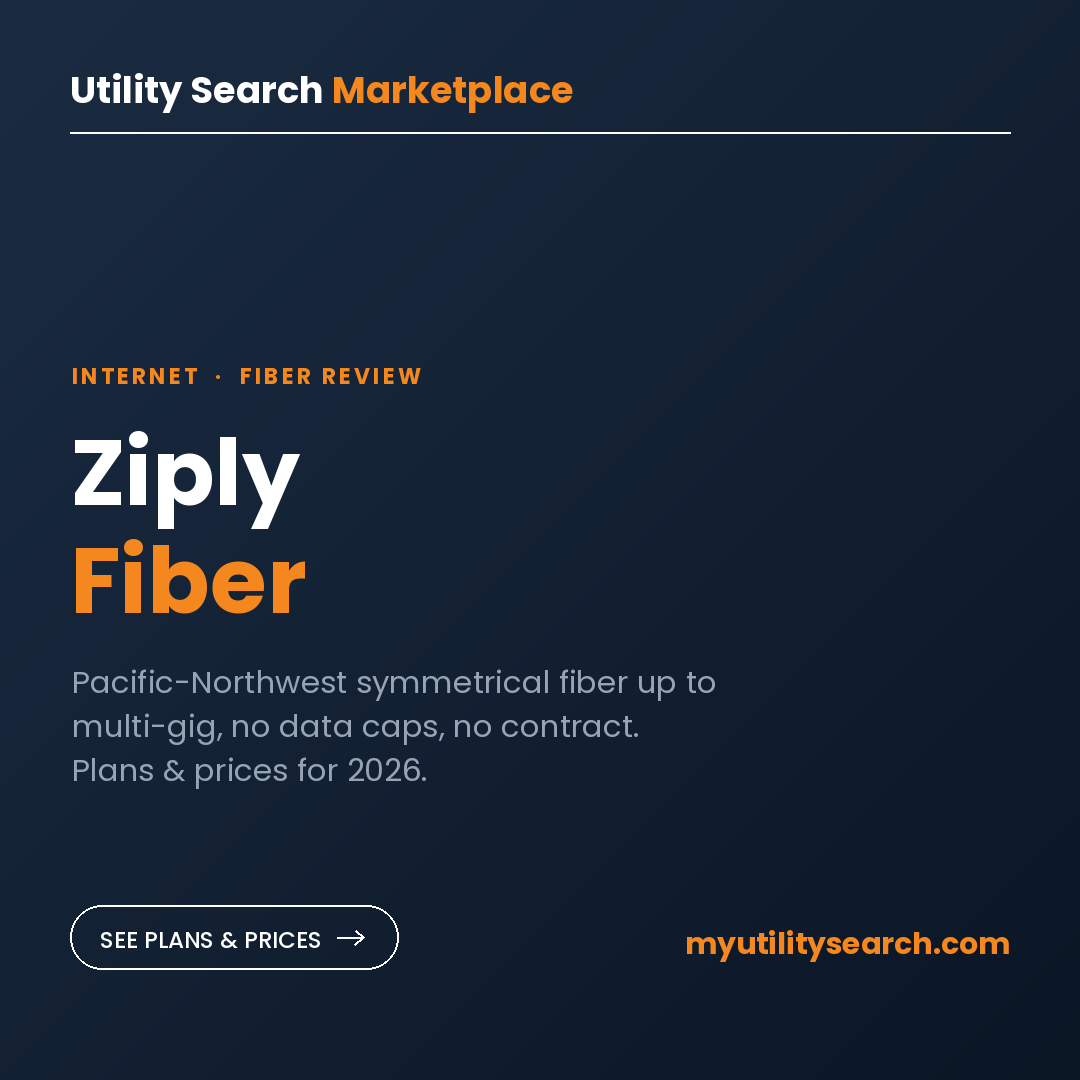
Ziply Fiber is a 100% fiber internet provider serving the Pacific Northwest, with symmetrical speeds from 300 Mbps up to multi-gig and no data caps or contract. Plans run about $35–$90/mo across Washington, Oregon, Idaho, and Montana. Ziply is known for fast symmetrical uploads and transparent, contract-free service.
TL;DR — key takeaways
- Type: 100% fiber, symmetrical upload and download.
- Plans: 300 Mbps, 1 Gig, 2 Gig, and up to 5 Gig+ in select areas.
- Price: about $35–$90/mo; no data caps, no contract.
- Owner: Northwest Fiber, LLC (Ziply); serves WA, OR, ID, MT.
What is Ziply Fiber?
Ziply is a regional fiber-to-the-home provider in the Pacific Northwest, built on former Frontier Northwest lines and heavily upgraded to fiber. Because it is full fiber, upload matches download — ideal for remote work, large uploads, and gaming. Its plans have no data caps and no term contract.

Ziply Fiber plans and prices
| Plan | Speed | Typical price* | Best for |
|---|---|---|---|
| Fiber 300 | 300 / 300 Mbps | from ~$35/mo | 1–2 people |
| Fiber 1 Gig | 1000 Mbps | ~$65/mo | Families, remote work |
| Fiber 2 Gig | 2000 Mbps | ~$80/mo | Power users |
| Fiber 5 Gig+ | 5000 Mbps+ | higher | Max speed (limited areas) |
*Introductory pricing may rise after 12 months. Confirm the current offer on Ziply’s site.
Who owns Ziply?
Ziply Fiber is owned by BCE Inc. (Bell Canada). BCE completed its acquisition on August 1, 2025 for US$3.65 billion (C$5.0 billion) in cash, plus the assumption of roughly C$2.6 billion in net debt. Ziply began as Northwest Fiber, LLC, which bought Frontier’s Pacific Northwest operations in 2020 and rebuilt them into a modern fiber network — that history is why the brand still feels regional. Under Bell, Ziply Fiber operates as a separate business unit, still headquartered in Kirkland, Washington, with its existing management team.
Is Ziply Fiber good and worth it?
Ziply earns strong marks for its symmetrical speeds, no data caps, and straightforward service, and it frequently rates well for value in its region. It is worth it if fiber has reached your address in the Northwest; symmetrical upload makes it especially strong for remote work and creators.
How much does Ziply Fiber cost per month?
Ziply plans cost roughly $35–$90/mo: about $35 for 300 Mbps, $65 for 1 Gig, and $80 for 2 Gig, with faster tiers available in some areas. There are no data caps or contracts, though introductory pricing can increase after the first year.
Is Ziply better than Xfinity?
For upload and consistency, Ziply usually beats Xfinity because it is full fiber with symmetrical speeds and no data caps, while Xfinity is mostly cable with lower upload and a data cap in many areas. Xfinity has broader national coverage, but within the Northwest, Ziply’s fiber is often the stronger choice for remote work.
Does Ziply require a contract, deposit, or have a data cap?
Ziply does not require a contract and has no data caps, so there are no early termination or overage fees. A credit check may apply at sign-up and a deposit is uncommon; equipment terms vary by plan, so confirm any router fee when ordering.
How do I cancel or contact Ziply?
You can cancel Ziply anytime with no early termination fee through your online account or by contacting Ziply support; return any provided equipment to avoid charges. To check availability or start service, use the Ziply website. Comparing options? See our roundup of the best internet providers for 2026.
Is your plan keeping up?
If your results are lower than you’re paying for, you may have faster options at your address. Compare internet plans available where you live — fiber, cable, and 5G, side by side.
What the Bell acquisition means for Ziply Fiber customers
Short answer: very little day to day, and potentially quite a lot over the next few years. BCE bought Ziply Fiber to enter the U.S. fiber market, not to strip it — and the structure of the deal reflects that. Ziply runs as its own business unit under a segment Bell calls Bell CTS U.S., keeping its headquarters, its management team, and its brand.
The growth numbers support the read. Ziply Fiber reported 368,643 fiber customers in its most recent quarter, up about 7% year over year, adding 6,775 subscribers in the quarter — ahead of the prior quarter’s pace. Companies being wound down do not post accelerating subscriber growth.
| What | Status under Bell |
|---|---|
| Brand | Still Ziply Fiber |
| Headquarters | Kirkland, Washington |
| Management | Existing team retained |
| Footprint today | Washington, Oregon, Idaho, Montana |
| Homes passed | ~1.4 million |
| Target by end of 2028 | ~3 million homes |
| Long-term U.S. goal | ~8 million homes |
That buildout target is the genuinely consequential part for consumers. Going from 1.4 million homes passed to roughly 3 million by the end of 2028 means Ziply Fiber will reach addresses that currently have one wired option or none. If you have been stuck with a single cable provider in the Northwest, this is the deal most likely to change that.
What to watch as the buildout accelerates
An expansion of this size changes the competitive picture in the Pacific Northwest more than any marketing campaign would. A few things worth tracking if you live in Washington, Oregon, Idaho, or Montana:
- Whether availability reaches your street. Homes passed is the metric that matters to you, and it is scheduled to roughly double by the end of 2028. An address that showed no service two years ago is worth re-checking annually.
- Whether flat pricing holds. The brand built its reputation on straightforward rates without the promotional cliff that defines cable pricing. That is the characteristic most exposed to change under a returns-focused owner, and the clearest signal of intent.
- How incumbents respond. Competition tends to produce better offers from whoever was already there. When a new fiber build enters a market, the existing cable operator often improves its retention pricing — which benefits you even if you never switch.
- Equipment and installation fees. These are where costs quietly migrate when headline rates stay flat. Compare the total first-year cost, not the advertised monthly figure.
The broader context is that capital is flowing into American fiber from unusual places right now — a Canadian carrier here, an infrastructure fund elsewhere, national wireless carriers buying regional operators. For households, the practical upshot is that the list of providers reaching a given address is changing faster than at any point in the last decade, and the only reliable way to know your options is to check them rather than assume.
Is Ziply Fiber Available At Your Address?
Ziply is expanding fast under Bell, so coverage may have reached your street since you last checked. Compare Ziply against every other provider at your address — fiber, cable, and 5G, side by side on price and speed.
Compare internet plans at my address →Is Ziply Fiber’s independence a good thing?
It is worth putting this deal next to the others reshaping the market. In 2026 alone, Verizon absorbed Frontier, AT&T bought Lumen’s consumer fiber, and Charter moved on Cox — each folding a regional brand into a national carrier. The Bell purchase of Ziply Fiber is structurally different: a foreign parent funding expansion of a regional operator rather than absorbing it into an existing U.S. footprint.
The practical upside is capital without consolidation. Bell has no overlapping U.S. network, so there is no duplicate territory to rationalize and no competitor being removed from your street. The honest counterpoint is that any owner eventually wants returns, and fiber builds are funded on the expectation of future pricing power. For the fuller picture of who now owns what, see our telecom consolidation tracker.
If you want to check what actually reaches your address rather than relying on any provider’s coverage claim, the FCC’s National Broadband Map reports provider-claimed service by location.
Ziply Fiber for business: Ziply small business fiber plans
Ziply Fiber sells four symmetrical small-business tiers — Fiber 300/300, Fiber 500/500 (which Ziply marks as best value), Fiber Gig and Fiber 2 Gig — with no annual contract for new business customers, a contract buyout of up to $200 on qualifying plans, and free installation (a $90 value) on offers running through September 30, 2026. Monthly prices are not published on the business pages as of September 28, 2026; Ziply quotes after an address check or by phone, and notes that prices exclude taxes and that speed is not guaranteed. Against the residential Fiber Gig at about $65 on the table above, expect the business Gig quote to sit above it for the business support and commercial terms.
| Business plan | Monthly price | Terms |
|---|---|---|
| Fiber 300/300 | Quoted by address | No annual contract; free install through 9/30/2026 |
| Fiber 500/500 (best value) | Quoted by address | No annual contract; up to $200 contract buyout |
| Fiber Gig (1,000/1,000) | Quoted by address | No annual contract |
| Fiber 2 Gig | Quoted by address | No annual contract; high-traffic and cloud use |
Source: the provider’s own business pages, read September 28, 2026. Business pricing is quoted by address and term; treat these as the published starting points.
What the business plan adds over the residential one: a service-level agreement with priority repair, static IP options, commercial-use terms and business support. If downtime does not cost you money, the residential plan at the same address is the cheaper answer — see business internet providers compared and what business internet costs.
Compare business internet at your address
Business plans are quoted by address and term. See which providers reach your storefront or office before you sign anything.
Frequently asked questions
Is Ziply Fiber good?
Yes — Ziply offers symmetrical fiber speeds, no data caps, and no contract, making it a strong choice for remote work and gaming across the Pacific Northwest.
How much is Ziply per month?
About $35–$90/mo depending on the speed tier, with no data caps or contract. Introductory pricing may rise after 12 months.
Who owns Ziply?
Northwest Fiber, LLC operates Ziply, having acquired and upgraded Frontier’s former Pacific Northwest network.
Does Ziply have a data cap?
No. Ziply has no data caps and no annual contract, so there are no overage or early termination fees.
Is Ziply better than Xfinity?
For upload and consistency, usually yes — Ziply is symmetrical fiber, while Xfinity is mostly cable with data caps in many areas. Xfinity has wider coverage nationally.
Does Ziply Fiber offer business internet?
Yes. Ziply Fiber sells symmetrical small-business tiers at 300, 500, 1,000 and 2,000 Mbps with no annual contract, up to $200 in contract buyout and free installation on offers through September 30, 2026. Prices are quoted by address as of September 28, 2026.
Compare internet, energy & home security at your address