Blog
Google Fiber (GFiber): Plans, Prices & Review

Updated on September 20, 2026
12 min read
By the Utility Search Marketplace Team · Last updated September 20, 2026 · Prices verified at checkout
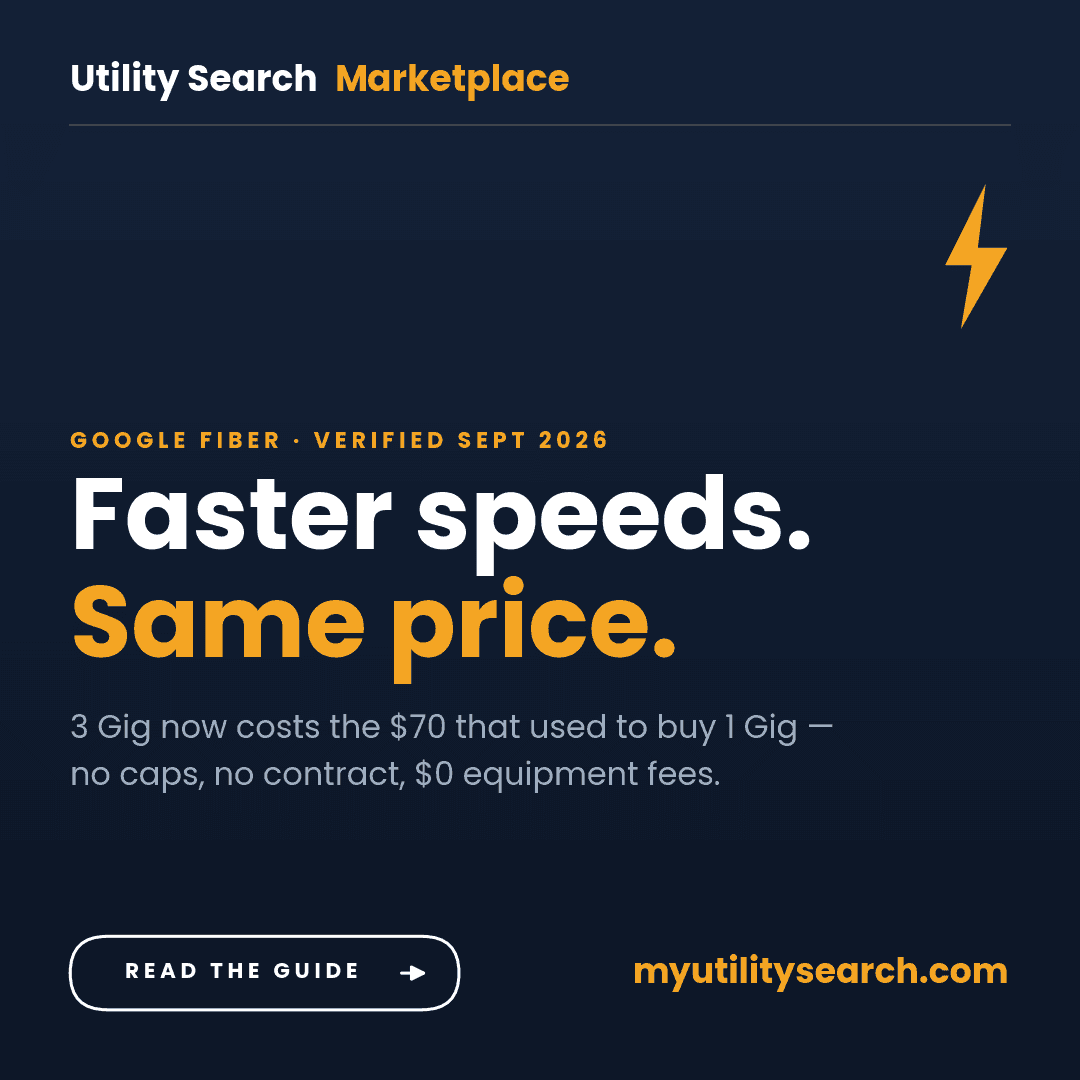
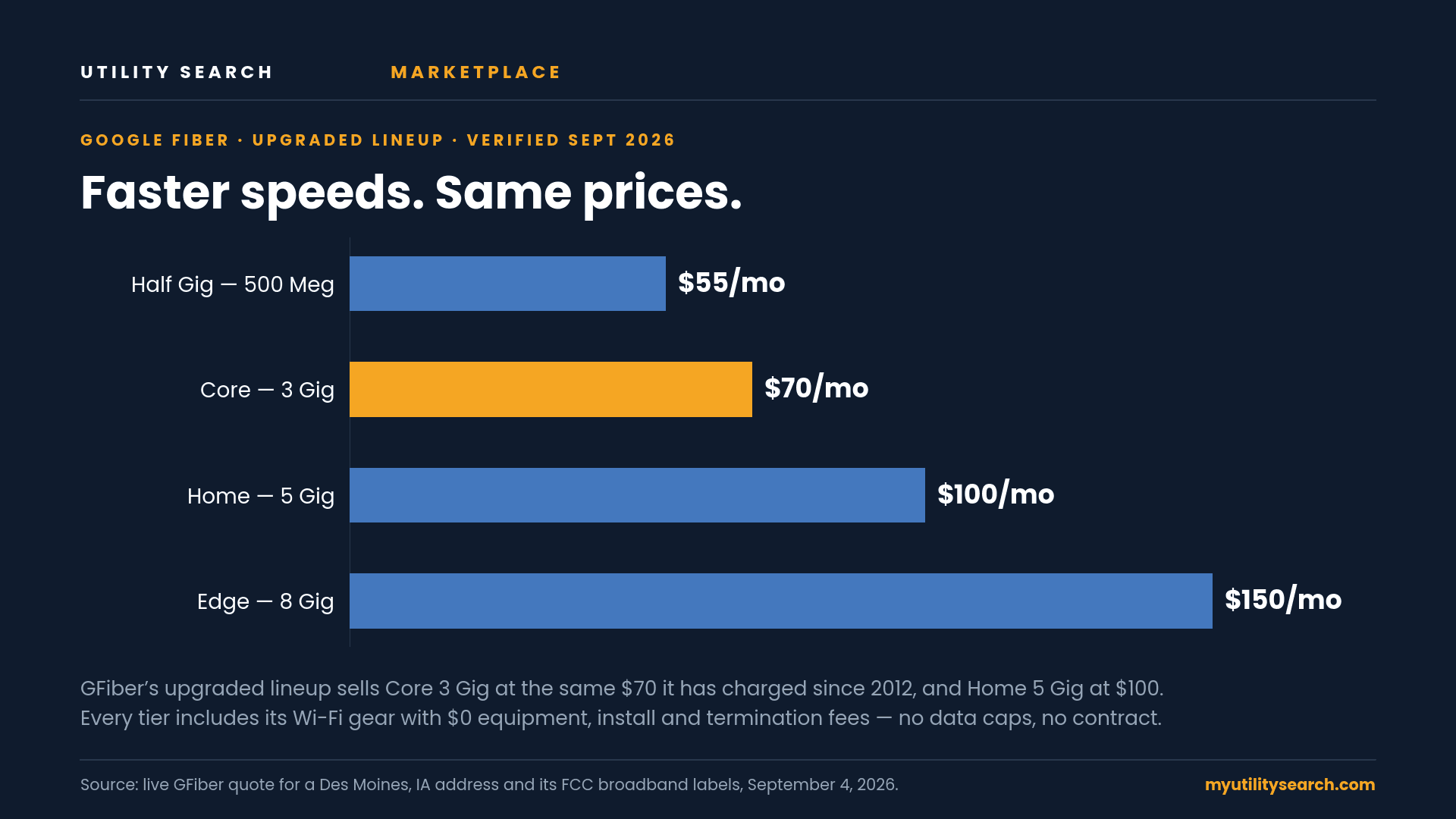
Google Fiber (GFiber) sells symmetrical fiber from $55/mo for 500 Meg up to $150/mo for 8 Gig — and on its upgraded lineup, verified on a live Des Moines, Iowa address quote September 4, 2026, $70 now buys 3 Gig and $100 buys 5 Gig (“even faster speed, same price”), with no data caps, no annual contract, and equipment included. It is one of the fastest residential providers in the U.S., and its ownership is changing: Alphabet announced in March 2026 it is selling a majority stake to Stonepeak, which is combining GFiber with Astound Broadband. Availability remains the main limitation — GFiber reaches metro areas in 19 states.

TL;DR — key takeaways
- Type: 100% fiber, symmetrical upload and download.
- Plans: on the upgraded lineup — verified on a live Des Moines, Iowa address quote September 4, 2026 — $55 buys 500 Meg, $70 buys 3 Gig (Core), $100 buys 5 Gig (Home) and $150 buys 8 Gig (Edge), all symmetrical. Markets still on the older lineup see 1 Gig at $70 and 3 Gig at $100.
- Price rules: flat, non-introductory pricing — the FCC broadband labels on a September 2026 quote show $0 equipment, install and early-termination fees and a $0 local access fee (government taxes vary by location); no data caps, no contract.
- Reliability: 8 Gig includes battery backup and a 99.9%+ uptime guarantee — 25% off the month’s bill if you’re down more than 45 minutes.
- Owner: Google (Alphabet) today — Stonepeak takes majority ownership in the GFiber–Astound merger, expected to close in Q4 2026.
What is Google Fiber?
GFiber is Google’s fiber-to-the-home internet service, now marketed as GFiber. Because it is full fiber, upload speeds match download speeds — ideal for remote work, large uploads, and gaming. GFiber has no data caps and no term contract, and its plans are among the fastest available to homes.
GFiber plans and prices
| GFiber plan | Speed (symmetrical) | Price* | Best for |
|---|---|---|---|
| Half Gig | 500 Meg (typical 515/506 Mbps) | $55/mo | Budget pick for the essentials — Google Wifi point included |
| Core — 3 Gig | 3 Gig (typical 3,423/3,418 Mbps) | $70/mo | Same $70 price since 2012, now 3 Gig — Wi-Fi 6E router + extender included |
| Home — 5 Gig | 5 Gig (typical 5,709/5,797 Mbps) | $100/mo | GFiber’s recommended pick — Wi-Fi 7 router + mesh extender included |
| Edge — 8 Gig | 8 Gig symmetrical | $150/mo | Creators & gamers — battery backup and uptime guarantee included |
*Lineup and typical speeds from a live GFiber address quote and its FCC broadband labels, September 4, 2026. Pricing is flat and non-introductory: the labels and checkout show $0 equipment, install, one-time and early-termination fees and a $0 local access fee, with unlimited data and 13 ms typical latency (government taxes vary by location). Each tier ships its own included Wi-Fi gear: a Google Wifi point on Half Gig, a Wi-Fi 6E router and extender on Core, and a multi-gig Wi-Fi 7 router and mesh extender on Home. Some markets still show the older 1 Gig $70 / 3 Gig $100 / 8 Gig $150 lineup — GFiber is rolling out “even faster speed, same price” upgrades.
Naming note: in the signup flow these tiers appear as Half Gig, Core, Home and Edge, while GFiber’s marketing site sells the same ladder by speed. Whichever label you see at your address, the price points are $55, $70, $100 and $150.
Watch the add-ons at checkout. GFiber Phone is a reasonable $20/mo — but on the same Des Moines checkout, the optional Phone Battery Backup rang up as a one-time $1,230 equipment charge for up to 24 hours of outage protection. That single add-on costs more than 17 months of Core internet, so decline it unless a landline that survives long power outages is genuinely critical for you; a basic UPS from a hardware store keeps most home phone gear alive for a fraction of that.
Confirm availability and current offers for your address on GFiber’s site.
What happens when you check a real Google Fiber address?
Advertised prices only tell you so much, so we walked a real Des Moines, Iowa address through Google Fiber’s own checkout on September 20, 2026, and captured what the order summary actually shows. The short version: the price on the plan card is the price on the order, and Google Fiber does not stack equipment, installation, or activation charges on top of it.
| Order line (Home 5 Gig, Des Moines, IA) | Monthly | One-time |
|---|---|---|
| Home 5 Gig internet | $100.00 | — |
| GFiber Multi-Gig Wi-Fi 7 Router | Included | $0 |
| GFiber Wi-Fi 7 Mesh Extender | Included | $0 |
| Installation / activation | — | $0 |
| Total shown at checkout | $100.00/mo* | $0 |
| gFiber Phone (optional add-on) | $20.00 | — |
*”Plus taxes and fees,” per Google Fiber’s own order summary. Google Fiber does not itemize those until the final step, and they vary by city.
Three details from that checkout are worth knowing before you compare Google Fiber against a cable offer. First, the equipment line is genuinely $0 — both the Wi-Fi 7 router and a mesh extender were listed as “Included” with no monthly rental, which is where most cable providers quietly add $10–$15 a month. Second, “no annual contracts” held up: nothing in the flow asked for a term commitment. Third, and easy to miss: the speed you get for the price depends on your market. On the same day, Google Fiber’s public plans page still listed Core as 1 Gig ($70, Wi-Fi 6E router) and Home as 3 Gig ($100), while the Des Moines checkout showed Core at 3 Gig and Home at 5 Gig for the same $70 and $100 under an “Even faster speed. Same price.” banner, plus a $55 Half Gig tier. The upgrade is rolling out city by city, so check your own address rather than trusting a plan card — and don’t be surprised if a third-party comparison site quotes the older speeds.
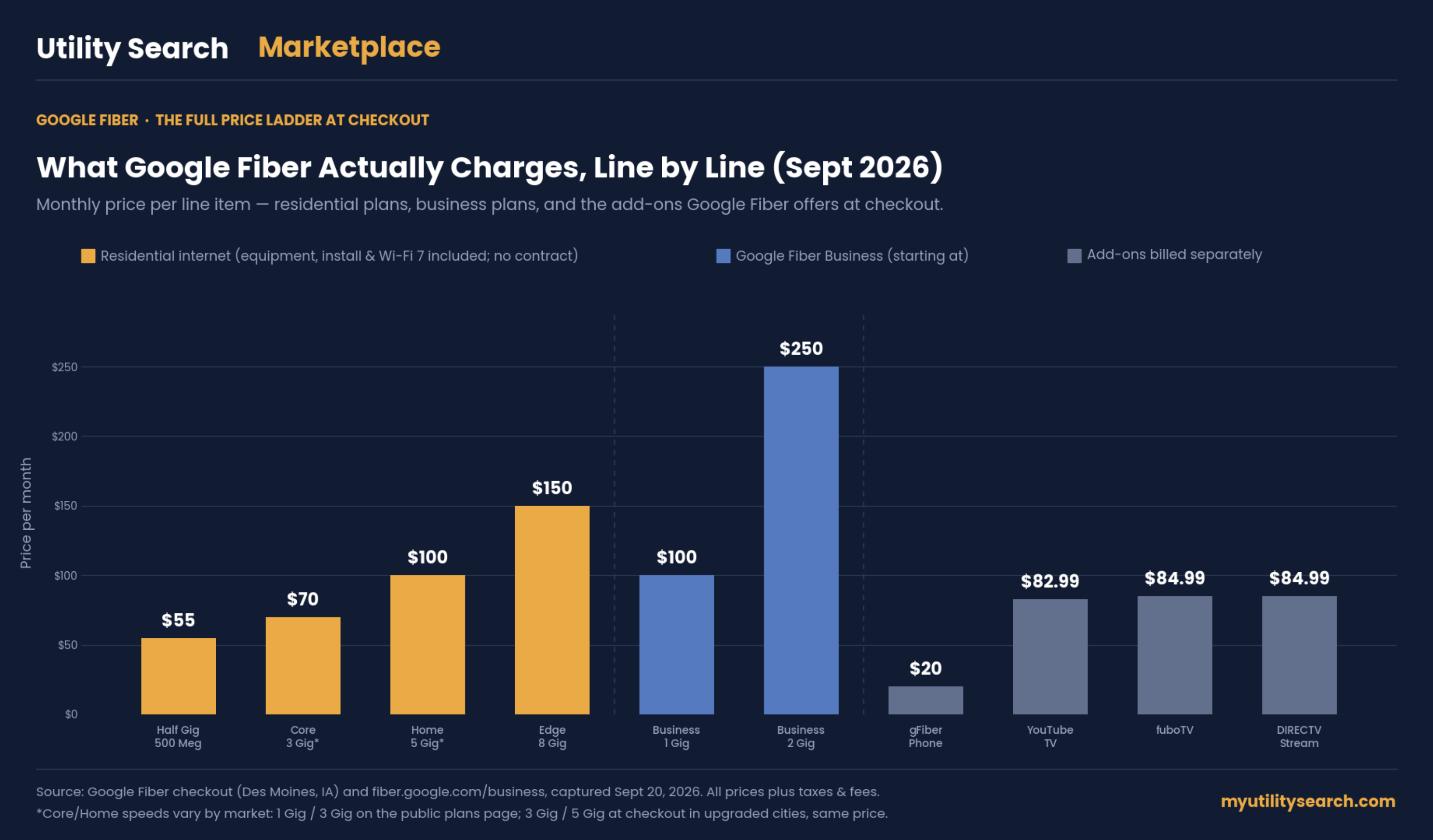
Google Fiber also offers streaming add-ons during checkout — YouTube TV ($82.99/mo), fuboTV ($84.99/mo), DIRECTV Stream ($84.99/mo), and Sling — but these are billed separately by each service and are not part of your Google Fiber bill. Treat them as a convenience shortcut, not a bundle discount; the prices matched each streamer’s own standalone rate.
One more thing the checkout confirmed: as of September 20, 2026, the order flow is still entirely gFiber-branded — there is no Astound Broadband cross-sell, bundle, or co-branding anywhere in it. That squares with what both companies have said about the pending GFiber–Astound merger: the two operate separately, with separate plans, billing, and support, until the deal closes (expected Q4 2026). If that changes, this page will be updated.
Does Google Fiber offer business internet?
Yes. Google Fiber Business is sold separately from the residential plans and, as of September 20, 2026, comes in two tiers. Both are “starting at” prices plus taxes and fees, and both are symmetrical fiber with the same no-data-cap policy as the home plans.
| Google Fiber Business plan | Speed | Starting price | Best for |
|---|---|---|---|
| Business 1 Gig | 1 Gig symmetrical | $100/mo | Small offices and shops that need reliable, always-on connectivity |
| Business 2 Gig | 2 Gig symmetrical | $250/mo | Busy locations with multiple systems, point-of-sale, cameras, and many users |
Two add-ons matter for small businesses. gFiber Phone runs $20/mo (the phone box is included; the handset is sold separately, and unreturned equipment is billed a replacement fee after 60 days). For a fuller business phone system, Google Fiber partners with Dialpad, a third-party service billed separately, with a 25% discount for Google Fiber Business customers. In Chicago, Denver, Miami, Oakland, San Diego, San Francisco, and Seattle, businesses may instead be offered gFiber Webpass Business, the company’s point-to-point wireless product for multi-tenant buildings.
Who owns GFiber?
Today GFiber is owned by Google’s parent, Alphabet Inc. That is changing: on March 11, 2026, Alphabet announced it is selling a majority stake to infrastructure investor Stonepeak, which also owns Astound Broadband. The deal — expected to close in Q4 2026, pending regulatory approval — combines GFiber and Astound into one independent internet company covering roughly 7.1 million locations, with GFiber’s management team leading it and Alphabet keeping a significant minority stake. Nothing changes for customers until it closes. Full breakdown: the GFiber + Astound merger, explained. Day to day, GFiber keeps what it is known for: flat, transparent pricing, no equipment fees, and no promotional price hikes.
Is GFiber good and worth it?
GFiber consistently ranks at or near the top of customer-satisfaction studies thanks to symmetrical speeds, flat pricing, no data caps, and no contract. It is well worth it if it is available at your address; the only real catch is limited availability, since GFiber serves a select list of metro areas.
Compare internet, energy & home security at your address
How much does Google Fiber cost per month?
On GFiber’s upgraded lineup, verified on a live Des Moines, Iowa address quote September 4, 2026: 500 Meg costs $55/mo, 3 Gig costs $70/mo, 5 Gig costs $100/mo and 8 Gig costs $150/mo. Pricing is flat and non-introductory with no promotional cliffs, equipment and installation are $0, and there are no data caps or contracts. The $70 price point has held since 2012 — it just keeps buying more speed. Markets not yet upgraded still see 1 Gig at $70 and 3 Gig at $100.
Is GFiber better than AT&T Fiber?
GFiber and AT&T Fiber are both excellent symmetrical fiber services. GFiber offers a faster top tier (8 Gig) and famously flat, fee-free pricing, while AT&T Fiber has a far larger footprint. For most people the deciding factor is availability — GFiber reaches fewer cities, so where it exists it is often the top pick.
Does GFiber require a contract, deposit, or have a data cap?
GFiber does not require a contract, so there are no early termination fees, and there are no data caps on any plan. There is generally no separate equipment fee, and deposits are uncommon; a credit check may apply at sign-up.
How do I cancel or contact GFiber?
You can cancel GFiber anytime with no early termination fee through your online account or by contacting GFiber support; return any provided equipment to avoid charges. To check availability or start service, use the GFiber website. Comparing your options? See our roundup of the best internet providers for 2026.
Is your plan keeping up?
If your results are lower than you’re paying for, you may have faster options at your address. Compare internet plans available where you live — fiber, cable, and 5G, side by side.
Frequently asked questions
The questions below are the ones people most often ask about Google Fiber before ordering — pricing, contracts, equipment, and how Google Fiber compares to the cable and fiber providers it competes with.
Is Google Fiber good?
Yes — GFiber routinely tops customer-satisfaction rankings. It offers symmetrical fiber speeds, flat pricing, no data caps, and no contract, making it excellent for remote work and gaming where available.
How much is GFiber per month?
On the upgraded lineup: $55/mo for 500 Meg, $70/mo for 3 Gig, $100/mo for 5 Gig, or $150/mo for 8 Gig — flat non-introductory pricing, no data caps, no contract (verified on a live Des Moines, Iowa address quote September 4, 2026). Some markets still show 1 Gig at $70 and 3 Gig at $100.
Who owns Google Fiber?
Google’s parent Alphabet owns GFiber today, but announced in March 2026 that it is selling majority ownership to Stonepeak, which is combining GFiber with Astound Broadband. The deal is expected to close in Q4 2026; nothing changes for customers until then.
Does GFiber have a data cap?
No. GFiber has no data caps on any plan and no annual contract, so there are no overage or early termination fees.
Is GFiber better than AT&T Fiber?
Both are top-tier symmetrical fiber. GFiber has a faster 8 Gig tier and flat pricing; AT&T Fiber has wider availability. Where GFiber is offered, it is often the better pick.
Does Google Fiber have business plans?
Yes. Google Fiber Business offers two tiers as of September 2026: Business 1 Gig starting at $100/mo and Business 2 Gig starting at $250/mo, both symmetrical fiber with no data caps, plus taxes and fees. Google Fiber also offers gFiber Phone at $20/mo and a 25% discount on Dialpad’s business phone system, and in Chicago, Denver, Miami, Oakland, San Diego, San Francisco, and Seattle it sells gFiber Webpass Business for multi-tenant buildings.
Can I bundle TV or streaming with Google Fiber?
Not in the traditional bundle sense. Google Fiber stopped selling its own TV service; at checkout it offers YouTube TV ($82.99/mo), fuboTV ($84.99/mo), DIRECTV Stream ($84.99/mo), and Sling as add-ons, but each is billed separately by that service and is not part of your Google Fiber bill. There is no bundle discount — the prices match each streamer’s standalone rate — so treat it as a convenience shortcut rather than a savings.
Does Google Fiber charge for equipment or installation?
No. On a real Google Fiber order (Des Moines, IA, September 2026) the Wi-Fi 7 router and a Wi-Fi 7 mesh extender were both listed as “Included,” installation was $0, and the order summary showed $0 in one-time charges. The only extras are taxes and fees, which Google Fiber itemizes at the final checkout step, and the optional $20/mo gFiber Phone (phone box included; handset sold separately, with a replacement fee if equipment isn’t returned within 60 days of canceling).
Where is GFiber available?
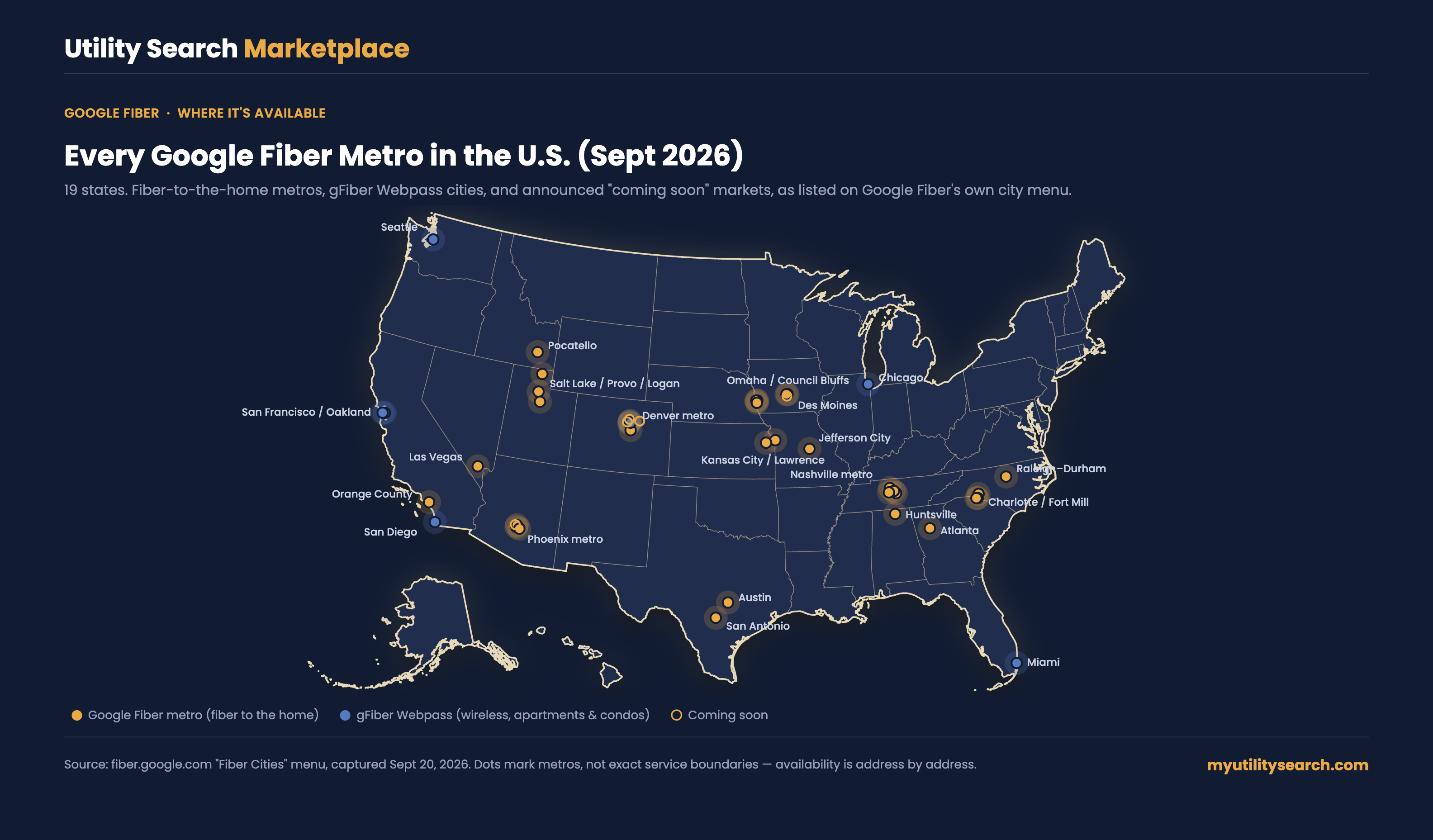
Availability is the main limitation. As of September 4, 2026, GFiber lists service areas in 19 states: Alabama, Arizona, California, Colorado, Florida, Georgia, Idaho, Illinois, Iowa, Kansas, Missouri, Nebraska, Nevada, North Carolina, South Carolina, Tennessee, Texas, Utah and Washington — metro by metro, not statewide. Once the Astound merger closes, the combined company will cover roughly 7.1 million locations. Coverage is address-specific, so check your address before planning around it.
Google Fiber’s footprint is city-by-city rather than statewide, so two homes a few miles apart can get different answers. This is the full list from Google Fiber’s own “Fiber Cities” menu as of September 20, 2026. Cities marked coming soon are announced but not yet serviceable; cities marked Webpass are served by gFiber Webpass (point-to-point wireless for apartments and condos) rather than fiber to the home.
| State | Google Fiber cities |
|---|---|
| Alabama | Huntsville |
| Arizona | Chandler, Mesa, Queen Creek, Tempe (coming soon) |
| California | Orange County; Oakland, San Diego, San Francisco (Webpass) |
| Colorado | Lakewood, Westminster, Wheat Ridge, Douglas County; Denver (Webpass); Adams County, Golden, Broomfield County (coming soon) |
| Florida | Miami (Webpass) |
| Georgia | Atlanta |
| Idaho | Pocatello |
| Illinois | Chicago (Webpass) |
| Iowa | Council Bluffs, Des Moines, West Des Moines; Norwalk (coming soon) |
| Kansas | Kansas City, Lawrence |
| Missouri | Kansas City, Jefferson City |
| Nebraska | Omaha, Bellevue |
| Nevada | Metro Las Vegas |
| North Carolina | Charlotte, The Triangle (Raleigh–Durham) |
| South Carolina | Fort Mill, Tega Cay |
| Tennessee | Nashville, Murfreesboro, Smyrna, Franklin |
| Texas | Austin, San Antonio |
| Utah | Salt Lake Valley, Provo, Logan |
| Washington | Seattle (Webpass) |
Even inside a listed city, availability is street by street. The fastest check is entering your address on Google Fiber’s site; the second-fastest is the FCC National Broadband Map, which lists every provider reporting service at your address, Google Fiber included.
Pros and cons
The advantages are symmetrical multi-gig speeds, flat pricing with no equipment fees or promo cliffs, no data caps, and no contract — a combination few providers match. The main drawback is limited reach; where the service has not built out yet, a fiber competitor like AT&T Fiber or Frontier is the alternative for a similar experience.
Confirm current plans and pricing for your address on the provider’s official site and the FCC Broadband Facts label.
Compare internet, energy & home security at your address
Sources
- Google Fiber — Internet plans — plan names, speeds, and monthly prices (Half Gig $55, Core 3 Gig $70, Home 5 Gig $100, Edge 8 Gig $150), checked September 20, 2026.
- Google Fiber checkout — real order summary for a Des Moines, IA address (equipment included, $0 one-time charges, gFiber Phone $20/mo, streaming add-ons billed separately), captured September 20, 2026.
- FCC National Broadband Map — provider availability by address.
- Google Fiber Business — Business 1 Gig $100/mo and Business 2 Gig $250/mo, gFiber Phone, Dialpad partnership, Webpass Business cities; checked September 20, 2026.
- Google Fiber — Fiber Cities — current, coming-soon, and Webpass cities by state, as listed September 20, 2026.
Prices and availability change; confirm at your own address before ordering.
Keep going
- GFiber + Astound merger: Alphabet sells majority stake to Stonepeak — what the deal means for customers and the footprint.
- Best fiber internet for working from home
- Best internet for remote work and gaming
- Verizon Fios review
- Frontier internet review
- Do you need 1-Gig internet?
- Compare the best internet providers for 2026