Blog
Cox Homelife Ended Oct 22, 2026: What Still Works & What to Do Now

Updated on October 25, 2026
11 min read
Cox Homelife ended on October 22, 2026. Cox shut down both professionally monitored and self-monitored Homelife service on that date and is leaving the home security and automation business entirely as it becomes Spectrum. Monitoring has stopped, the touchscreen and hub no longer connect, and nobody is dispatched if a sensor trips. If you still have Homelife equipment on the wall, this page covers what still works, what you can reuse, and how to replace the monitoring without starting from zero.
Last updated: 25 October 2026
Latest update — October 25, 2026
Cox Homelife service ended on October 22, 2026. Cox confirmed in its Homelife FAQ that security monitoring, the app and automation control stopped on that date, that there are no cancellation fees or contract obligations tied to the shutdown, that no equipment return is required, and that there is no refund for Homelife equipment you bought. Cox has an offer with SimpliSafe for former Homelife customers; Spectrum has not announced a security product of its own. Billing stops at the end of the current cycle after the disconnect.
TL;DR — where Cox Homelife stands
- Service ended October 22, 2026. Monitoring, the app and remote control are off; no one is dispatched on an alarm.
- Lights, locks and thermostats still work by hand at the device. The leased touchscreen and hub do not work with any other provider.
- Most sensors are yours and many can be reused by a new provider, depending on model. Cameras and the video doorbell usually cannot.
- No fees, no contract, no return required. No refund on purchased equipment either.
- Spectrum has no replacement product. Cox is pointing customers to SimpliSafe; local alarm companies and the national providers compared below will take over monitoring.
- If you have not replaced monitoring yet, you are unmonitored today. Treat it as this week’s task.

Is Cox Homelife discontinued?
Yes. Cox Homelife was discontinued on October 22, 2026. The wind-down ran in stages: new signups stopped in 2024, the standalone app was retired, support language narrowed to existing devices in 2025, and after Charter completed its purchase of Cox on August 20, 2026, Cox published a shutdown date and a customer FAQ. On October 22 the monitoring center stopped receiving signals from Homelife systems, which is the moment a security system stops being a security system.
What stopped working on October 22
Professional monitoring and emergency dispatch; self-monitoring alerts and push notifications; the Homelife features inside the Cox app; remote control of lights, locks, thermostats and cameras; and cloud video recording for Homelife cameras. The touchscreen panel may still power on, but it is no longer connected to anything.
What still works
Anything you can operate at the device itself: smart locks with a keypad, light switches and plugs by hand, thermostats at the wall. Door and window sensors are inert without a panel talking to a monitoring center. Cameras record nothing without the Homelife cloud service.
Does the Charter–Cox merger change anything for Cox Homelife customers?
It is the reason the shutdown happened on a date rather than by slow neglect. Charter runs Spectrum, which has never sold home security, so there was no product to migrate Homelife customers into; Cox exited the business instead. For you, the merger means two things: your Cox internet and TV accounts are converting to Spectrum plans market by market (the Homelife line simply drops off the bill), and any future security offer will come from a third party, not from Spectrum. Cox’s current partner offer is with SimpliSafe; it does not use your Homelife equipment.
What should Cox Homelife customers do?
Four things, in order.
- Find out exactly what you have and what you’re paying. Log your panel model, sensor count and types, camera models, monthly monitoring fee, contract end date, and whether you own or lease the equipment. Lease versus own is the single most consequential line — leased equipment usually has to go back, owned equipment may be reusable.
- Find out whether your equipment is reusable. Many Homelife installations use hardware built on common security platforms. Whether a given panel or sensor can be adopted by another monitoring company depends on the specific model and how it was provisioned. Ask a prospective provider directly, with model numbers in hand, before you assume either answer.
- Get monitoring back now. Your system has been unmonitored since October 22. Get two or three quotes this week; takeover installs are the fastest route if your sensors are compatible.
- Do not sign a long contract out of anxiety. Being unmonitored is urgent; a three-year contract is not the only fix. Self-monitored and no-contract professionally monitored options both exist, and a three-year agreement signed in a hurry is a worse outcome than the problem you’re solving.
Compare internet, energy & home security at your address
What are the alternatives to Cox Homelife?
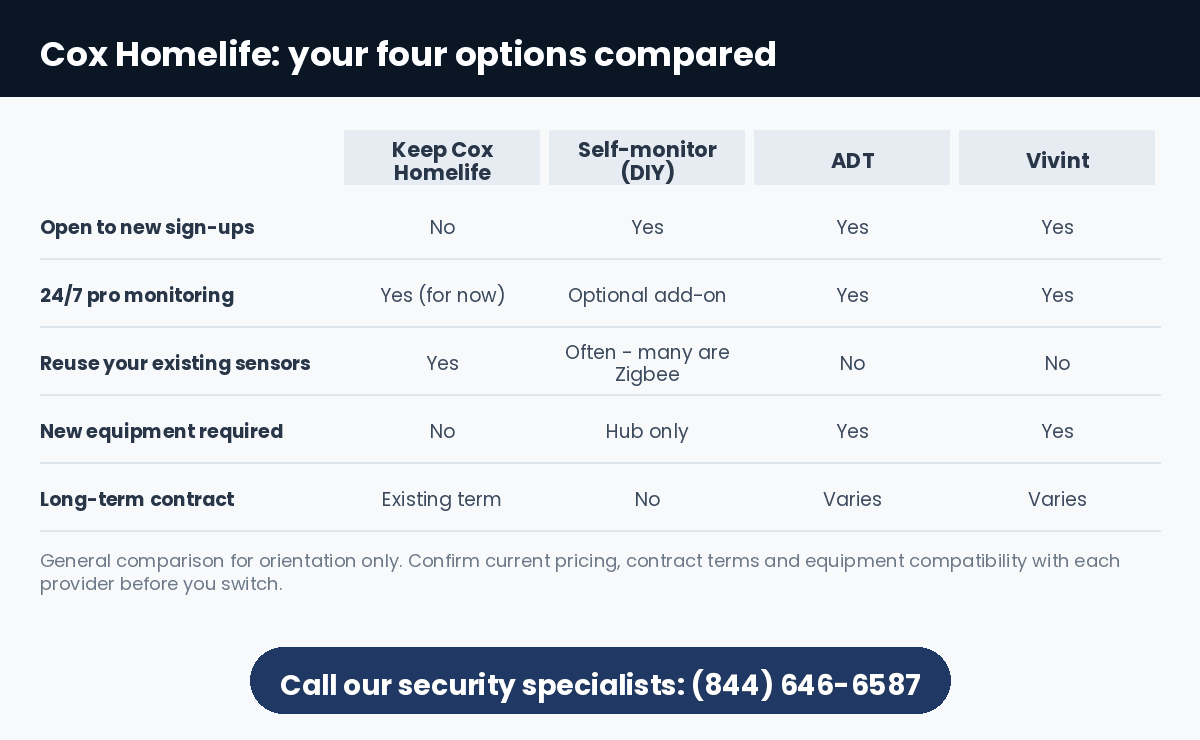
Here is how the main paths compare on the four factors that decide it for a Homelife customer. Monitoring prices move constantly, so we keep current pricing on the linked review pages rather than freezing a number here.
| Option | Monitoring | Contract | Cellular backup | Works with existing gear? |
|---|---|---|---|---|
| Vivint | Professional, 24/7 | Varies — financing terms apply to equipment | Yes | Ask with model numbers; some third-party gear supported |
| Brinks | Professional, 24/7 | Term contract typical | Yes | Known for adopting existing compatible systems — ask first |
| DIY / self-monitored | Self-monitored (pro optional) | Usually none | Varies by kit | Usually no — new hardware, lower cost |
The four columns that decide it, in order of how much they matter:
- Contract length. You have already been through one product wind-down. Do not buy into a long lock-in.
- Equipment reuse. If any of your existing sensors can be adopted, the switching cost drops sharply.
- Professional monitoring vs. self-monitoring. Homelife was professionally monitored. If that mattered to you — insurance discount, alarm permit requirements in your city — it still does.
- Cellular backup. Your Homelife system almost certainly had it. A cheaper WiFi-only replacement is not equivalent.
Cox’s support page states it is “only supporting existing Cox Homelife devices” — the dedicated Homelife app has been retired, and new customer enrollment ended in 2024.
Cox Homelife for business: Cox Business Security is closed to new customers
Cox’s commercial security product, Cox Business Security Solutions (alarms, cameras, motion sensors, thermostats and key fobs on the Digital Watchdog surveillance platform), stopped taking new customers on December 31, 2022. Cox’s support page states that it “will continue to service and support our existing customers,” who can still add equipment by phone, but no business can sign up today. With Cox Business now migrating to Spectrum Business, a Cox-footprint business that needs monitored security should price ADT Business, Vivint Business Security or SimpliSafe for Business, and a business that needs cameras only can compare Ring for Business and Comcast Business SmartOffice where available.
| Business product | Status | Notes |
|---|---|---|
| Cox Business Security Solutions | Not sold to new customers since 12/31/2022 | Existing customers supported; equipment add-ons by phone |
| Alternatives for a Cox-footprint business | ADT Business, Vivint Business Security, SimpliSafe for Business | Published commercial plans; see the security hub |
Source: the provider’s own business pages, read September 28, 2026. Business security is quoted by location and configuration; treat these as the published starting points.
What a business security plan adds over the residential one: commercial monitoring with employee access codes and open/close reporting, multi-location management, video verification or virtual guard options, and commercial-use terms. For a home office, the residential plan on this page is usually the right buy; for a storefront, warehouse or office, price the business plan against the systems compared here and the two or three business lines below.
Business shopper? Compare security systems at your address, see business internet providers, or talk to a specialist.
Cox Homelife FAQ: the questions people are asking since the shutdown
What former Homelife customers type, in their own words, answered as of October 25, 2026.
When did Cox Homelife end, and what months was it phased out?
Service ended on October 22, 2026. The phase-out ran from 2024 (no new customers) through 2025 (app retired, support narrowed) to the shutdown notice issued after the Charter purchase closed in August 2026. There was no market-by-market schedule; every Homelife system stopped being monitored on the same date.
What is Cox Homelife, for anyone searching after the fact?
Cox Homelife was Cox Communications’ home security and automation service, sold from 2012 to 2024: a touchscreen panel, door, window and motion sensors, smoke and CO detectors, cameras, a video doorbell, and smart lights, locks and thermostats, all controlled through the Cox app with optional 24/7 professional monitoring. It ran on the iControl/Comcast-derived platform also used by Xfinity Home. It was discontinued on October 22, 2026.
Can I reuse my Cox Homelife sensors and cameras with another platform?
Sensors, often; cameras, usually not. Homelife door, window and motion sensors are standard 345 MHz wireless sensors (most are Honeywell/Resideo or Nortek models), and many professionally installed systems and some DIY panels can take over 345 MHz devices; the installer confirms model by model. The touchscreen panel and hub are Cox-leased and locked to Cox. Homelife cameras and the video doorbell streamed only to the Cox cloud and have no standalone mode, so they need replacing. Smart locks, light switches and thermostats are ordinary Z-Wave or Zigbee devices and can be paired to a new hub.
Who makes the door and window switches used by Cox Homelife, and which third-party platforms accept them?
The door and window contacts are mostly Honeywell/Resideo 5800-series or Nortek 2GIG-style 345 MHz sensors, with some Zigbee contacts in later installs. Platforms that can take over 345 MHz sensors include most professionally installed panels (Honeywell/Resideo Lyric and ProSeries, 2GIG, Qolsys IQ Panel with the 345 MHz daughter card) sold by local alarm companies and by Vivint and Brinks dealers. SimpliSafe, Ring and Google Nest use their own sensors and cannot reuse them.
Can I still use Cox Homelife cameras without a subscription?
No. Homelife cameras were cloud-only devices that authenticated to Cox’s servers; with the service shut down they do not record locally and cannot be adopted by another app. The same is true of the Homelife video doorbell. Keep the mounts and wiring (the doorbell wiring is reusable for a Ring, Google Nest or Arlo doorbell) and replace the cameras.
Who can take over Cox Homelife monitoring in my city?
Any licensed alarm company can take over monitoring on compatible equipment; search for alarm companies in your city that advertise Cox Homelife takeovers, since many are running exactly that offer. Nationally, Vivint and Brinks dealers do takeovers with a new panel and reuse of compatible sensors, and SimpliSafe is Cox’s referral partner but requires all-new equipment. In Baton Rouge, Phoenix, Tulsa, Las Vegas, San Diego, Oklahoma City, Omaha and the other Cox metros, local installers have been the fastest option since October 22.
What are the best alternatives to Cox Homelife, and is SimpliSafe the right choice?
It depends on whether you want to keep your sensors. If yes, a local alarm company or a Vivint or Brinks dealer doing a takeover is cheapest because you pay for a panel, not a whole system. If you would rather start clean, SimpliSafe (Cox’s partner offer), Ring Alarm and Google Nest are the DIY options at $10 to $30 a month for monitoring, and ADT and Vivint are the professionally installed options. Compare the systems at your address below; Cox’s SimpliSafe offer is a discount on equipment, not a special service.
How do I disconnect Cox Homelife equipment from my home?
There is nothing to cancel: Cox turned the service off and no return is required. Unplug the touchscreen and hub from power and remove their backup batteries (a small Phillips screw on the back) so they stop beeping, leave the sensors in place if a new provider may reuse them, and take the panel, hub and cameras to a Cox or Spectrum store for recycling if you do not want them. Remove the Homelife line from autopay expectations; billing stops at the end of the cycle after the disconnect.
Will Spectrum offer a version of Homelife?
Not as of October 2026. Spectrum has no home security product and has not announced one for former Cox customers. The only Spectrum-adjacent option is the SimpliSafe partner offer that Cox is promoting during the transition. If Spectrum announces a security product we will update this page.
What should I take to Spectrum from my old Cox Homelife account?
Nothing. Homelife was a Cox product with its own equipment and billing line; your internet, TV and phone accounts convert to Spectrum on your market’s schedule without any action on the Homelife side, and the Homelife charge disappears. Keep your final Cox bill showing the Homelife disconnect in case a charge reappears after conversion.
Is there a refund or compensation for Cox Homelife equipment?
No. Cox’s FAQ states there is no refund or compensation for Homelife equipment you purchased, and no cancellation fee or contract obligation on the service. Customers who were mid-contract on a Homelife agreement are released without penalty. If you were billed for Homelife after October 22, call Cox/Spectrum and ask for the charge to be reversed.
Why did Cox discontinue Homelife?
Because the business was small, aging and about to be owned by a company with no security division. Homelife ran on a platform that dated to 2012, had stopped adding customers in 2024, and competed with DIY systems costing a third as much. Once Charter agreed to buy Cox in 2025, there was no path to keep it: Spectrum does not sell security, and migrating a legacy platform into Spectrum’s systems was not worth it for a shrinking customer base. The practical effect is the same whatever the reason: the equipment on your wall needs a new monitoring provider.
Also searched as: cox.com/homelife, coxhomelife.com, homelife cox, Cox home life, Cox Homelife security and Cox Homelife app. They all mean the Cox Homelife service, which ended October 22, 2026.
Cox Homelife has been off since October 22, 2026. Compare replacement systems at your address below and get monitoring back this week.
Compare internet, energy & home security at your address
Keep going
- Charter Cox merger: what it means for customers — the full merger picture
- Best home security systems — the current comparison
- How much does home security cost? — monitoring, equipment and install pricing
- Vivint home security review — professionally monitored alternative
- Brinks home security review — professionally monitored alternative
- DIY home security systems — if you’d rather self-monitor