Blog
Chicago Electricity Rates: ComEd Price to Compare & Best Plans 2026

Updated on September 5, 2026
Chicago electricity rates run on ComEd’s price to compare, which is 10.399 cents per kWh from June 1 through September 30, 2026. That figure is 8.677¢ of supply plus 1.722¢ of transmission, and it rose roughly 9% on June 1 because of regional capacity costs. Illinois has retail electric choice, so you can shop that supply portion — ComEd still delivers the power and restores it after a storm either way.
TL;DR — Chicago electricity rates right now
- Price to compare: 10.399¢/kWh (ComEd, Jun 1 – Sep 30, 2026).
- Made up of 8.677¢ supply + 1.722¢ transmission.
- Up about 9% on June 1 — far less than downstate Ameren’s ~29%.
- Chicago is cheaper than downstate on supply this summer, which surprises most people.
- You can switch suppliers; ComEd keeps the wires, meter, billing, and outage response.
- Rates reset October 1 — summer pricing is seasonal.
What is the price to compare for Chicago electricity rates?
ComEd’s residential price to compare is 10.399 cents per kWh for June 1 through September 30, 2026, combining an 8.677¢ electric supply charge with a 1.722¢ transmission services charge.
The price to compare exists for one purpose: to give you a fair benchmark. It is the rate you pay by default if you never shop, so any competitive supplier offer has to beat it to be worth switching. You can verify the current figure on Plug In Illinois, the Illinois Commerce Commission’s official comparison site, which lists only certified suppliers.
What it does not include is delivery. ComEd’s distribution charges, taxes, and riders stay on your bill regardless of supplier, which is why shopping affects roughly the supply half of what you pay rather than the whole bill.
Why Chicago electricity rates rose less than downstate Illinois
This is the detail that makes Chicago electricity rates unusual this year, and it comes down to which grid you are on.
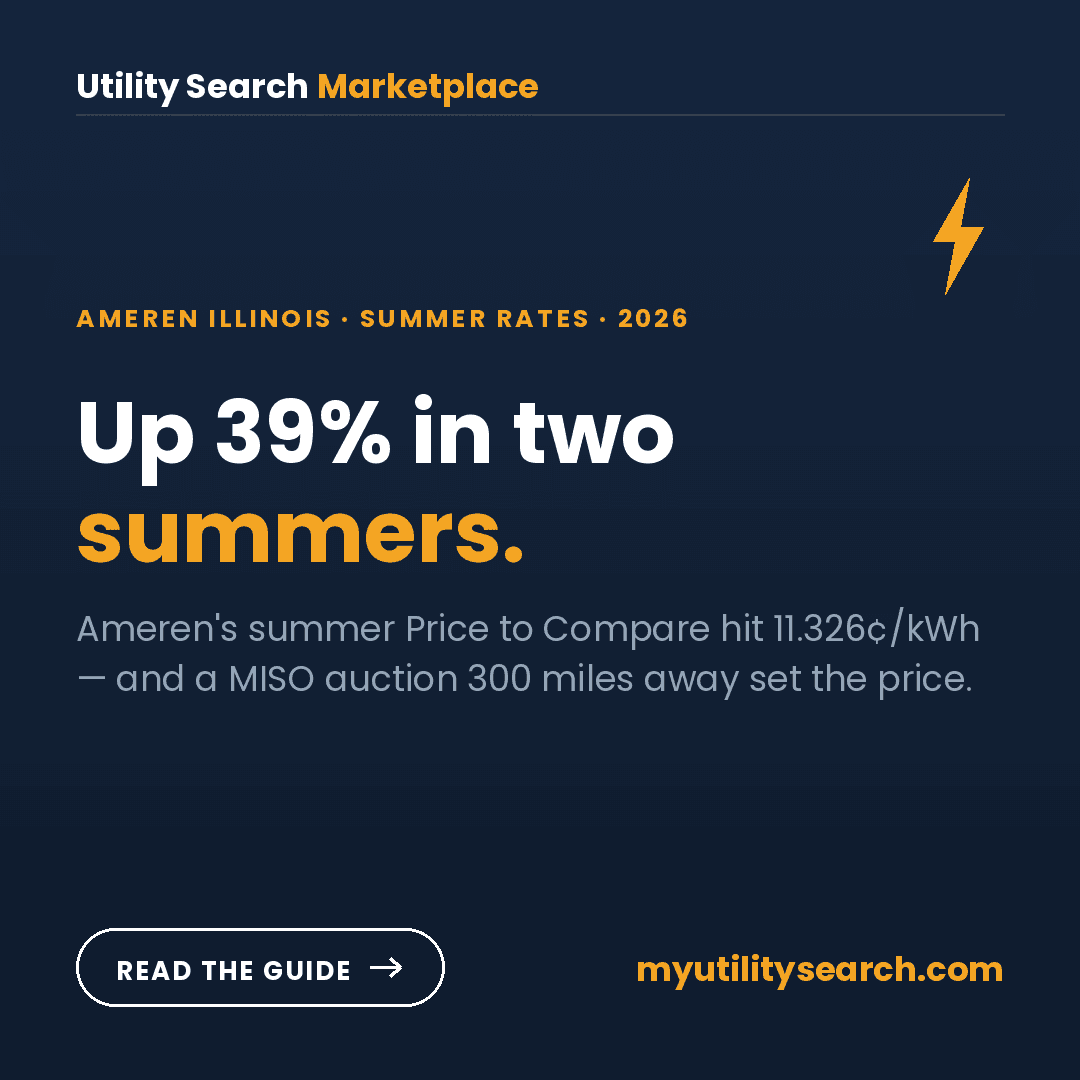
ComEd belongs to PJM Interconnection. Ameren Illinois, which serves the center and south of the state, belongs to MISO. Each grid runs its own capacity auction — the mechanism that pays generators to stay available for peak demand — and this year those auctions produced very different outcomes. MISO’s cleared at $666.50 per MW-day against roughly $30 the prior year, an increase of about 2,122%. PJM’s rose too, but passed through far more moderately.
The result is that Chicago electricity rates increased roughly 9% while Ameren territory jumped about 29% — and downstate customers now pay more per kWh on supply than Chicago does. If you have seen statewide coverage quoting one Illinois number, it is almost certainly wrong for one half of the state. Our Illinois electricity rates comparison breaks down both sides.
What can you actually shop on a ComEd bill?
| Charge | Who sets it | Can you shop it? |
|---|---|---|
| Electric supply | ComEd default or your chosen supplier | Yes |
| Transmission services | Regulated, passed through | No |
| Delivery / distribution | ComEd, ICC-regulated | No |
| Taxes, riders, franchise fees | State and city | No |
Only the first row is competitive. Any supplier promising to halve your bill is overselling, because the rest of the statement is fixed no matter who supplies your electricity.
What’s the best electricity plan in Chicago?
The best of the Chicago electricity rates offers beats 10.399¢ on a fixed term without recovering the difference in fees. Four checks:
- Fixed, not variable. Variable rates reset monthly and, in a year of elevated capacity costs, they reset upward more often than down.
- Judge the full term. Chicago electricity rates reset October 1, so a 12-month offer should be measured against expected annual pricing, not against today’s summer peak.
- Watch monthly fees. A one-cent per kWh gain on 700 kWh is about $7 a month — a $9 service charge erases it entirely.
- Read cancellation terms before locking a long contract. Flexibility is worth something when prices are moving.
The Citizens Utility Board, Illinois’ independent consumer advocate, publishes analysis of supplier offers and is worth consulting before you enroll in anything.
Municipal aggregation in the Chicago area
Chicago electricity rates are complicated further by aggregation: many suburban communities around Chicago run opt-out municipal aggregation, negotiating a supply rate on residents’ behalf and enrolling households automatically unless they decline. If your village or township does this, you may already be on an aggregation rate rather than ComEd’s default.
That changes your math entirely. A supplier offering to beat “the ComEd rate” may be comparing against a benchmark you are not actually paying. Before shopping Chicago electricity rates, pull your latest bill and find the supply line — whatever number appears there is your real point of comparison, not the published price to compare.
Lowering your bill when the rate is out of your hands
Shopping supply is the fastest lever on Chicago electricity rates but rarely the largest. The Department of Energy’s Energy Saver guidance puts heating and cooling at roughly half of a typical home’s energy use, which means summer thermostat behavior often outweighs a one-cent supply difference.
Chicago’s housing stock skews old, and in a two-flat or a vintage walk-up the cheapest wins tend to be mechanical: sealing window AC units properly, blocking direct afternoon sun on west-facing windows, and keeping vents and radiators clear. None of it is dramatic, and all of it compounds across a humid August.
Three mistakes that cost Chicago households money
- Letting a fixed contract expire into a variable rate. Most suppliers roll you to month-to-month pricing when a term ends rather than renewing the fixed rate. In a year with capacity costs this elevated, that default is expensive — put the contract end date in your calendar the day you sign.
- Comparing against the wrong benchmark. If your community runs opt-out aggregation, an offer beating ComEd’s published rate may still be worse than what you currently pay.
- Enrolling from a cold call or door knock. Verify any supplier is certified on the state comparison site before giving out an account number. A legitimate offer survives a day’s delay; a pressure tactic does not.
If you believe you were switched without clear consent — a practice regulators call slamming — the Illinois Commerce Commission accepts and investigates complaints. Keeping the enrollment paperwork and your bills makes that process considerably easier.
Renting in Chicago: what to know before your lease starts
Most Chicago apartments require electric service in the tenant’s name, and the city’s rental market turns over heavily on May and October lease dates. A few practical notes:
- Start service several days before you move. Connection is rarely instant, and an unpowered apartment on moving day is a genuinely bad afternoon.
- Expect a deposit if you have no established utility history, and ask what alternatives exist — many are negotiable.
- Check whether your building is master-metered. Some vintage buildings bill electricity through the landlord, in which case you cannot shop supply at all.
- Confirm the shutoff date when you leave. Forgotten accounts on a vacated unit quietly accrue charges for months.
Because Chicago electricity rates are seasonal, a May move-in lands you just before the summer peak and an October move-in just after it — worth factoring into your first few months of budgeting.
Compare Chicago Electricity — And Your Internet Options
Check supply offers against the 10.399¢ price to compare — or against your aggregation rate if your community has one — and see which internet providers actually reach your address.
Compare electricity rates → Compare internet plans →FAQ
What are Chicago electricity rates right now?
ComEd’s residential price to compare is 10.399 cents per kWh from June 1 through September 30, 2026, made up of 8.677 cents supply and 1.722 cents transmission.
Why did my ComEd bill go up in June?
Regional capacity costs rose, and those flow into supply rates. ComEd’s price to compare increased roughly 9% on June 1, 2026, a far smaller jump than the roughly 29% seen in Ameren territory downstate.
Can I choose my electricity supplier in Chicago?
Yes. Illinois has retail electric choice, so you can pick a competitive supplier for the supply portion of your bill. ComEd continues to deliver electricity, read your meter, and handle outages.
Is Chicago more expensive than downstate Illinois?
Not on supply this summer. ComEd’s 10.399 cents per kWh is lower than Ameren Illinois’ roughly 11.33 cents, reversing the usual assumption that the metro is the pricier market.
Am I on ComEd’s default rate or a municipal aggregation rate?
Many Chicago-area communities run opt-out aggregation programs, so you may be on a negotiated rate instead. Check the supply line on your bill to confirm before comparing any supplier offer.
When do Chicago electricity rates change again?
The price to compare resets on October 1 for the non-summer period. Rates are set seasonally, so the summer figure is not permanent.