Blog
Con Edison Asked for 18%. Regulators Said 5%. Here’s Your Real Bill.

Updated on September 5, 2026
The Con Edison rate increase approved by New York regulators on January 22, 2026 is far smaller than the one Con Edison asked for. The Public Service Commission approved about a 2.8% total bill increase per year across three rate years, against a request that would have raised commercial delivery bills 18.1% in year one. The supply half of your bill is still shoppable.
TL;DR — the Con Edison rate increase at a glance
- Approved January 22, 2026 by the New York Public Service Commission
- Year one: $234 million, about a 2.8% total bill increase (4.4% on delivery revenue)
- Years two and three: $409.7 million and $421.1 million, about 2.8% total bill each
- Commercial customers asked for 18.1% delivery increase in year one, got 5.1%
- A typical commercial account pays about $83.25 more per month in year one
- What you control: delivery is fixed by the PSC, but supply can be bought from an ESCO
What the Con Edison rate increase actually approved
Headlines in late 2025 carried Con Edison’s ask, and the number most people remember is not the number the Con Edison rate increase actually delivered: double-digit increases, 11.3% on electricity and 13.4% on gas, effective January 2026. That is what the company requested. It is not what regulators granted.
On January 22, 2026, the New York Public Service Commission approved a three-year rate plan with substantially smaller increases:
| Rate year | Revenue increase | Total bill impact | Delivery revenue |
|---|---|---|---|
| Year 1 | $234 million | about 2.8% | 4.4% |
| Year 2 | $409.7 million | about 2.8% | 4.4% |
| Year 3 | $421.1 million | about 2.8% | 4.3% |
The gap between ask and outcome is the story most coverage of the Con Edison rate increase missed. For commercial customers, Con Edison proposed a first-year delivery bill increase of 18.1%. The Commission approved 5.1%.
What the Con Edison rate increase costs a business

The New York State Department of Public Service modeled a typical commercial account using 10,800 kWh per month with 30 kW of demand. Under the approved plan, that customer sees:
Year one: about $83.25 more per month — 5.1% on delivery, 3.1% on the total bill.
Year two: about $61.57 more per month — 3.6% on delivery, 2.2% on the total bill.
Year three: about $64.24 more per month — 3.6% on delivery, 2.3% on the total bill.
Roughly $1,000 a year in year one for a mid-sized commercial account, compounding across three years. That is real money, and it is money the Con Edison rate increase places on the delivery line — the half of the bill no supplier can touch.
Which is exactly why the other half deserves attention.
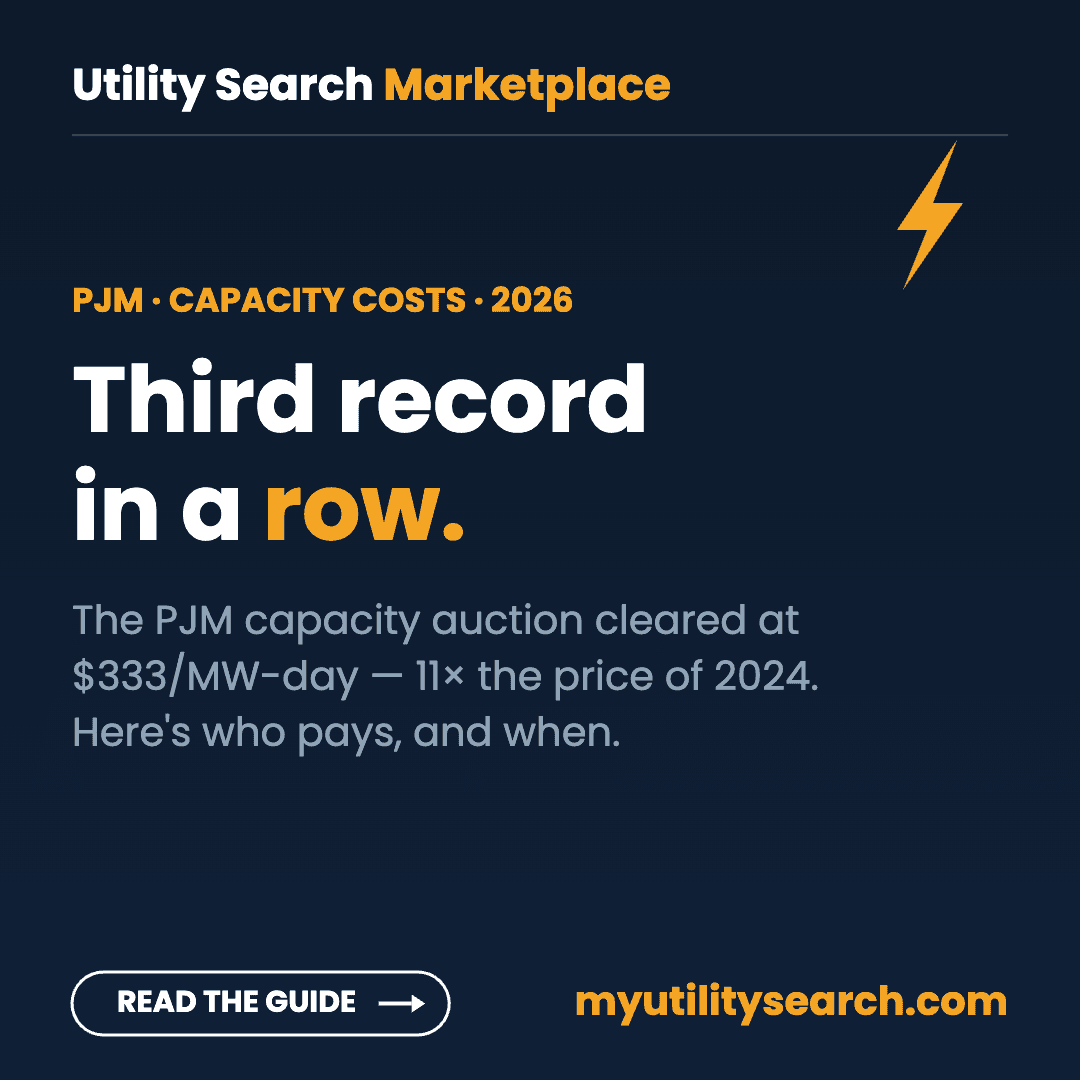
There is a second reason to look past the delivery line. New York sits next to the PJM region, where capacity auctions have cleared at three consecutive record prices, and wholesale power costs across the Northeast are climbing for reasons no state rate case can undo. The Con Edison rate increase is a regulated, capped, three-year known quantity. The supply market is the part that moves — in both directions — and it is the part you are allowed to act on.
The two halves of a Con Edison bill
Every New York electric bill splits into delivery and supply, and the Con Edison rate increase touched only one of them. Understanding which is which determines what you can actually do about it.
Delivery vs. supply
- Delivery is what Con Edison charges to move electricity over its poles and wires, maintain the system, read your meter, and restore service. It is regulated by the Public Service Commission and is the portion this rate case changed. No supplier can lower it.
- Supply is the electricity itself. In New York you may buy it from Con Edison or from an ESCO, an Energy Services Company licensed by the state. This is the shoppable half.
The Con Edison rate increase moved the delivery number. It left the supply market exactly where it was — competitive, and open to anyone willing to compare.
Who the Con Edison rate increase affects
The Con Edison rate increase reaches a large footprint. Con Edison serves roughly 3.6 million residential customers and more than 368,000 commercial accounts across New York City and Westchester County. The approved plan applies across that footprint, including all five boroughs.
Westchester officials pushed back hard during the proceeding, and the reduction from the original request reflects that opposition along with formal party objections. The final settlement runs three rate years, so the second and third increases arrive on schedule unless a future proceeding changes them.
For a business, the practical read is this: budget for the delivery increase, because it is fixed and it is coming. Then treat the supply line as the variable you actually manage. A commercial account using 10,800 kWh a month is buying roughly 130,000 kWh a year of supply — a rate difference of one cent per kWh is $1,300 annually, which is more than the entire first-year delivery increase the Commission just approved.
That arithmetic is the whole argument for shopping. The Con Edison rate increase added about $1,000 a year to a typical commercial bill. A single cent on the supply rate is worth more than that, and unlike the delivery charge, it is negotiable.
Compare internet, energy & home security at your address
How to respond to the Con Edison rate increase
Four moves, in order of impact:
- Read your current supply rate off the bill. It is a separate line item. If it says Con Edison, you are on utility default supply and have never shopped.
- Compare ESCO offers against that rate. New York’s competitive market has licensed suppliers offering fixed-rate terms that protect against the volatility default supply passes straight through.
- Check the contract structure before the headline rate. Fixed versus variable matters more than a fraction of a cent. Variable-rate ESCO contracts are where most New York complaints originate — the rate that looked good in month one is not the rate in month eight.
- For commercial accounts, ask about demand charges. A business paying 30 kW of demand has more levers than a residential customer: load shifting, peak management, and supply structures that separate capacity from energy.
- Time the decision against your usage curve. Summer peaks in New York City are severe, and a supply contract signed in February against winter usage looks different once July arrives. Compare on annualized usage, not last month’s bill.
- Get the renewal terms in writing before you sign. New York’s competitive market has a long history of contracts that convert to a variable rate at expiration without a clear notice. Ask what happens in month 13 and get the answer on paper.
Businesses with multiple locations have one more lever: aggregate the accounts. A portfolio of sites carries more weight with a supplier than a single meter, and it is the simplest way to get a desk to sharpen a quote.
One caution specific to New York: not every ESCO offer is a saving. The state has an active enforcement history in this market. Compare against your actual current rate, insist on the full contract terms in writing, and treat any offer that will not put its expiration terms on paper as a decline.
FAQ
How much is the Con Edison rate increase in 2026?
The Con Edison rate increase runs about 2.8% on the total bill in each of three rate years, approved January 22, 2026. Year one is $234 million in revenue, which works out to roughly 4.4% on delivery revenue and, for a typical commercial customer, about $83.25 more per month.
Did Con Edison get the 11.3% increase it asked for?
No. Con Edison requested substantially more than it received — for commercial customers, an 18.1% first-year delivery bill increase against the 5.1% the Commission approved. The approved plan is a fraction of the original request.
Can switching to an ESCO cancel out the Con Edison rate increase?
Partly. Switching changes the supply portion of your bill only. The delivery increase approved in this rate case applies no matter who supplies your electricity. A better supply rate can offset some or all of the delivery increase in dollar terms, but it does not remove it.
Does using an ESCO change who fixes an outage?
No. Con Edison continues to own the wires, read the meter, and restore power. You still call Con Edison during an outage. Only the supply charge changes hands, which is why an ESCO switch is a response to the Con Edison rate increase rather than an escape from it.
Is the Con Edison rate increase the reason my summer bill spiked?
Probably not by itself. A summer spike is usually usage plus the supply rate, not the delivery increase, which is spread evenly and capped at roughly 2.8% of the total bill per year. Air conditioning load and the supply price you are paying explain far more of a July bill than this rate case does.
What should I watch for in rate years two and three?
Two things. First, the increases are already approved, so they arrive on schedule and belong in your budget now rather than as a surprise later. Second, the Con Edison rate increase is a delivery-side event, which means the supply market can move independently in either direction over those same three years — a supply contract signed today may look very different against year-three delivery rates.
When do the year two and three increases hit?
The approved plan covers three consecutive rate years, with increases of about 2.8% on the total bill in each. Year two and year three arrive on the schedule set in the January 2026 order.
Compare internet, energy & home security at your address
Keep going
- Compare ESCOs in New York: Best Rates and How to Switch
- What Is an ESCO? NY and NJ Energy Supplier Guide
- New York Energy Costs: How to Save $60 to $200+ a Year
- Deregulated Energy New York: Best ESCO Electricity Suppliers
- Summer Electric Bills NYC and NJ: Ways to Cut the Spike
- Brooklyn Electricity Rates: Ways to Cut Your Bill
- PJM Capacity Auction: Guide to Rising 2026 Bills