Blog
New England Locked In Its 2026 Power Prices at the Worst Possible Moment

Updated on September 5, 2026
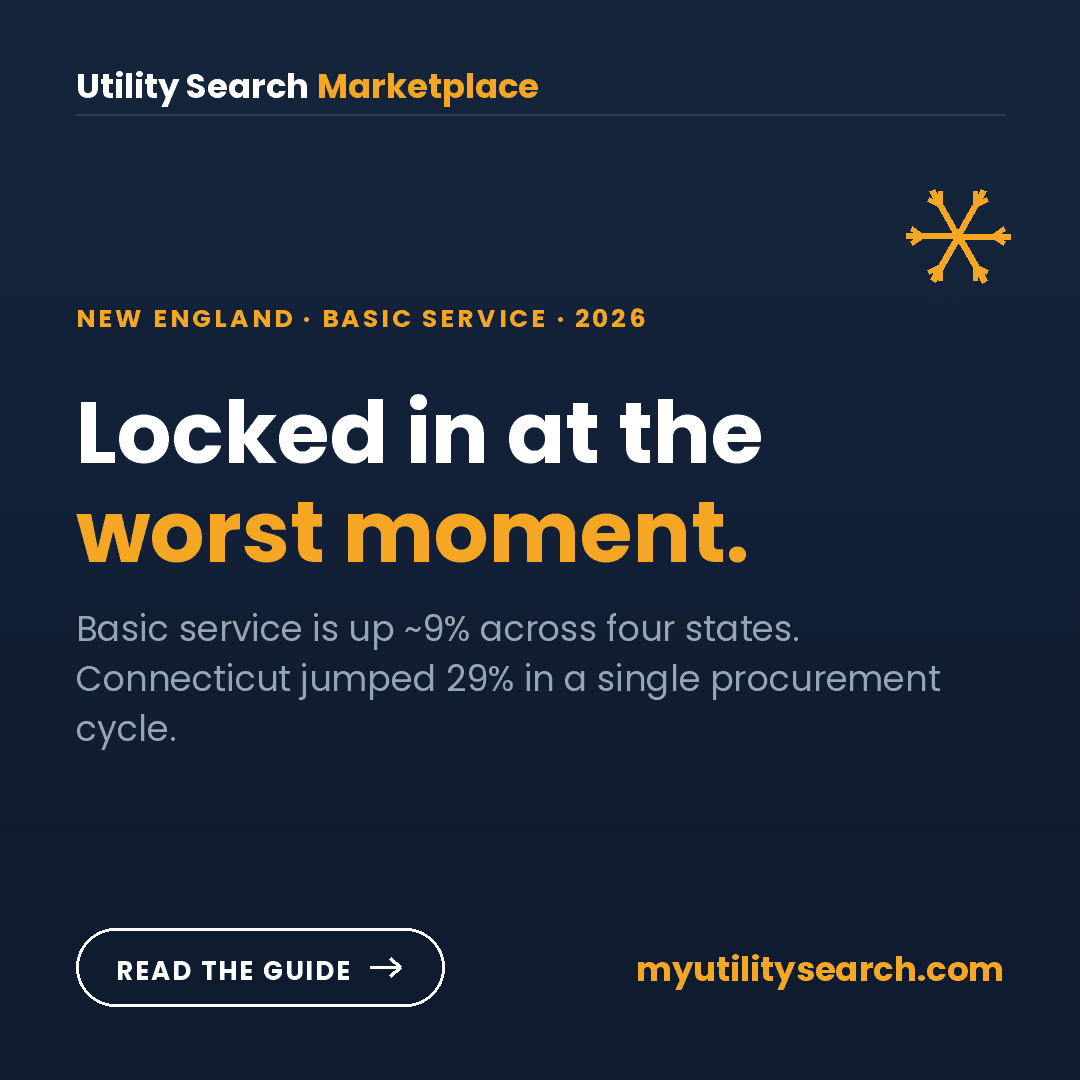
New England electricity rates are rising about 9% on average across seven utilities in four states for 2026, driven by winter natural gas prices rather than local policy. Connecticut leads the increases at roughly 10%, Maine at 20%. Three of these states let you replace the supply half of your bill with a competitive supplier.
TL;DR — New England electricity rates in 2026
- Basic service rates across seven utilities in four New England states are up about 9% on average versus 2025
- By state: Maine about 20%, Connecticut about 10%, Massachusetts about 3%, New Hampshire about 1%
- Connecticut standard service, January 1 through June 30, 2026: Eversource 12.64 cents per kWh, United Illuminating 13.695 cents per kWh
- Eversource’s Connecticut rate rose about 29% from the prior six-month period
- Root cause: wholesale natural gas prices during the October to December 2025 procurement window, plus constrained pipeline capacity into the region
- Connecticut, Massachusetts, and New Hampshire all allow supplier choice on the supply portion of the bill
Why are New England electricity rates so high?
New England electricity rates sit at the top of national tables for a structural reason that has nothing to do with how much electricity anyone uses.
New England sits at the end of the natural gas pipeline network. On the coldest days, gas that would otherwise generate electricity gets diverted to home heating, and the region imports liquefied natural gas at global prices to make up the difference. Because gas-fired plants usually set the wholesale price of electricity, New England electricity rates inherit the volatility of a globally traded fuel.
That is why New England electricity rates consistently sit near the top of national price tables, and why the timing of a utility’s supply procurement matters as much as anything a regulator does.
Basic service, standard service, default service
- Three names for the same thing: the electricity supply your utility buys on your behalf if you never choose a supplier. Utilities buy it in advance through competitive solicitations and pass the cost through without markup. It is not a subsidized rate and it is not automatically the cheapest option — it is simply the default.
What changed for New England electricity rates in 2026

Utilities across the region locked in their 2026 supply during a procurement window running roughly October 15 through December 10, 2025 — a period when forward natural gas prices were both elevated and volatile. Global LNG demand, geopolitical risk, and New England’s constrained gas infrastructure all fed into the number.
The result is uneven by state, and the spread across New England electricity rates comes down to when each utility bought and for how long:
| State | 2026 basic service change | Why |
|---|---|---|
| Maine | about +20% | Procured a full January-to-December 2026 supply during the highest-price stretch |
| Connecticut | about +10% | Six-month standard service period bought into elevated forwards |
| Massachusetts | about +3% | Shorter February-to-July contract period limited exposure |
| New Hampshire | about +1% | Shorter contract period, similar effect |
Massachusetts and New Hampshire customers were partly protected by contract structure, not by better luck on price. A utility that buys twelve months of supply in a single expensive window locks that price in for a year. A utility that buys six months, or five, gets another chance sooner. Maine bought long at the top; Massachusetts and New Hampshire bought short and will reset again while forward prices are easing. The spread across those four states is the clearest evidence that New England electricity rates are set by procurement timing as much as by geography. Maine customers got the reverse.
Connecticut: the sharpest increase
Connecticut’s numbers are the clearest illustration of what happened to New England electricity rates this year. For the period running January 1 through June 30, 2026, the Office of Consumer Counsel reports standard service at 12.64 cents per kWh for Eversource and 13.695 cents per kWh for United Illuminating.
Eversource’s prior period, covering July through December 2025, was 9.748 cents per kWh. That is an increase of roughly 29% in a single procurement cycle. United Illuminating moved from 11.6841 cents to 13.695 cents, about 17%.
Connecticut’s Office of Consumer Counsel also flags something worth repeating: when shopping, use the official EnergizeCT rate board directly. Many searches route customers to supplier-funded comparison sites that do not display every publicly available rate.
The Counsel also noted that as of late November 2025, third-party supplier offers were already available below the forthcoming standard service rate. That is the single most useful fact in this entire story: the increase was known in advance, and beating it was possible before it took effect. New England electricity rates are published ahead of their effective date, which means the window to act is open weeks before the higher rate ever appears on a bill.
Massachusetts and New Hampshire: smaller increases, same mechanics
Not every corner of the region moved together. Massachusetts basic service rose about 3% and New Hampshire about 1% — modest next to Connecticut and Maine, and for a structural reason rather than a policy one. Both states’ utilities procured over shorter contract periods, which limited how much of the elevated winter forward curve they locked in.
Shorter procurement cycles cut both ways. They limited the damage this year, and they mean both states reset sooner, which is an advantage while forward prices are falling. For a customer in either state, the practical implication is that the default rate is a moving target with a known expiration date, and a supplier contract should be sized against that date rather than signed open-ended.
Both states also run active competitive supply markets for residential and commercial customers, which means the comparison exercise is the same one Connecticut customers run — only against a lower benchmark.
Compare internet, energy & home security at your address
How to shop New England electricity rates
Three of the four states above have retail supplier choice for residential and commercial customers: Connecticut, Massachusetts, and New Hampshire. In each, the utility keeps the wires, the meter, and the outage response, while a competitive supplier can replace the supply charge.
The method for shopping New England electricity rates is the same in each state:
- Find your utility’s current basic or standard service rate and its expiration date. In Connecticut that is 12.64 cents per kWh for Eversource through June 30, 2026.
- Compare supplier offers against that number for the same period. Comparing a summer supplier rate against a winter default rate produces a meaningless answer.
- Favor fixed rates over variable in a volatile gas market. Variable-rate contracts in New England pass winter spikes straight to you, which is the specific risk worth paying to avoid here.
- Check the term against the utility’s next reset. A supplier contract that expires the same month the default rate drops leaves you re-shopping at the worst moment.
- Read the exit fee. In a region where forward prices are projected to decline over the next several years, the ability to leave a long contract has real value.
One regional note worth carrying into any comparison: New England’s price problem is a fuel and pipeline problem, not a capacity-auction problem. In PJM, next door, capacity auctions have cleared at three consecutive records and that cost flows to bills on a delayed schedule. In New England the pressure arrives through winter gas prices and shows up at each procurement reset. Different mechanism, same direction, and it is why New England electricity rates move in six-month steps rather than annual ones.
One practical note for businesses: commercial accounts in these states are often on a different default service schedule than residential, with separate procurement dates and separate rates. Check which schedule your account sits on before comparing anything, because a residential benchmark quoted against a commercial account produces a meaningless comparison.
The forward outlook is genuinely better: analysts project New England wholesale prices declining roughly 4.4% annually through 2032 as behind-the-meter solar, renewables, and stable gas supply build out. That argues against locking a very long term at today’s elevated number.
FAQ
Why are New England electricity rates higher than the rest of the country?
Pipeline constraint. The region is at the end of the natural gas network, and on peak winter days gas is diverted to heating while the region imports LNG at global prices. Gas plants typically set the wholesale electricity price, so that cost flows through to rates.
Which New England states let me choose an electricity supplier?
Connecticut, Massachusetts, New Hampshire, Maine, and Rhode Island all have some form of retail choice. Connecticut, Massachusetts, and New Hampshire have the most active competitive residential and commercial markets.
Is switching suppliers guaranteed to lower my bill?
No. Shopping New England electricity rates changes only the supply portion of the bill, and only if the supplier’s rate beats your utility’s default for the same period. Delivery charges are set by state regulators and are unaffected by who supplies your power.
Will New England electricity rates come down?
Forward markets suggest yes over time — projections point to roughly 4.4% annual declines through 2032 on the back of added solar and renewable capacity. Short-term winter volatility in New England electricity rates is still expected, which is the argument for a fixed rate over a variable one rather than for waiting.
Should I lock a long fixed rate right now?
It depends on how much certainty is worth to you. Forward markets point to New England electricity rates easing over the next several years, which argues against locking a very long term at today’s elevated numbers. A shorter fixed term protects against winter volatility without committing you through the projected decline.
Where do I find my state’s official rate board?
Connecticut publishes rates through EnergizeCT and the Office of Consumer Counsel. Massachusetts and New Hampshire publish default service rates through their respective utility commissions. Use the official state board rather than a supplier-funded comparison page. Those boards are the only place to check New England electricity rates against an offer on equal terms.
Compare internet, energy & home security at your address
Keep going
- Deregulated Energy Connecticut: Best Electricity Suppliers
- Deregulated Energy Massachusetts: Best Electricity Suppliers
- Deregulated Energy New Hampshire: Compare Electricity Suppliers
- Deregulated Electricity States: Cut Your Power Bill
- Commercial Electricity Rates by State: Cheapest to Highest
- Are Electricity Prices Going Up? The 45-Year Trend
- PJM Capacity Auction: Guide to Rising 2026 Bills