Blog
AT&T Internet Air: One Plan, $55 a Month, and the Speeds You Actually Get

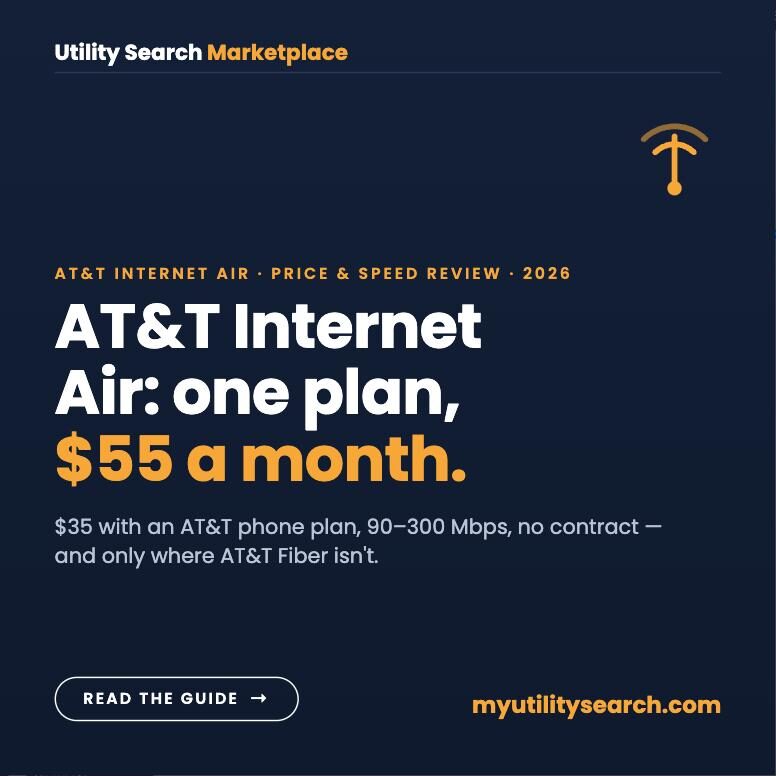
AT&T Internet Air costs $55 a month in September 2026 with bank-account AutoPay and paperless billing, or $35 a month if you also have an eligible AT&T wireless plan. Taxes are extra. There is one plan, one speed range (90–300 Mbps down, 8–30 Mbps up), unlimited data, no contract, an included All-Fi Hub gateway, and a 12-month promise not to raise the price. AT&T sells it only at addresses where AT&T Fiber is not available, which makes it the company’s replacement for the copper DSL it is retiring by 2029.
Below is the full price breakdown, what speeds people actually get, how it compares to Verizon and T-Mobile, and who should choose fiber instead.
Last updated: 6 September 2026. Prices verified against att.com and refreshed monthly.
TL;DR — AT&T Internet Air in September 2026
- Price: $55/mo with bank AutoPay + paperless billing ($65 without AutoPay; $60 if you AutoPay with a card). $35/mo with an AT&T wireless plan. Taxes and fees are added on top.
- Speed: 90–300 Mbps download, 8–30 Mbps upload. Third-party testing puts average latency around 42 ms. Only about a third of speed tests hit the advertised range.
- Terms: no contract, unlimited data, $0 self-setup, All-Fi Hub included, extenders $10/mo, optional pro install $99, price held for 12 months.
- Where: 47 states, city by city, and only at addresses without AT&T Fiber. It is the landing spot for AT&T’s DSL customers as copper retires through 2029.
- Verdict: the right answer for AT&T phone customers and ex-DSL households; the wrong answer if fiber, or even cable above 300 Mbps, reaches your door.
How much does AT&T Internet Air cost?
AT&T advertises Internet Air “starting at $55/mo,” and that number carries three conditions in the fine print: you enroll in AutoPay from a bank account, you take paperless billing, and you pay taxes and regulatory fees on top. Miss AutoPay and the base rate is $65; AutoPay with a debit or credit card only earns $5 off instead of $10. The much lower number people see in AT&T’s ads — $35 a month — requires an eligible AT&T wireless plan on the same account. Here is how the rate card resolves for each situation.
| Situation | Monthly price | What it requires |
|---|---|---|
| Best case, internet only | $55/mo + taxes | AutoPay from a bank account + paperless billing |
| AutoPay with a debit/credit card | $60/mo + taxes | Card AutoPay earns only $5 off |
| No AutoPay | $65/mo + taxes | Paper bill or manual payment |
| With an AT&T wireless plan | $35/mo + taxes | Eligible AT&T wireless plan on the account, bank AutoPay + paperless |
| Promotional markets | $40/mo for 12 months | “$15 off for 12 months” offer that appears at some addresses; reverts to $55 |

Two things worth knowing about that table. First, AT&T raised prices $5 on its fiber and copper internet plans effective August 16, 2026, but Internet Air was not named in that increase, and its $55 headline price is unchanged on att.com as of September 2026. Second, the 12-month price promise is real but short: AT&T says it will not raise your Internet Air rate in the first year, which is one-third of Verizon’s shortest lock and less than a quarter of T-Mobile’s five-year pledge.
How fast is AT&T Internet Air really?
AT&T quotes typical downloads of 90–300 Mbps and uploads of 8–30 Mbps, and those are honest ranges rather than a single “up to” figure. The catch is where in the range you land. Internet Air runs on AT&T’s 5G network using both mid-band spectrum and, in a few cities, millimeter wave, and it is deprioritized behind AT&T phone traffic. In CableTV.com’s 2026 speed-test sample only 33.5% of Internet Air tests met the advertised speed, versus 35.9% for Verizon 5G Home and 47.5% for T-Mobile. Average latency measured 42.5 ms — fine for streaming and video calls, noticeable for competitive gaming.
| Metric | AT&T’s figure | What to expect | Good enough for |
|---|---|---|---|
| Download | 90–300 Mbps | 100–200 Mbps at a good signal; under 90 at the margin or in the evening | 4K streaming on 2–3 TVs, remote work, a family of four |
| Upload | 8–30 Mbps | 10–20 Mbps typical | Video calls and cloud backup; not live streaming or large uploads |
| Latency | Not published | ~40–50 ms | Casual and console gaming; not competitive shooters |
| Congestion policy | Speed “greatly reduced” for 30+ min if your usage contributes to congestion | Rare, but it is in the terms | Households that are not running servers or torrents |
The single biggest variable is where you put the All-Fi Hub. It is a 5G receiver, so it wants a window facing the nearest AT&T tower, not a media cabinet. The AT&T Smart Home Manager app shows a signal reading during setup; moving the hub from an interior wall to a window routinely doubles measured speed, and hard-wiring a TV or PC to one of its Ethernet ports removes the Wi-Fi variable entirely.
Where is AT&T Internet Air available?
AT&T Internet Air is sold in 47 states, but availability is decided address by address, and there is one rule that matters more than any coverage map: AT&T will not sell it where AT&T Fiber is available. The product exists to serve the roughly 35% of the country inside AT&T’s wireless footprint that fiber does not reach — suburban fringes, small towns, and the copper DSL territories AT&T is shutting down. If the address checker offers you fiber, Internet Air disappears from the menu, and that is the right outcome, because fiber at $35–$55 beats fixed wireless on every metric.
The copper story is why the AT&T Internet Air footprint keeps growing. AT&T stopped taking new copper orders across about 20 states on October 15, 2025, began permanently decommissioning roughly 500 wire centers in June 2026, filed in July 2026 to discontinue service in 55 more wire centers across 13 states starting October 16, 2026, and has told the FCC it intends to retire copper across “the vast majority” of its footprint by the end of 2029.
Every DSL household in those areas gets one of two AT&T offers: fiber if the street has been built, Internet Air if it has not. Enter your address in our internet comparison tool to see AT&T Internet Air alongside every cable, fiber, satellite and fixed-wireless provider that serves your home before you accept either.
Compare internet, energy & home security at your address
AT&T Internet Air vs Verizon 5G Home vs T-Mobile Home Internet
All three carriers now cluster around the same $50–$60 standalone and $35 bundled price points, so the real differences are in speed promises, price-lock length and what is included in the box. Here is the September 2026 line-up.
| Provider & plan | Standalone (AutoPay) | With carrier phone plan | Speed (provider figure) | Price lock | Taxes |
|---|---|---|---|---|---|
| AT&T Internet Air | $55 | $35 | 90–300 Mbps | 12 months | Extra |
| Verizon 5G Home | $50 | $35 | Up to 100 Mbps | 3 years | Included |
| Verizon 5G Home Plus | $60 | $45 | Up to 150 Mbps | 4 years | Included |
| Verizon 5G Home Ultimate | $75 | $60 | Up to 300 Mbps | 5 years | Included |
| T-Mobile Rely | $50 | $35 | 170–354 Mbps | 5 years | Included |
| T-Mobile Amplified | $60 | $45 | 170–498 Mbps | 5 years | Included |
| T-Mobile All-In | $70 | $55 | 170–498 Mbps | 5 years | Included |
Read straight across, AT&T Internet Air is the weakest of the three on paper: the shortest price lock, the only one that adds taxes, and a speed range that T-Mobile’s cheapest plan exceeds. Its two real advantages are the $35 bundle price with any eligible AT&T wireless plan — the same as Verizon’s and T-Mobile’s bundle floors — and the AT&T Guarantee, which credits your bill automatically for any outage lasting 20 minutes or more.
Our best 5G home internet guide covers the signal-check step that decides which carrier is actually fastest at your address, and our Verizon 5G Home Internet and T-Mobile Home Internet pages break each rival down tier by tier.
Is AT&T Internet Air worth it?
Yes in three cases. If you have an AT&T wireless plan, $35 for unlimited home internet with no contract is the cheapest broadband most non-fiber addresses can buy, and AT&T bills both on one statement. If you are an AT&T DSL customer being told your copper line is going away, Internet Air is a genuine upgrade — 90–300 Mbps against DSL’s 10–50 — at roughly the same price. And if your only wired option is a cable company charging $80 or more after the promo, Internet Air’s flat $55 with a 12-month hold is a fair trade for slightly less consistent speed.
No in three cases. If AT&T Fiber or any other fiber provider reaches your address, take it: AT&T Fiber 300 is $35 a month, symmetrical, and not deprioritized. If you upload for a living — video creators, photographers, anyone on Twitch — the 8–30 Mbps upload ceiling will frustrate you. And if you can get Verizon 5G Home or T-Mobile at the same address, their longer price locks and tax-inclusive pricing usually make them the better fixed-wireless pick unless the AT&T bundle discount applies to you.
What equipment and fees come with AT&T Internet Air?
The AT&T All-Fi Hub is included at no monthly charge. It combines the 5G receiver and a Wi-Fi 6 router, handles about 20 connected devices comfortably, and has Ethernet ports for wired connections. Self-setup is free and takes minutes: plug it in near a window, open the Smart Home Manager app, and follow the signal-strength prompts. Professional installation is available for $99 if you want a technician to find the best spot. AT&T All-Fi extenders for larger homes rent for $10 a month each, which is the one recurring add-on cost to watch.
There is no annual contract, no early-termination fee and no data cap. Return the hub within the trial window if you cancel, or AT&T bills for unreturned equipment. The AutoPay and paperless discount takes up to two billing cycles to appear, so the first bill can look $10 higher than quoted. Taxes and AT&T’s cost-recovery fee add a few dollars a month on top, and the amount varies by state.
What is the AT&T Guarantee, and does it apply to Internet Air?
Yes. The Internet Air plan page now carries the “backed by the AT&T Guarantee” badge, so the same outage promise AT&T makes to fiber and wireless customers applies here. The relevant promise is the outage credit: if a network outage caused by AT&T drops your connection for 20 minutes or more, AT&T credits your bill for a full day of service automatically. Weather, power outages at your home and problems on your own equipment are excluded. For a fixed-wireless product that depends on cell-site health, it is a meaningful backstop that neither Verizon nor T-Mobile offers in the same automatic form.
AT&T Internet Air FAQ
How much is AT&T Internet Air per month?
AT&T Internet Air costs $55 a month with bank-account AutoPay and paperless billing, $60 with card AutoPay, or $65 with no AutoPay, plus taxes and fees. With an eligible AT&T wireless plan it drops to $35 a month.
What speeds does AT&T Internet Air deliver?
AT&T quotes 90–300 Mbps download and 8–30 Mbps upload. Independent testing finds roughly a third of connections hit the advertised range, with average latency around 42 ms. Placing the All-Fi Hub in a window facing the nearest tower is the biggest factor.
Does AT&T Internet Air have a data cap or contract?
No. AT&T Internet Air includes unlimited data with no overage fees and requires no annual contract. AT&T reserves the right to slow your speed for at least 30 minutes if your usage is contributing to network congestion, which is rare in practice.
Can I get AT&T Internet Air if AT&T Fiber is available at my address?
No. AT&T sells Internet Air only at addresses where AT&T Fiber is not available. If the address checker offers fiber, Internet Air is not shown, and fiber is the better product at a similar price.
Is AT&T Internet Air replacing AT&T DSL?
Effectively yes. AT&T stopped new copper orders in about 20 states in October 2025 and plans to retire copper across most of its footprint by the end of 2029. DSL customers in areas without fiber are offered Internet Air as the replacement.
Is AT&T Internet Air better than T-Mobile Home Internet?
On paper T-Mobile wins: higher quoted speeds (170–354 Mbps on its $50 Rely plan), taxes included, and a five-year price guarantee versus AT&T’s 12 months. AT&T Internet Air wins for AT&T wireless customers, who pay $35, and for the automatic outage credit under the AT&T Guarantee. Signal strength at your address decides real-world speed.
What equipment does AT&T Internet Air use?
The AT&T All-Fi Hub, a combined 5G receiver and Wi-Fi 6 router, is included free. Self-setup costs $0; professional installation is $99; Wi-Fi extenders rent for $10 a month each.
Does the AT&T Internet Air price go up after 12 months?
AT&T promises not to raise the Internet Air rate for the first 12 months. After that it can change, and any $15-off promotional pricing in select markets ends after 12 months and reverts to the $55 standard rate. Taxes and fees can change at any time.
That is AT&T Internet Air in September 2026: one plan at $55, $35 for AT&T phone customers, honest 90–300 Mbps speeds that depend on your window, a 12-month price hold, and a footprint that grows every time AT&T shuts off another copper exchange. Compare it against every provider at your address before you sign.
Compare internet, energy & home security at your address
Sources
- AT&T, Internet Air plan page — “starting at $55/mo,” AutoPay and paperless requirement, taxes extra, congestion policy, All-Fi Hub, $0 self-setup, AT&T Guarantee (verified 6 September 2026).
- Allconnect, AT&T Internet Air (updated July 16, 2026) — $55 standalone / $35 with AT&T mobile, $10 bank vs $5 card AutoPay discount, 90–300 / 8–30 Mbps, 12-month price promise, ~35% availability.
- CableTV.com, AT&T Internet Air review (updated April 9, 2026) — 33.5% of tests meeting advertised speed, 42.5 ms average latency, 47-state footprint, $10/mo extenders.
- BroadbandNow, AT&T deals (June 2026) — $15-off-for-12-months promotional pricing, $65 base rate, AT&T Fiber $35/$50/$50/$125 tiers.
- TheStreet, “AT&T quietly raises internet prices” (July 25, 2026) — $5 increase on fiber and copper plans effective August 16, 2026.
- Ooma, AT&T copper shutdown timeline — October 15, 2025 order freeze, June 2026 wire-center decommissioning, July 2026 FCC filing (55 wire centers, 13 states), 2029 target.
- Verizon, 5G Home Internet plans and BroadbandNow, T-Mobile Home Internet deals (August 14, 2026) — comparison-table pricing.
Keep going
- Brightspeed internet — symmetrical fiber from $29.99 in 20 states where AT&T does not run copper
- TDS internet plans — what a regional fiber builder charges for a symmetrical gig
- Verizon 5G Home Internet plans and prices — the three-tier rival with 3–5 year price locks
- T-Mobile Home Internet — Rely, Amplified and All-In compared
- Best 5G home internet — AT&T, Verizon and T-Mobile head to head
- Quantum Fiber internet — the Lumen fiber network AT&T bought in 2026
- AT&T–Lumen fiber deal explained — what the $5.75B acquisition changes for AT&T customers
- Best internet for rural areas — what to do when neither fiber nor 5G reaches you