Blog
T-Mobile Fiber: Best Plans, Prices & Review 2026

Updated on September 19, 2026
INTERNET / PROVIDER NEWS
By The Utility Search Marketplace Team · 20+ years in consumer home services
Last updated: June 2, 2026
T-Mobile Fiber is here — and it is the retail payoff of a multi-year buying spree. After spending billions to fold Lumos and Metronet into fiber joint ventures, T-Mobile is now selling T-Mobile Fiber directly to homes, with a 5-year price guarantee, unlimited data, free equipment, free installation, and no annual contract. If your income runs on a home connection, that combination is worth a hard look.
Here is every current T-Mobile Fiber plan, the real prices showing on T-Mobile today, and an honest read on whether it beats what you already pay — especially for upload-heavy work like video calls and large file transfers. (For the full deal history behind this launch, see our guide to T-Mobile’s fiber and spectrum acquisitions.)
The 30-second version
What it is: 100% fiber home internet from T-Mobile, the retail face of its Lumos + Metronet fiber joint ventures
Plans: Fiber 300 Mbps, Fiber 1 Gig, Fiber 2 Gig — speeds vary by location
Real prices (with AutoPay): $45 / $60 / $70 a month, plus taxes & fees
Guarantee: 5-year price lock on the internet rate while on an eligible plan
No fluff: Unlimited data, Wi-Fi router and installation included, no annual contract
T-Mobile Fiber plans and prices for 2026
There are three T-Mobile Fiber speed tiers, and the prices below are the AutoPay rates showing on T-Mobile’s site right now. The AutoPay discount is worth $10/month — without it (or paying by something other than a bank account or debit card), each plan runs $10 more. Speed tiers and availability vary by address, so always confirm at your own.
Fiber 300 Mbps — for everyday remote work
$45/month with AutoPay ($55 standard), plus taxes and fees. Symmetrical speeds for everyday remote work — reliable video calls, file syncing, and streaming for a typical household.
Fiber 1 Gig — for busy multi-person homes
$60/month with AutoPay ($70 standard), plus taxes and fees. Everything in the 300 tier, plus a mesh Wi-Fi extender as needed to cover a larger home. T-Mobile is currently running a “Month on Us” promo on this tier. This is the sweet spot for several people streaming, gaming, and on calls at once.
Fiber 2 Gig — for power users and creators
$70/month with AutoPay ($80 standard), plus taxes and fees. T-Mobile’s fastest tier, with the strongest Wi-Fi, for smart homes, creators, and heavy uploaders. At launch it carries a “Month on Us” plus a $100 prepaid-card promo on qualifying activations — limited-time, so read the current terms before counting on it.
Watch the AutoPay and promo fine print
Two things to keep straight: the headline prices assume Fiber AutoPay (otherwise add $10/month), and the launch promos — Month on Us, $100 back, refer-a-friend — are limited-time and change. The 5-year price guarantee covers the internet data rate itself, not taxes, fees, equipment upgrades, or promotional pricing.
T-Mobile Fiber 2026 plans at a glance
Fiber 300 Mbps: $45/mo with AutoPay — everyday remote work, symmetrical speed
Fiber 1 Gig: $60/mo with AutoPay ($70 standard) — busy households, adds mesh Wi-Fi
Fiber 2 Gig: $70/mo with AutoPay ($80 standard) — power users and creators
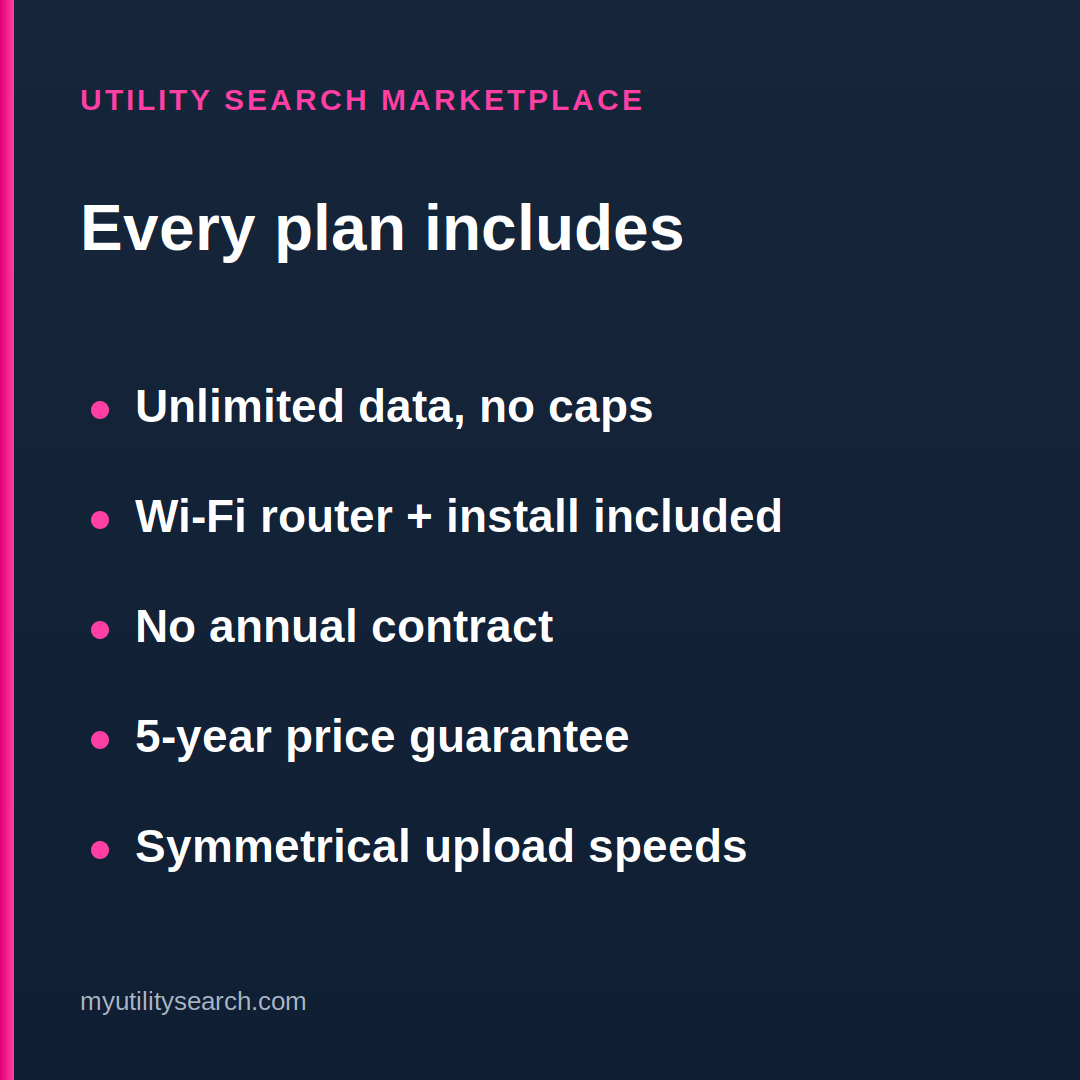
All plans: unlimited data, router + install included, no annual contract, 5-year price guarantee
Why the price guarantee matters if you work from home
The reason most home-internet bills creep up is the post-promo reset: you sign at a great rate, and a year later the price jumps. T-Mobile’s 5-year price guarantee locks the internet data rate while you stay on an eligible plan, so that predictability is arguably worth as much as the speed itself.
It is also worth knowing where this network came from. T-Mobile built Fiber by buying its way in — through 50/50 joint ventures that absorbed Lumos (with EQT) and Metronet (with KKR) — and it expects to reach 12 to 15 million fiber households by 2030. That is why availability is patchy today but expanding fast, and why the brand you sign up with is now T-Mobile rather than the company that built the line in your neighborhood.
In our provider mapping, T-Mobile Fiber currently registers in under 0.3% of tracked ZIP codes — but that footprint is expanding faster than any other brand on the list. Through its Metronet (~2.6M passes) and Lumos (~320K) acquisitions, T-Mobile is targeting 12–15 million homes passed by 2030, which would represent roughly 10% of U.S. households. At that scale T-Mobile Fiber would leapfrog most regional cable brands and land in the same tier as Frontier- and Ziply-scale fiber overbuilders.
T-Mobile Fiber vs. T-Mobile 5G Home Internet
If you already considered T-Mobile, you have probably seen its 5G Home Internet — the fixed-wireless service nearly 7 million customers already use. The new Fiber product is different in ways that matter for remote work:
- Speed ceiling: Fiber offers symmetrical speeds up to 2 Gig; fixed-wireless 5G is typically slower on the upload side, which is the side video calls and file uploads lean on.
- Consistency: Fiber is a wired line, so it does not share the same congestion and signal variability that wireless can see at peak hours.
- Availability: 5G Home Internet reaches far more addresses today; Fiber is rolling out market by market. Check both at your address before deciding.
Rule of thumb: if T-Mobile Fiber is live at your address and upload-heavy work is your reality, Fiber is the stronger pick. If it is not there yet, 5G Home Internet or satellite is the fallback worth comparing — and if you are weighing Starlink, see Starlink Price Increase 2026: What It Means.
Pairing your internet with the rest of your home setup
Switching providers is the natural moment to look at the rest of your monthly home bills, not just the internet line. Two quick wins while you are at it:
- Electricity: If you live in a deregulated state — Texas, Pennsylvania, Ohio, Illinois and much of the Northeast — you can shop your electricity supply the same way you shop internet, and lock a fixed rate before summer peak.
- Home security: A faster, more reliable connection also makes smart-home security (cameras, sensors, professional monitoring) work better — worth bundling into the same decision.
Comparing all three in one place is exactly what a utility marketplace is for — one address, one set of choices.
Compare internet, energy & home security at your address
T-Mobile Fiber FAQ
How much does T-Mobile Fiber cost in 2026?
Answer: With Fiber AutoPay, T-Mobile Fiber runs $45/month for Fiber 300 Mbps, $60/month for Fiber 1 Gig, and $70/month for Fiber 2 Gig, plus taxes and fees. Without AutoPay, add $10/month per plan. Launch promos like “Month on Us” and a $100 prepaid card may also apply on qualifying tiers.
Is T-Mobile Fiber available everywhere?
Answer: No. T-Mobile Fiber is rolling out market by market on the network it built through its Lumos and Metronet joint ventures, targeting 12 to 15 million households by 2030. Check your address at fiber.t-mobile.com to see whether it is live and which speed tiers are offered there.
Does T-Mobile Fiber have a contract or data cap?
Answer: No. Every T-Mobile Fiber plan includes unlimited data with no annual contract, and a Wi-Fi router and installation are included. Each plan also carries a 5-year price guarantee on the internet data rate while you stay on an eligible plan.
Is T-Mobile Fiber good for working from home?
Answer: Yes, where it is available. T-Mobile Fiber offers symmetrical upload and download speeds, which matter for video calls and large file transfers, plus a multi-year locked price that makes budgeting predictable for remote workers.
The deal history behind the launch: T-Mobile Acquisitions: Fiber & Spectrum Deals (2020–2026).
Choosing a connection for remote work: Best Internet Provider for Working From Home (2026).
Compare every provider at your address: Best Internet Providers 2026: Compare Plans.
T-Mobile Internet FAQ
How much does T-Mobile Fiber cost?
T-Mobile Fiber offers four plans from about $45 to $110 per month with AutoPay, covering 300 Mbps to 2 Gbps with symmetrical speeds, unlimited data, and no annual contract. A limited-time Founders Club deal offers the 2 Gig plan for $70/month with AutoPay in select areas.
Does T-Mobile Fiber have a 5-year price guarantee?
T-Mobile Fiber launched in June 2025 with a 5-year price guarantee, but as of April 30, 2026, new fiber plans no longer include it. Existing customers on qualifying plans keep theirs, and the limited-time Founders Club plan comes with a 10-year guarantee. T-Mobile 5G Home Internet still carries its 5-year Price Lock.
What is the difference between T-Mobile Home Internet and T-Mobile Fiber?
T-Mobile Home Internet is a 5G wireless service delivered through a plug-in gateway over T-Mobile’s cellular network — no wires, available almost anywhere with coverage. T-Mobile Fiber is a wired fiber-to-the-home connection with faster, symmetrical speeds, available only where T-Mobile has built fiber lines.
How much does T-Mobile Home Internet cost per month?
T-Mobile 5G Home Internet has three plans: Rely ~$50, Amplified ~$60, and All-In ~$80 per month with AutoPay, all with unlimited data and no annual contract. Rely can drop to about $35/month if you also have a qualifying T-Mobile voice line.
Does T-Mobile Home Internet have a price lock guarantee?
Yes. T-Mobile 5G Home Internet includes a 5-year Price Guarantee (Price Lock), so your monthly plan price will not rise for five years as long as you stay on the plan (taxes and fees excluded). That makes it one of the most predictable options for long-term budgeting.
Which T-Mobile internet tier is best for remote workers or large households?
For a single remote worker, T-Mobile 5G Home Internet’s Rely or Amplified plan usually handles video calls well. For large households or multiple remote workers, choose T-Mobile Fiber’s 1 Gig or 2 Gig plan — symmetrical upload speeds keep calls and file uploads smooth with several people online.
Is T-Mobile better than Starlink for home internet?
For most homes within T-Mobile coverage, T-Mobile 5G Home Internet is cheaper and faster to set up than Starlink, with no equipment to buy. Starlink is better in rural areas beyond T-Mobile’s network. Where available, T-Mobile Fiber beats both on speed and consistency.
Keep going
- Verizon 5G Home Internet review — the fixed-wireless alternative when fiber is not at your address
- T-Mobile Home Internet (5G) vs fiber: plans & prices
- Compare the best internet providers for 2026
- AT&T Fiber internet review
- Verizon Fios review
- Spectrum internet review
- Fiber vs cable vs 5G home internet
- Best fiber internet for working from home
- 1 gig internet: what it costs across providers