Blog
Data Centers and Electric Bills: What AI Is Really Adding — and the Part You Can Still Control

Updated on October 1, 2026
8 min read
TL;DR: Data centers and electric bills are now colliding across the U.S., and the honest answer is nuanced: AI and cloud growth are pushing up the delivery and generation side of power costs in the hardest-hit states, but how much lands on your bill depends on where you live — and one part of your bill is still yours to shop. This guide breaks down what the data actually shows, which states feel it most, and the exact portion you can lower today.
The connection between data centers and electric bills has become one of the biggest energy stories of 2026 — and one of the most confusing. Depending on which headline you read, AI data centers have either quietly added billions to household power costs or had almost no measurable effect at all. Both claims come from serious sources. So what is actually true, and what can you do about your own bill?
Do data centers and electric bills actually move together?
Here is the tension in one place. On one side, a widely cited Fortune analysis reported that data centers have already added roughly $23 billion to electricity costs borne by the public. On the other, an E3 white paper commissioned by the Data Center Coalition found no clear evidence that data centers are the primary driver of higher residential rates nationally. PolitiFact, reviewing similar claims, landed in the middle: the effect is real in some regions and overstated in others.
The reason both can be true is geography. Electricity is a regional market. A surge of data-center demand in Virginia or Texas does not raise a bill in a state with no data-center buildout. So the national average washes out an effect that is very real in specific places — which is exactly why data centers and electric bills look connected in some states and unrelated in others.
The part of your bill data centers actually push
To see where the pressure lands, it helps to split an electric bill into two pieces:
- The all-in rate — the total you pay per kWh, covering generation, transmission, distribution, riders, and taxes. This is the figure the U.S. Energy Information Administration (EIA) reports.
- The shoppable supply portion — in deregulated states, the generation part you can actually choose a provider for, often called the Price to Compare.
Data-center demand mostly pushes the first bucket: the grid buildout — new transmission, kept-online power plants, and capacity charges — needed to serve enormous new loads. That is the part set by regulators and utilities, and the part you cannot shop away. Understanding that split is the key to the whole story of data centers and electric bills: the pressure lands on the fixed side, but the shoppable side is still yours.
Which states feel it most
The impact concentrates where the data centers are:
- Virginia — the densest data-center market in the country. EIA data shows commercial electricity sales in Virginia have soared, driven directly by data centers, and CNBC has reported bills surging in the states with the heaviest data-center concentration.
- Texas (ERCOT) — facing an extraordinary interconnection queue of hundreds of gigawatts of requested large-load projects, ERCOT has forecast that demand could double within about six years and has moved to pause and screen new data-center connections. That buildout pressure shows up on the delivery side of Texas bills.
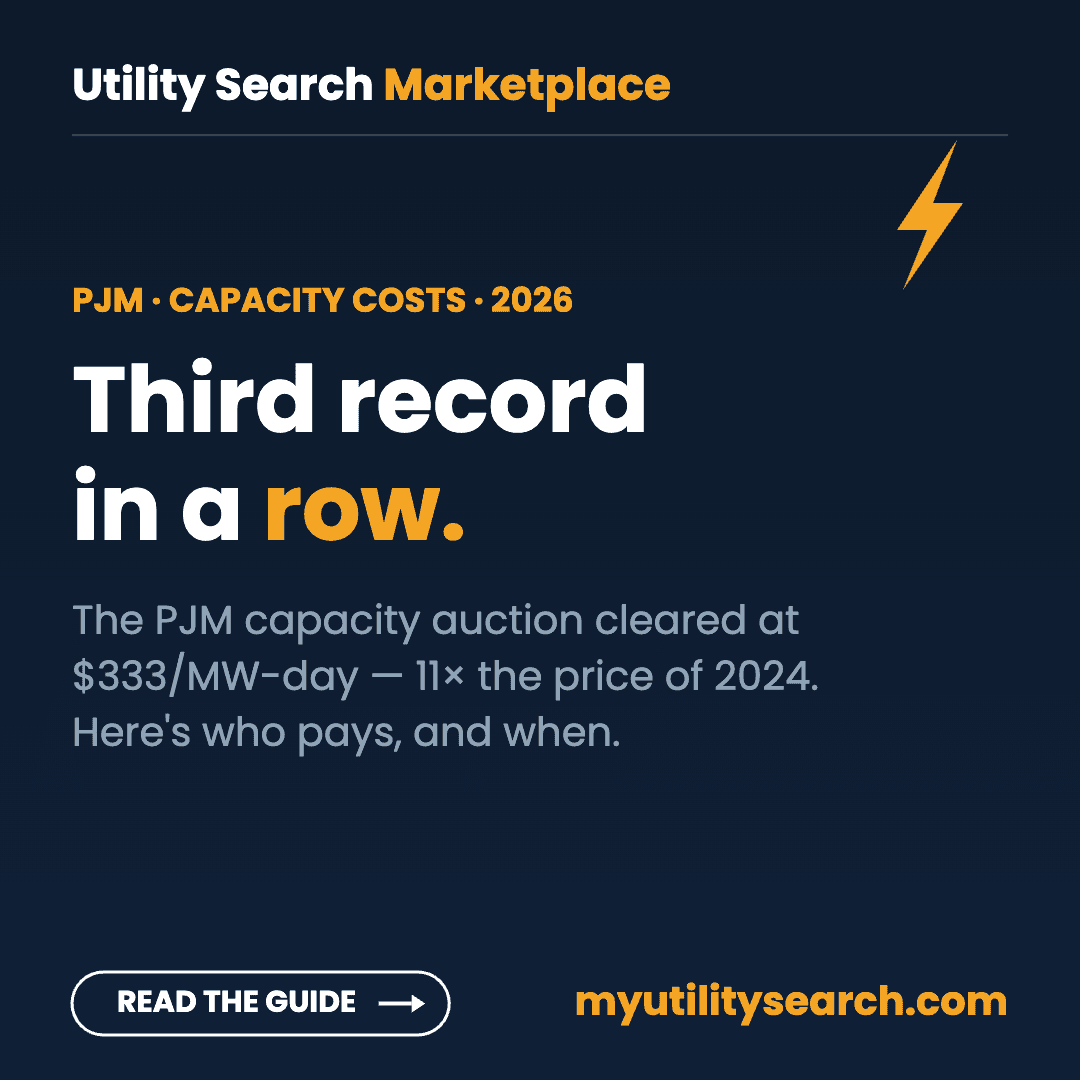
- PJM states (PA, OH, NJ, IL) — capacity-auction costs from large-load growth pass through to ratepayers, and utilities such as PPL have filed rate cases that include new data-center tariffs.
The common thread: in these markets, data centers and electric bills really are linked — but through the delivery and capacity side, not the part households choose.
By the numbers: how big is the switchable gap?
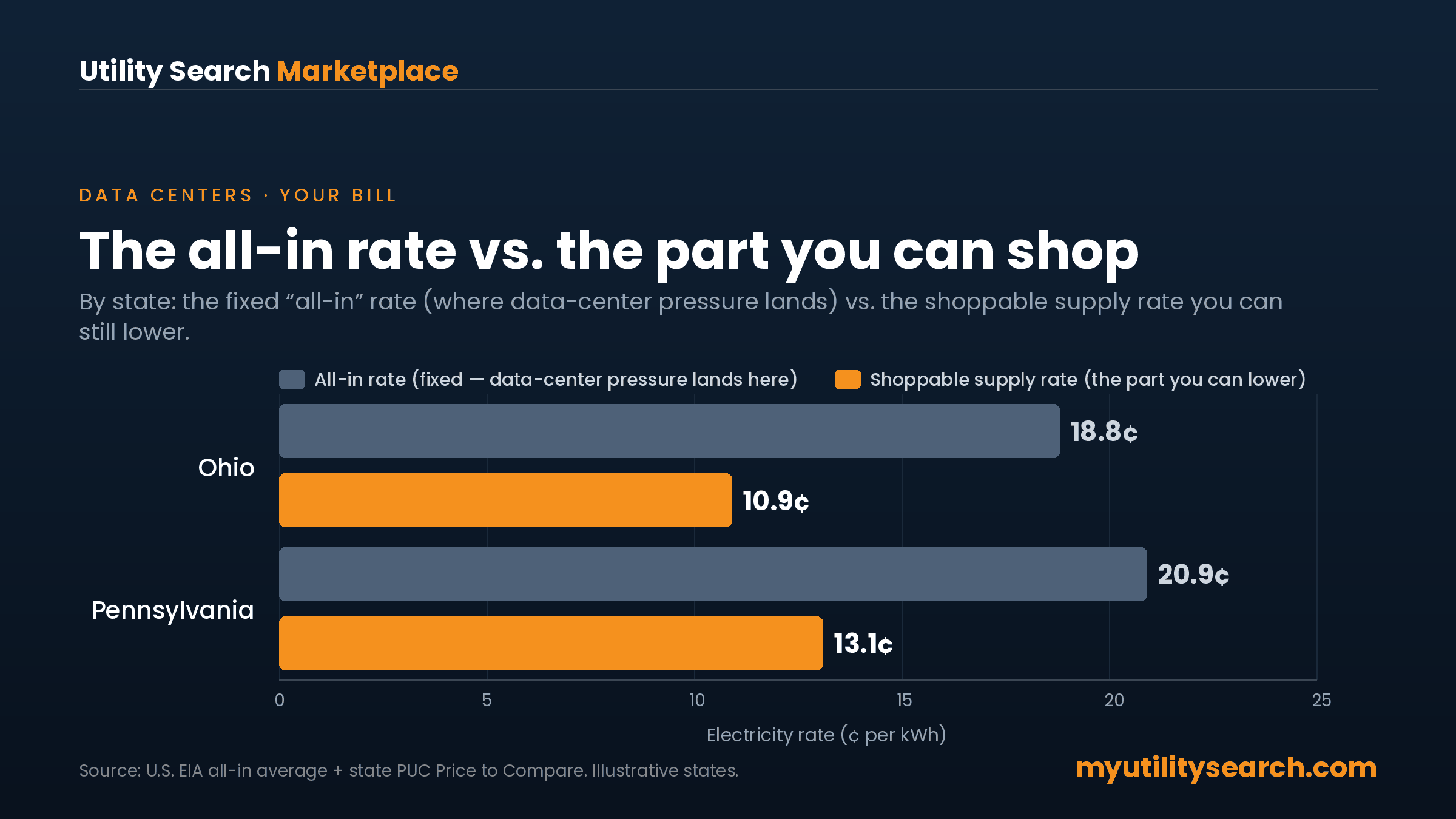
The clearest way to see why data centers and electric bills feel connected — yet still leave you a lever — is to compare the two halves of the bill in real deregulated states. Take Ohio and Pennsylvania, both with published rates:
- In Ohio, the all-in average runs about 18.78¢/kWh, while the shoppable supply portion — the Price to Compare households can actually switch — sits near 10.9¢/kWh, a spread of roughly eight cents.
- In Pennsylvania, the all-in average is about 20.92¢/kWh, with a shoppable Price to Compare closer to 13.1¢/kWh.
In both states, grid and delivery costs — the side that absorbs data-center buildout pressure — make up the larger, fixed piece, while the shoppable supply rate is the smaller slice you control. When AI data centers push a state’s costs higher, they push that fixed side; the gap between your default rate and the best available offer stays open for you to capture. The chart below shows the split at a glance.
Texas works a little differently — rates are quoted by delivery zone, roughly 14.6¢ to 16.8¢/kWh all-in, and the lowest fixed 12-month plans still advertise from around 6.6¢/kWh on the energy portion — but the principle is identical: the buildout pressure lands on delivery, and the competitive supply market is where a household saves. Across every deregulated state, data centers and electric bills move together on the fixed side, but the shoppable side remains yours regardless of the AI buildout.
Why the fixed side of your bill keeps climbing
There is a second, quieter way data centers and electric bills are connected: generation. To meet round-the-clock AI demand, utilities are keeping older power plants online longer. Reporting from Grist and Utility Dive describes data centers as coal and gas plants’ new best friend, and the EIA has noted that planned retirements of generating capacity may keep slipping into 2026. Delaying those retirements avoids blackouts, but it also keeps higher-cost generation on the system — a cost that flows through the fixed side of everyone’s bill.
Who is supposed to pay?
The most important policy fight right now is cost allocation: when a utility spends billions to connect a data center, does the data center pay for it, or does everyone’s bill? States are answering differently. Some are approving dedicated large-load tariffs designed to make data centers cover their own infrastructure; SEPA has documented a nationwide surge in these new tariffs, and a PPL rate-case settlement of about $275 million included exactly such a data-center tariff. Where those protections are weak, more of the cost socializes onto regular ratepayers — which is why “who pays” is the question that decides whether data centers and electric bills stay linked for you.
The part you can still control
Here is the practical takeaway that most coverage skips. Even where data-center pressure is real, it lands on the fixed delivery side of your bill — not the shoppable supply side. In a deregulated state, you can still choose the generation portion of your rate. The gap between your utility’s default Price to Compare and the lowest fixed offer available at your address is your switchable savings, and it is unaffected by the data-center debate. You can start by comparing electricity rates by state to see where your market stands.
In other words: you cannot vote a data center off your grid, but you can stop overpaying on the part of the bill you are allowed to shop. That single action turns an overwhelming national story into a lower bill this month.
Frequently asked questions
Do data centers and electric bills rise together everywhere?
No. The effect is concentrated in states with heavy data-center buildout — Virginia, Texas, and parts of the PJM region — and is minimal in states without it. National averages understate the local impact and overstate the nationwide one.
How much are data centers adding to electric bills?
Estimates vary widely and are contested. One Fortune analysis cited about $23 billion added to public electricity costs, while an industry-commissioned study found no clear national link. The honest answer is that it is significant in specific regions and small elsewhere.
Which part of my bill do data centers affect?
Mostly the delivery, transmission, and capacity charges — the fixed side set by utilities and regulators. That is the part you cannot shop. The generation and supply portion in deregulated states is still yours to choose.
Can I lower my bill even if data centers are raising rates in my state?
Yes. In deregulated markets you can shop the supply portion of your rate. Comparing your utility’s Price to Compare against the lowest available fixed offer at your address is the one lever you control, regardless of the data-center trend.
Where does the data on data centers and electric bills come from?
Rate figures come from the U.S. Energy Information Administration and each state’s public utility commission; data-center demand figures come from regional grid operators such as ERCOT and PJM and from published industry analyses. Every number here is sourced and refreshable.
The bottom line
Data centers and electric bills are genuinely connected in the states carrying the AI buildout — but through the fixed, delivery side of the bill, not the part you get to choose. The debate over exactly how many billions have been added will run for years. Your bill will not wait that long. Check the one number you can act on — the gap between your default supply rate and the best offer at your address — and lower the part of the bill that is actually yours to control.