Blog
Business Electricity Rates Texas (2026): Averages, Demand Charges, 4CP and What Power to Choose Won’t Show You


Updated on September 29, 2026
18 min read
Last updated September 28, 2026 · Prices are EIA averages for Texas commercial and industrial customers, the one public Texas small-commercial Electricity Facts Label, the published NRG Business contract terms, and the five TDU delivery tariffs. Every figure is dated in the text.
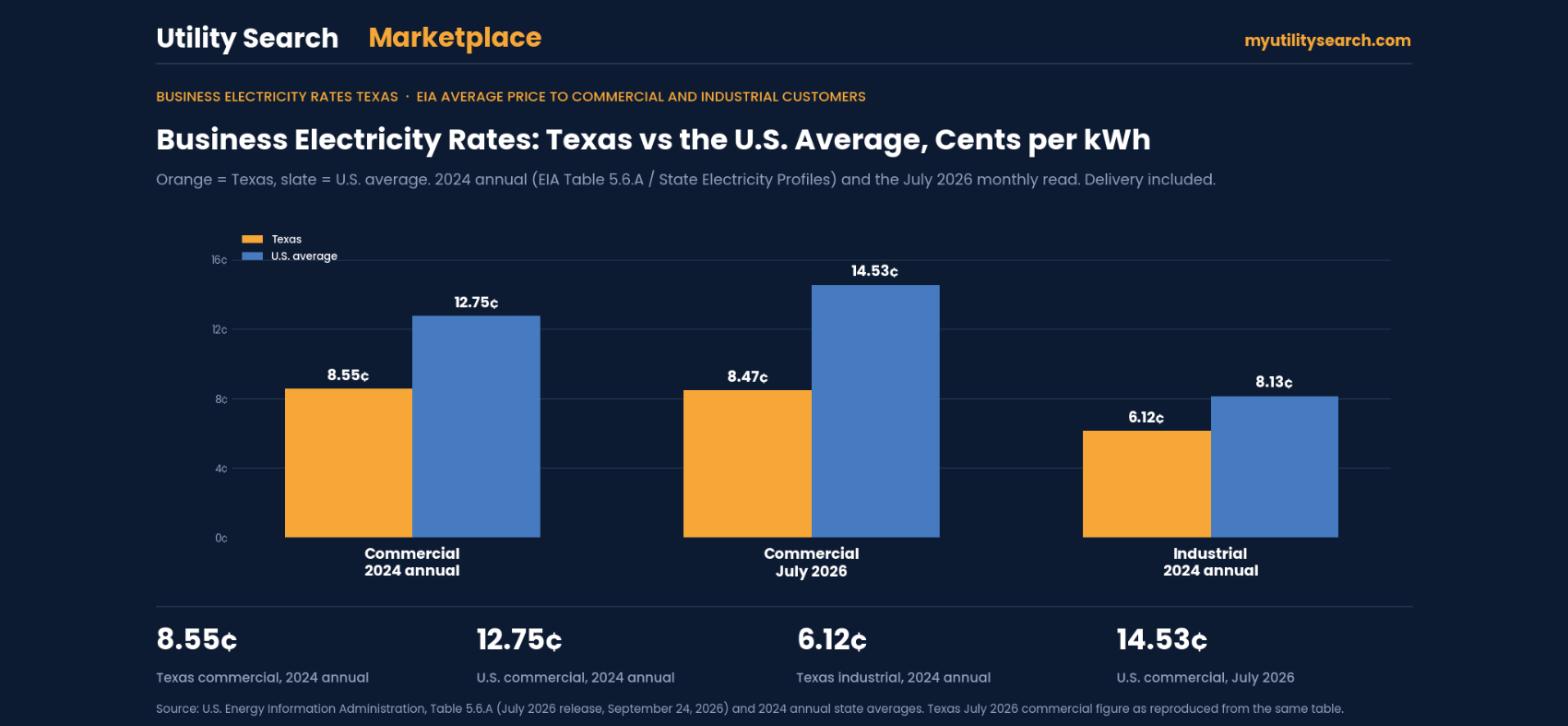
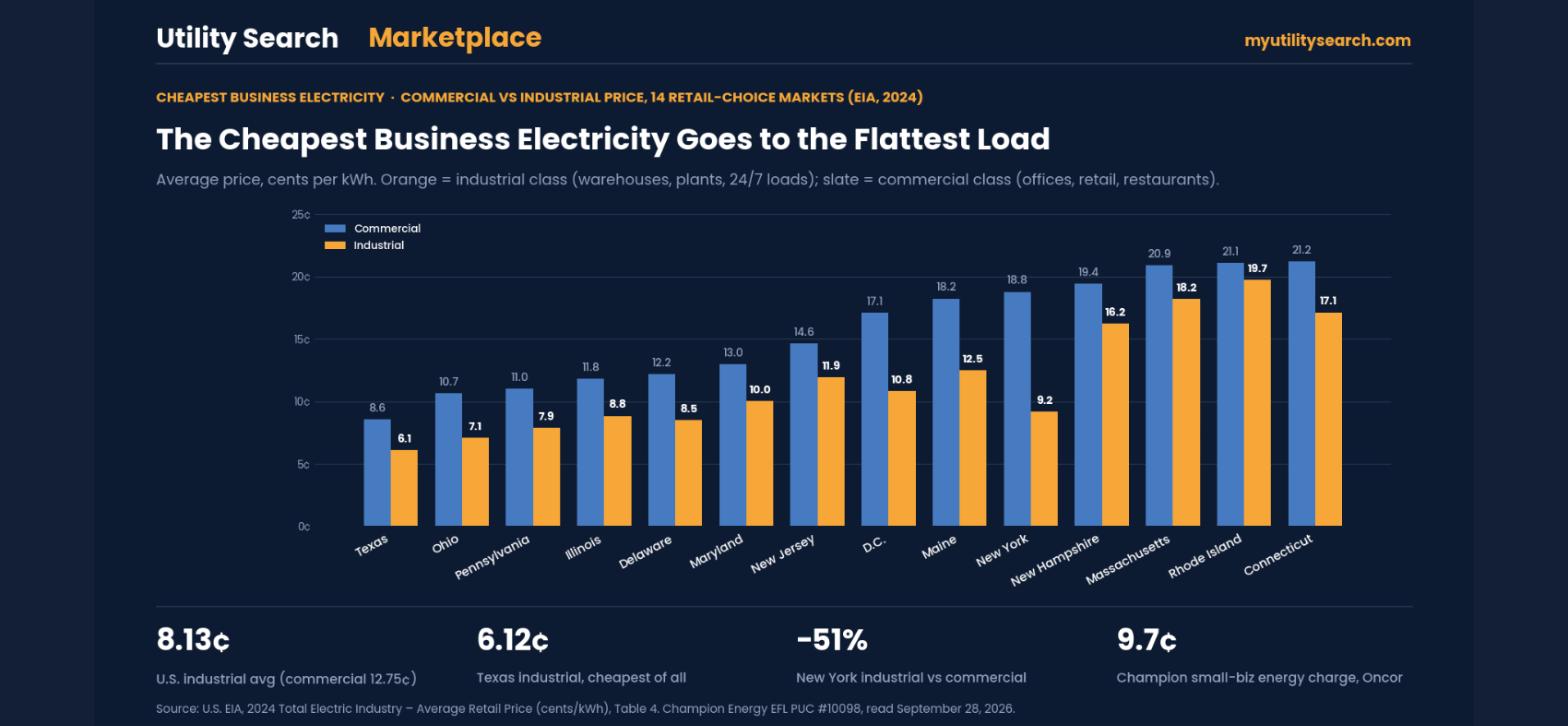
Business electricity rates Texas companies pay average 8.55¢ per kWh for commercial customers and 6.12¢ for industrial on EIA’s 2024 full-year data, against 12.75¢ and 8.13¢ nationally; EIA’s July 2026 monthly read puts Texas commercial at 8.47¢ while the U.S. average climbed to 14.53¢. Those are blended averages with delivery included. The one small-commercial plan a Texas business can price without a quote — Champion’s Business Savings Champ 18 on Oncor — carries a 9.7¢ energy charge and 17.0 to 18.7¢ all-in at 1,500 to 3,500 kWh a month. Above 50 kW, every rate is a custom quote.
TL;DR — business electricity rates Texas, September 2026
- The averages: Texas commercial 8.55¢/kWh and industrial 6.12¢/kWh (EIA 2024 annual); Texas commercial 8.47¢ in July 2026 vs 14.53¢ U.S. (EIA monthly). Texas is the cheapest retail-choice market in the country for business load.
- The one published small-business price: Champion Energy Business Savings Champ 18 (Oncor): 9.7¢ energy charge, 17.0–18.7¢ average all-in, 18 months, EFL dated September 28, 2026.
- Everything else is quoted: TXU, Reliant, Gexa, Direct Energy, Constellation and NRG price business meters by 12-month usage, load profile and term. NRG’s published Texas small-commercial terms — $4.95 per meter base charge, TDSP delivery passed through at cost, early-termination fee of $250 per remaining month capped at 12 — are the public reference for contract structure.
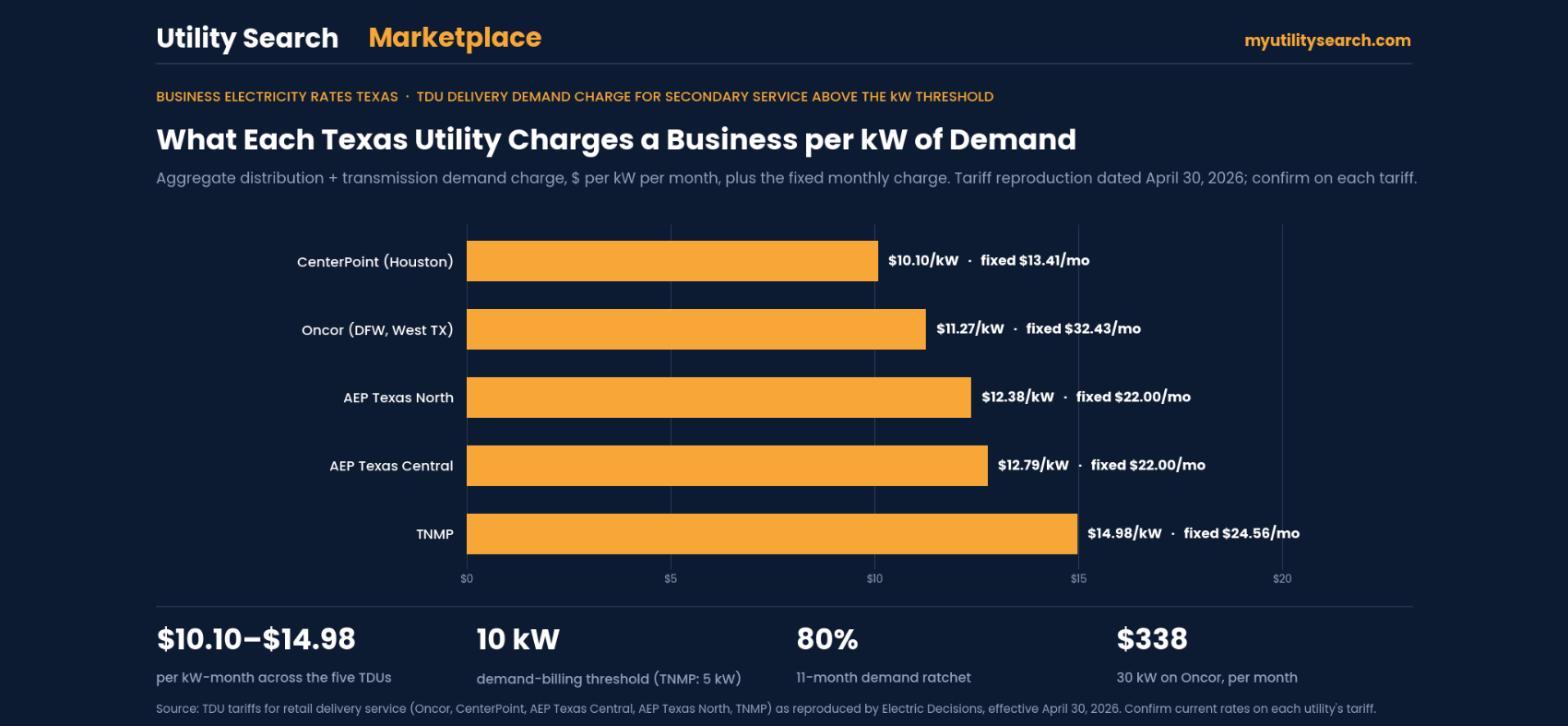
- Delivery is the half Power to Choose never shows: above 10 kW (5 kW on TNMP) the utility bills a demand charge of roughly $10.10 to $14.98 per kW-month plus a fixed charge, with an 80% ratchet against your highest peak in the past 11 months.
- 4CP: facilities above roughly 700 kW pay transmission on their load at ERCOT’s four summer system peaks; the method is under PUCT review (Project 58484) with new rules due by December 31, 2026.
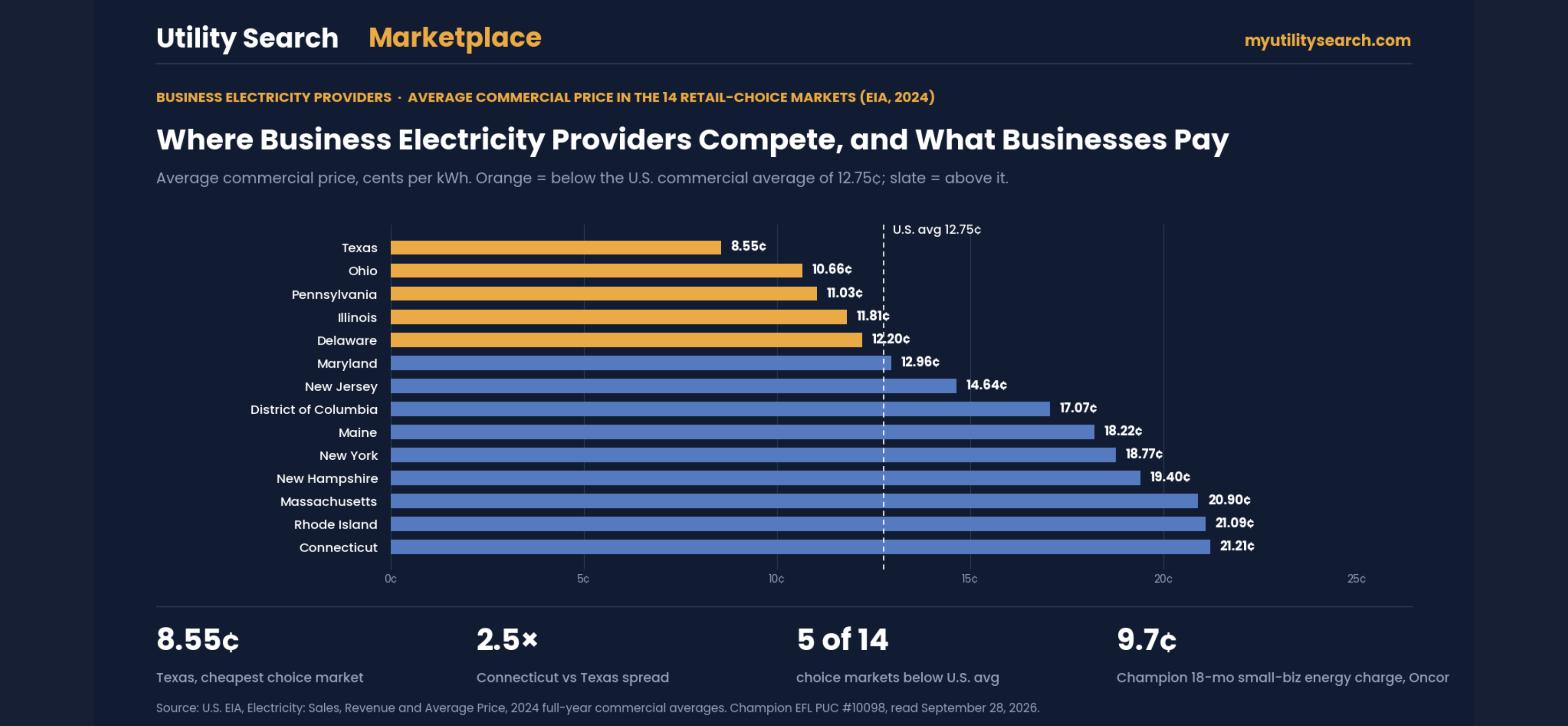
Texas is the floor of the whole retail-choice map. Across the 14 markets where a business can pick its supplier, business electricity rates Texas companies pay are the lowest on EIA’s 2024 commercial data at 8.55¢, against 10.66¢ in Ohio, 11.03¢ in Pennsylvania, 11.81¢ in Illinois and 21.21¢ in Connecticut; the full state-by-state picture is in commercial electricity rates by state.
Business electricity rates Texas: the numbers that actually exist
Most pages about Texas business electricity quote a single “average rate” with no source and no date. The honest picture is four different numbers that answer four different questions, and a business owner needs to know which one applies to their meter before any quote makes sense.
| Figure | Value | What it measures | Source and date |
|---|---|---|---|
| Texas commercial average | 8.55¢/kWh (2024); 8.47¢ (July 2026) | All commercial revenue ÷ all commercial kWh, delivery included, every size of business | EIA Table 5.6.A and state profiles; July 2026 release dated September 24, 2026 |
| Texas industrial average | 6.12¢/kWh (2024) | Large manufacturing and process loads, delivery included | EIA 2024 annual |
| U.S. commercial average | 12.75¢ (2024); 14.53¢ (July 2026, +3.4% YoY) | Same measure nationally | EIA Table 5.6.A |
| Published small-commercial plan | 9.7¢ energy; 17.0–18.7¢ all-in | Champion Business Savings Champ 18, Oncor area, 1,500–3,500 kWh/mo, 18 months, 20% renewable | Champion EFL, PUC #10098, dated September 28, 2026 |
| Published contract terms | $4.95/meter base; TDSP at cost; ETF $250 × remaining months (max 12) | Small-commercial structure at NRG Business (parent of Reliant and Direct Energy) | NRG Business Texas terms of service, REP #10011, read September 28, 2026 |
| Quoted commercial supply | Custom, by meter | TXU, Reliant, Gexa, Direct Energy, Constellation, Engie, APG&E and others | Supplier business pages, read September 28, 2026 |
Read the table top to bottom and the gap between the average (8.5¢) and the one published small-business plan (17–19¢ all-in) is the whole story of business electricity rates Texas shoppers run into. The average is dominated by large loads that buy energy at wholesale-plus and spread delivery over millions of kWh. A 2,500 kWh storefront pays the same delivery tariff on a fraction of the volume, so its all-in rate is roughly double the state average even when its energy charge is competitive.
Why Power to Choose does not show your business rate
Power to Choose, the PUCT’s comparison site, is built around Electricity Facts Labels, and its own glossary defines a small commercial customer as a business whose peak demand stays under 50 kW in any 12-month period. That is the ceiling of the published market. A coffee shop, a dental office or a small warehouse with a couple of compressors can sit under it and shop a labeled plan like Champion’s; a restaurant with a full kitchen, a car wash, a cold-storage room or any building with a large HVAC load will cross 50 kW on a summer afternoon and move into quote-only territory.
Three things follow. First, there is no public rate card for most Texas business load, which is why the supplier roundup on this site scores companies on how they quote rather than on a rate.
Second, the EFL a small-commercial customer does get shows an average all-in price at 1,500, 2,500 and 3,500 kWh — a usage band that fits a storefront but tells a 20,000 kWh operation nothing. Third, a business quote is built from your meter’s interval or monthly history, so the same supplier will quote two neighbours differently. Our comparison with Power to Choose covers what the site does and does not surface for residential shoppers; for business meters the answer is simpler: above 50 kW it surfaces nothing.
How a Texas business electricity bill is built
The business electricity rates Texas suppliers quote are only the first layer of the bill. Every commercial bill in the ERCOT choice area has the same four layers. The retail electric provider owns the first; the transmission and distribution utility (TDU) owns the second and third; the state owns the fourth. Only the first is negotiable.
| Layer | Who sets it | How it is billed | What moves it |
|---|---|---|---|
| Energy charge | Your retail provider (TXU, Reliant, Champion, NRG…) | ¢ per kWh, fixed or indexed, for the contract term; often a per-meter base charge ($4.95 at NRG) | Wholesale forward prices at signing, your load factor, term length, credit |
| Delivery — energy | TDU (Oncor, CenterPoint, AEP Texas, TNMP), approved by the PUCT | Fixed customer + metering charge, and ¢ per kWh on secondary service at or below 10 kW | Tariff changes (Oncor set new base rates June 1, 2026 and a temporary surcharge from August 1) |
| Delivery — demand | TDU | $ per kW of billing demand on secondary service above 10 kW (5 kW on TNMP); billing kW is the higher of this month’s 15-minute peak or 80% of the highest peak in the prior 11 months | Your single worst 15 minutes each month, and the ratchet |
| Transmission (4CP) | ERCOT / TDU | For interval-metered loads, typically above 700 kW: next year’s transmission charge is set by your average load at ERCOT’s four summer system peaks | Whether you curtail during the June–September peak intervals |
| Taxes and assessments | State and city | Sales tax where applicable, gross-receipts reimbursement and PUC assessment pass-throughs | Location and exemption status (manufacturing can be exempt) |
The reason Texas business electricity rates are quoted per meter is in row three. Two businesses buying 8,000 kWh a month at the same 9.7¢ energy charge can have delivery bills $300 apart if one peaks at 20 kW and the other at 50 kW. A supplier that quotes you without asking for 12 months of history is guessing at the layer that matters most.
TDU delivery charges for commercial meters, by utility
This is the half of business electricity rates Texas comparison sites leave out. The five TDUs in the ERCOT choice area each publish a tariff for retail delivery service with a “Secondary Service greater than 10 kW” schedule (TNMP’s threshold is 5 kW). The table below is the aggregate distribution-plus-transmission demand rate and the fixed monthly charge for that schedule as reproduced from the tariffs effective April 30, 2026. Oncor changed its base rates on June 1, 2026 and added a temporary surcharge on August 1, so treat these as the spring-2026 reference and confirm the current sheet on each utility’s tariff before you model a bill.
| TDU (service area) | Fixed charge / month | Demand charge / kW-month | Demand threshold | Ratchet |
|---|---|---|---|---|
| CenterPoint Energy (Houston) | $13.41 | $10.10 | >10 kW (some schedules bill kVA) | 80% of highest NCP kW, prior 11 months |
| Oncor (Dallas–Fort Worth, West Texas) | $32.43 | $11.27 | >10 kW | 80%, prior 11 months |
| AEP Texas North (Abilene, San Angelo) | $22.00 | $12.38 | >10 kW | 80%, prior 11 months |
| AEP Texas Central (Corpus Christi, Valley) | $22.00 | $12.79 | >10 kW | 80%, prior 11 months |
| TNMP (Gulf Coast, North and West pockets) | $24.56 | $14.98 | >5 kW | 80%, prior 11 months |
Source: each TDU’s Tariff for Retail Delivery Service, Secondary Service >10 kW, as reproduced by Electric Decisions with an effective date of April 30, 2026; the 10 kW threshold, 15-minute demand interval and 80% ratchet are stated on Oncor’s Delivery Charges 101 page, read September 28, 2026. Per-kWh riders on this schedule are small and omitted.
Demand charges explained, with the math
A demand charge bills the highest average power you drew in any 15-minute window of the month, in kilowatts, regardless of how many kilowatt-hours you used overall. It exists because the wires and transformers serving you are sized for that peak, not for your average. Two worked examples show why it dominates business electricity rates Texas owners are surprised by.
| Line | Small storefront (≤10 kW), Oncor | Light commercial (30 kW peak), Oncor |
|---|---|---|
| Usage | 2,500 kWh/month | 8,000 kWh/month |
| Energy charge | Champion Business Savings Champ 18 — 9.7¢: $242.50 | Same 9.7¢: $776.00 |
| TDU fixed charge | Included in the EFL’s 17.5¢ average | $32.43 |
| TDU demand charge | None (per-kWh delivery instead) | 30 kW × $11.27 = $338.10 |
| Bill before taxes and riders | 2,500 × 17.5¢ = $437.50 | $1,146.53 |
| Effective all-in rate | 17.5¢/kWh | 14.3¢/kWh |
| Same site after one 50 kW spike in the past 11 months | n/a | Billing kW = 80% × 50 = 40 kW → demand $450.80; bill $1,259.23; 15.7¢/kWh |
Two lessons. The 30 kW site pays a lower rate per kWh than the storefront because it spreads fixed delivery over more volume, which is the pattern behind the 8.5¢ state average. And a single hot afternoon when every rooftop unit, the walk-in cooler and the compressor started together costs that site $112.70 a month for the next eleven months through the ratchet — $1,240 for fifteen minutes. Staggering start-ups, a demand controller, or simply knowing what your peak is are worth more than a tenth of a cent on the energy charge.
Compare business electricity at your address
Commercial contracts are priced off your meter and 12 months of usage, not a published rate card. Start with what your address can actually buy.
4CP: the summer-peak charge for large Texas loads
ERCOT’s Four Coincident Peak calculation identifies the single 15-minute interval in each of June, July, August and September when the whole ERCOT system drew the most power. For interval-metered customers — in practice loads above roughly 700 kW — the average of your demand at those four intervals sets the transmission portion of your delivery charge for the following calendar year. Industry estimates put the summer-2026 transmission rate at $5.50 or more per kW-month, so a plant that shaved 500 kW off its load during the four peaks would avoid on the order of $33,000 over the next year. Peak-day alerts and curtailment plans are a standard commercial service in Texas for that reason.
The method is being rewritten. Senate Bill 6 (2025) requires the PUCT to amend its transmission cost-recovery rules by December 31, 2026, and the commission’s March 16, 2026 draft in Project 58484 recommends moving from four summer peaks to a 12CP approach with a peak in every month, longer measurement windows, and minimum demand charges for very large new loads such as data centers; a June 10, 2026 gubernatorial directive set a July 31 deadline for reducing the residential share. As of September 28, 2026 those are draft recommendations, not final rules.
Any business electricity contract that runs past 2026 should be quoted with that change in mind, and a supplier or broker who cannot explain it should not be pricing your transmission.
Term pricing: what a 12-, 24- or 36-month business contract is made of
Term length is the second lever on business electricity rates Texas buyers control. Texas is an energy-only market — ERCOT has no capacity auction — so a Texas business supply price has fewer moving parts than one in PJM or ISO-NE. A fixed-price quote bundles the forward energy price for your term, a load-shape premium for how peaky your usage is, ancillary services, congestion for your zone, and the supplier’s margin.
The forward curve is the reason a 36-month price is not simply the 12-month price repeated: when the curve slopes up the long term costs more per kWh, and when the curve is flat or inverted the long term is the bargain. In September 2026 the only Texas small-commercial term price you can read without a quote is Champion’s 18-month 9.7¢ on Oncor; every other term spread is delivered in the quote.
| Contract term | What it buys | When it wins | The exit cost to check |
|---|---|---|---|
| 12 months | One year of price certainty; renewal risk next fall | Forward curve sloping up; you expect to close, move or add load | NRG-style ETF: $250 × months remaining, capped at 12 |
| 18–24 months | Two summers covered | Flat curve; stable operation | Champion: ETF based on annual historic consumption (Terms of Service) |
| 36 months or longer | Budget certainty through the 4CP rule change | Flat or inverted curve; landlord-locked premises | Ask for the ETF formula in writing and whether the price reopens if the PUCT changes cost allocation |
| Index / block-and-index | Wholesale exposure with a margin adder | Sophisticated buyers with flexible load | Usually none, but no price protection |
Compare business quotes as an all-in price at your real usage, never as an energy charge. The method — annual kWh times energy charge, plus base charges, plus the TDU delivery you will pay under any supplier — is laid out in our cheapest business electricity guide, and the contract red flags (pass-through clauses, bandwidth limits, auto-renewal to a variable rate) are the same in Texas as anywhere else.
Who sells business electricity in Texas, and what each one publishes
The supplier field is compared in full in business electricity providers. The Texas-specific summary as of September 28, 2026:
| Supplier | How it prices Texas business meters | What is public |
|---|---|---|
| Champion Energy (Calpine) | Published small-commercial EFLs by TDU area; larger loads by quote | Business Savings Champ 18, Oncor: 9.7¢ energy, 17.0–18.7¢ all-in, 18 months |
| NRG Business | Small-commercial online enrollment; C&I by quote | Terms of service: $4.95/meter base, TDSP at cost, ETF $250 × remaining months (max 12) |
| TXU Energy Business | Custom quote; specialists Mon–Sat | 60-day Total Satisfaction Guarantee; Business Surge Protect $10.95–$24.95/mo; no rate card |
| Reliant Business (NRG) | Custom quote by ZIP | 24/7 support, usage tracking; rates behind the form |
| Direct Energy Business (NRG) | Online portal by service location for buildings ≤10,000 sq ft; quote above | No meter changes, no interruption on switch |
| Gexa Energy Business (NextEra) | Fixed Price product by quote | Product name only |
| Constellation | Fully bundled fixed-rate plans priced online by location; capacity-adjust and custom by phone | Plan structures; Texas among 10 electricity markets |
| 4Change, Payless Power | Residential only | No commercial line |
Broker or direct? The Texas answer
Whether a broker improves the business electricity rates Texas companies are offered depends on size. Under 50 kW, go direct or through a comparison site: the plans are labeled, the terms are short, and a broker’s fee (built into the energy charge, typically a fraction of a cent per kWh) is not worth paying on 2,500 kWh a month. Above 50 kW, a licensed aggregator or broker earns its adder by running your interval data against several suppliers at once, which is the only way to see the load-shape premium each one is charging you.
Either way, put five questions in the request for quote: the energy charge and every base or minimum charge; whether TDSP delivery is passed through at cost; the exact early-termination formula; what happens at the end of the term if you do nothing; and whether the price reopens on a regulatory change such as the 4CP rewrite. A quote that cannot answer all five in writing is not a quote.
How to get the lowest business electricity rate in Texas
- Pull 12 months of bills and note the billing kW on each one. If you have never crossed 10 kW you are a per-kWh delivery customer and the EFL average price is your real comparison number.
- Know your TDU. Delivery is the same under every supplier; only the energy charge, base charges and terms move. Model the bill with the utility’s demand charge, not a blended rate.
- Price the term against the forward curve. Ask for 12, 24 and 36 months in the same quote and look at the spread; a flat spread means the long term is cheap insurance.
- Fix your peak before you fix your price. Staggered start-ups, thermostat scheduling and a demand controller reduce the layer no supplier can discount, and the savings survive every contract.
- Hold every quote against the public benchmarks: Champion’s 9.7¢ energy charge and 17.0–18.7¢ all-in on Oncor, and NRG’s $4.95 base and $250-per-month ETF. A quote far outside those on a similar load needs an explanation.
- Diary the end date. Texas business contracts roll to a month-to-month or variable product if you do nothing; the renewal offer is rarely the best one on the table.
Methodology
How the business electricity rates Texas figures on this page were assembled. Averages are EIA’s average price of electricity to ultimate customers by state and sector: the 2024 annual figures and the July 2026 monthly figures from Table 5.6.A (Electric Power Monthly, July 2026 data, released September 24, 2026). The published small-commercial price is Champion Energy’s Business Savings Champ 18 Electricity Facts Label for the Oncor delivery area, dated September 28, 2026. Contract terms are NRG Business’s Texas small-commercial terms of service, read the same day.
TDU demand charges are the Secondary Service >10 kW schedules as reproduced with an April 30, 2026 effective date, cross-checked against Oncor’s own description of the 10 kW threshold, 15-minute interval and 80% ratchet; Oncor’s June 1, 2026 base-rate change and August 1 surcharge are noted but not modelled.
4CP mechanics are from ERCOT’s Four Coincident Peak page and the PUCT’s Project 58484 materials as reported; the transmission-rate estimate is an industry projection, not a tariff figure. Worked examples are arithmetic on those published numbers before taxes and per-kWh riders.
Frequently asked questions about business electricity rates in Texas
What is the average business electricity rate in Texas?
EIA puts the Texas commercial average at 8.55¢ per kWh for 2024 and 8.47¢ for July 2026, with industrial at 6.12¢ (2024), delivery included. The U.S. commercial average was 12.75¢ in 2024 and 14.53¢ in July 2026. A small storefront pays well above the average — Champion’s published small-commercial plan runs 17.0 to 18.7¢ all-in on Oncor — because fixed delivery charges are spread over less usage.
Does Power to Choose show business electricity plans?
Only for small commercial customers, which its glossary defines as peak demand under 50 kW in any 12-month period, and only where a supplier has posted an Electricity Facts Label. Above 50 kW, Texas business electricity is priced by custom quote from the supplier’s business division or through a broker, and nothing appears on Power to Choose.
What is a demand charge on a Texas business electricity bill?
A charge from your transmission and distribution utility for the highest 15-minute average power you drew in the month, billed per kW on secondary service above 10 kW (5 kW on TNMP). As reproduced from the April 30, 2026 tariffs it runs $10.10 per kW-month at CenterPoint to $14.98 at TNMP, and billing kW is the higher of this month’s peak or 80% of your highest peak in the prior 11 months.
What is 4CP and does it affect my business?
4CP is ERCOT’s Four Coincident Peak method: your average load during the four 15-minute system peaks in June through September sets next year’s transmission charge. It applies to interval-metered loads, typically above 700 kW, so most small businesses never see it. The PUCT is reviewing the method in Project 58484 under Senate Bill 6, with new rules due by December 31, 2026.
Is a 36-month business electricity contract a good idea in Texas?
It depends on the forward curve at signing. Ask for 12, 24 and 36 months in one quote; if the spread is flat the long term is cheap budget certainty, especially with the 4CP rewrite due by the end of 2026. Confirm the early-termination formula in writing first — NRG’s published Texas terms charge $250 per remaining month, capped at 12.
Is comparing business electricity here free?
Yes. Comparing business electricity rates through MyUtilitySearch is free. You pay the rate on your contract and nothing else, and every quote is worth holding against the published Champion and NRG benchmarks on this page.
Bottom line on business electricity rates in Texas
Texas has the cheapest business electricity in the retail-choice states — 8.55¢ commercial and 6.12¢ industrial against 12.75¢ and 8.13¢ nationally on EIA’s 2024 data — but almost none of it is published. Under 50 kW you can read a real price (Champion’s 9.7¢ energy, 17.0–18.7¢ all-in on Oncor) and shop it like a household. Above that, the rate is a quote built from your meter, and the numbers that decide whether it is a good one are the TDU demand charge, the ratchet and, for large loads, 4CP. Get the twelve months of billing kW in front of you before anyone quotes you, and compare every offer all-in.
Compare business electricity at your address
Commercial contracts are priced off your meter and 12 months of usage, not a published rate card. Start with what your address can actually buy.
Sources
- EIA — Electric Power Monthly, Table 5.6.A, average price of electricity to ultimate customers by end-use sector, by state (July 2026 data, released September 24, 2026; 2024 annual)
- EIA — Electricity Monthly Update, end-use prices (U.S. July 2026: residential 18.31¢, commercial 14.53¢, industrial 9.77¢)
- Oncor — Delivery Charges 101 (secondary service ≤10 kW and >10 kW, 15-minute demand, 80% ratchet) and Tariff for Retail Delivery Service
- Electric Decisions — Texas commercial demand charges (TDU secondary >10 kW schedules reproduced, effective April 30, 2026)
- ERCOT — Four Coincident Peak calculations
- Texas Power Cost — PUCT Project 58484 / SB 6 transmission cost allocation review (March 16, 2026 draft; December 31, 2026 rule deadline)
- KilowattLogic — ERCOT 4CP summer 2026 (700 kW threshold; $5.50+/kW-month projection)
- Power to Choose — Glossary (small commercial customer: peak demand under 50 kW)
- Champion Energy — Business Savings Champ 18 Electricity Facts Label, Oncor, PUC #10098, dated September 28, 2026; NRG Business — Texas small-commercial terms of service, REP #10011, read September 28, 2026 (both detailed on our business electricity providers page)
Keep going
- Business electricity providers — the suppliers selling commercial contracts, scored on how they quote
- Cheapest business electricity — contract types, term spreads and the all-in comparison method
- Commercial electricity rates by state — where Texas sits against the other choice markets
- Business electricity explained — how the commercial market works
- Champion Energy review — the supplier with the published small-commercial EFL
- Texas electricity rates — the residential picture by TDU
- Texas deregulated energy hub — who can choose, and where
- Business utilities hub: electricity, internet, security and more for a new location