Blog
Power to Choose Texas (2026): What the PUCT Site Shows, What It Leaves Out, and the Alternatives — 1,895 Plans Read on September 29


Updated on September 29, 2026
15 min read
Last updated September 29, 2026 · originally published May 15, 2026 · Every plan price on this page was read from the Public Utility Commission of Texas’s own Power to Choose offer export on September 29, 2026, for the Oncor delivery area (ZIP 75078).
Power to Choose Texas is the free, official electricity-shopping site run by the Public Utility Commission of Texas at powertochoose.org. On September 29, 2026 it listed 1,895 offers from 46 retail electric providers statewide, 142 of them at ZIP 75078. It is honest, complete for residential plans, and easy to misread: it ranks plans by the average price at exactly 1,000 kWh, it shows nothing for businesses, and seven of the ten “cheapest” plans in the Oncor area are bill-credit plans that cost about three times as much at 500 kWh.
This guide shows what Power to Choose Texas does well, where it leads shoppers wrong, how to use it properly, and the alternatives, including where a business has to go instead.
Power to Choose Texas in 60 seconds
- What it is: the PUCT’s official comparison site for the deregulated part of Texas. Every plan links to its Electricity Facts Label (EFL), Terms of Service and Your Rights as a Customer document. It is free and it does not sell anything.
- What it showed on September 29, 2026: 1,895 offers statewide from 46 providers (949 English-language listings, 946 Spanish); 173 English-language offers in the Oncor area, 142 visible on the default results page for ZIP 75078.
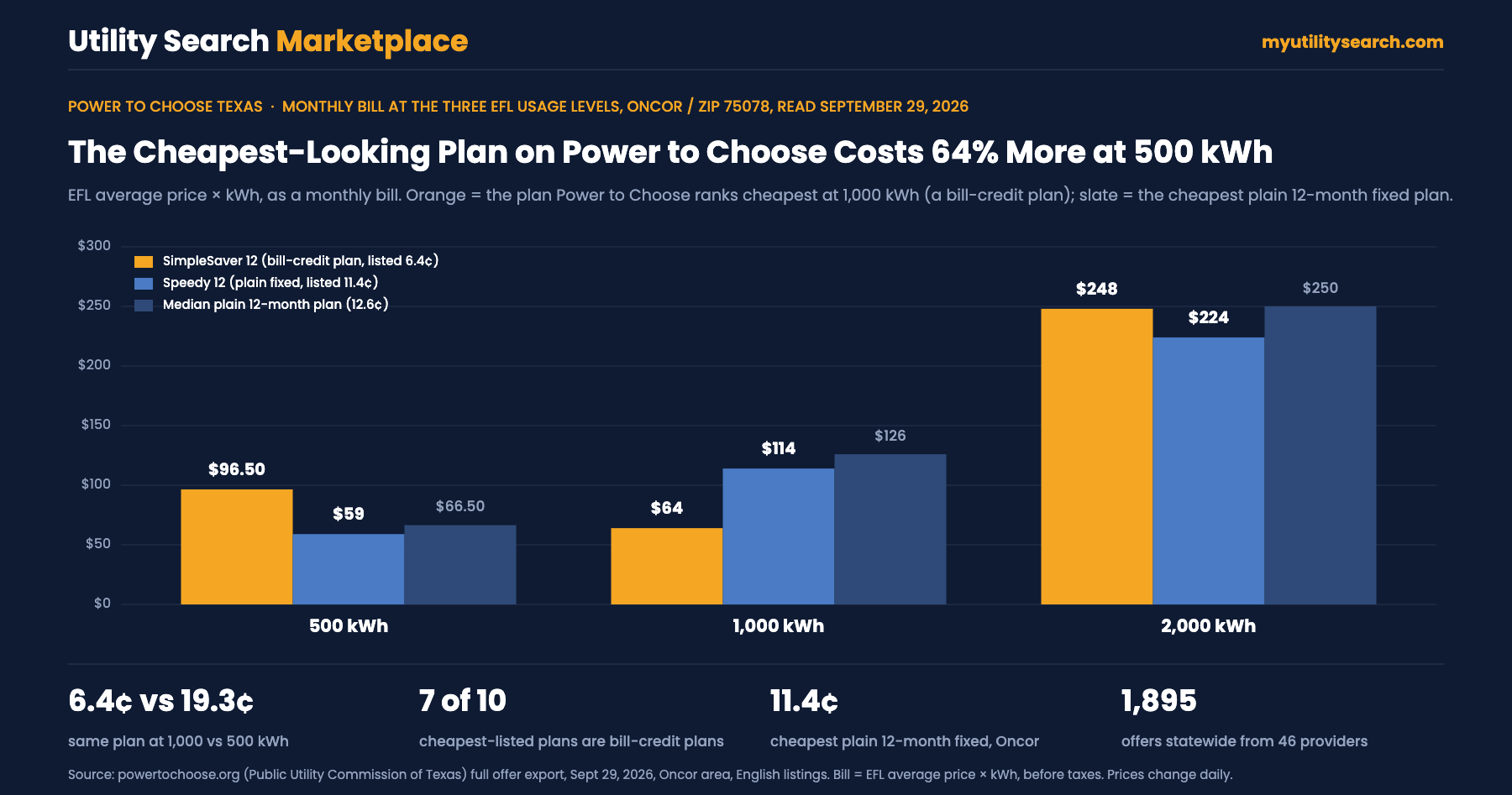
- The trap: the site sorts by the EFL average price at 1,000 kWh. The plan it ranked cheapest in Oncor territory, AP Gas & Electric’s SimpleSaver 12, shows 6.4¢ at 1,000 kWh and 19.3¢ at 500 kWh. The cheapest plain 12-month fixed plan, Express Energy’s Speedy 12, shows 11.8¢ / 11.4¢ / 11.2¢ across all three usage levels.
- What it leaves out: business plans. The PUCT’s own business page says commercial electricity is “a negotiated purchase process.” Small commercial customers (under 50 kW peak demand) can use residential-style plans; everyone larger gets a quote, not a listing.
- The fix: set the usage level to match your bill, turn on the filter that hides bill-credit and tiered plans, sort, then read the EFL at all three usage levels before you enroll. The alternatives to Power to Choose Texas are below, with what each one adds.
What is Power to Choose Texas?
Power to Choose Texas is the Public Utility Commission of Texas’s plan-comparison website for the roughly 85 percent of the state where retail electric choice applies (the ERCOT-served areas delivered by Oncor, CenterPoint, AEP Texas, TNMP and Lubbock Power & Light). Retail electric providers, the companies that actually bill you, list their residential offers on it under PUCT rules. Every listing carries the plan’s Electricity Facts Label, which the PUCT glossary defines as “a fact sheet that provides customers with standardized information about an electric plan, including contract terms, pricing, fees, and the percentage of renewable energy offered.”
Three things make Power to Choose Texas different from every commercial comparison site. It is run by the regulator, so no provider pays to be ranked higher. It shows the full public offer set, not a curated subset. And it exports the entire offer database as a spreadsheet through the “Export Offers” link in the footer, which is how the numbers on this page were produced. What it does not do is interpret any of that for you, and that is where the trouble starts.
What Power to Choose Texas showed on September 29, 2026
We pulled the complete offer export at 6:45 p.m. Central on September 29, 2026 and filtered it to English-language listings in the Oncor delivery area, which is what a shopper in ZIP 75078 sees. The table below is that market, plan by plan type, using each plan’s EFL average price at 1,000 kWh. “Plain fixed” means a fixed-rate plan with no bill credit, no minimum-usage fee, no prepaid and no time-of-use structure. Prices are cents per kWh and include delivery.
| Contract length | Plans listed | Plain fixed plans | Bill-credit plans | Cheapest plain plan at 1,000 kWh | Median plain plan at 1,000 kWh | Median plain plan at 500 / 2,000 kWh |
|---|---|---|---|---|---|---|
| 3 months | 20 | 14 | 2 | 9.7¢ | 9.9¢ | 10.7¢ / 9.7¢ |
| 6 months | 7 | 6 | 0 | 10.7¢ | 12.1¢ | 12.7¢ / 11.8¢ |
| 12 months | 48 | 34 | 11 | 11.4¢ | 12.6¢ | 13.3¢ / 12.5¢ |
| 24 months | 25 | 24 | 1 | 12.3¢ | 13.7¢ | 14.2¢ / 13.5¢ |
| 36 months | 21 | 19 | 2 | 12.5¢ | 13.5¢ | 14.1¢ / 13.4¢ |
Source: powertochoose.org offer export, September 29, 2026, Oncor delivery area, English-language listings (173 offers in total, including 1-, 9-, 10-, 18- and 60-month terms not shown). Prices change daily.
Three patterns stand out. First, the short-term plans really are cheaper right now: the median 3-month plain plan is 9.9¢ against 12.6¢ for 12 months, because September is the start of the cheap shoulder season and a 3-month plan expires before winter. Second, the 12-month shelf is where the bill-credit plans cluster: 11 of the 48 twelve-month plans carry a credit or minimum-usage structure, and they occupy the top of the sort. Third, longer terms cost a premium, not a discount: the cheapest plain 36-month plan (12.5¢) is 1.1¢ above the cheapest plain 12-month plan (11.4¢), the price of locking through two summers.
Statewide the picture is the same. Across all delivery areas, the 265 English-language 12-month fixed plans had a median price of 12.6¢ at 1,000 kWh; the 187 plain ones had a median of 13.0¢. The PUCT’s complaint scorecard, shown as a star rating on each listing, was spread almost evenly from one star (378 offers statewide) to five (424), which means the rating is worth checking and rarely decides the sort.
Why the cheapest plan on Power to Choose Texas is rarely the cheapest for you
Texas rule 16 TAC §25.475 requires every EFL to disclose the average price at three usage levels: 500, 1,000 and 2,000 kWh a month. Power to Choose Texas sorts on whichever of the three you select, and the default is 1,000. Retail providers know this, so a whole category of plans is built to be cheapest at exactly 1,000 kWh: a high energy charge offset by a fixed bill credit that only pays if you use 1,000 kWh or more (the exported credit text on the top-ranked plan reads “$125 bill credit when usage is at least 1000 kWh”). Use 999 kWh and the credit disappears; use 500 and you pay the high rate on every kWh.
| Plan (Oncor, Sept 29, 2026) | Type | 500 kWh | 1,000 kWh | 2,000 kWh | Monthly bill at 500 / 1,000 / 2,000 | Early-termination fee |
|---|---|---|---|---|---|---|
| AP Gas & Electric SimpleSaver 12 | Bill credit, 12 mo | 19.3¢ | 6.4¢ | 12.4¢ | $96.50 / $64 / $248 | $150 |
| Chariot Energy GridPlus 12 | Bill credit, 12 mo, 100% renewable | 19.5¢ | 6.5¢ | 12.6¢ | $97.50 / $65 / $252 | $15 |
| Spark Energy Sure Saver 12 | Bill credit, 12 mo | 17.0¢ | 6.6¢ | 11.4¢ | $85 / $66 / $228 | $100 |
| Express Energy Speedy 12 | Plain fixed, 12 mo | 11.8¢ | 11.4¢ | 11.2¢ | $59 / $114 / $224 | $20 |
| Veteran Energy Basic 12 | Plain fixed, 12 mo | 11.8¢ | 11.4¢ | 11.2¢ | $59 / $114 / $224 | $20 |
| Budget Power No Gimmicks 24 | Plain fixed, 24 mo | 12.7¢ | 12.3¢ | 12.1¢ | $63.50 / $123 / $242 | $175 |
| Median plain 12-month plan | Plain fixed, 12 mo | 13.3¢ | 12.6¢ | 12.5¢ | $66.50 / $126 / $250 | varies |
Source: powertochoose.org offer export, September 29, 2026. Bill = EFL average price × kWh, before taxes. The credit plans are cheapest only in the narrow band around 1,000 kWh; the EFL is the only place that shows the exact band, because the site prints three points, not the curve.
Seven of the ten cheapest plans in the Oncor sort were credit plans on the day we read it, and 27 of the 173 Oncor listings showed a gap of at least 1¢ between the 500 and 1,000 kWh price, 15 of them a gap of 3¢ or more. Statewide, 174 of 1,895 offers carried a minimum-usage fee or credit, and 400 had at least a 1¢ gap.
A home that averages 1,000 kWh over the year but swings from 600 in April to 1,600 in August will spend most of the contract outside the band where the credit plan wins. The plain fixed plan is the one whose price you can actually predict, and on a typical Texas usage curve it is usually the cheaper contract.
Compare Texas electricity, internet & home security at your address
How to use Power to Choose Texas the right way
Used with the right settings, Power to Choose Texas is the most complete residential shelf in the state. Used with the defaults, it sorts the gimmicks to the top. The sequence below takes about five minutes and removes most of the risk.
- Find your real usage first. Pull the kWh from your last twelve bills (Smart Meter Texas shows it by month). Note your lowest month, your highest month and the average. Most Texas homes swing by a factor of two or more between spring and August.
- Enter your ZIP, then set “Estimated Use” to the level closest to your average, not the default. If your average is 700 kWh, look at the 500 column; if it is 1,400, look at 2,000. The site re-sorts on the level you pick.
- Under “Pricing and Billing,” choose “Plans without a minimum usage fee/credit and plans without tiered pricing.” This single filter removes the plans built to win the 1,000 kWh sort. It is off by default.
- Set “Contract Length” to the term you actually want. Right now 3-month plans are cheapest because they expire before winter; a 12-month plan bought in late September locks the shoulder-season price through next summer, which is usually the better trade.
- Open the Fact Sheet on each of the top three plans and read all three prices. A plain plan reads within about 1¢ across 500, 1,000 and 2,000 kWh, the way Speedy 12 does at 11.8 / 11.4 / 11.2. Anything that drops sharply at 1,000 is a credit or tier plan the filter missed. Check the base charge and the early-termination fee on the same page; the plain plans in the table above range from $20 to $300.
- Check the Company Rating and the History link. The star rating is the PUCT’s complaint scorecard. Several of the cheapest credit plans on September 29 came from one-star providers.
- Enroll through the provider’s own site, not a reseller, and screenshot the EFL the day you sign. The EFL is the contract’s price page; if the bill disagrees with it, that screenshot is your complaint.
What Power to Choose Texas does not show you
Business plans. Power to Choose Texas lists residential offers only. Its own Business (Non-Residential) page says: “Shopping for electric service for your business is different from shopping for your residential service. For many businesses, shopping for electricity is a negotiated purchase process.” The PUCT glossary defines a small commercial customer as a business “whose peak electric demand during any 12-month period is less than 50kW.” Below that line a provider may sell you a residential-style plan on request; above it every price is a quote against your load profile, and no public site shows it.
The price curve between the three points. The EFL shows 500, 1,000 and 2,000 kWh. It does not show 750 or 1,250, which is where most of a credit plan’s cost lives. You have to compute it from the energy charge, base charge and credit terms on the EFL, or use a comparison tool that does.
What happens at renewal. Every listing is a new-customer offer. When the term ends, the provider moves you to a month-to-month rate that is not on Power to Choose Texas and is usually several cents higher. The site’s job ends at enrollment; the shopper’s does not.
Plans that are not listed. Providers are not required to list every product. Several sell address-specific or bundle plans only on their own sites, and a handful of the 46 providers on the export list only a plan or two. The export is the full public offer set, not the full market.
Your delivery utility’s charges as a separate line. The three EFL prices include Oncor’s or CenterPoint’s delivery charge, which is good for comparison and bad for understanding. Oncor’s residential delivery charge was $4.06 a month plus 6.0295¢ per kWh from August 1, 2026, which means roughly $64 of a $114 bill at 1,000 kWh is delivery no plan can beat. Our guide to reading a Texas Electricity Facts Label walks through the arithmetic.
Power to Choose alternatives: what each one adds
The honest framing is that there is no reason to avoid Power to Choose Texas; the reason to use a Power to Choose alternative is that each one adds a layer the PUCT site leaves out. The table compares the options a Texas shopper actually has.
| Option | Who runs it | What it adds over Power to Choose Texas | What it lacks | Best for |
|---|---|---|---|---|
| Power to Choose Texas (powertochoose.org) | Public Utility Commission of Texas | The complete public residential offer set, the EFL on every plan, the complaint scorecard, a downloadable export. No commercial bias. | Sorted on one usage point; no business plans; no renewal pricing; no usage-curve math. | Verifying that a plan exists and reading its EFL. |
| MyUtilitySearch | Utility Search Marketplace (this site) | One address search across electricity, internet and home security; ZIP-level plan and provider mapping for the whole choice footprint; a specialist on the phone for business and multi-service moves; commercial electricity through a broker path. | Only providers we partner with are shoppable; use Power to Choose Texas to check the rest of the shelf. | Moving in, setting up a business location, or shopping more than one service at once. |
| Provider websites directly | Each retail electric provider | Address-specific offers and bundles that are not listed; the enrollment itself. | One shelf at a time; the marketing copy sits between you and the EFL. | Enrolling once you have chosen. |
| Commercial comparison sites | Private companies paid per enrollment | Usage-curve calculators, editorial plan picks, filtering by real bill. | Ranked lists reflect partner relationships; check any “best” pick against Power to Choose Texas. | Second opinions on a shortlist. |
| A licensed broker or aggregator | PUCT-registered aggregators and brokers | Negotiated commercial contracts, demand-charge analysis, multi-site pricing. | Residential shoppers do not need one; fees are built into the quoted rate. | Businesses above 50 kW, multi-location operators. |
The site you are reading is on that list, so the disclosure is straightforward: MyUtilitySearch is a marketplace, and the plans you can shop here come from the providers we work with. Power to Choose Texas remains the reference for the full shelf; the value we add is the address search across services and the specialist when the answer is not on a list.
Power to Choose Texas for business: why commercial shoppers need a different path
The single most common thing Texas business owners search for and cannot find is a Power to Choose business listing. It does not exist. A retail provider may sell a small commercial customer (under 50 kW) a plan that looks like a residential one, priced from the same EFL grid, but the provider is not required to list it and most do not.
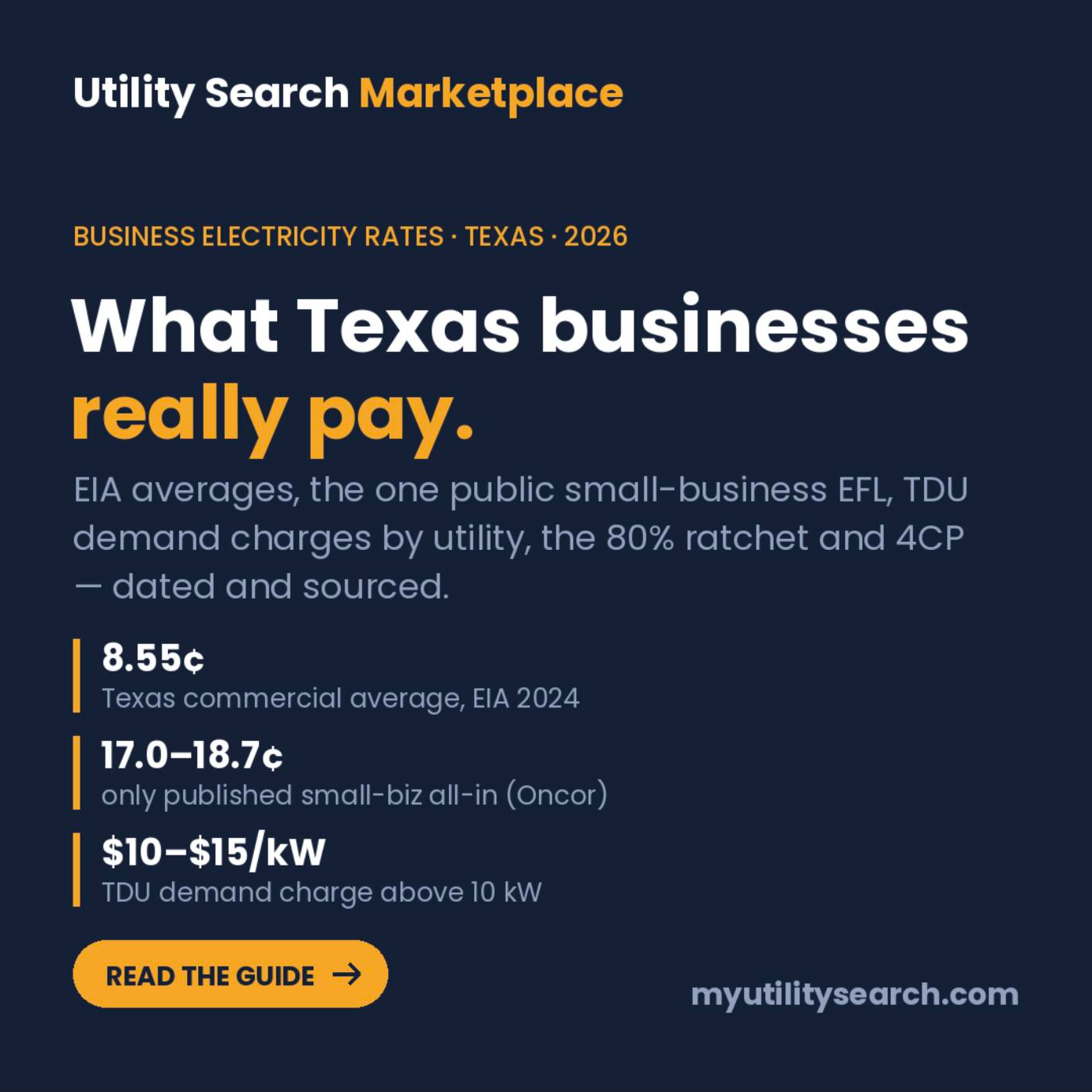
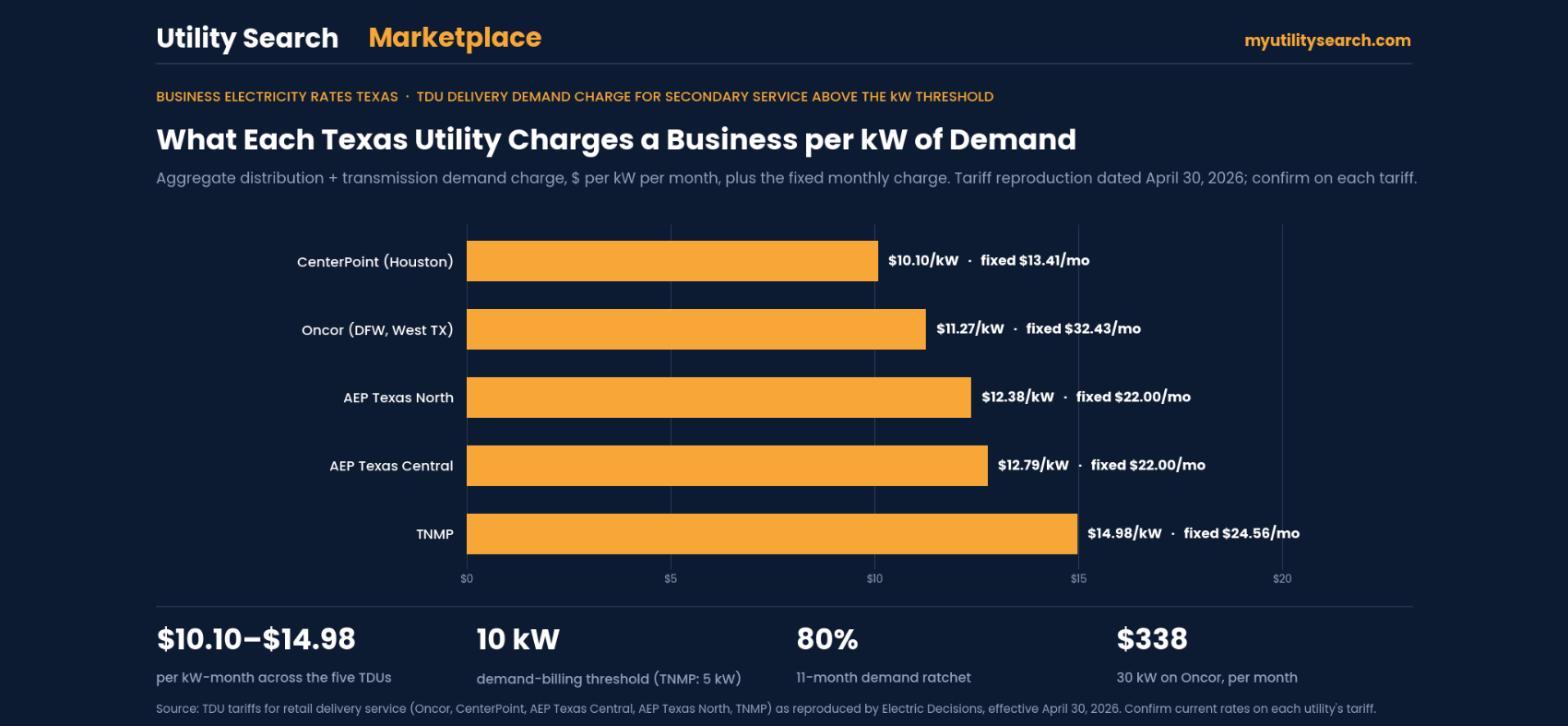
Above 50 kW, the price is set by your interval data: your peak demand in kW, your load factor, your delivery utility’s demand charge (Oncor’s is $11.27 per kW of billing demand for secondary service above 10 kW, on the tariff reproduced in our Texas commercial guide) and the term you choose. Two businesses with the same monthly kWh can get quotes 3¢ apart because one runs a flat overnight load and the other runs a peaky daytime one.
One legal point applies to both groups. House Bill 16, effective September 1, 2021, states that “an aggregator, a broker, or a retail electric provider may not offer a wholesale indexed product to a residential or small commercial customer,” a wholesale indexed product being one whose price “includes a direct pass-through of real-time settlement point prices.” That is the post-Uri ban on Griddy-style plans, and it means the “Variable” and “Indexed” plans still on Power to Choose Texas (15 of the 173 Oncor listings) are indexed to a published formula, not to the ERCOT real-time price.
For the commercial path, start with business electricity rates in Texas for the demand-charge math and the reform status of Project 58484, then business electricity providers for who actually writes commercial contracts and cheapest business electricity for the contract clauses that decide the price.
Business shopper? Power to Choose stops at 50 kW. We don’t.
Is Power to Choose Texas worth using in 2026?
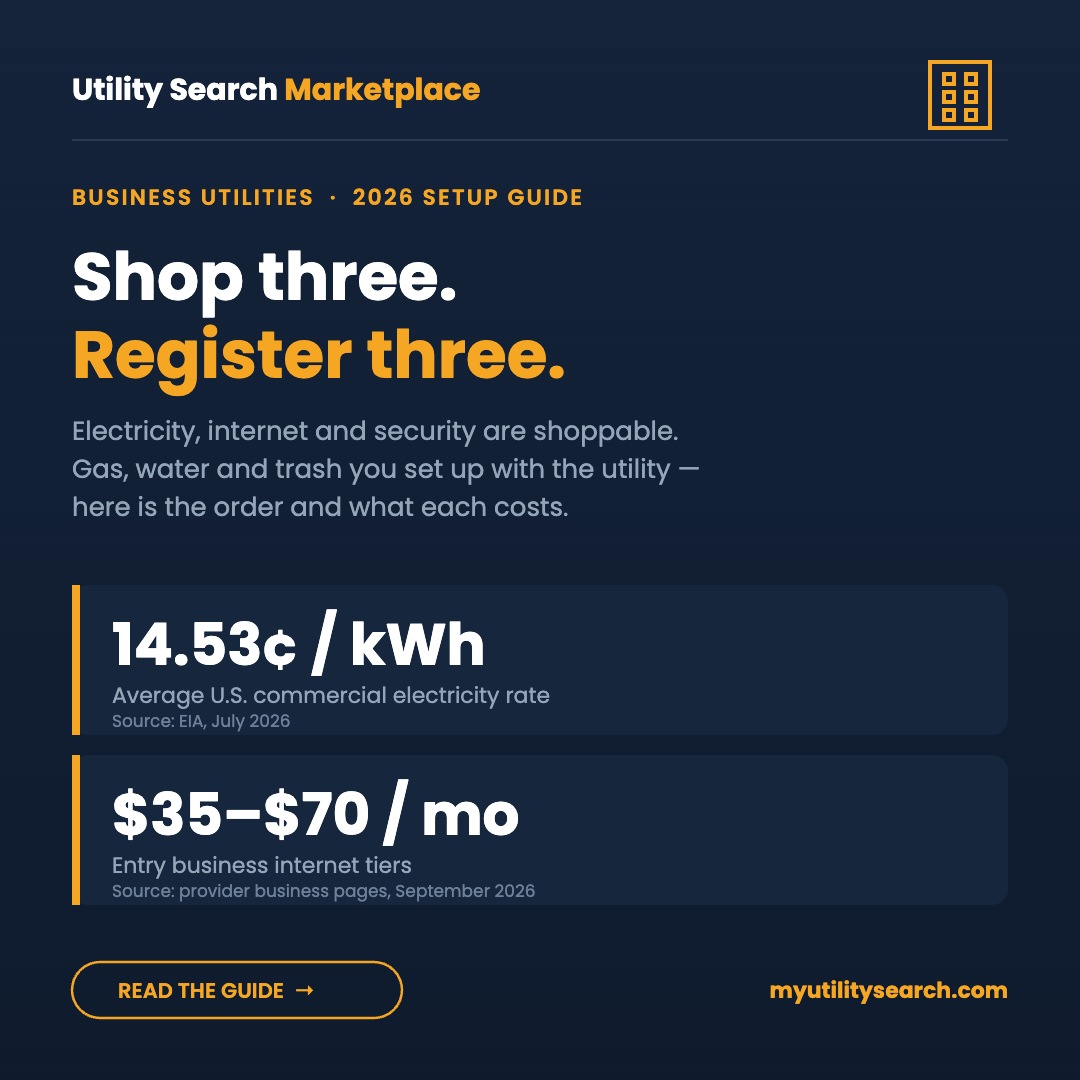
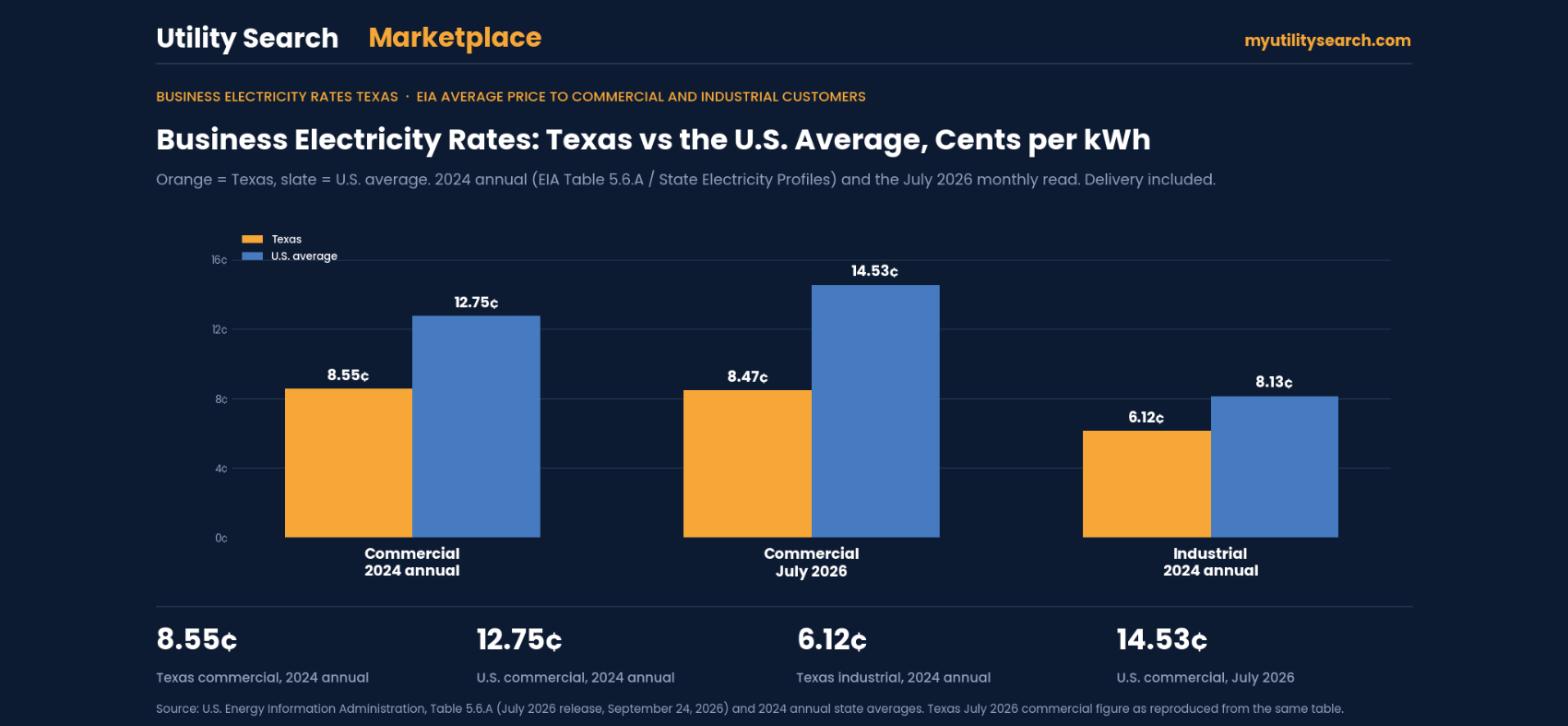
Yes, as the reference shelf. The residential market it lists is real competition: 46 providers, 1,895 offers, and a plain 12-month price in Oncor territory (11.4¢ at the cheapest, 12.6¢ at the median) that is well under the 14.53¢ U.S. average commercial rate the EIA reported for July 2026 and in line with the state’s 2024 residential average. The site’s weakness is presentation, not data. Apply the usage level and the no-gimmick filter, read the EFL at all three prices, and Power to Choose Texas is as good a starting point as exists. Then use an alternative for the things it cannot do: the usage-curve math, the renewal price, the multi-service move, and anything with a business meter on it.
Frequently asked questions
Is Power to Choose Texas legit?
Yes. Power to Choose Texas (powertochoose.org) is operated by the Public Utility Commission of Texas, the state regulator. It is free, it lists only certified retail electric providers, every plan links to its Electricity Facts Label, and the site’s own disclaimer says the PUCT does not endorse any third-party product. Look-alike sites with “power to choose” in the name are private comparison sites, not the PUCT.
Is the cheapest plan on Power to Choose Texas really the cheapest?
Usually not. The site sorts by the EFL average price at the usage level you select, 1,000 kWh by default. On September 29, 2026, seven of the ten cheapest Oncor-area plans were bill-credit plans that cost 17¢ to 20¢ per kWh at 500 kWh. The cheapest plain 12-month fixed plan was 11.4¢ at every usage level. Turn on the “plans without a minimum usage fee/credit” filter and the order changes.
Does Power to Choose Texas show business electricity rates?
No. Power to Choose Texas lists residential plans only. The PUCT’s business page describes commercial electricity as a negotiated purchase, and its glossary defines a small commercial customer as one under 50 kW of peak demand. Businesses get quotes from a provider, broker or aggregator based on their interval data; our Texas commercial guide explains the demand charges that set those quotes.
Why does Power to Choose Texas show three prices for every plan?
Texas rule 16 TAC §25.475 requires every Electricity Facts Label to state the average price at 500, 1,000 and 2,000 kWh a month, delivery included. A plan whose three prices are within about a cent of each other is a plain fixed plan. A plan that drops sharply at 1,000 kWh has a bill credit or tiered rate built around that number.
What is the best Power to Choose alternative?
It depends on what the PUCT site is missing for you. For the full residential shelf and the EFL, nothing beats Power to Choose Texas itself. For a move that involves electricity, internet and home security at once, or for a business location, MyUtilitySearch adds a single address search and a specialist. For a commercial contract above 50 kW, a PUCT-registered broker or aggregator is the path, because those prices are never listed anywhere.
Does MyUtilitySearch charge for comparing plans?
No. Comparing and enrolling is free to you; providers pay us when you sign up through the marketplace, which is the same model as every private comparison site. Power to Choose Texas is paid for by the state and lists providers we do not work with, which is why we recommend checking it alongside any marketplace, including ours.
Sources
- Public Utility Commission of Texas, Power to Choose offer export (powertochoose.org, “Export Offers”), downloaded September 29, 2026, 6:45 p.m. CT; results page for ZIP 75078 read the same day.
- Public Utility Commission of Texas, Power to Choose glossary (definitions of Electricity Facts Label, fixed, variable and indexed rate plans, and small commercial customer), read September 29, 2026.
- Public Utility Commission of Texas, Power to Choose “Business (Non-Residential)” resource page, read September 29, 2026.
- Texas Legislature Online, House Bill 16, 87th Regular Session (2021), enrolled text, effective September 1, 2021.
- 16 Texas Administrative Code §25.475 (customer protection rule requiring EFL disclosure at 500, 1,000 and 2,000 kWh).
- Oncor Electric Delivery residential tariff effective August 1, 2026 ($4.06 monthly customer charge, 6.0295¢ per kWh), as reproduced in our Midland electricity rates guide.
- U.S. Energy Information Administration, Electric Power Monthly, Table 5.6.A (July 2026 average commercial price, 14.53¢ U.S.).
Keep going
- Texas electricity rates: what a kWh costs by utility territory right now
- Cheapest electricity in Texas: the plain-plan shortlist
- How to read a Texas Electricity Facts Label line by line
- Business electricity rates Texas: demand charges, 4CP and the broker path
- Texas deregulated energy hub: choice ZIPs, utilities and providers
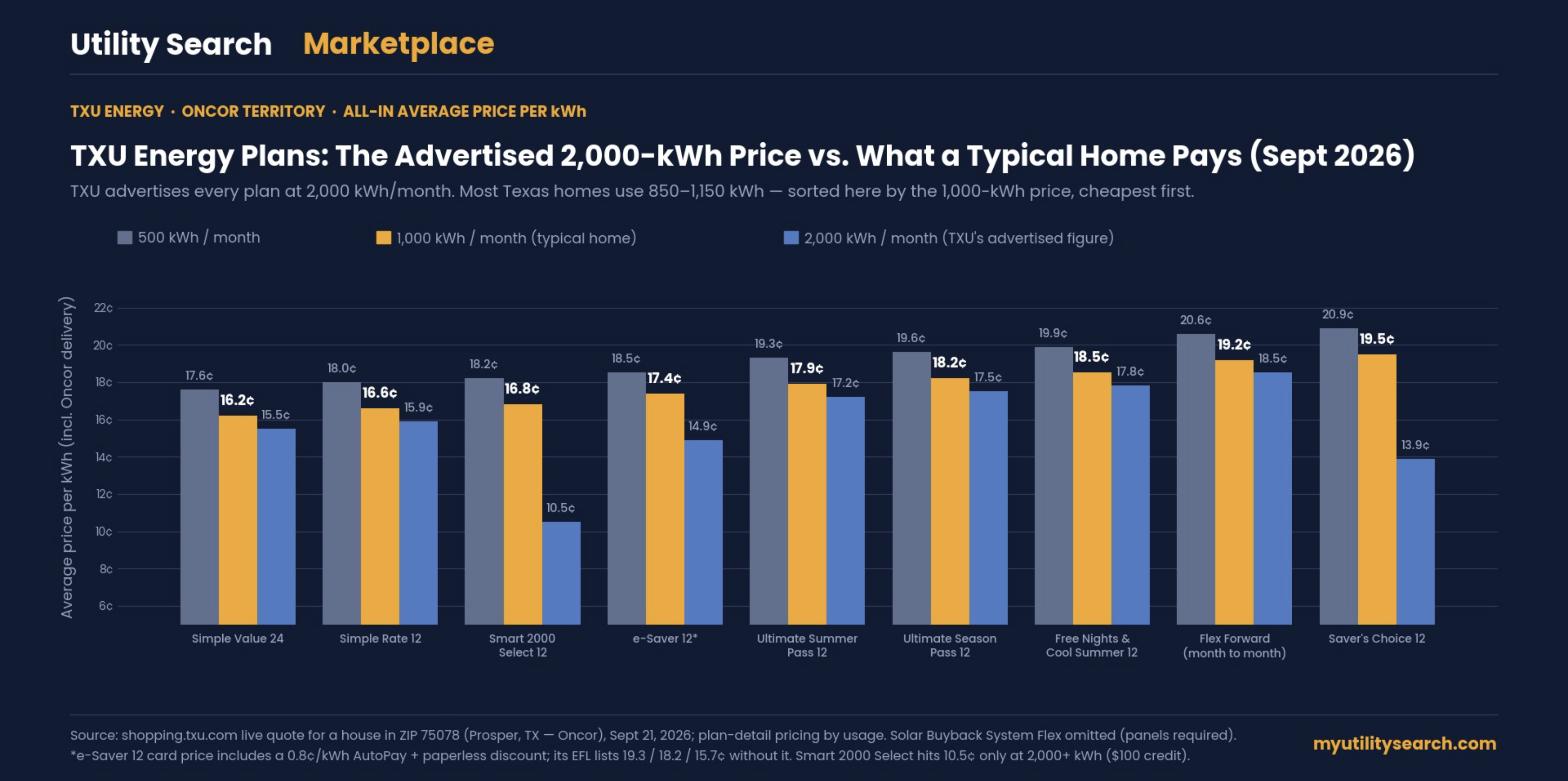
- TXU Energy plans read from the EFLs: which ones are plain and which ones dip at 1,000 kWh
- Why is my electric bill so high? The Texas checklist