Blog
New York Energy Costs Are Among the Highest in the Country — Here’s What You Can Do About It

Updated on September 20, 2026
9 min read
New York energy costs are among the highest in the continental U.S. in 2026: the statewide average all-in residential electricity price is 28.55¢/kWh (EIA, March 2026), driven largely by Con Edison’s downstate rates. Your utility still delivers the power and sets a default supply rate — but you can shop a licensed Energy Service Company (ESCO) against that rate and cut the supply portion of your bill.
Compare New York energy rates at your address →
The benchmark to compare against: New York’s major utilities are Con Edison (NYC/Westchester), PSEG Long Island, National Grid, NYSEG, RG&E, Central Hudson, and Orange & Rockland. The number that matters is your utility’s default supply rate — find it on the supply line of your bill. Compare any ESCO offer against it carefully: in New York, some ESCO plans have cost more than the utility default, so treat that supply rate as your benchmark, not the ESCO’s marketing price.
Last updated: September 20, 2026. Sources: U.S. EIA Electric Power Monthly (state average); New York Public Service Commission / utility default supply rates. Utility supply rates and ESCO offers change frequently and are verified against the primary sources linked in “Sources” below.
New York Energy Costs Are Among the Highest in the Country — Here’s What You Can Do About It
New York energy costs are consistently ranked among the highest in the United States. Con Edison customers in New York City, along with households in Long Island and upstate New York, regularly pay some of the nation’s steepest electricity rates. But here’s what most New Yorkers don’t know: New York has had a deregulated energy market since 1996, overseen by the New York Public Service Commission (PSC), which means you can shop for a lower supply rate from a licensed Energy Service Company (ESCO) right now — without switching utilities, changing equipment, or risking an outage.
Why Are New York Energy Costs So High?
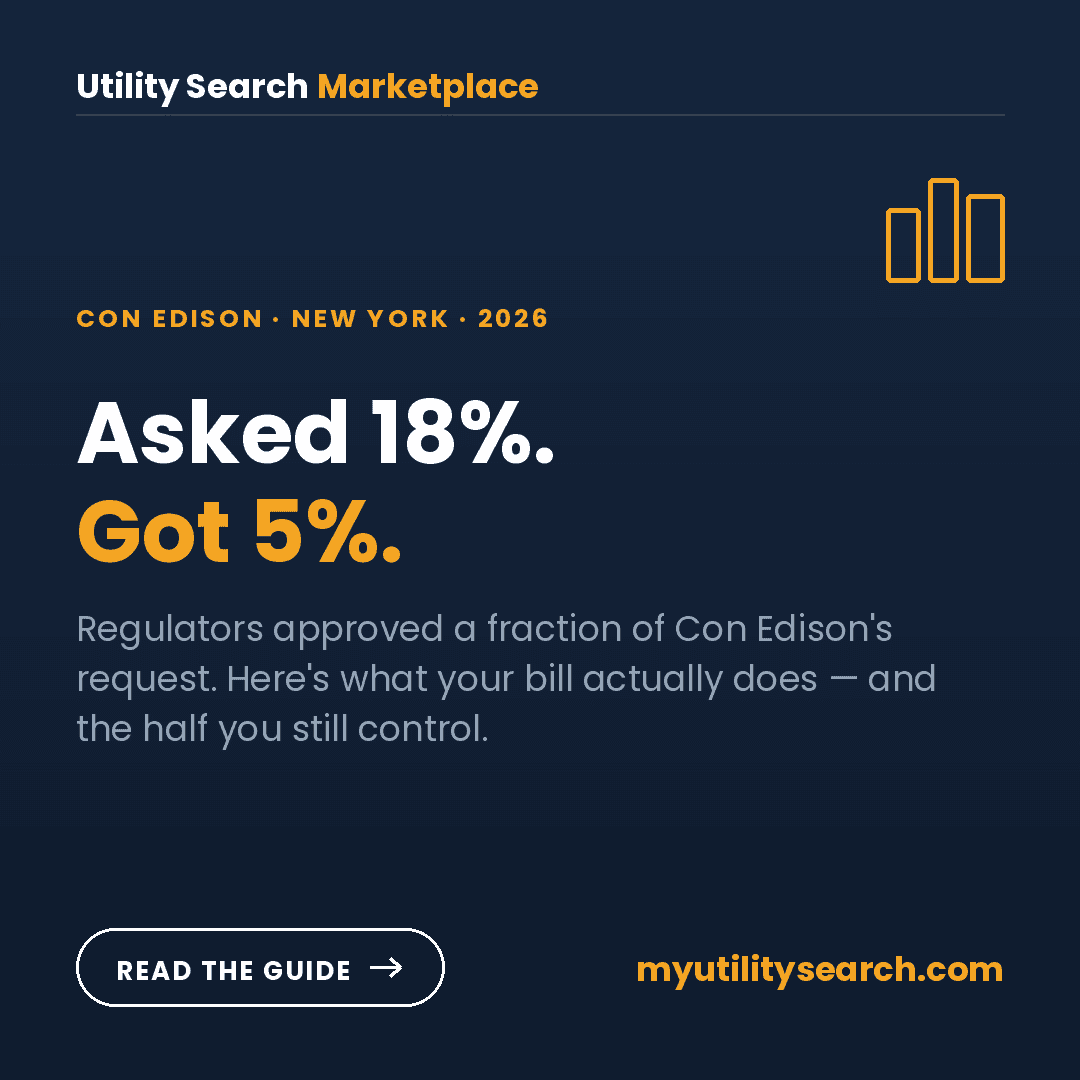
New York energy costs are driven by several factors: aging grid infrastructure, high transmission costs, and a complex regulatory environment layered across seven separate utility territories. Con Edison’s supply charges in New York City alone represent 40–60% of the average electric bill. For Long Island customers served by PSEG Long Island, the situation is similar. Meanwhile, National Grid and NYSEG customers in upstate New York face their own cost pressures, particularly during winter heating months when natural gas usage spikes. The result: the average New York household pays significantly more per kilowatt-hour than the national average. In some zones, the price gap between the highest- and lowest-cost utility territories runs $0.04–$0.08 per kWh — which translates to $60–$200+ per year in extra costs just because residents haven’t compared their options.
New York Energy Costs by Utility Territory (2026)
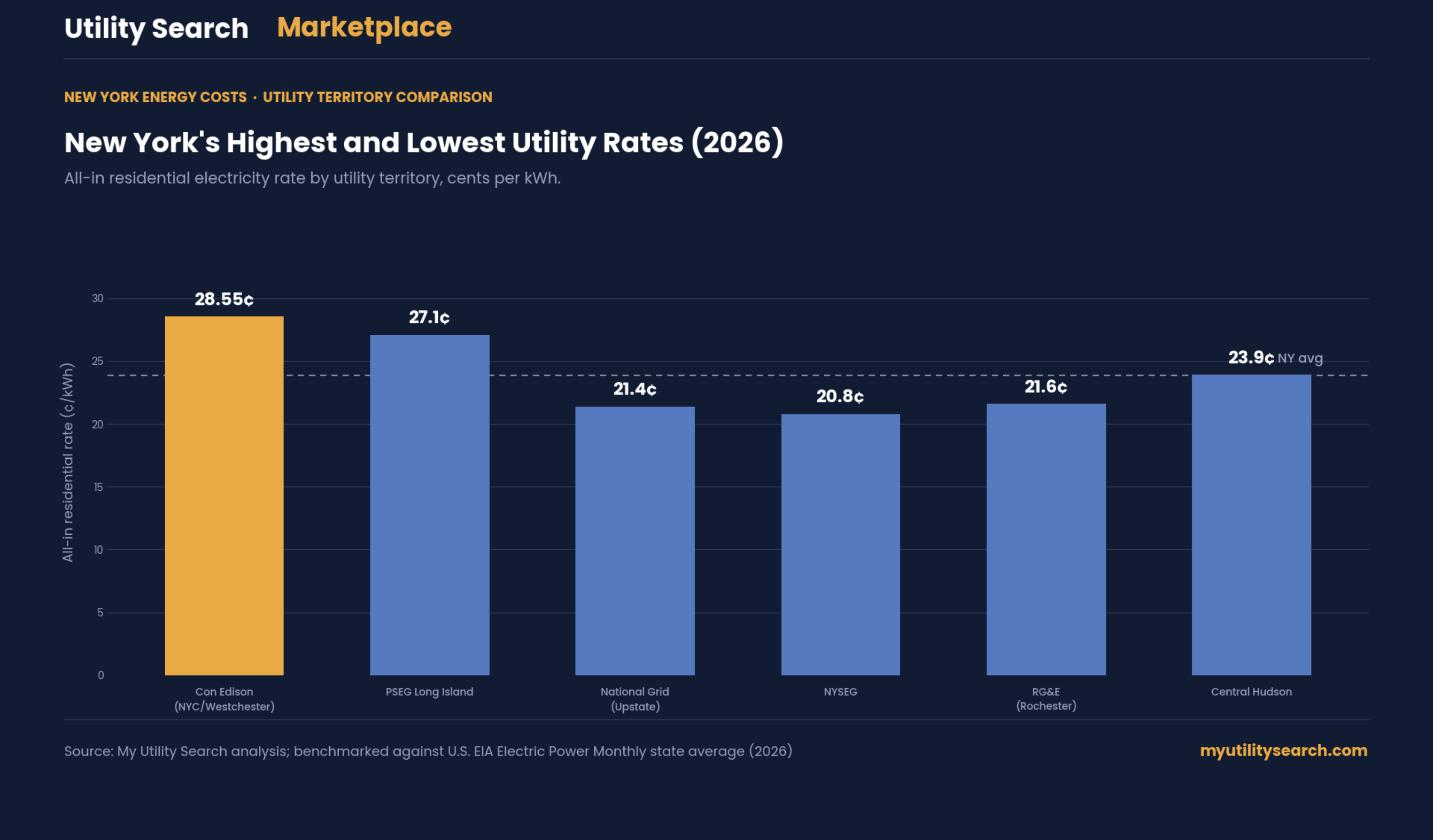
Not every New Yorker pays the same rate. New York energy costs vary by more than 35% depending on which utility delivers your power, which is why the first step in lowering your bill is knowing where your territory ranks. The chart below benchmarks all-in residential rates across New York’s six largest utility territories against the statewide average.
| Utility territory | All-in rate (¢/kWh) | vs. NY average | Typical ESCO savings potential* |
|---|---|---|---|
| Con Edison (NYC/Westchester) | 28.55¢ | +19% | $120–$200+/yr |
| PSEG Long Island | 27.10¢ | +13% | $100–$180/yr |
| Central Hudson | 23.90¢ | flat | $60–$120/yr |
| RG&E (Rochester) | 21.60¢ | -9% | $60–$100/yr |
| National Grid (Upstate) | 21.40¢ | -10% | $60–$100/yr, more on gas heat |
| NYSEG | 20.80¢ | -13% | $60–$90/yr |
*Estimated ESCO supply-rate savings vs. utility default supply, average household usage. Actual savings depend on your usage and the ESCO offers live in your territory — compare current rates before switching. Source: My Utility Search analysis, benchmarked against U.S. EIA Electric Power Monthly state average (2026).
The takeaway: if you’re a Con Edison or PSEG Long Island customer, you’re paying the state’s highest New York energy costs — and you also have the most to gain from comparing ESCO supply rates. Upstate customers on National Grid or NYSEG start from a lower baseline, but heating-season gas costs can still make switching worthwhile.
New York Energy Costs Compared to Neighboring States
New York energy costs don’t exist in a vacuum — cross-border comparisons help put them in perspective. New Jersey’s average all-in residential rate runs close to New York’s downstate average, while Pennsylvania and Connecticut post lower figures thanks to different generation mixes and delivery-charge structures. Massachusetts, another deregulated market bordering New England, tends to track closer to New York’s upstate rates than its downstate ones. The takeaway for shoppers: New York energy costs are high relative to the national average, but they’re not uniquely high among Northeast states — every one of these markets runs its own ESCO or supplier-choice program, and the same switching logic that lowers New York energy costs works the same way just across the state line.
Three factors specific to New York help explain why New York energy costs run higher than many neighboring states. First, capacity costs: New York City and Long Island sit inside their own constrained capacity zones, and NYISO’s capacity auctions price that scarcity directly into Con Edison’s and PSEG Long Island’s supply charges — a driver of New York energy costs that doesn’t show up the same way upstate or in most neighboring states. Second, the Regional Greenhouse Gas Initiative (RGGI) adds a carbon cost to fossil-generated power across the state, a charge New York shares with only a handful of other Northeast states. Third, New York’s transmission and distribution infrastructure is older on average than newer-build regions, and the cost of maintaining and upgrading it flows through to the delivery portion of every bill — the part an ESCO switch can’t touch, but one more reason the supply-side savings on New York energy costs matter as much as they do.
How Deregulation Works in New York
Deregulation splits your bill into two parts. Your utility still delivers your electricity and natural gas, and still handles outages and maintenance — that never changes, no matter who supplies your energy. The delivery charge stays the same regardless of which supplier you choose. But the supply charge — the biggest and most variable portion of your bill, and the main driver of New York energy costs — can be significantly reduced by switching to a competitive ESCO.
What is an ESCO? An Energy Service Company (ESCO) is a state-licensed supplier that sells electricity and/or natural gas supply in a deregulated market like New York. ESCOs compete on the supply rate only — your utility still owns the wires, delivers the power, and responds to outages.
How the Process Works
- Find your current rate: Look at your electricity bill and locate the “supply” charge listed in cents per kWh.
- Compare ESCOs: Use MyUtilitySearch to compare available ESCOs in your utility territory. Enter your zip code to see your options.
- Choose a fixed-rate plan: Fixed-rate plans protect you against seasonal price spikes, which are especially common in New York during summer cooling and winter heating peaks.
- Switch: Your utility handles the transition. There’s no service interruption and no need to install new equipment.
Compare internet, energy & home security at your address
What ESCOs Operate in New York?
New York has dozens of licensed ESCOs operating across its utility territories. Some of the most well-known include CleanChoice Energy (which offers 100% renewable plans), Verde Energy, and Constellation Energy. For natural gas, options like Direct Energy and US Gas & Electric are also available in many parts of the state. New York’s Public Service Commission maintains a list of all licensed ESCOs, and every ESCO must be licensed and follow state consumer-protection rules. When you compare ESCOs through MyUtilitySearch, you’re seeing only PSC-licensed suppliers — never an unlicensed reseller.
Savings Potential for New York Households
The savings from switching ESCOs depend on your current rate, your usage, and the available offers in your territory. Here’s a general breakdown of how New York energy costs translate into real household savings:
- NYC/Con Edison territory: Switching from Con Edison’s supply rate to a competitive ESCO can save $120–$200+ per year for average households — the largest single opportunity in the state.
- Long Island/PSEG territory: Long Island has some of the highest electricity prices in the state, making ESCO switching especially valuable here, typically $100–$180 per year.
- Upstate NY/National Grid or NYSEG: Natural gas customers in upstate New York can often find significant savings on their heating bills by switching gas suppliers, on top of $60–$100 per year in electric supply savings.
To put that in perspective: $150 a year in avoided New York energy costs is roughly a full month of the average household’s grocery bill, or 12 months of a mid-tier streaming bundle — money that’s currently going toward a supply rate you never had to accept as final.
Frequently Asked Questions About New York Energy Costs
Will switching ESCOs affect my power reliability?
No. Your utility (Con Edison, National Grid, PSEG, or NYSEG) still delivers your electricity and handles outages. Switching ESCOs only changes who provides your supply — your lights, appliances, and service stay exactly the same.
Are there risks to switching in New York?
The main risk is choosing a variable-rate ESCO plan, which can increase during high-demand periods. Always compare fixed-rate offers to avoid surprise increases. Every ESCO must disclose its rates and terms upfront under New York law.
How do I know if an ESCO is legitimate?
All ESCOs operating in New York must be licensed by the New York Public Service Commission. You can verify any ESCO’s license status through the PSC website. When you compare options at MyUtilitySearch, we only show PSC-licensed providers.
Is electricity deregulated in New York?
Yes. New York is deregulated, so you can choose a licensed Energy Service Company (ESCO) for the supply portion of your bill while Con Edison, National Grid, NYSEG, or another utility delivers the power and handles outages.
Does MyUtilitySearch charge a fee to compare New York energy rates?
No. Comparing ESCO and utility supply rates through MyUtilitySearch is free for New York households. We’re paid a referral fee by suppliers only if you choose to switch — never by you, and never before you compare.
Start Reducing Your New York Energy Costs Today
New York energy costs may be high — but you don’t have to pay more than necessary. By comparing ESCOs and switching to a fixed-rate plan, most New York households can save $60–$200+ per year on their electricity bill, and Con Edison and PSEG Long Island customers typically see the largest gains. Add natural gas savings and the total can be even higher. For more details on New York’s energy deregulation laws, visit the New York Department of Public Service.
Compare internet, energy & home security at your address
Sources
New York energy costs data on this page is verified against: U.S. EIA – New York Energy Profile · New York Department of Public Service · ENERGY STAR Home Energy Savings. Last updated September 20, 2026; utility supply rates and ESCO offers change frequently.
Shopping in a nearby state? See our guides to deregulated energy in Massachusetts and Connecticut.