Blog
Texas Electricity Rate Freeze: What Hinojosa’s Plan Can and Can’t Do for Your Bill

8 min read
By Chris Burg, Utility Search Marketplace · Last updated November 12, 2026
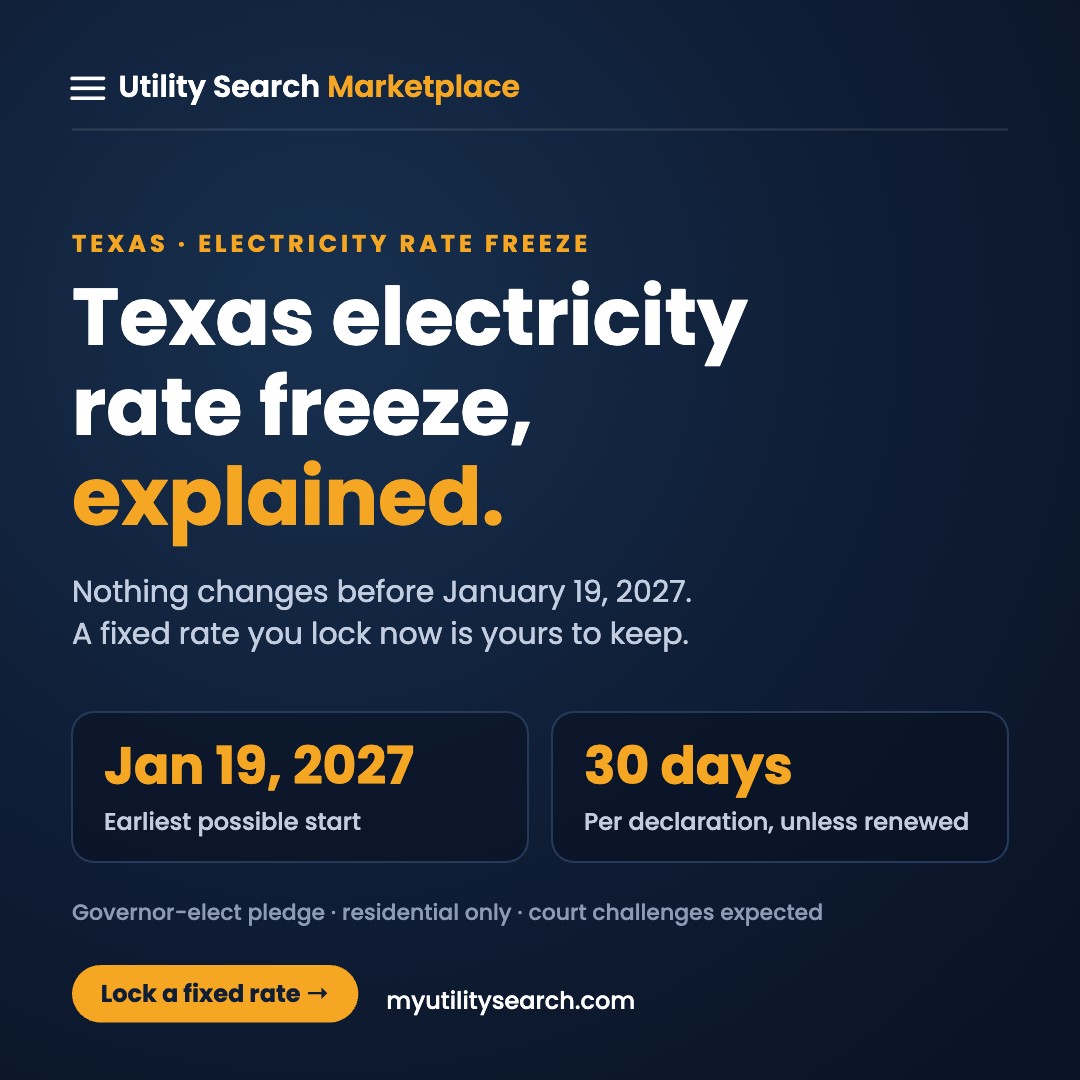
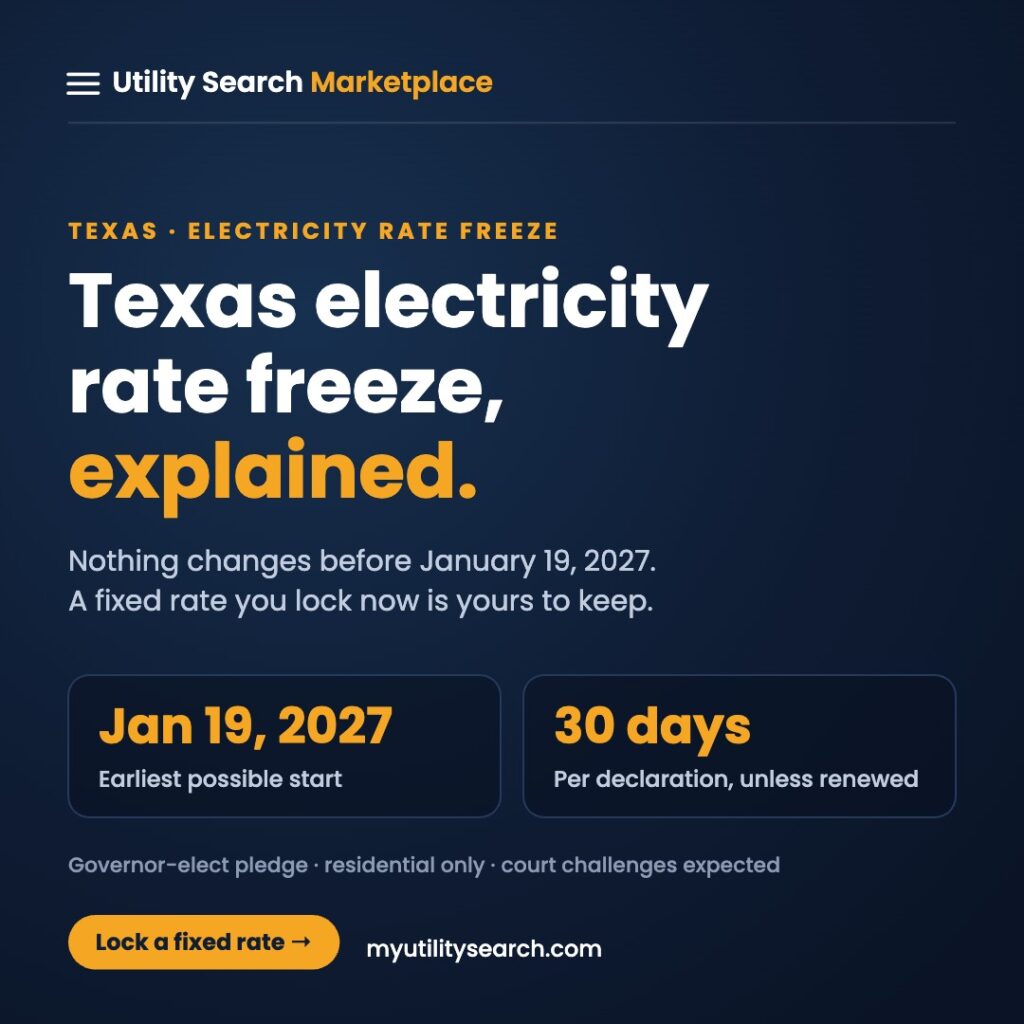
The Texas electricity rate freeze is a promise, not a policy yet. Governor-elect Gina Hinojosa says that on her first day in office, January 19, 2027, she will declare a “high-cost emergency” and freeze residential electricity rates. Until then nothing changes on your bill. Whether a freeze survives court challenges is an open question, but a fixed-rate plan you sign now is protection you control today.
Key takeaways: Texas electricity rate freeze
- Earliest start: January 19, 2027, inauguration day. Rates move normally until then.
- Legal tool: the Texas Disaster Act, which lets a governor suspend rules that hinder disaster response. High prices are not named as a disaster in the law.
- Time limit: a disaster declaration lasts 30 days unless the governor renews it.
- Scope: residential customers only. Business accounts are not in the pledge.
- Your move: a fixed-rate contract is governed by its own terms. Variable-rate customers carry the most risk between now and January.
What is the Texas electricity rate freeze?
The Texas electricity rate freeze is Gina Hinojosa’s campaign pledge to stop residential electricity rates from rising once she takes office. She won the November 3, 2026 governor’s race on an affordability platform. Her campaign said she would “freeze residential electricity rates and make corporations finally pay their fair share.”
Her campaign site frames it a second way. It says she would direct the Public Utility Commission of Texas (PUCT) to freeze residential rates until new laws make data centers and other large power users pay for the grid costs they create. The same emergency order would also suspend the state gas and diesel tax, according to EnergyChoiceMatters.
How would a Texas electricity rate freeze work legally?
The plan relies on the Texas Disaster Act, Chapter 418 of the Government Code. Under Section 418.016, a governor may suspend a regulatory statute or agency rule when strict compliance would “prevent, hinder, or delay necessary action in coping with a disaster.”
That is where the doubts start. The statute does not list high prices or an affordability crisis as a disaster. Texas also does not set most residential electricity prices. Since retail competition began on January 1, 2002, dozens of retail electric providers have set their own plan prices in the competitive market, and customers pick among them.
Nick Loris, president of C3 Solutions, told reporters that providers could challenge a declaration in court, and that courts may not accept high prices as a disaster (AOL / Morning Honey). Expect any Texas electricity rate freeze order to be tested by a lawsuit quickly.
Definition: TDU delivery charge
The part of a Texas electric bill paid to the wires company that owns the poles and lines in your area: Oncor, CenterPoint Energy, AEP Texas or TNMP. The PUCT sets these rates. Every retail provider passes them through unchanged, so they are the one piece of a competitive-market bill a state agency directly controls.
Because the PUCT sets delivery rates, they are the most plausible lever for a freeze. The commission could, in theory, hold off approving new delivery-rate increases. Reaching the energy charge that providers set on their own plans is a much harder legal question. Read more in our guide to Texas electricity delivery charges.
When could the Texas electricity rate freeze start, and how long could it last?
The Texas electricity rate freeze cannot start before January 19, 2027, the day Hinojosa is sworn in. Under Section 418.014, a state of disaster “may not continue for more than 30 days unless renewed by the governor.” She can keep renewing it every 30 days.
The same section says the Legislature “by law may terminate a state of disaster at any time.” A law needs both chambers and the governor’s signature, or a two-thirds veto override. After the 2026 election, the Texas Tribune reports Democrats control the Texas House and Republicans hold the Senate. That split makes a quick legislative shutdown of the order unlikely. A court ruling is the more realistic way it ends early.
Her stated end point is open-ended: the freeze lasts until lawmakers pass rules making large loads pay their own way. Data-center bills are already being filed for the session. They include proposals on data-center water disclosure and on tax incentives.
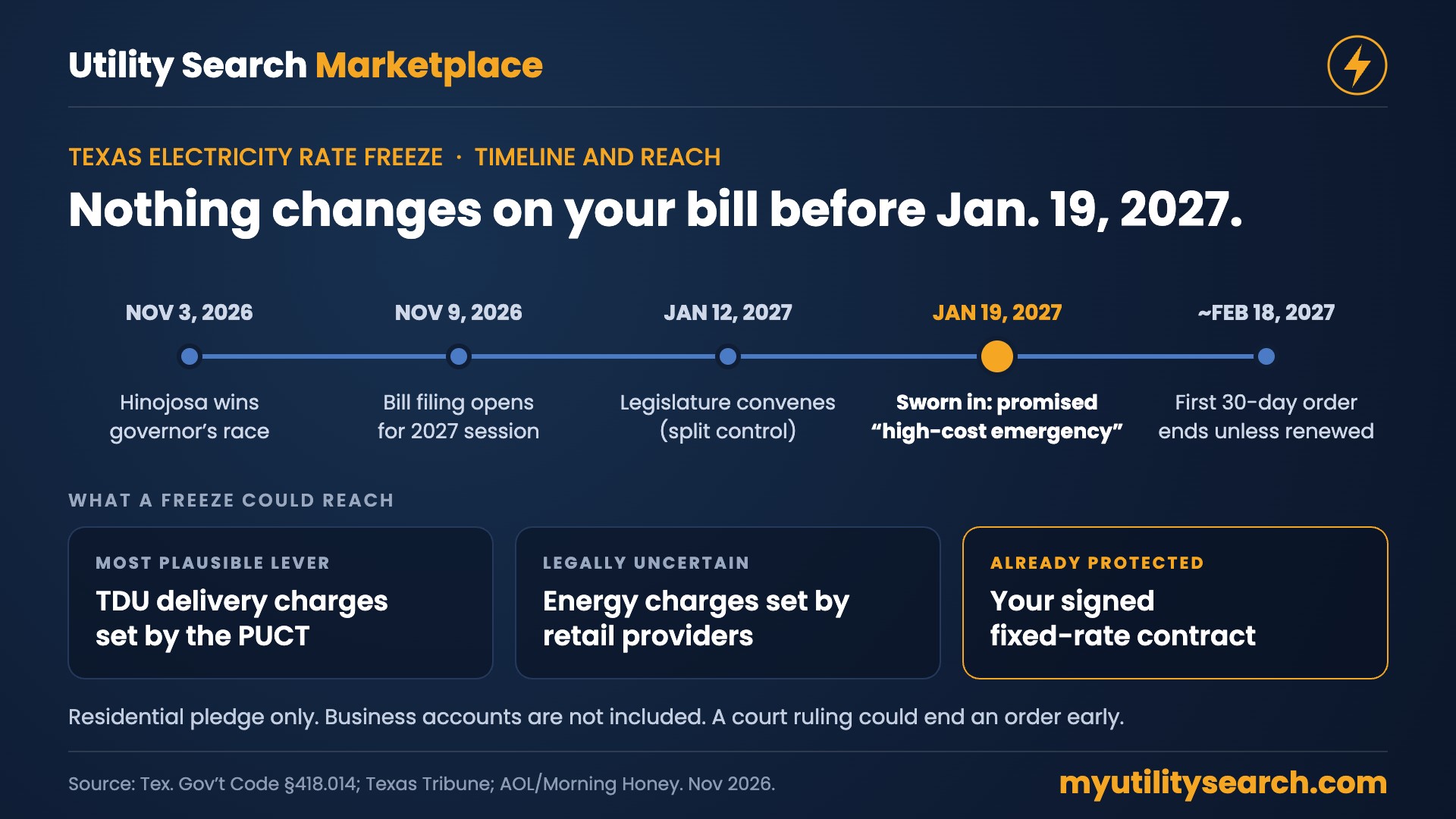
| Date | What happens | Effect on your bill |
|---|---|---|
| Nov 3, 2026 | Hinojosa wins the governor’s race | None |
| Nov 9, 2026 | Bill filing opens for the 90th Legislature | None |
| Jan 12, 2027 | Legislature convenes (Democratic House, Republican Senate) | None yet |
| Jan 19, 2027 | Inauguration; promised “high-cost emergency” order | Freeze could begin, if it holds up |
| About Feb 18, 2027 | First 30-day declaration would expire unless renewed | Depends on renewal and courts |
What would a Texas electricity rate freeze cover, and what can’t it reach?
A Texas electricity bill has several parts, and each is set by a different party. That matters because a freeze can only touch what the state controls.
| Part of your bill or plan | Who sets it | Could a freeze reach it? |
|---|---|---|
| TDU delivery charges | PUCT | Most plausible lever |
| Energy charge on a competitive plan | Your retail electric provider | Legally uncertain; likely challenged |
| Fixed-rate contract you already signed | Your contract terms | Already locked for the term |
| Variable-rate or month-to-month plan | Your provider, monthly | Uncertain; most exposed until January |
| Austin Energy, CPS Energy, co-ops | City council or co-op board | Outside the competitive market; set locally |
| Business and commercial accounts | Negotiated contracts | Not in the residential pledge |
Why is Hinojosa proposing a rate freeze?
Her angle is affordability, and her target is big power users. Her campaign says Texans pay about $40 more a month since Winter Storm Uri, and that Texas disconnects more households than any other state. Those are campaign figures, not independently verified data.
The bigger story is load growth. Data centers and industrial users are adding demand faster than the grid is expanding, and someone pays for the new lines and plants. Hinojosa wants that cost moved onto the large users. We break down that debate in how data centers affect electric bills.
Who benefits from a Texas electricity rate freeze, and what are the risks?
The case for it: households would get short-term relief on the charges the state controls. The pressure on lawmakers to make data centers fund their own grid costs is also real, and bills are already in motion.
The case against it: Travis Fisher of the Cato Institute calls it “a political Band-Aid.” His argument is that price controls do not make power cheaper to produce and can discourage investment in new power plants. Loris warns that providers who cannot recover their costs could come under financial pressure.
The PUCT itself may shift too. Its commissioners are appointed by the governor and confirmed by the Senate, and two seats come up on September 1, 2027. That gives the new governor influence over the commission later in 2027, with a Republican Senate holding the confirmation vote.
Compare internet, home warranty & home security at your address
What you control while the Texas electricity rate freeze plays out
You do not need to wait on the courts or the Capitol. A fixed-rate contract sets your energy charge for the full term, no matter what happens with the Texas electricity rate freeze. Here is a simple checklist:
- Find your contract end date on your Electricity Facts Label or latest bill. If you are past it, you are probably on a variable rate.
- Check your early termination fee. Texas rules generally bar that fee if you switch within 14 days of your contract’s end date.
- Compare fixed-rate plans at your address at your actual usage level (500, 1,000 and 2,000 kWh prices differ).
- Pick a term that clears the uncertainty. A 12- to 24-month fixed plan carries you past the 2027 legislative session.
New to switching? Start with how to switch electricity providers in Texas, or see the cheapest electricity in Texas right now.
Texas electricity rate freeze FAQ
Is there a Texas electricity rate freeze right now?
No. The Texas electricity rate freeze is a campaign promise from Governor-elect Gina Hinojosa. The earliest it could take effect is January 19, 2027, her inauguration day. Until then, rates and plans work exactly as they do today.
Can the governor of Texas legally freeze electricity rates?
It is disputed. Hinojosa plans to use the Texas Disaster Act, which lets a governor suspend rules that hinder disaster response. The law does not name high prices as a disaster, and most residential prices are set by competing retail providers, so a court challenge is likely.
How long could a Texas electricity rate freeze last?
A Texas disaster declaration lasts 30 days unless the governor renews it, and she can renew it repeatedly. The Legislature can end it by passing a law, and a court can block it. Her campaign says the freeze would last until laws make data centers pay their own grid costs.
Does the Texas electricity rate freeze apply to my fixed-rate plan?
A fixed-rate contract is governed by its own terms, so your energy charge is already locked for the term. Variable-rate and month-to-month customers have the most exposure before January, which is why many shoppers lock a fixed plan now.
Does the rate freeze cover businesses?
No. The pledge covers residential electricity rates only. Business and commercial accounts on negotiated contracts are not included.
Bottom line: the Texas electricity rate freeze may or may not survive January, but the rate on your next contract is a decision you can make today.
Compare internet, home warranty & home security at your address
Sources
- Texas Government Code §418.014: declaration of state of disaster
- Texas Government Code §418.016: suspension of laws and rules
- Public Utility Commission of Texas
- Texas Tribune: bill filing begins for the 90th Legislature (Nov 9, 2026)
- AOL / Morning Honey: legal questions over the rate freeze (Nov 11, 2026)
- EnergyChoiceMatters: Hinojosa wins on a rate-freeze pledge (Nov 4, 2026)
- Cato Institute: rate freeze could discourage new power plants (Nov 11, 2026)