





Blog
Best Internet for My Area: How to Find It by Address

Updated on October 1, 2026
5 min read
The best internet for your area depends on your exact address — availability changes block to block, so the only reliable way to know is to check the providers serviceable at your specific home. Most addresses have a mix of fiber, cable, 5G home, or satellite; entering your address reveals the real plans and prices you can actually order.
TL;DR — key takeaways
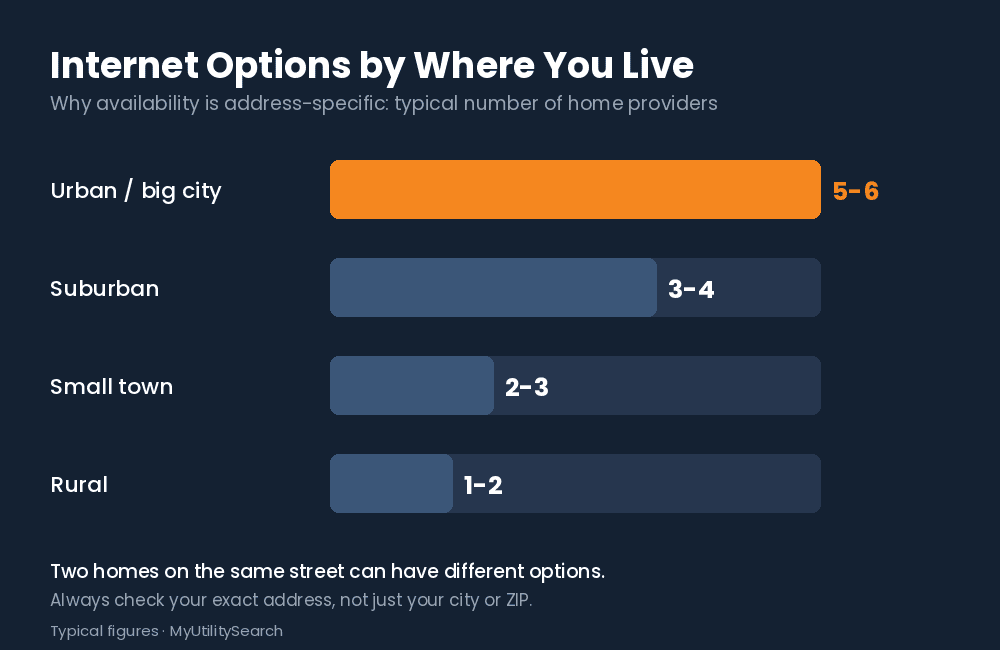
- Availability is address-specific — two homes on the same street can have different options.
- Check your exact address, not just your city or ZIP.
- Most areas have fiber, cable, 5G home, or satellite; fiber is best where offered.
- Use an address checker and the FCC map to confirm what is serviceable before you compare.
Who is my internet provider?
Your internet provider is the company on your monthly internet bill, and its name is usually printed on the modem or router it supplied. If you are asking which providers can serve your address, that is a different question, and the answer changes street by street.
- To find who you use now: check your bill or bank statement, look at the label on your modem or gateway, or log in to your Wi-Fi app. Free “what is my ISP” sites also read the provider from your connection.
- To find who can serve your address: search your full address on the FCC National Broadband Map, then compare live prices for the same address with our internet lookup.
- If your provider’s name changed: mergers have renamed many lines in 2026. Our guide to who serves my address after the fiber shake-up explains who owns what now.
How do I find the best internet in my area?
To find the best internet for your area, start with your exact address rather than your city. Enter it into a provider comparison tool to see which companies actually service your home, then compare their plans on speed, price, data caps, and contract. The FCC National Broadband Map shows coverage, and each provider’s site confirms serviceability at the door.
Why internet options are different at every address
How many providers should you actually expect?
We mapped the coverage footprints of the 19 largest wired internet providers across every ZIP code in the United States. The answer is smaller than most people assume: the median address has two, and just over a third of ZIP codes have only one.
| Wired providers at that ZIP code | ZIP codes | Share of the country |
|---|---|---|
| 1 provider | 10,014 | 35.1% |
| 2 providers | 11,192 | 39.2% |
| 3 providers | 5,380 | 18.8% |
| 4 providers | 1,556 | 5.4% |
| 5 or more | 423 | 1.5% |
That is why a national “best internet provider” list is close to useless for an individual household. In roughly 74% of ZIP codes you are choosing between one or two wired companies, not shopping an open market — and which two depends entirely on your street. Checking your own address is not a formality; it is the only step that produces a real answer.
Internet availability is decided by which networks have been physically built to your street. A fiber provider may serve one side of a block and not the other; cable footprints, 5G tower range, and rural coverage all vary house to house. That is why the best internet for your area can only be answered by checking your specific address, not a citywide list.
Internet options you will typically find
| Type | Typical speed | Where it is common | Best for |
|---|---|---|---|
| Fiber | 300 Mbps–5 Gig | Cities, newer suburbs | Best overall where available |
| Cable | 100 Mbps–2 Gig | Most suburban/urban areas | Wide availability, fast downloads |
| 5G home | ~100–300 Mbps | Near cell towers | No-wires alternative |
| Satellite | ~50–200 Mbps | Rural, anywhere | Where nothing wired reaches |
Once you know what is serviceable, compare the specific plans in our roundup of the best internet providers for 2026, or read our reviews of Verizon Fios, Frontier, Cox, and more.
How to compare the best internet for your area
After you see which providers reach your address, compare them on the things that matter: real speed (especially upload for remote work), price after any promo period, data caps, and whether a contract is required. Fiber usually wins where offered; where only cable is available, pick the tier that fits your household; and in rural areas, weigh 5G home internet against satellite.
Compare internet, energy & home security at your address
Frequently asked questions
How do I find internet providers in my area?
Enter your exact address into a comparison tool and the FCC National Broadband Map to see which providers service your home, then compare their plans on speed, price, and terms.
What internet is available at my address?
It depends on which networks are built to your street — commonly fiber, cable, 5G home, or satellite. Availability can differ from your neighbors, so always check the exact address.
Who has the best internet provider for my area?
The best internet for your area is usually fiber where it is offered; otherwise a wired cable plan, then 5G home or satellite in rural spots. The winner depends on what is serviceable at your home.
Why do my neighbors have internet I cannot get?
Because networks are built street by street. A provider may have wired one block or side of the street and not yet reached yours, so options vary by exact address.
How do I switch to a better provider in my area?
Confirm a better option is serviceable at your address, compare plans, then schedule the new install before canceling the old service to avoid a gap.



One thought on “Best Internet for My Area: How to Find It by Address”