Blog
Starlink News 2026: Every Price Increase, Outage, Launch and Filing — Dated

Updated on September 9, 2026
By Christopher Burg · Utility Search Marketplace · Last updated: 6 September 2026. This is the rolling Starlink news page: every price change, outage, launch, filing and competitor move gets a dated entry here the week it happens.
The most recent Starlink price increase took effect with billing cycles on or after June 18, 2026: Residential 100 went from $50 to $55, Residential 200 from $80 to $85, Residential MAX from $120 to $130, Roam Unlimited from $165 to $175, and Standby Mode doubled from $5 to $10. Since then SpaceX has reported its first quarterly earnings as a public company (August 4), a spent Falcon 9 stage has hit the Moon (August 5), and Amazon Leo has cleared the FCC hurdle that stood between it and a late-2026 launch. Every one of those events is logged below, newest first, with what it means for your bill.
TL;DR — Starlink news as of September 2026
- Prices: the June 18, 2026 Starlink price increase added $5–$10 a month to most U.S. plans. No further increase has been announced.
- Scale: about 12 million subscribers worldwide, roughly 2.7 million in the U.S., about 3.9% U.S. home-internet share — but the leader in rural and unserved areas.
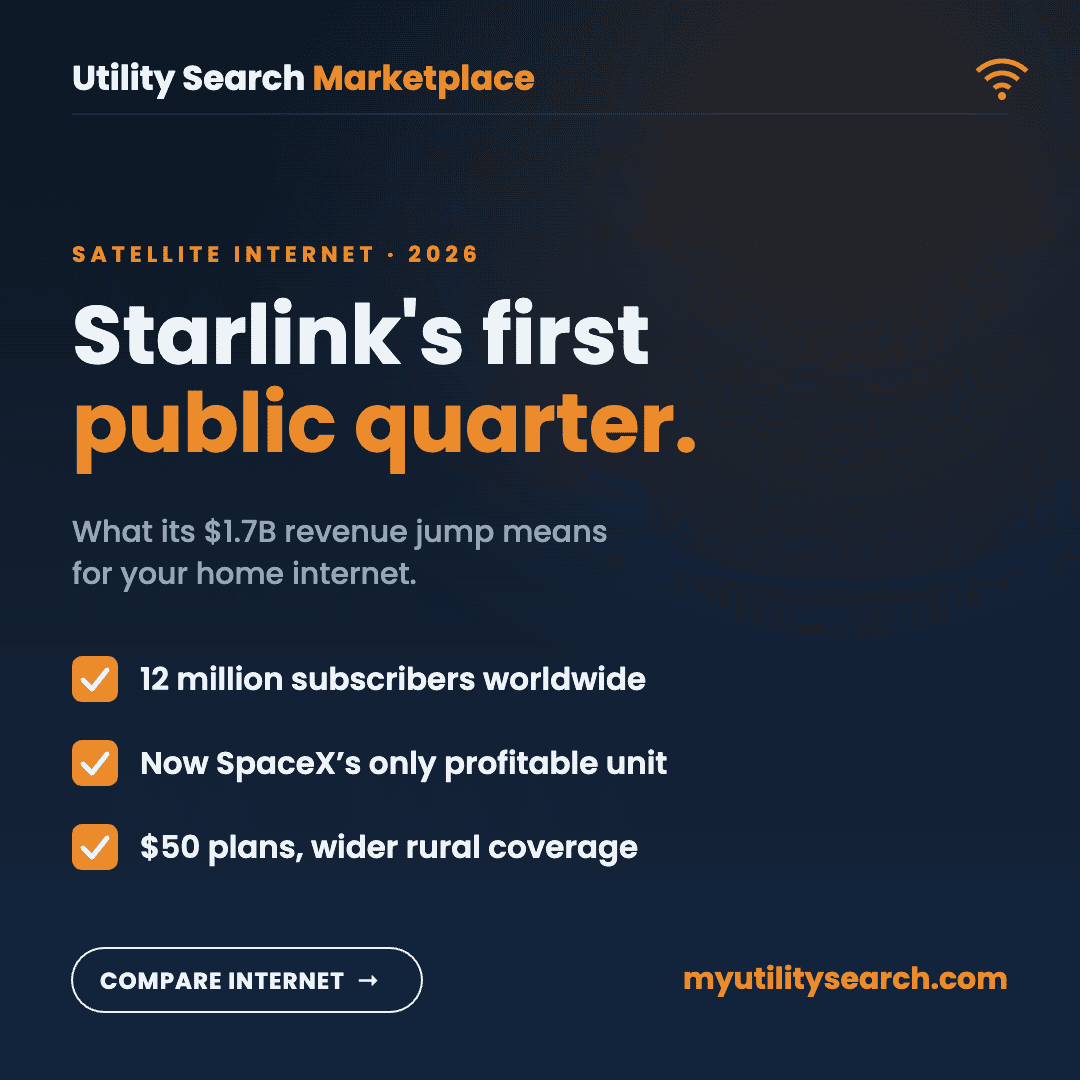
- Money: SpaceX’s first public quarter (Q2 2026) showed Starlink at $4.3 billion revenue and $1.66 billion profit, the company’s only profitable segment.
- Competition: Amazon Leo has ~400 satellites up, a waived FCC deadline, and says U.S. service starts later in 2026 — no price yet.
- Outages: no multi-hour national outage since the July 2025 event; check the Starlink app or status page before assuming a local problem is network-wide.
Starlink timeline 2026: every price increase, launch and filing, dated
Newest first, with each Starlink price increase in bold so you can scan for the ones that hit your bill. Every entry links to a primary source in the Sources section.
- September 2026 — Amazon Leo says commercial service starts “later this year.” ULA Vulcan launches begin carrying 45 Leo satellites per mission; the residential waitlist at leo.amazon.com stays open with no announced price. Full detail in our Amazon Leo pricing guide.
- August 5, 2026 — A discarded Falcon 9 upper stage hits the Moon. The stage struck near Einstein Crater at about 5,400 mph at roughly 2:35 a.m. EDT, carving a fresh crater. No risk to Earth, no effect on Starlink service — it was a spent rocket body, not a satellite. It made headlines because the same company runs the internet service on your roof; nothing changed for subscribers.
- August 4, 2026 — SpaceX reports its first earnings as a public company. Q2 2026 revenue rose 92% to $7.8 billion. Starlink’s connectivity segment delivered $4.3 billion of revenue and $1.66 billion of profit, the only profitable segment. Subscribers: about 12 million worldwide, ~2.7 million in the U.S.
- July 2, 2026 — Amazon Leo passes 375 satellites in orbit after an Atlas V launch and says it has enough capacity to begin service. Independent trackers count about 396 including test units, against Starlink’s 9,000+.
- June 18, 2026 — Starlink price increase takes effect. $5 more on Residential 100 and 200, $10 more on Residential MAX and Roam Unlimited, Standby Mode from $5 to $10. Notices went out by email and the rate card on starlink.com was updated the same week.
- June 11, 2026 — Arkansas signs the first state BEAD agreement with Amazon Leo — about 1,700 locations, $1.76 million in BEAD funds plus $580,000+ of Amazon match. Satellite providers took roughly a fifth of all BEAD locations nationally, with Starlink the largest satellite awardee.
- June 8, 2026 — FCC waives Amazon Leo’s July 30 half-constellation deadline, with spectrum-priority conditions through March 2028. Leo’s 2029 full-deployment deadline stands. This is the ruling that keeps a second LEO provider on the calendar.
- May 28, 2026 — Blue Origin’s New Glenn explodes during a hot-fire test at Cape Canaveral. No injuries, heavy pad damage. New Glenn is one of Amazon Leo’s launch vehicles, so the delay pushed part of Leo’s manifest to ULA and SpaceX rockets.
- Late May 2026 — SpaceX files publicly to go public. The IPO is the reason the Q2 numbers above exist; before it, Starlink subscriber and revenue figures were estimates.
Starlink price increase history: what each plan has cost
The June 2026 Starlink price increase was the fourth broad U.S. residential price move since launch. The pattern is a $5–$10 step roughly every 12–18 months, offset by cheaper hardware and by the new lower-priced tiers that arrived with the speed-based plan structure.
| Plan | Before June 18, 2026 | After June 18, 2026 | Change |
|---|---|---|---|
| Residential 100 | $50/mo | $55/mo | +$5 |
| Residential 200 | $80/mo | $85/mo | +$5 |
| Residential MAX | $120/mo | $130/mo | +$10 |
| Roam 100 GB | $55/mo | $55/mo | no change |
| Roam 300 GB | $80/mo | $80/mo | no change |
| Roam Unlimited | $165/mo | $175/mo | +$10 |
| Standby Mode | $5/mo | $10/mo | +$5 |
| Standard kit | $349 | $349 (free rental promos in low-demand areas) | no change |
For context, the original single Residential plan launched at $99 a month in 2021, rose to $110 in 2022 and $120 in 2023, and was then split into the 100/200/MAX tiers — so the MAX tier at $130 is the direct descendant of that original plan, while the $55 entry tier is cheaper than Starlink has ever been. The Starlink price increase hits hardest on Roam Unlimited and MAX, the two plans with priority data; the budget tiers were left alone.
What the first public quarter says about the next Starlink price increase
The August 4 earnings put hard numbers behind a strategy that was previously inferred. Starlink is trading price for reach: the $55 tier, free-rental kits in low-demand cells, direct-to-cell service through T-Mobile, and a new satellite generation with roughly ten times the capacity per satellite all point at grabbing more of the U.S. home-internet market, not maximizing revenue per subscriber. With about 3.9% U.S. share overall, Starlink is small next to cable and fiber, but in rural and unserved territory it is frequently the only broadband-speed option and has become the default choice — which is exactly where BEAD money is being spent. Expect the next Starlink price increase, when it comes, to land on priority tiers again rather than on the entry plan.
| Metric (Q2 2026) | Figure | Why it matters for your bill |
|---|---|---|
| SpaceX revenue | $7.8 billion (+92% YoY) | Launch revenue subsidizes constellation growth |
| Starlink revenue | $4.3 billion | Now the majority of SpaceX revenue |
| Starlink profit | $1.66 billion | Room to hold entry-tier prices while raising priority tiers |
| Subscribers | ~12 million worldwide, ~2.7 million U.S. | Congestion charges and deprioritization follow density |
| U.S. home-internet share | ~3.9% | Dominant only where cable and fiber are absent |
Compare internet, energy & home security at your address
What to do after a Starlink price increase
- Check which tier you are actually on. A Starlink price increase lands hardest on the tier you never chose. Many rural subscribers were moved to Residential MAX by default when the tiers launched. If the app shows you rarely exceed 100 Mbps, Residential 200 at $85 or Residential 100 at $55 (where offered) is the same service minus the priority flag — a $45–$75 monthly saving.
- Look at the alternatives that arrived since you signed up. Fixed wireless from T-Mobile and Verizon now reaches many addresses that were satellite-only in 2023, at $35–$60 with no dish. Fiber overbuilds funded by BEAD are lighting up rural counties through 2028.
- Use Standby Mode deliberately. The Standby Starlink price increase was the biggest in percentage terms — 100%. At $10 it is still the cheapest way to keep a dish active for a seasonal property, but it is no longer a rounding error — pause fully if the property sits empty for months.
- Watch Amazon Leo, but do not wait for it. Leo’s dish target (“under $400”) is parity with Starlink’s $349 kit, not a discount, and its monthly price is unannounced. The competitive effect on Starlink pricing is a 2027 story.
Is Starlink down? How to read an outage (and why it is not a Starlink price increase in disguise)
Most “Starlink outage” searches are local: obstructions, a rebooting router, or a congested cell at 8 p.m. A real network outage shows up three ways at once — the Starlink app reports “Disconnected” with no obstruction warning, the status page at starlink.com shows an incident, and outage trackers spike nationally within minutes. The last major one was the July 2025 event, about two and a half hours worldwide, traced by SpaceX to a core-network software failure. There has been no comparable outage in 2026 as of this update; when one happens, it will be logged in the timeline above with the cause SpaceX gives.
Starlink news FAQ
When was the last Starlink price increase?
June 18, 2026. Residential 100 rose from $50 to $55, Residential 200 from $80 to $85, Residential MAX from $120 to $130, Roam Unlimited from $165 to $175, and Standby Mode from $5 to $10. Roam 100 GB and 300 GB and the $349 Standard kit did not change.
Is another Starlink price increase coming in 2026?
None has been announced as of September 2026. Starlink’s pattern since 2021 has been a $5–$10 step every 12–18 months, concentrated on priority tiers, so the next move is unlikely before mid-2027 — and Amazon Leo’s launch gives Starlink a reason to hold entry-tier prices.
What is Starlink’s market share in 2026?
About 3.9% of U.S. home-internet subscriptions, roughly 2.7 million households, according to figures disclosed with SpaceX’s Q2 2026 earnings. In rural and unserved areas its share is far higher because it is often the only broadband-speed option.
How many Starlink subscribers are there?
About 12 million worldwide and roughly 2.7 million in the U.S. as of the August 4, 2026 earnings report — up from an estimated 5 million worldwide at the start of 2025.
Is Starlink profitable?
Yes. In Q2 2026 Starlink’s connectivity segment earned $1.66 billion on $4.3 billion of revenue and was SpaceX’s only profitable segment; SpaceX overall reported $7.8 billion in revenue, up 92% year over year.
Did the SpaceX moon crash affect Starlink service?
No. The August 5, 2026 impact was a spent Falcon 9 upper stage hitting the Moon near Einstein Crater — a discarded rocket body, not a Starlink satellite. No Starlink outage or service change resulted from it.
That is the state of Starlink as of September 2026: one Starlink price increase this year, a profitable first public quarter, no national outage, and a competitor arriving without a price tag. This page updates the week each of those changes.
Compare internet, energy & home security at your address
Sources
Every figure above can be checked against the primary document:
- Starlink — Residential plans and pricing — current rate card reflecting the June 18, 2026 Starlink price increase.
- SEC EDGAR — SpaceX filings — Q2 2026 results and IPO registration statements.
- GeekWire, “FCC gives Amazon Leo more leeway,” June 8, 2026 — waiver conditions and Leo satellite count.
- Broadband Breakfast, “Arkansas first state to execute BEAD agreement with Amazon Leo,” June 11, 2026 — locations, BEAD dollars, Amazon match.
- FCC National Broadband Map — check which fixed and satellite providers report service at your address.
Keep going
- Starlink internet plans and prices 2026 — the full post-increase rate card, every tier, kit and fee
- Best Starlink for RV — Roam plans, the Mini kit and in-motion rules
- Amazon Leo pricing — what the competitor has confirmed vs Starlink
- Starlink vs T-Mobile Home Internet — satellite against 5G fixed wireless
- Satellite direct-to-device explained — the T-Mobile T-Satellite and carrier fight
- Best internet for rural areas — every option that reaches unserved addresses