Blog
Why Is My AC Bill So High? How to Lower Your Summer Electric Bill (2026)


Updated on September 25, 2026
9 min read
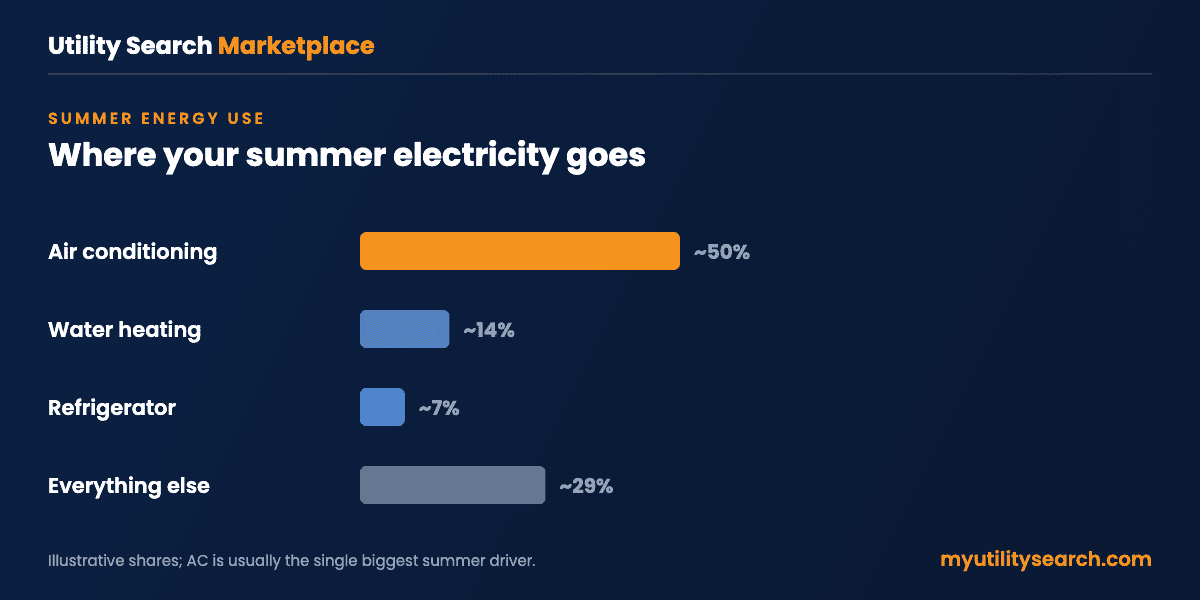
Why is my AC bill so high? In summer, air conditioning can account for roughly half of your home’s electricity use, so a hot month, a mid-year rate hike, or an inefficient system can push your AC bill sharply higher. In 2026, with the U.S. average electricity price at a record 19.8¢/kWh, the same cooling simply costs more than it did last year. The good news: most of a high AC bill is fixable.
TL;DR — why is my AC bill so high?
- Air conditioning is usually the single biggest driver of a summer electric bill — often 40–60% of use.
- An expensive AC bill stacks three causes: more heat, higher electricity rates (a record 19.8¢/kWh in 2026), and an inefficient system.
- Running central AC costs roughly $80–$210+ per month depending on climate, size, and efficiency.
- Yes — your AC bill is part of your electric bill; cooling is not billed separately.
- You can cut an AC bill 10–30% with thermostat, filter, sealing, and (in deregulated states) a locked fixed rate.
Why is my AC bill so high in 2026?
Your AC bill is high because three forces hit at the same time in summer. First, cooling demand spikes: every degree hotter outside makes your air conditioner run longer to hold the same indoor temperature. Second, electricity rates are at record highs — the U.S. city-average price reached 19.8¢/kWh in mid-2026, and many utilities reset supply rates upward heading into summer. Third, efficiency losses — a clogged filter, low refrigerant, leaky ducts, or an aging unit — quietly waste power. Put together, a single hot month can lift an AC bill by $50–$150 over a mild one.
What makes an AC bill spike in summer?
When an AC bill jumps, it is rarely one thing — it is a stack of small factors that each add kilowatt-hours. The most common culprits behind a high AC bill:
- Heat waves. Your air conditioner runs on a duty cycle; a 100°F day can double its run time versus an 85°F day, and that shows up directly on your AC bill.
- Thermostat set too low. Every degree below about 78°F can add roughly 3–5% to cooling cost. Setting 72°F instead of 78°F can raise an AC bill 20% or more.
- A dirty filter or coils. Restricted airflow forces the system to run longer for the same cooling — one of the cheapest fixes for a high AC bill.
- Leaky ducts and poor insulation. Cooled air escaping into an attic means the unit never catches up, so it never shuts off.
- An old or oversized unit. A 10–15+ year old air conditioner or a failing part can use far more power than a modern high-SEER model.
- A higher electricity rate. If your supply rate reset or a fixed-rate plan expired, the same usage costs more — inflating the AC bill even if your habits did not change.
How much does it cost to run AC per month?
A typical central air conditioner draws about 3–5 kilowatts and runs several hours a day in summer. At the 2026 average rate near 19–20¢/kWh, that puts most monthly AC bills in the ranges below.
| Cooling setup | Typical summer draw | Est. added to your monthly AC bill |
|---|---|---|
| Window / room AC unit | 0.5–1.5 kW | ~$25–$70 |
| Central AC (small home) | 2–3.5 kW | ~$80–$140 |
| Central AC (large / hot climate) | 3.5–5+ kW | ~$140–$210+ |
| Heat pump (efficient) | 1.5–3 kW | ~$60–$120 |
Stat: At 19.8¢/kWh, running a 3.5 kW central AC for 6 hours a day adds about $125 a month to your electric bill (3.5 kW × 6 h × 30 days × $0.198).
Is AC part of my electric bill? Yes. Home air conditioning runs on electricity, so your AC bill is not a separate charge — it is the summer spike inside your normal electric bill. That is why cooling costs rise and fall with both your usage and your per-kWh rate.
What is a normal summer electric bill?
There is no single “normal,” but context helps you judge whether your bill is out of line. The U.S. average residential electric bill runs roughly $130–$180 a month, and in peak cooling months households in hot states routinely see $200–$400. A useful rule of thumb: if your summer electric bill is more than about double your spring shoulder-season bill, cooling is the reason — and it is worth checking whether the jump came from usage, a higher rate, or an equipment problem.
Compare your current bill to the same month last year, not just last month: a year-over-year rise of 5–10% is mostly the rising rate, while a sudden 50+% jump points to a heat wave or a failing system. Tracking three numbers — the kWh you used, your rate per kWh, and your average daily temperature — explains almost every move in your AC bill.
How to lower your AC bill this summer
You cannot change the weather, but you can shrink almost every other line in your AC bill. These steps deliver the biggest savings for the least effort:
- Set the thermostat to 78°F when home, higher when away. This is the single biggest lever on an AC bill — each degree up saves roughly 3–5% on cooling.
- Run ceiling fans. Fans let you feel 4°F cooler at the same setting, so you can raise the thermostat and trim the AC bill without losing comfort.
- Change the air filter monthly in summer. A clean filter restores airflow and is the cheapest high-AC-bill fix there is.
- Seal leaks and add shade. Weatherstrip doors, close blinds on sun-facing windows, and seal duct gaps so cooled air stays inside.
- Use a smart or programmable thermostat. Automatically easing off cooling while you sleep or work can cut an AC bill 8–15%.
- Service the unit yearly. Clean coils and correct refrigerant keep an aging system from quietly inflating your AC bill.
- Lock a competitive electricity rate. In a deregulated state, shopping a fixed-rate plan protects the price side of your AC bill from summer rate spikes.
The first six steps attack how much electricity your cooling uses; the last one attacks how much each kilowatt-hour costs. Together they are how you get an AC bill back under control.
Can a bad capacitor or old unit cause a high AC bill?
Yes. A failing AC capacitor makes the compressor or fan motor work harder and draw more current, which can noticeably raise your AC bill before the unit fails outright — so a sudden, unexplained jump is worth a technician visit. Likewise, an old or oversized air conditioner short-cycles and runs inefficiently; replacing a 15-year-old unit with a high-SEER model can lower the cooling portion of your electric bill by 20–40%. If your AC bill spiked with no change in habits or weather, suspect a mechanical problem first.
Does locking a fixed-rate plan lower your AC bill?
Partly — it fixes the price side. Your AC bill has two levers: how many kilowatt-hours you use, and how much each one costs. Efficiency steps cut the usage; a fixed-rate electricity plan controls the price. In a deregulated state you can lock a set ¢/kWh for 6–36 months, so a mid-summer supply-rate spike does not land on your AC bill. It will not make your air conditioner draw less power, but it stops the rate from climbing under you during the hottest, highest-usage months — exactly when an unlocked rate hurts most. With electricity prices at record highs in 2026, locking before peak season is a low-risk way to cap the price half of your cooling costs.
How your state and home size change your AC bill
Two identical thermostats can produce very different bills. A large home in a hot, humid climate can run several times the cooling load of a small apartment in a mild one, and your state’s electricity rate multiplies the gap.
| Home & climate | Typical summer AC bill |
|---|---|
| Apartment / small condo, mild climate | ~$30–$70 |
| Mid-size home, moderate climate | ~$90–$150 |
| Large home, hot & humid (TX, FL, AZ, Southeast) | ~$180–$300+ |
| Any home in a high-rate state (HI, CA, New England) | Add ~30–70% vs. national average |
If you live in a deregulated, high-rate state like Texas, shopping your supply rate is one of the few ways to offset a naturally high cooling load. Check your Texas electricity rates or see which states let you switch suppliers.
When to call a pro about a high AC bill
Some causes are DIY; others signal a failing system. Call an HVAC technician if you notice a bill that doubled with no weather or rate change, an air conditioner that runs almost constantly, vents blowing warm or weak air, frequent short-cycling on and off, or loud clicking at startup (a classic weak-capacitor sign). Catching a refrigerant leak, failing capacitor, or dying compressor early keeps a nuisance from becoming an emergency replacement — and stops the unit from silently inflating your electric bill all season.
Why is my AC bill so high? FAQ
Why is my AC bill so high all of a sudden?
A sudden jump usually means a heat wave, a supply-rate increase, or a mechanical problem such as a clogged filter, low refrigerant, or a failing capacitor. If your usage and weather did not change, suspect the equipment or your rate first.
Is AC part of my electric bill?
Yes. Home air conditioning runs on electricity, so your AC bill is the summer spike inside your regular electric bill — it is not billed separately.
How much does it cost to run AC per month?
Most central-AC homes add about $80–$210 a month in summer at 2026 rates; a window unit adds roughly $25–$70. A 3.5 kW system run 6 hours a day costs about $125 a month at 19.8¢/kWh.
What temperature should I set my AC to save money?
78°F when you are home and higher when you are away; each degree above 78°F trims roughly 3–5% off the cooling part of your AC bill.
Can a bad AC capacitor cause a high electric bill?
Yes. A weak capacitor makes the motor draw more current and run inefficiently, raising your AC bill before the unit fails. A sudden unexplained spike is worth a technician visit.
Will a new AC unit lower my electric bill?
Often, yes. Replacing a 15-year-old air conditioner with a high-SEER model can cut the cooling portion of your electric bill by 20–40%, though the upfront cost means it pays off over several seasons.