
Blog
Is 5G Moving the North Pole? Myth vs. Real Science (2026)


Updated on October 1, 2026
9 min read
No — 5G is not moving the North Pole. Earth’s magnetic north pole really is drifting, and fast, but it is driven by molten iron churning in the planet’s core thousands of miles down — not by cell towers, 5G, or any human technology. The pole has wandered since scientists first pinned it down in 1831, long before radio existed. The claim that 5G is moving the North Pole mixes up two true headlines — a shifting pole and a new wireless standard — that have nothing to do with each other.
The short answer
- The magnetic north pole is moving toward Siberia — that part is real and well documented.
- The cause is Earth’s liquid-iron outer core (the “geodynamo”), not 5G, not HAARP, not satellites.
- 5G is low-power, non-ionizing radio. It cannot reach or influence the core that generates the magnetic field.
- Scientists have tracked the pole’s march since 1831 and formally update the World Magnetic Model to keep GPS and compasses accurate.
- 5G home internet operates within FCC safety limits and is considered safe by health regulators.
Is 5G moving the North Pole?
It is not. The idea that 5G is moving the North Pole is a myth built on coincidence: the magnetic pole’s recent speed-up and the global 5G rollout happened around the same time, so the two got linked online. But the magnetic north pole was already sprinting toward Russia years before 5G networks switched on, and it was moving steadily for nearly two centuries before that. Correlation in the headlines is not causation in the physics.
Why the magnetic north pole is actually moving
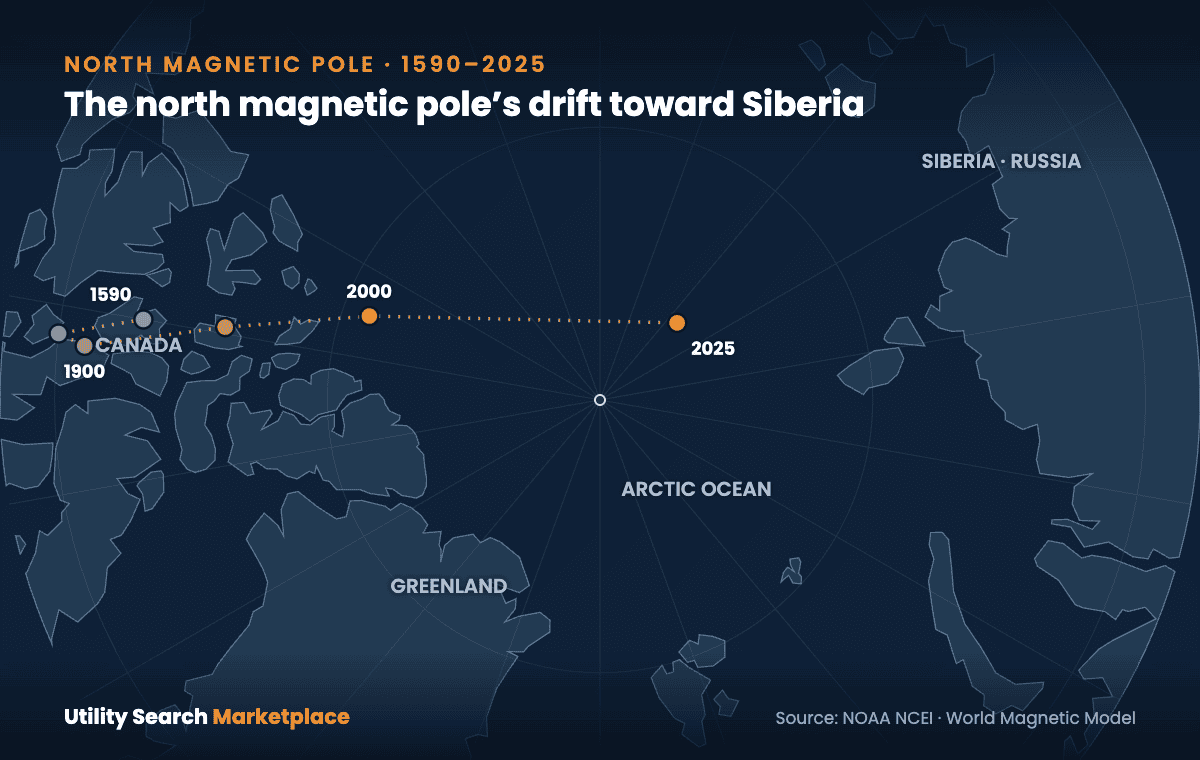
Earth’s magnetic field is generated deep inside the planet, where a vast ocean of liquid iron and nickel swirls around the solid inner core. That churning metal acts like a giant dynamo, and as the flow shifts, so does the magnetic field at the surface. Researchers believe two competing magnetic “lobes” — one under Canada and one under Siberia — have been in a tug-of-war, and the Siberian lobe is winning. That is why the north magnetic pole has been sliding off the Canadian Arctic and toward Russia.
The movement is not subtle. Through the 1900s the pole crept along at roughly 10 kilometers a year; by the 2000s it accelerated to around 50–55 kilometers a year, fast enough that scientists issued an early, out-of-cycle update to global navigation models. More recently the pace has eased somewhat. Because compasses, smartphones, aviation, and the military all rely on knowing where magnetic north is, NOAA’s National Centers for Environmental Information and the British Geological Survey jointly maintain the World Magnetic Model, which they revise on a regular schedule to track exactly where the pole has moved.
None of this is new science. Explorer James Clark Ross located the north magnetic pole in the Canadian Arctic in 1831, and researchers have re-measured its position ever since — first with expeditions and magnetic observatories, now with satellites like the European Space Agency’s Swarm mission. That long record is exactly why scientists can say with confidence that the pole’s motion is a natural, core-driven process that predates radio, television, satellites, and cellular networks by generations.
How NOAA actually tracks the moving pole
The pole’s position is not guessed — it is computed. NOAA’s National Centers for Environmental Information, together with the British Geological Survey, maintain the World Magnetic Model (WMM), the global model that GPS, phones, aviation, and the military rely on for magnetic north. It is updated on a five-year cycle (the current release is WMM2025) and validated annually.
There are actually two “north magnetic poles” scientists refer to. The dip pole is the spot where the magnetic field points straight down — the one explorers physically hunted for. James Clark Ross first located it in the Canadian Arctic in 1831, and Natural Resources Canada ran repeated surveys to re-fix it for decades. The geomagnetic pole is a smoother, model-based point derived from the WMM.
Both have been marching toward Siberia, and NOAA reports the north dip pole’s pace has actually slowed — from roughly 55 kilometers a year in the early 2000s to about 45 kilometers a year more recently. You can watch the entire 1590–2025 track on NOAA’s wandering geomagnetic poles viewer. None of it involves cell networks; all of it is measured magnetic-field data going back to explorers with compasses.
Is Earth’s magnetic field weakening?
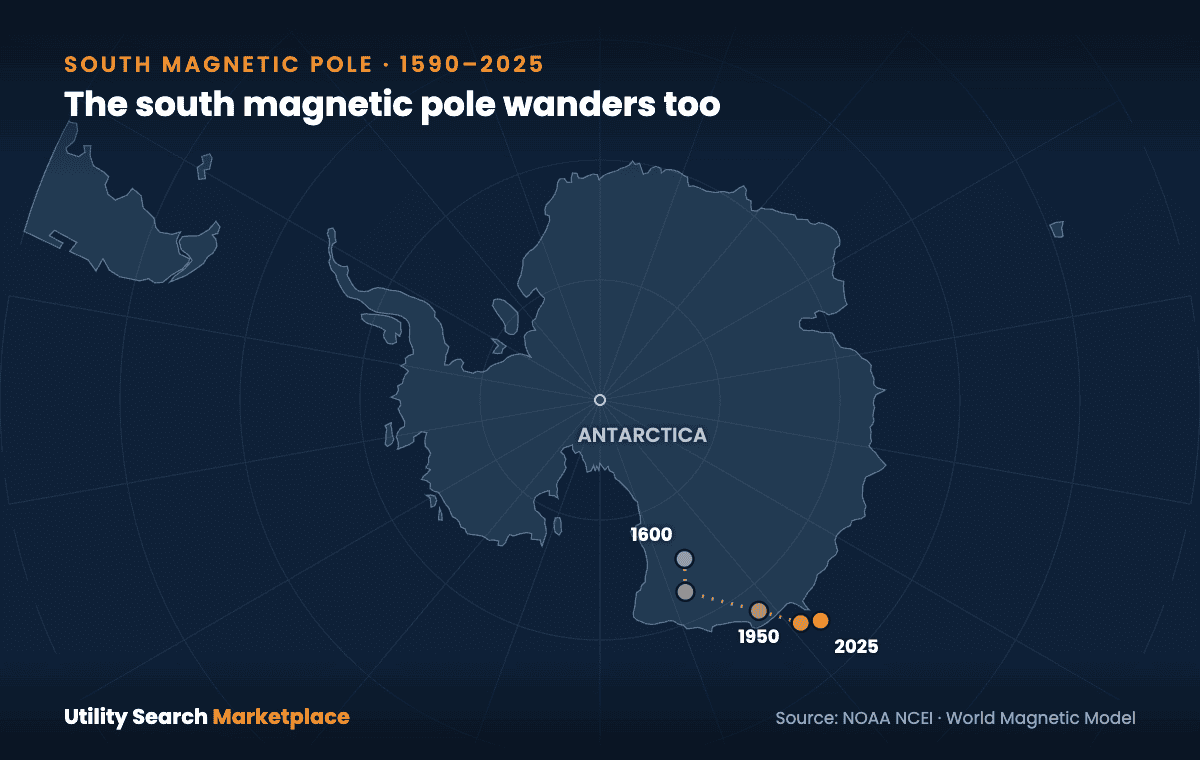
This is the part that fuels much of the online anxiety: yes, Earth’s overall magnetic field has been getting weaker — by roughly 9% over the past two centuries, according to satellite data from the European Space Agency’s Swarm mission. There is also a large, growing patch of especially weak field over the South Atlantic and South America, called the South Atlantic Anomaly, which satellites have to navigate carefully.
Does that mean a pole flip is coming? Not any time soon. Researchers — including teams at Germany’s GFZ and at ESA — have found no clear sign that the anomaly signals an imminent reversal, and full reversals unfold over thousands of years. The field is still more than strong enough to shield the planet.
The key point for this article: the weakening field, the drifting pole, and the South Atlantic Anomaly are all products of the same churning liquid-iron core. They are geophysics, not technology. No wireless standard — 5G included — adds or subtracts a single nanotesla from Earth’s magnetic field.
Could 5G — or any technology — actually move the pole?
No, and the reason is a matter of scale and physics. Earth’s magnetic field comes from processes happening more than 2,900 kilometers below the surface, involving flows of molten metal larger than entire continents. 5G signals are non-ionizing radio waves broadcast at low power from equipment on the ground; they travel a few hundred meters to a few kilometers and are absorbed by buildings, trees, and air. They do not penetrate the crust, let alone the mantle and core. Expecting a cell tower to steer the geodynamo is like expecting a flashlight to change the tides.
Where the 5G North Pole myth comes from
Myths like this thrive when two real, unrelated news stories overlap in time. The magnetic pole’s acceleration made headlines the same years carriers were plastering “5G” across their coverage maps. Add the general unease some people feel about a new, invisible technology, and it is easy to see how “the pole is moving” and “5G is everywhere” got stitched into a single false story. The antidote is the same as always: follow the measurements and the mechanism, both of which point squarely at Earth’s core.
Does the moving pole affect your phone or GPS?
For everyday life, barely at all — because the systems that need magnetic north already correct for the drift automatically. Your phone’s compass, aviation instruments, and marine navigation all pull from the World Magnetic Model, which is updated on a schedule (and occasionally early, as happened when the pole sped up). The most visible real-world effect has been at airports: because runways are numbered by their magnetic heading, a number of airports have had to repaint and renumber runways as magnetic north shifted. Beyond that, there is nothing you need to do — no setting to change, no device to replace.
It is also worth separating “the pole is moving” from the much rarer idea of a full magnetic reversal, where north and south swap places. Reversals have happened many times across Earth’s history, but they unfold over thousands of years, and the current drift is normal wandering — not a sign that a flip is imminent. Either way, the driver is the planet’s interior, operating on timescales and energy scales no ground-based technology comes close to.
So is 5G home internet safe?
Yes. If the North Pole scare made you wonder about 5G in your house, the reassuring news is that 5G home internet uses the same kind of licensed, non-ionizing radio that Wi-Fi and 4G have used for years, and it operates within exposure limits set by the Federal Communications Commission. Major health bodies have found no established harm at these everyday levels. What 5G can do is deliver fast, low-latency home internet — often a strong option where cable or fiber is limited. If you want to see whether 5G, fiber, or cable reaches your address, you can compare real providers and plans by ZIP in a couple of minutes.
It also helps to know what “5G” actually means for a home. 5G runs across low-band and mid-band frequencies (which carry farther and power most home internet) and, in dense areas, high-band millimeter wave (faster but short-range). All of it is non-ionizing radio, the same broad category as the Wi-Fi router already in your house. The FCC sets and enforces exposure limits for this equipment, and fixed 5G home internet gateways are designed to operate well within them. In practice, the bigger question for most households is not safety but availability — whether a strong 5G, fiber, or cable signal actually reaches your address.
Is 5G home internet actually any good?
Since the North Pole scare tends to lump all things “5G” together, it helps to separate fear from reality on the home-internet side. 5G home internet (fixed wireless) can be a genuinely competitive option — especially where cable is a local monopoly or fiber has not arrived. Typical 5G plans deliver download speeds in the low-to-mid hundreds of megabits per second, come with unlimited data and no annual contract, and install in minutes with a self-setup gateway. The trade-offs are real too: 5G speeds can vary with tower congestion and signal strength, and it is usually not the pick for heavy 4K-streaming-plus-gaming homes where fiber is available. The honest answer for most households: 5G home internet is safe, often cheaper than cable, and well worth a quick price check at your address.
Compare internet, energy & home security at your address
Shop InternetShop Energy RatesShop Home SecurityFrequently asked questions
Is the magnetic north pole really moving?
Yes. It has been tracked since 1831 and is currently drifting toward Siberia. Scientists update the World Magnetic Model on a set schedule so GPS and compasses stay accurate.
What is actually causing the pole to move?
Flows of molten iron in Earth’s outer core. A shifting balance between magnetic lobes under Canada and Siberia is pulling the pole toward Russia.
Can 5G or Wi-Fi affect Earth’s magnetic field?
No. These are low-power, non-ionizing radio signals that stay near the surface. They cannot reach or influence the core that generates the magnetic field.
Is Earth’s magnetic field about to flip?
Almost certainly not in our lifetimes. The field has weakened about 9% in two centuries and has a growing weak spot over the South Atlantic, but scientists find no clear evidence of an imminent reversal — a process that would take thousands of years to play out.
Is 5G home internet safe to use?
Yes. 5G home internet works within FCC exposure limits and uses the same non-ionizing radio as Wi-Fi and 4G, which health regulators consider safe at normal usage levels.
Compare internet, energy & home security at your address
Shop InternetShop Energy RatesShop Home SecurityKeep going
- Best internet providers: compare plans for 2026
- Best satellite & 5G internet for rural areas
- Internet choice in deregulated energy states
- Compare internet plans at your address
By the Utility Search Marketplace Team · Last updated August 7, 2026. Sources: NOAA National Centers for Environmental Information & British Geological Survey (World Magnetic Model); U.S. Federal Communications Commission RF-exposure guidelines.