Blog
Verizon 5G Home Internet: Plans, Real Prices and the Speeds Behind the “Up To” Numbers


Updated on September 9, 2026
Verizon 5G Home Internet costs $50, $60 or $75 a month with Auto Pay in September 2026, or $35, $45 and $60 if you also have a Verizon phone plan. The three tiers are 5G Home (up to 100 Mbps), 5G Home Plus (up to 150 Mbps) and 5G Home Ultimate (up to 300 Mbps). Every plan includes the Wi-Fi 6 gateway, unlimited data, no contract, and a price guarantee of three, four or five years. Below is the full plan table, what speeds people actually get, how it stacks up against T-Mobile and AT&T Internet Air, and who should skip it.
Last updated: 6 September 2026. Prices verified against verizon.com and refreshed monthly.
TL;DR — Verizon 5G Home Internet in September 2026
- Price: $50 / $60 / $75 a month with Auto Pay for 5G Home, Plus and Ultimate. Add $10 a month without Auto Pay. Subtract $15 with any Verizon mobile plan ($35 / $45 / $60).
- Speed: up to 100 / 150 / 300 Mbps download by Verizon’s own figures. Uploads run roughly 5–20 Mbps on the base plans, up to about 75 Mbps on Ultimate at a strong signal.
- Price guarantee: 3 / 4 / 5 years, no contract, no equipment fee, no data cap, 30-day money-back guarantee.
- Perks: $100 Amazon gift card on 5G Home and Plus, $200 on Ultimate, plus Whole-Home Wi-Fi with an extender on Ultimate. Online orders only.
- Best for: Verizon phone customers, renters, and anyone paying $80+ for cable. Not for: heavy uploaders, competitive gamers, or anyone with fiber at the address.
What are the Verizon 5G Home Internet plans and prices?
Verizon sells three fixed-wireless home plans on its 5G Ultra Wideband network. The names, prices and inclusions below are what verizon.com shows a new customer in September 2026. The “with mobile” column is the number most people see advertised — it requires any Verizon phone plan on the same account, not a premium one.
| Plan | With Auto Pay | With Verizon mobile | Without Auto Pay | Download (Verizon) | Price guarantee | Included |
|---|---|---|---|---|---|---|
| 5G Home | $50/mo | $35/mo | $60/mo | Up to 100 Mbps | 3 years | Wi-Fi 6 gateway, unlimited data, 1080p streaming, $100 Amazon gift card |
| 5G Home Plus | $60/mo | $45/mo | $70/mo | Up to 150 Mbps | 4 years | Everything in 5G Home, premium (non-deprioritized) data, $100 Amazon gift card |
| 5G Home Ultimate | $75/mo | $60/mo | $85/mo | Up to 300 Mbps | 5 years | Whole-Home Wi-Fi with one extender, free gateway upgrade after 3 years, 4K streaming, $200 Amazon gift card, $10/mo perk credit |
Two things are easy to miss in that table. First, the $15 mobile discount stacks with Auto Pay, so a Verizon phone customer on the base plan pays $35 all-in, which is the cheapest unlimited home internet most addresses can get from a national carrier. Second, the price guarantee length rises with the tier: the $75 Ultimate plan is locked for five years, which is longer than any cable promo and matches T-Mobile’s five-year pledge.
How fast is Verizon 5G Home Internet really?
Verizon’s own plan pages now quote a single “up to” number per tier — 100, 150 and 300 Mbps — rather than the wide 85–1,000 Mbps ranges it published in 2024 and 2025. The change makes the plans easier to compare but also sets a more honest ceiling. Independent testing and comparison sites still report typical results of roughly 50–85 Mbps on 5G Home and 88–250 Mbps on the Plus and Ultimate tiers, with uploads between 5 and 20 Mbps. Speeds depend on how far you are from the tower, whether your address is served by C-band or millimeter-wave spectrum, and how congested the cell is in the evening.
| Tier | Verizon’s stated download | Typical real-world download | Typical upload | Good for |
|---|---|---|---|---|
| 5G Home | Up to 100 Mbps | 50–85 Mbps | 5–10 Mbps | 1–3 people, HD streaming, remote work on one or two devices |
| 5G Home Plus | Up to 150 Mbps | 88–250 Mbps | 10–20 Mbps | 2–5 people, 4K streaming, several video calls at once |
| 5G Home Ultimate | Up to 300 Mbps | 88–300 Mbps | 10–35 Mbps (up to ~75 Mbps at strong signal) | Large households, smart-home gear, whole-home coverage |
The practical rule: if Verizon’s address check shows your home is eligible for Ultimate, the signal is strong enough that even the $50 base plan will likely beat its “up to 100 Mbps” label most of the day. If the checker only offers 5G Home, expect the lower end of the range and test it inside the 30-day window before cancelling cable.
What is the difference between 5G Home, Plus and Ultimate?
The three Verizon 5G Home Internet tiers share the same gateway and the same network. What you pay extra for is priority, coverage hardware and perks, not a different radio.
- Data priority. 5G Home uses standard data that can be slowed behind mobile customers when a cell is busy. Plus and Ultimate carry “premium” data, which is why their evening speeds hold up better even though the ceiling is only 50 Mbps higher on paper.
- Wi-Fi coverage. Ultimate ships with Whole-Home Wi-Fi, meaning a mesh extender in the box and a free gateway replacement after three years. On the lower plans you supply your own extender if the single gateway does not reach every room.
- Perks. All three plans get an Amazon gift card for online orders ($100 or $200). Ultimate adds a $10-a-month perk credit toward a streaming service and, for the 2026 season, NFL Sunday Ticket from YouTube.
- Price guarantee. Three, four and five years respectively. Verizon can still change taxes and surcharges, but the plan price itself is frozen.
For most households the sweet spot is 5G Home Plus at $60 ($45 with mobile): premium data for $10 more than the base plan is the single upgrade that changes day-to-day performance. Ultimate is worth it only if you need the extender or you will actually use the $10 streaming credit, which brings its effective price down to $65.
Compare internet, energy & home security at your address
Verizon 5G Home Internet vs T-Mobile vs AT&T Internet Air
All three national carriers now sell fixed wireless at almost the same price points, so the decision usually comes down to which carrier has the strongest signal at your address and which phone plan you already pay for. Here is how the September 2026 rate cards line up.

| Provider & plan | Price (Auto Pay) | With carrier phone plan | Speed (provider figure) | Price guarantee |
|---|---|---|---|---|
| Verizon 5G Home | $50 | $35 | Up to 100 Mbps | 3 years |
| Verizon 5G Home Plus | $60 | $45 | Up to 150 Mbps | 4 years |
| Verizon 5G Home Ultimate | $75 | $60 | Up to 300 Mbps | 5 years |
| T-Mobile Rely | $50 | $35 | 170–354 Mbps | 5 years |
| T-Mobile Amplified | $60 | $45 | 170–498 Mbps | 5 years |
| T-Mobile All-In | $70 | $55 | 170–498 Mbps | 5 years |
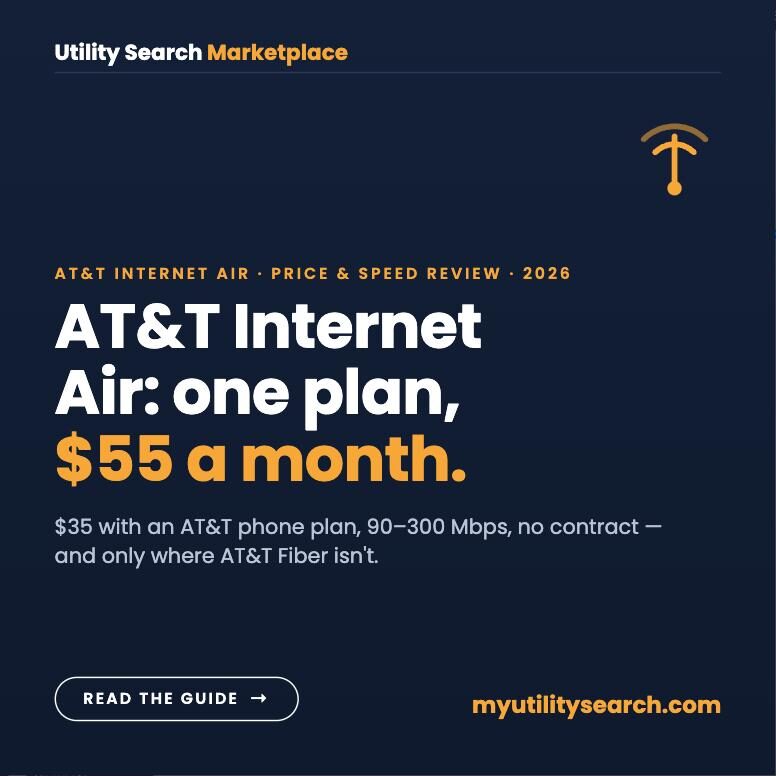
| AT&T Internet Air | $55 | $35 | 90–300 Mbps | 12 months |
On paper T-Mobile quotes higher speed ranges for the same money, and its five-year guarantee applies to every tier rather than only the top one. Verizon’s edge is in the hardware and the mobile discount: the Ultimate plan’s included extender and gateway refresh are things T-Mobile charges for, and Verizon’s $15 phone-plan discount applies to any mobile line while T-Mobile’s requires a voice line on a current plan. AT&T Internet Air is the simplest — one plan, $55 a month or $35 with an AT&T wireless plan — but its price lock runs only 12 months and taxes are extra. Our best 5G home internet comparison walks through the signal-check step that matters more than any of these numbers.
Is Verizon 5G Home Internet worth it?
Yes for four kinds of households, and no for three. It is worth it if you already have a Verizon phone, because $35 a month for unlimited, tax-inclusive internet with a three-year lock undercuts every cable and fiber introductory rate we track. It is worth it if you rent or move often, since the gateway is plug-and-play and there is no installation appointment or early-termination fee. It is worth it if your cable bill has crept past $80 after the promo expired, and it is worth it in suburbs and small cities where the only wired option is DSL or a single cable company.
Skip it if fiber is available at your address — Verizon’s own Fios 300 plan is $30 with mobile and symmetrical, and every other fiber provider beats fixed wireless on upload speed and latency. Skip it if you upload large files or stream on Twitch, because 5–20 Mbps uploads are the weakest part of the service. And skip it if you play competitive online games where latency of 30–60 ms, which is typical for 5G fixed wireless, would be noticeable against cable’s 15–25 ms.
How do you check Verizon 5G Home Internet availability?
Availability is decided address by address, not by ZIP code, because Verizon only sells the service where its model says the cell has spare capacity. Verizon says the service reaches more than 900 cities, but two houses on the same street can get different answers. Enter your full address in our internet comparison tool to see Verizon 5G Home Internet alongside every cable, fiber and satellite provider that serves the address, then run Verizon’s own eligibility check to confirm which of the three tiers it will sell you. If the checker offers only 5G Home, your signal is at the margin; if it offers Ultimate, it is strong.
Where 5G Home is not available, Verizon usually offers Home Internet Lite (formerly LTE Home Internet) at $35 a month with a mobile plan. It runs on 4G LTE at up to 25 Mbps down and 6 Mbps up, with a 150 GB or 200 GB monthly allowance before speeds drop to about 10 Mbps. It is a rural stopgap, and our rural internet guide compares it against Starlink and cable where those exist.
What equipment comes with Verizon 5G Home Internet?
Every plan ships with the Verizon Internet Gateway, a combined 5G receiver and Wi-Fi 6 router that plugs into a wall outlet — there is no coax, no phone line and no technician unless you pay $99 for optional professional setup, which Verizon waives in many areas. The gateway’s app walks you through placing it in a window facing the nearest tower and shows a signal-strength reading; moving it from an interior wall to a window typically doubles measured speed.
The Ultimate plan adds a Wi-Fi extender for whole-home coverage and a free gateway replacement after three years. Ethernet ports on the back let you hard-wire a TV or desktop, which is the single best fix for latency complaints.
What fees and fine print should you know?
Verizon’s advertised price is the all-in price: taxes and fees are baked into the $50, $60 and $75 figures, and the gateway is included rather than rented. The $10 Auto Pay discount requires a bank account or debit card, not a credit card. The $15 mobile discount disappears the month you cancel your Verizon phone line.
The Amazon gift card arrives about 60 days after activation and only for orders placed online. If you switch from another provider, Verizon will credit up to $500 toward the old provider’s early-termination fee. There is no contract, and the 30-day money-back window covers the gateway if you return it. One quiet cost: 5G Home’s standard data can be deprioritized, so if you notice evening slowdowns the fix is the $10 upgrade to Plus, not a new gateway.
Verizon 5G Home Internet FAQ
How much is Verizon 5G Home Internet per month?
Verizon 5G Home Internet costs $50, $60 or $75 a month with Auto Pay for the 5G Home, Plus and Ultimate plans in September 2026. With any Verizon mobile plan the prices drop to $35, $45 and $60. Taxes, fees and the gateway are included.
Does Verizon 5G Home Internet have a data cap?
No. All three 5G Home plans include unlimited data with no overage charges. The base 5G Home plan uses standard data that can be slowed during congestion; Plus and Ultimate use premium data that is not deprioritized.
Is Verizon 5G Home Internet good for gaming?
It is fine for casual and console gaming, with latency usually between 30 and 60 ms. Competitive players who need sub-25 ms ping will notice the difference from cable or fiber. Hard-wiring the console to the gateway’s Ethernet port improves consistency.
Does Verizon 5G Home Internet require a contract?
No. Plans are month to month with no early-termination fee, and Verizon backs them with a 30-day money-back guarantee. Verizon will also pay up to $500 toward another provider’s termination fee when you switch.
What is the Verizon 5G Home Internet price guarantee?
Verizon freezes the plan price for 3 years on 5G Home, 4 years on 5G Home Plus and 5 years on 5G Home Ultimate. Taxes and surcharges can still change, but the monthly plan rate cannot.
Can I use my own router with Verizon 5G Home Internet?
Yes. The Verizon Internet Gateway must stay in place as the 5G receiver, but you can connect your own router or mesh system to its Ethernet port and put the gateway in bridge-style passthrough mode from the Verizon app.
Is Verizon 5G Home Internet better than T-Mobile Home Internet?
They cost the same at every tier ($50, $60, $70–75) and both include taxes. T-Mobile quotes higher speed ranges and locks prices for five years on all plans; Verizon includes more hardware on its top tier and offers its $15 mobile discount on any phone plan. Signal strength at your address decides which is actually faster.
How do I check if Verizon 5G Home Internet is available at my address?
Enter your full street address in an availability checker — Verizon sells the service address by address, not by ZIP code. If 5G Home is not offered, Verizon may offer Home Internet Lite on 4G LTE at $35 a month with a mobile plan.
That is Verizon 5G Home Internet in September 2026: three plans from $50, $35 if you carry a Verizon phone, unlimited data, a locked price for three to five years, and speeds that depend far more on your window than on the tier you pick. Compare it against every wired provider at your address before you decide.
Compare internet, energy & home security at your address
Sources
- Verizon, 5G Home Internet plans — plan names, $50/$60/$75 Auto Pay pricing, “up to” speeds, 3/4/5-year price guarantees, gift-card and Whole-Home Wi-Fi inclusions (verified 6 September 2026).
- Verizon, Home Internet plans — $35 with-mobile pricing, Auto Pay requirement, Home Internet Lite guarantee terms.
- BroadbandNow, Verizon deals (updated August 6, 2026) — with-mobile prices, gift-card amounts, equipment and installation terms.
- Allconnect, Verizon 5G Home Internet (updated September 3, 2026) — upload speed ranges, Home Internet Lite speeds and data allowance, 900-city availability figure.
- WhistleOut, Verizon 5G Home Internet plans — typical real-world download and upload ranges by tier.
- BroadbandNow, T-Mobile Home Internet deals (updated August 14, 2026) — Rely/Amplified/All-In pricing and speed ranges.
- Allconnect, AT&T Internet Air (updated July 16, 2026) — $55 standalone / $35 with AT&T mobile, $10 bank AutoPay discount, 90–300 Mbps down and 8–30 Mbps up; the $55 starting price confirmed on att.com/internet/internet-air (September 2026).
Keep going
- TDS internet plans — symmetrical fiber at the same $49.99 price point, where it is built
- AT&T Internet Air review — the third fixed-wireless carrier, priced and tested
- Best 5G home internet — Verizon, T-Mobile and AT&T Internet Air head to head
- T-Mobile Fiber plans and prices — the wired alternative from the other big carrier
- Starlink vs T-Mobile Home Internet — satellite against 5G fixed wireless
- Best internet for rural areas — what to do when 5G Home is not offered
- How to lower your internet bill without canceling — the negotiation script that works on cable
- Xfinity internet plans — the cable plan most people are leaving for 5G
- Starry internet — Verizon’s apartment-only sibling: $45 gigabit with a 3-year lock, and a checker that hands misses to Verizon 5G Home